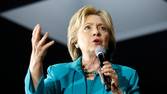
Donald Trump Defends His National Security Positions as Hillary Clinton Attacks
Clinton is working to stoke fears that Trump fails the "commander-in-chief test"
 ENLARGE
Hillary Clinton is leveling a withering attack on Donald Trump’s temperament and judgment when it comes to national security, calling him unqualified to be commander in chief and stoking fears that he is too impulsive to control the nuclear launch codes. Mr. Trump made clear in an interview Sunday that he won’t take the incoming fire lightly.
With national security looming as a potential vulnerability, Mr. Trump was unsparing in his criticism of the former secretary of state, saying she “knows nothing about national security” and dismissing her experience as irrelevant because “she’s incompetent.”
“She is grossly incompetent when it comes to national security. And ISIS sits back and laughs at her,” he said in an interview with the Wall Street Journal on Sunday.
The sharp fire suggests that neither candidate will pull punches on the subject as what is already a nasty campaign between them intensifies over the summer and fall.
More In Election 2016
- Donald Trump's National Political Director Leaves Campaign
- How Donald Trump's Attack on Susana Martinez Undermines the GOP--and Trump
- Rick Santorum Warns Donald Trump Against Shifting on Ethanol
- Paul Ryan: I Haven't Decided Whether to Endorse Donald Trump
- Elizabeth Warren Steps Up Attacks on Donald Trump
- Bernie Sanders Wants Votes Reviewed in Tight Kentucky Race
Polling suggests Mr. Trump has more ground to make up. A New York Times/CBS News survey released last week found just 27% of registered voters think Mr. Trump has the right kind of temperament and personality to be a good president, versus 48% who said that of Mrs. Clinton.
The Clinton campaign, seeing an advantage, is now delivering attacks on a near daily basis. The candidate and her advisers cite his support for a ban on Muslims coming to the U.S.; his claims that he opposed the Libya invasion and the Iraq war, when evidence suggests he backed them both; his willingness to pull back from the North Atlantic Treaty Organization; and his comfort with additional nations acquiring nuclear weapons.
In an interview with CNN last week, Mrs. Clinton labeled his outlook “irresponsible, reckless, dangerous.” In an interview with NBC’s “Meet the Press” that aired Sunday, she said his positions pose “immediate dangers.” Her campaign chairman, John Podesta, said Friday that he doesn’t have the “qualifications or the temperament” to be commander in chief.
Campaigning last week in Kentucky, Mrs. Clinton offered an extended riff on her own experience as President Barack Obama’s first secretary of state, recounting the decision to attack what intelligence officials thought—but could not be sure—was al Qaeda leader Osama bin Laden’s compound, and her own recommendation to go forward.
She also talked about flying to Israel from Cambodia in 2012 to broker a cease-fire between Israel and Hamas, citing her work with Egypt’s Muslim Brotherhood and asking the audience to imagine how hard that would have been with a president who bars Muslims’s admission to the U.S.
“What you hear from Donald Trump is not just offensive. It is dangerous,” she said last week in Fort Mitchell, Ky. “This will be a big part of the general election.”
Presidential elections rarely turn on national security, but the Clinton campaign aims to persuade enough voters that Mr. Trump fails the “commander-in-chief test,” a threshold competency that one can handle the job, and that he would represent an unacceptable risk to American security.
Geoff Garin, a pollster for the pro-Clinton super PAC Priorities USA, said he has conducted focus groups and polling that affirm voter anxiety about how Mr. Trump would manage a crisis. “Concerns about his temperament, or lack of temperament, kick in most meaningfully for voters when they think about safety and security,” he said.
In the interview with the WSJ on Sunday, Mr. Trump defended himself on particular points of policy. For instance, he repeated that his willingness to pull back from NATO is justified as leverage to get other nations to foot the bill for their security.
“When they don’t pay up, they’ve backed out of their obligations, then we no longer have an obligation to defend them,” he said. “You always have to be prepared to walk from something. I don’t want to get out of NATO. I want the countries of NATO to pay us.”
Asked whether it was in the U.S.’s national security interest to keep those nations protected, Mr. Trump said that was outdated thinking. “We can’t afford that anymore, I hate to say it,” he said.
He also made clear that he will try to use Mrs. Clinton’s 2002 vote in the Senate to authorize the Iraq war against her—a tact Mr. Obama successfully used in their 2008 Democratic primary and that Sen. Bernie Sanders has pressed less successfully in their contest this year.
Asked about the Clinton charge that he is impulsive, Mr. Trump said, “I’m not impulsive, she was impulsive. She voted for the war and I was against the Iraq war. She’s impulsive.”
Mr. Trump cited news reports from 2004, after the war began. There is no evidence he opposed the war before the invasion, and in a September 2002 interview unearthed by BuzzFeed, he was asked by radio host Howard Stern if he was for invading Iraq. “Yeah, I guess so,” he replied. “I wish the first time it was done correctly.”
A spokeswoman reiterated that he opposed the war ahead of time.
Asked about Mrs. Clinton’s assessment of his temperament, Mr. Trump said that she is confused. “She likes to equate toughness with temperament and she thinks she’s gonna scare people,” he said. “Well, we need to have a tough tone.”
Mr. Trump also dismissed the value of making an overseas trip. His campaign already canceled one planned for Israel late last year. He said Sunday that it would not be a good idea “at this moment,” but held out the idea that a trip might still be arranged.
“I don’t think it registers with the voters to be honest with you. What I really want to do is focus on our country and the election, but I might,” he said. “I’ve been invited by numerous countries to go.”
Mr. Trump also responded to the Clinton campaign’s criticism last week that he was wrong to make the near-immediate call that a missing airliner was linked to terrorism before having the facts.
“Why should I be politically correct?” he said, adding that there was nothing wrong with the timing of his statement because “I’m turning out to be right. I’m always right… you’ll see, you’ll see. I’m always right.”
MORE:
Trump: No Guns in Classrooms, Except Some Teachers
Hillary Clinton’s Lead Over Donald Trump Narrows
Video: Why Speculation About VP Picks Is Probably Wrong



![[http://m.wsj.net/video/20160525/052516obamarapper/052516obamarapper_167x94.jpg]](https://web-archive.nli.org.il/National_Library/20160526010038im_/http://m.wsj.net/video/20160525/052516obamarapper/052516obamarapper_167x94.jpg)
![[http://m.wsj.net/video/20160525/052516modiyear1/052516modiyear1_167x94.jpg]](https://web-archive.nli.org.il/National_Library/20160526010038im_/http://m.wsj.net/video/20160525/052516modiyear1/052516modiyear1_167x94.jpg)
![[http://m.wsj.net/video/20160525/052516modi1/052516modi1_167x94.jpg]](https://web-archive.nli.org.il/National_Library/20160526010038im_/http://m.wsj.net/video/20160525/052516modi1/052516modi1_167x94.jpg)
![[http://m.wsj.net/video/20160525/052516taleoftwocities/052516taleoftwocities_167x94.jpg]](https://web-archive.nli.org.il/National_Library/20160526010038im_/http://m.wsj.net/video/20160525/052516taleoftwocities/052516taleoftwocities_167x94.jpg)