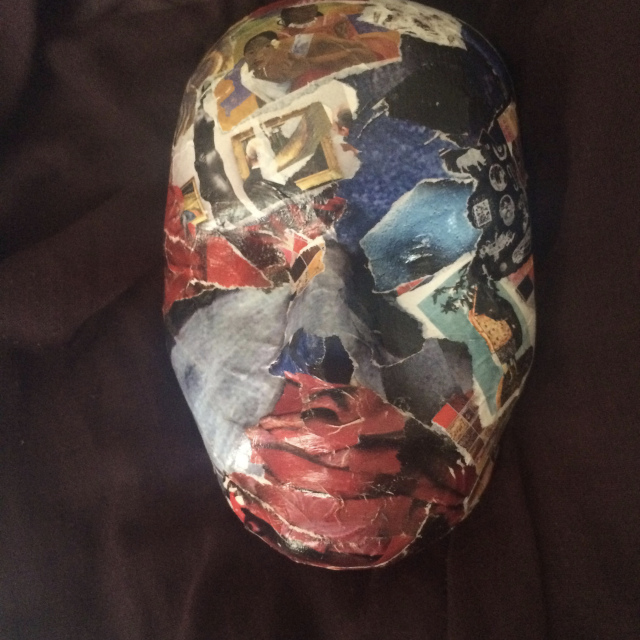
… if you are not allowed to cut with a blade or a scissor, you tear the paper with your hands and then you glue it together … and something different appears – some ~~ thing ~~ you never pre(prior) planned – common plain planes – and you cannot really explain what this face you made said – it just happened.
“Right(s) as a concept emerges in any arrangement triggered by a relationship of power (pouvoir) which concerns established ways of acting or being acted upon together with the affirmation of the multiplicity and the capacity of individual and collective bodies to affect and to be affected (puissance) by an event. RADICALLY THINKING rights, AS THINKING a life, AS THINKING LIFE RIGHTS, entail a jurisprudence of multiplicities for it is directed at accommodating multiple relations to transform the established ways of acting and being acted upon (Linda Stewart).”
I am the blood pulsating through your veins
contracting your heart …
Mistaken ideas always end in bloodshed, but in every case it is someone else’s blood. This is why our thinkers feel free to say just about anything. Albert Camus
If Deleuze and Guattari parse out the potential for thinking into these three styles – art, science and philosophy – where would we place law? (Claire Colebrook ‘Legal theory after Deleuze’ in Rosi Braidotti, Claire Colebrook and Patrick Hanafin eds., Deleuze and Law, 2009, pp. 14-22).
Law is a mixed form of thinking philosophy, science and art. Law proceeds from philosophical concepts such as rights and justice but it also engages in scientific thinking for example posing questions as to what constitutes ‘a grievous and irremediable medical condition’. Furthermore, law also produces affects. The invalidation of prohibited physician assisted suicide in the Carter v Canada case, for example, produced affects such as sympathy and horror in not only the legal case but also through rights activism narratives (as illustrated below).
“Of all the things that are beyond my power, I value nothing more highly than to be allowed the honor of entering into bonds of friendship with people who sincerely love truth. For, of things beyond our power, I believe there is nothing in the world which we can love with tranquility except such men.”
― Baruch Spinoza, The Letters
Good relations
Creating joy
laugher / tears “in-between”
infusing the good producing more joy
to escape mere passion and embrace action
petit things
a minor eye contact
a stroke on a hand on an arm
pulling faces
pouting lips
and sometimes even out comes a frown
Strange and weird words
[the] language not logical
it is mostly sounds
or tiny words/phrases flowing from one to another
it is icons on text
a wink
a smiley
an cute iconic character wiggling his arms or hips
this does not mean it lacks the “logical”
for even language is illogical 😉 [as so are some friends 😉 😉 ]
for friends to remain friends in their becoming-friend
pre-language is the art/playfulltool for becoming-friend
World-aparts
A becoming-friend in different worlds
where personal (for ever changing) ethics overlaps
As Spinoza says, it is only by human attributes (goodness, justice, charity and so on) that God “communicates” to human creatures the perfections they possess. It is, on the other hand, through his own attributes that God communicates to all creatures the power proper to each (Deleuze Expressionism in Philosophy 91).
“Here we must rid ourselves of all “personalist” references. The one that . . . does not refer to an individual, to a person, but rather to an event, that is, to the forces in their various relationships in a proposition or a phenomenon, and to the genetic relationship which determines these forces (power). “The one that” is always Dionysus, a mask or a guise of Dionysus, a flash of lightning” (Deleuze Nietzsche and Philosophy).