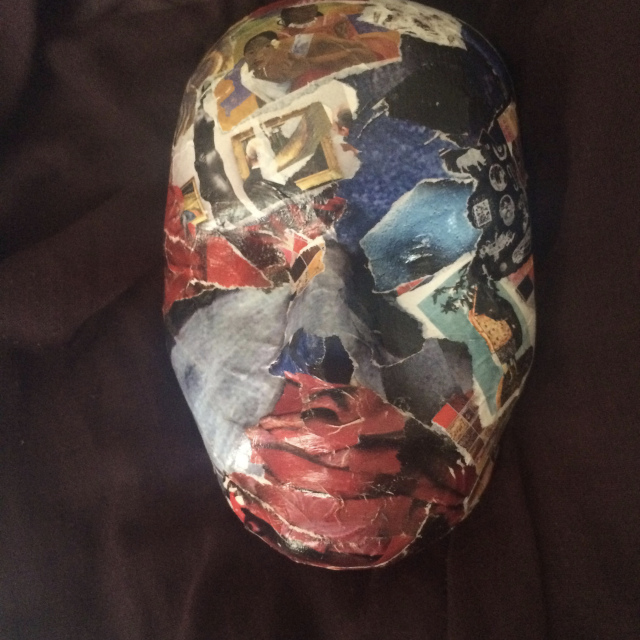
Tearing tears

TEARING tears tear!

… if you are not allowed to cut with a blade or a scissor, you tear the paper with your hands and then you glue it together … and something different appears – some ~~ thing ~~ you never pre(prior) planned – common plain planes – and you cannot really explain what this face you made said – it just happened.


#1 Searching

IMG_4876

#2 Expression

IMG_3976

#3 I am many

IMG_4018

#4 This is the hand that takes

IMG_4117

#5 Pop(f)art

IMG_4201

#6 Whoman

IMG_4245

#7 Synthetic zero

IMG_4495

#8 Blood

IMG_4236

#9 Blossoms flying

IMG_4520

#10 Félix

IMG_4596

#11 Kindred

IMG_4772

THE JUDGE FACIALITY MACHINE (PART 2)

Still from Stereoscope, 1999, animated film, 35 mm film, video and DVD transfer, 8’ 22’’. Courtesy of Marian Goodman Gallery New York (via http://www.imageandnarrative.be/inarchive/Timeandphotography/vancaelenberghe.html)

Still from Stereoscope, 1999, animated film, 35 mm film, video and DVD transfer, 8’ 22’’. Courtesy of Marian Goodman Gallery New York (via http://www.imageandnarrative.be/inarchive/Timeandphotography/vancaelenberghe.html)

I shall look into faces, and I shall see them seek some other face (Virginia Woolf, The Waves).

 Introduction

Judicial adjudication affords the individual and collective bodies an alternative / additional space in the event of a possible rights infringement, to challenge enacted laws, policy and the action of the sovereign. Although constitutionalism in modern liberal democracies has opened up a previous enclosed space for courts in the form of judicial adjudication to possibly creatively deal with rights alongside traditional forms of democratic participation, courts remain trapped within institutional boundaries when they rely on interpretative approaches, legal convention, legal culture, and legal history. Courts often defer a situation of rights-infringement to the legislature or executive branches of government as a macro-political matter. As such the concept of human rights grounded in the notion of a supposed fixed identity and judicial interpretation grounded in presupposed values confines movement or change. An underlying reason for this confinement is the artificial blockages created by our current knowledge apparatus and the overemphasis on medico-legal considerations on the issue of the right to passage.

In this post, I focus on two recent cases in two different domestic jurisdictions, Canada and South Africa that concerned the sensitive and controversial issue of the right to passage (euthanasia, assisted dying or assisted suicide). I argue that courts functions as a faciality machine producing both the concrete face and the landscape insofar the judge as faciality machines, manages decisions about health including decision-making between the messy borders of life and death on behalf of micro-political agencements (arrangements or assemblages). I focus on the most general function of facialisation that of biunivocalization function arguing that courts functions as normality computers and deviance detectors. Continue reading

The fuzzy borders between theory and praxis

The possibility of thinking law as thinking life

Deleuze in a conversation with Foucault, suggested that a new relationship between theory and practice is emerging. Deleuze explains the relationship between theory and practice was considered to be a process of totalisation where practice was either perceived as the application of theory or practice inspired the development of theory to oppose practice. Colebrook elaborates on the relationship between theory and practice in the context of law. Law is grounded in the ‘terror of the signifier’ and is still very much subjugated to the linguistic paradigm. This means that law assumes that life is ‘necessarily experienced as mediated or constituted through a symbolic system of language’. She argues that theory relates to law, because theory assumes that ‘there must be some lawful process through which such a world is constituted’ insofar ‘as we experience a world as having a certain being that is other than ourselves’.

Continue reading

Kay Lalor – Making different differences: Representation, rights and sexuality

Deleuze’s Difference and Repetition in the context of [human] rights


Published on 3 Aug 2012
The Law of Law – Dialectics in Critical and Sociolegal Research
by Kay Lalor @ “Making different differences: Representation, rights and sexuality”
Kay Lalor (2012) Uneven encounters and paradoxical rights: embodiment and difference in sexual orientation rights and activism PhD thesis: School of Law (University of Westminster) [electronic version].

Abstract: “Daughters of Chaos: Practice, Discipline, A Life”

Abstract for Daughters of Chaos: Practice, Discipline, A Life – 8th international Deleuze Studies conference, Sweden, 29th of June and the 1st of July 2015.

Thinking law, doing jurisprudence: A continued creation of a system of rights

‘If Deleuze and Guattari parse out the potential for thinking into these three styles – art, science and philosophy – where would we place law?’ (Colebrook 2009: 14-22).

Continue reading