Earthly shadow

The silence of the shadow

SPEAKS

 earth trembling

intensity

her multiplicity


growing taller

shrinking smaller

middle
–misting–
:::: mislink ::::
in~be~tweening

 as the sun burns kisses on her cheeks

and the moon caresses the dispossessions of her silhouette.


dirty_white_trash_1998A.jpg

DIRTY WHITE TRASH (WITH GULLS), 1998

What if Fanon had a dream?

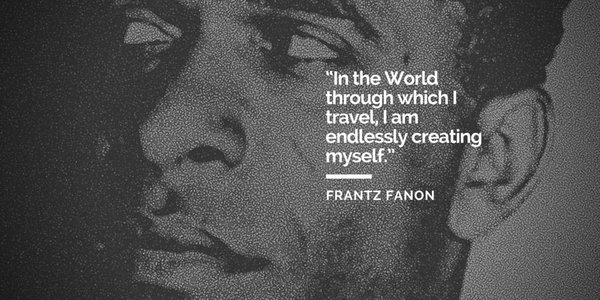
In the world through which I travel, I am endlessly creating myself (Fanon Black skins, White Masks 179) .

Fanon the symptomatologist,

Fanon the healer

Fanon the dreamer

Reading Fanon for the present

Walking, dancing, singing on African soil with Fanon

hand-in-hand

CREATING a LIFE

Overcoming the damnation of the JUDGMENT of western dominant thinking apparatus

Gently and lovingly healing the peoples from the western disease, the fixation of the image of death

Detangling the established ways of thinking and then doing,

that infected the peoples,

walking the Earth,

inscribing indebtness on the spirits of peoples,

the South,

by the Fathers of the West,

in holey writs

Freeing the intensities of thought in living immanence

to liberate the multitudes in thinking and living AFRIkA

An AFRIkA beyond the personal and the fixed identity

An AFRIkA dancing and singing to the rhythm across the boundaries of time and space

An AFRIkA pulsating LIFE!

fanon


ps: I wrote this a month ago and i was not sure if i should ‘wordpress’ it … ah well a girl can always dream …


Contracting your heart

I am the blood pulsating through your veins
contracting your heart …


qjrux


Mistaken ideas always end in bloodshed, but in every case it is someone else’s blood. This is why our thinkers feel free to say just about anything.  Albert Camus

…. i de [as if like] …. me

idea

birthed by love

in-be-twee-tinks


ideal as if i de (miss) de f y me

con coc t in

in fli c t in g

ideal-isms,  culture-ism, moral-ism, judgmental-ism, belief-in-ism, reflection-ism, reactive-ism, abstraction-ism, pollution-ism, ideologY-ism, human-ism, dominant-ism, dormant-ism, control-ism, discipline-ism

and so on

and on

and

on

too MUCH mean-in

slaughter in

multi-tune-in


~~~~~~ A LIFE ~~~~~~


If only one can see that

wor(l)ds

become

in

matter

if only one can see

Aye!!!!

Aye!!!

Aye, aye, aye …. !


as i f creating better wor(l)d(s)

with inter alia con tra c ting wor(l)d(s)

birthed in

~~~~~~~~ love ~~~~~~~

an affirmation

[ AYE affirm motion -de-miss-story-fic-t-ation-re-peace-IN-act-i-on-in ]

to get

her

in

ab sent in

an ordealing

o dour in g

of

or / or

other than

or   ..  i..   deal ….. ism

ord in a r y

con-tract-in(g)


a re life in

leaving

get it

t   t    t       t!!

breath   in

left in

to ward s

heal in

re la te in

multi       –        tune             –           in                   -x-is-t-in                                    -me-R-cy-                                               x-is-t-un-in-g


I * 

am


O *

N*

L*

aYe*

~~~~~~~~~~

love

5422c035c5a8b27f958af2c8a5c70ecf

I find myself continually redefining what I am!


Locating:  Linda Stewart (1970-09-22)


I hope this explain a little who I was, who I am and what I am becoming and that said, [I don’t like writing this, because it is about ‘me’ and I am merely representing one of the copies of me, but I find it necessary, to give some insights on my face]


I am a descendant from European settlers, I was born and grew-up in Apartheid South Africa.  I went to a Christian, Nationalist University and obtained my first three degrees there. I did my post-graduate studies in international/regional and domestic human right laws specialising in socio-economic rights. I teach legal hermeneutics and socio-economic rights. I have published extensively on these topics. I just completed my 20th year in formal academia. I am a full professor with a national research foundation rating.


I have attempted to do social activism work in rural, marginalised collectivities in South Africa. I have tried to participate in public participation processes. I was once a member of the ANC, the current ruling party, and stood in local elections as a candidate. I was also very much part of the establishment that tried to address the inequalities in South Africa, one of the ‘solutions’ being the introduction of a basic income grant (BIG). I have written on social protection (including social assistance, social security, social insurance and informal social protection measures). I did research for the Ministerial Committee on Social Protection (2001). I focused on the rights of vulnerable children and was and still is interested in water going beyond the right to access water in South Africa. I don’t regret doing this. I do have a good understanding how rights and constitutions operate as well as how to civil dis-obedience has potentialities for change.


About four years ago, after working with a collectivity in attempting to assist them to access land, housing and water, I went through a (personal) crisis. I could not understand why the world(s) is not what it seems to be. I started reading anthropology and philosophy. I did not engage with the history of philosophy but found an entry point (an opening door) in the works of Deleuze and Guattari. Reading Deleuze opened new world(s) to me.


As a law professor, Deleuze taught me about judgment, doxa and I learned and are still learning that there are a multitude ways of thinking, doing, and existing. I am currently going through yet again, a crisis trying to figure out how to write about inter alia the Law in terms of time and space and movement, justice as mercy, reconceptualising rights, not human rights (but a system of rights focusing on a situation), how courts operate and how in my eyes, constitutionalism has become a new form of colonialism and human rights an universal religion. There are numerous other issues included and outside these issues.


Putting it differently, one might say, I am interested in optional ethical (Spinoza/Deleuze) organising principles (navigating tools) opening-up movement in culture, morality, established ways of thinking and doing that are at present restricting multitude of ways of existence. In my world, there are no subjects, signs, signifiers. I am not concerned with moral arguments but with the processes opening up new possibilities. I work with relations between bodies (Spinoza’s idea of bodies) and how power and power (puissance) our capacity to act and be acted upon is intermingled and indeed highly complex.


What I am trying to say, is that I had no grounding when I started (and possible this may be a good thing). This process is exhausting!! Along with this, I experience my own marginalisation within the academic environment.* It is also important to note that I am a diagnosed Bipolar that have been taking psychiatric drugs for more than 18 years.


Enough said!

$_35.JPG

!!! Any comments or questions are welcome and will be appreciated in the spirit of friendship !!!

Crossing paths


Ik mis je mijn vriend. 

Ik denk aan Steven Biko (september,12, 1977) die leven in mijn hart! Ik dans in het ritme van Miriam MakebaIk deel met jou die woorden van Ingrid Jonker:

Het kind dat doodgeschoten is door soldaten bij Nyanga

Continue reading

download

Protected: a plane : A manifesto for a new earth and a new people

This content is password protected. To view it please enter your password below:

THE DARK MOUNTAIN MANIFESTO

It is time to look down – embrace the earth.

Slide1

Originally posted here: Out of the blue Like 


 UNCIVILISATION

The end of the human race will be that it will
eventually die of civilisation.

Ralph Waldo Emerson

Continue reading

Abstract: “Deleuze And Guattari And Africa: Southern Responses”

Abstract for Deleuze And Guattari And Africa: Southern Responses 15-16 July, UCT, Cape Town


FIGHTING FOR FREEDOM: JURISPRUDENCE AS CREATING RIGHTS

The aim of this paper is to create a concept of rights that moves beyond the dogmatic image of the law and the historical concept of human rights that is based on a fixed, reflexive subject as the subject of human rights. As such a concept can be likened to the ‘brick’, Massumi describes in his preface to Deleuze and Gauttari’s A Thousand Plateaus. A radical rethinking of rights as a concept is necessary in order to map current notions of human rights in an attempt to open blockages in thinking rights and doing jurisprudence. To bring about radical change we need to identify movement beyond the institutionalized form of law and (human) rights. This paper therefore distinguishes between institutionalised forms of rights and rights that stand outside institutionalised forms of law. This distinction is based on Patton’s argument (2012: 1-14) that Deleuze’s concepts of ‘Jurisprudence’ and ‘Rights’ opens a possibility that ‘there are cases where we will agree that the rights of individuals or groups have not been respected, even though they were treated in accordance with the law’. For Patton, this implies that rights exist independent of their institutional expression and the concept of ‘Rights’ require a broader and more nuanced concept than human rights, which may include legal, political or customary rights and thus not only vested in constitutionally protected rights.

Rights in its institutionalised are based on the supposed image of the majority standard. Deleuze and Guattari (2005: 105-106) describe the majority standard in constitutional states as an abstract figure, ‘the average adult-white-heterosexual-European-male-speaking a standard language’. The latter forms the majority not in a quantitative sense but because it forms the historical standard in which the rights and duties of citizens are measured by the axioms of a capitalist society. No one is ever the majority and everyone is in a constant struggle to become part of the majority. The notion that individuals and collective bodies appeal to courts in the form of judicial interpretation and adjudication to enforce their rights, illustrates the recurrent struggle in constitutional states to broaden the scope of the majoritarian standard. Put differently, (human) rights only become a matter of law (institutionalised) when a specific law or action of the sovereign is addressed in judicial adjudication. There is however ‘rights’ that stands outside these institutionalised forms of law. Right(s) as a concept beyond institutional expression may thus be understood as ‘established ways of acting or established ways of being acted toward’ (Patton 2012: 19). In following Patton (2012) it is thus possible to rethink the concept of rights, to a notion that is not based on a transcendental view of human nature. Moreover, this reconceptualization of rights enables a perspective that is based on the idea that rights are immanent and socially embedded. The latter component of rights illustrate different ways of ‘becomings’ that moves beyond the institutionalised image of law and the majoritarian standard.

This paper argues that rights as a concept beyond institutional expression is not concerned with a fixed, autonomous subject with a particular identity. Instead rights are to be understood in the context of a dynamic relational process that is affected by two kinds of assemblages, collective assemblages of enunciation and machinic assemblages of desire (Deleuze and Guattari 2005: 2, 7). The two assemblages function together and it is impossible to ‘make a radical break’ between them (Deleuze and Guattari 2005: 7; 111). Rights thus originate in any assemblage (arrangement) where the individual body’s capacity (puissance) to affect and to be affected are at play. When rights are perceived beyond institutional expression and a supposed fixed identity (subject) we may possibly identify different ways of ‘becomings’ (and be able to think rights as thinking ‘life itself’ and do jurisprudence focussing on the interest of material bodies rather than the abstract formless subject of law (Braidotti, Colebrook and Hanafin 2009: 1, 3).


a’strophe

2015-04-10 11.59.47 2015-04-10 12.00.18 2015-04-15 11.17.41

 a’strophe
by Sean Smith

cloven life grows c’lover

sprouting verdant and

stretching tendrils of tensors

tenderly grown closer

c’lovers discourse, these

verses in order, intension

a tentative holding

or folding or creasing

before suddenly c’leaving

.

.

un’folding

.

.

re’leasing

2015-04-15 11.13.53-1 2015-04-06 11.35.02 2015-04-15 11.20.42

Featured Image -- 127

Schizosophy 5th Anniversary

Congratulations to Adrián, his blog is schizo-cool. Reading and learning from him is a beautiful experience filled with a variety of affects. I must say I am – s c h i z o s o p h y – “groupie”. Highly recommended.

~ S c h i z o s o p h y ~

schizo 5years

It was five years ago since I blogged the first post here at Schizosophy, and it has been a great philosophical adventure. I would like to express gratitude to all my readers, friends and everyone who has being part of this blogging experience: nothing of this could ever happen without each one of you, so thanks for all your visits, comments and sharings ;-). Indeed, many things have occurred since that first post: 62,083 total views so far, which is not bad for a blog that has always discouraged search engines and net spiders from indexing it. But in order to celebrate this five years, I would like to share the very top-ten most-viewed schizosophical posts of all time accordingly to my wordpress stats, but also my own favourites and even a special refined selection of those posts which undoubtedly deserve to be recommended too. Of course, there are many…

View original post 279 more words