

Fig. 1
When you perceive sound, you experience ripple-like changes in air pressure. The classic visual example is dropping a stone in a pond and observing the resultant outwardly expanding rings. This change in air pressure is transduced (by microphone diaphragms, speakers, guitar pickups, etc.) into positive and negative voltages, back again into sound waves, and vice/versa. Simply put, a transducer is anything that converts one form of energy into another.
So, when you sing or play guitar into a mic, the changes in air pressure cause the diaphragm of the mic to move back in forth, which generates a tiny electrical current (that’s exactly analogous to the air pressure waves). This current goes into your interface’s mic pre, where it’s amplified and then transduced again into ones and zeroes (the digital version of positive and negative charges). It is then output from your interface and transduced back into an electrical current that causes your headphones or monitor speakers to move back and forth. Then, our eardrums transduce that back into bio-mechanical electrical charges that our brains perceive as sound! That’s a lot of transduction … and all you did was say “check one, two, three!”
Once we start recording music with the same sound source recorded to multiple tracks, like using a DI in conjunction with a mic for recording electric bass, checking phase becomes vitally important! It is here that we want to start toggling that phase button on and off and exploring the multiple ways to phase-align our tracks.
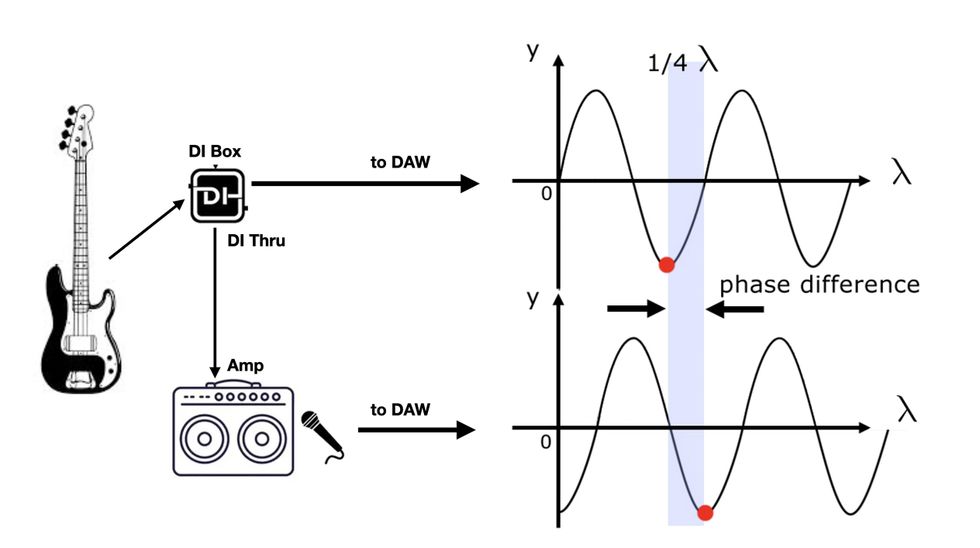
Fig. 2
Start by toggling the phase button on one of the two tracks to invert the polarity of that track’s recorded material and listen to the difference. You can also visually check for phase by zooming into the waveforms of both tracks to see if the two tracks are in phase with each other. (Go online for a visual representation.) Take a look at Fig.2, depending on how far away the mic was placed from the amp’s speaker, the amp track will range in phase relative to the DI track.Depending on how far away the mic was placed from the amp’s speaker, the amp track will range in phase relative to the DI track. In our online illustration, notice how there is a slight difference in each waveform’s peak and trough (red dot) relative to each other (90 degrees out of phase). As phase increases towards 180 degrees, the recorded sound will lose low to upper-midrange frequencies, will start sounding “hollow,” lack energy, and may even seem to disappear altogether—which can happen when two identical sine waves are 180 degrees out of phase.
How do we fix phase? Outside of flipping the polarity of one track by toggling the phase button, this is a loaded question. Musically speaking, phase is a naturally occurring property of acoustics and what we are trying to do here is mitigate the adverse effects of phase in our recordings. “Fixing phase” seems to imply that something is wrong, and that is highly dependent on what is out of phase. For example, using two close mics to record the same 2x12 cab? Make sure your mics are phase-aligned as close as humanly possible, otherwise you’ll have an anemic sounding guitar track. Close micing an acoustic guitar with a DI? The same logic applies. Are your left and right monitors out of phase? Fix it immediately!
Using two close mics to record the same 2x12 cab? Make sure your mics are phase-aligned as close as humanly possible.
Conversely, I find that phase matters less the further the additional mics are away from the source. Trying to record a choir with two overhead mics, two mid-room mics, and two far balcony mics? Start by flipping the phase and systematically listen to how all mic combinations give you the most desirable sound possible. If you don’t like the sound you’re getting, move the mics and check the phase again.
There are other great ways to fix phase and phase align tracks, and that will be the subject of the next Dojo. Until then, keep recording, checking phase, and blessing the world with your gifts. Namaste.
The maestro with his nearly omnipresent whammy bar, onstage at the Michigan Theater in Ann Arbor in 2015.
To call Beck a giant of the instrument nearly diminishes his monumental and singular accomplishments. He established his own supremely influential language of the guitar and spoke it fluently for more than six decades. Although he never sang on his recordings, in his hands the 6-string was vocal—fluid, melismatic, melodic, and most important, full of heart. Attending a Jeff Beck concert was to witness inspiration at its most wild and relentless. And to bask in a tone so large and purposeful that it could seemingly be heard around the planet.
Which it was. Beck was known and revered across the globe—an instrumentalist who made albums for the first two decades of his career, (starting with the Jeff Beck Group’s still stunning and innovative 1968 debut, Truth) that routinely made the top 20. Those include his groundbreaking duo of mid-’70s recordings, Blow by Blow and Wired, that transformed fusion into part of the soundtrack of popular culture. But Beck was not a jazz or rock guitarist. He was an omnivore, who digested every style—country, rockabilly, swing, Tin Pan Alley, punk, skronk—to both put his seal on them and twist them to his own ends, turning the Beatles’ “She’s a Woman” into a reggae playground and transforming an idea taken from a theme by composer Maurice Ravel and turning it into the epic, soaring, and harmonically supercharged “Beck’s Bolero.”
“Whenever I pick up a guitar, it will always be heavily blues influenced, but I try to push it further, because you have to expand your scales and melodic thinking.” —Jeff Beck
When I asked Beck about his approach, during the ’80s, he replied, “Whenever I pick up a guitar, it will always be heavily blues influenced, but I try to push it further, because you have to expand your scales and melodic thinking. But I’ll play a blues solo on a non-blues song, bending the notes into whatever the song takes. That’s my whole thing: trying to explore the blues to the maximum, really. It’s in the blood.”
Note that Beck said, “whatever a song takes,” not whatever it needs. The courage and will of his playing were consistent, impulsive, and limitless. Listen to “Morning Dew” from Truth. His guitar toys with themes, playing fragments of melodies, dropping patches of wah wah, howling, rather than weaving a defined rhythm or tune through the song. Then hear “Pull It,” from 2016’s Loud Hailer, an album cut with vocalist Rosie Bones and guitarist Carmen Vandenberg of the English punk outfit Bones UK. Made nearly 50 years after Truth, that song is also telegraphy as music—dots, dashes, fuzzy blots of tone. And yet both performances not only work—they’re riveting.
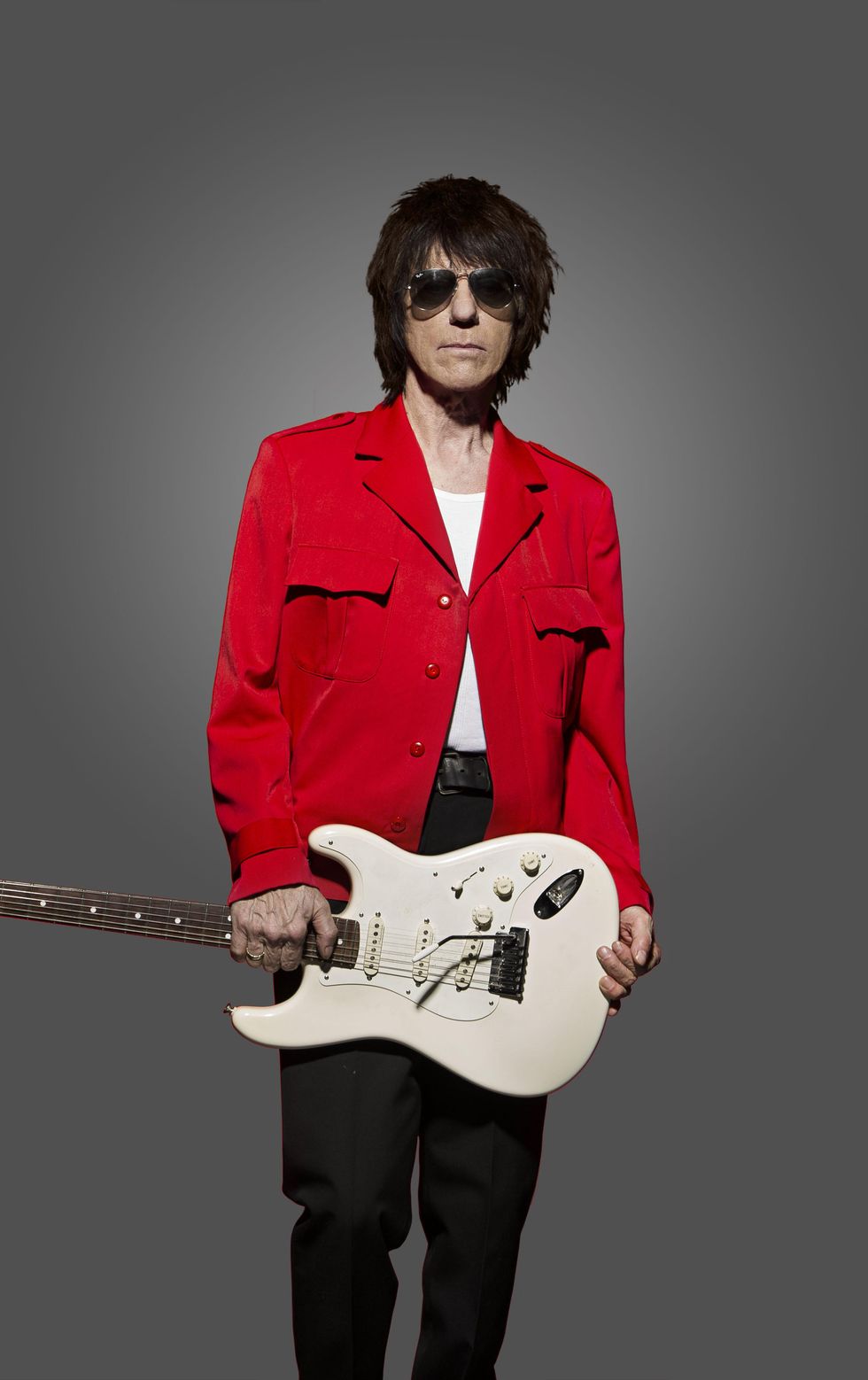
Beck considered blues to be the core of his music but saw its opportunities for expansion as limitless.
Photo by Ross Halfin
Beck was born in Wallington, Surrey, England, on June 24, 1944. Les Paul was his first guitar hero, followed by Cliff Gallup, B.B. King, and Steve Cropper. He became friends with Jimmy Page when they were both teenagers, and, while attending Wimbledon College of Art, he fell in with David “Screaming Lord” Sutch, with whom he first recorded in 1962. But Beck really began his 60-years-plus of breaking rules in 1965, when he replaced Eric Clapton in the Yardbirds. There, he pushed the group’s blues envelope with his inflammatory guitar on “Shape of Things” and the demented “Over Under Sideways Down,” where his hammer-ons, slides, and bends created the number’s sitar-influenced riff. Although Beck was unhappy in the Yardbirds, his 18-month membership earned him his first induction into the Rock ’n’ Roll Hall of Fame in 1992, followed by a second induction for his work as a leader and solo artist in 2009.
The inevitable formation of his own band, the Jeff Beck Group, featuring Rod Stewart and future Rolling Stone Ronnie Wood, occurred in 1967, and with the next year’s Truth, he presaged Led Zeppelin’s recasting of blues as psychedelic manifesto. Beck’s playing on that album remains practically avant-garde at its least restrained, yet still directly speaks a dialect of the blues. But with the notable addition of pianist Nicky Hopkins, the Group tilted further into rock with its next release, 1969’s Beck-Ola. Two more albums, Rough and Ready and Jeff Beck Group, followed, with the latter including “Going Down.” Beck’s version of the Don Nix tune that Freddie King had made famous became an instant FM radio staple.
“I saw Beck use the whammy bar alone to play a slow, lovely feedback melody through his array of amps, and then point the guitar’s headstock straight down into the stage and push himself into the air by placing his hands on the rounded back end of the body. When he touched down, he tossed the guitar—still feeding back—into his arms, hit two notes that revealed where the tuning had drifted, and flawlessly picked up the melody he’d been playing before his acrobatic stunt.”
That band was followed by the short-lived Beck, Bogert & Appice, who released an album of the same name in 1973. The group was a trio, with vocalist/bassist Tim Bogert and drummer Carmine Appice, from the Vanilla Fudge and Cactus. All along Beck had continued to maintain a studio career (which continued almost to the present) and had played on Stevie Wonder’s Talking Book the year before. Beck, Bogert & Appice’s rendition of Wonder’s “Superstition” was one of their album’s highlights, along with a beautiful slide-guitar-dappled reading of Curtis Mayfield’s “I’m So Proud.”
After this soul-music-influenced outing, Beck experienced a kind of rebirth. He was already a Gibson Les Paul player, but while recording in 1972 in Memphis he found a 1954 goldtop that was refinished in oxblood by its previous owner. That guitar is depicted in Beck’s hands on the cover of 1975’s all-instrumental Blow by Blow, which sold a million copies in the U.S. and reached number four on Billboard’s Hot 100 album chart. The epochal Blow by Blow alone is enough to ensure that Beck’s legendary status will endure. It’s full of monumental performances, including his emotional tribute to Roy Buchanan, “’Cause We’ve Ended as Lovers,” perhaps the greatest blues-inspired instrumental ever recorded.
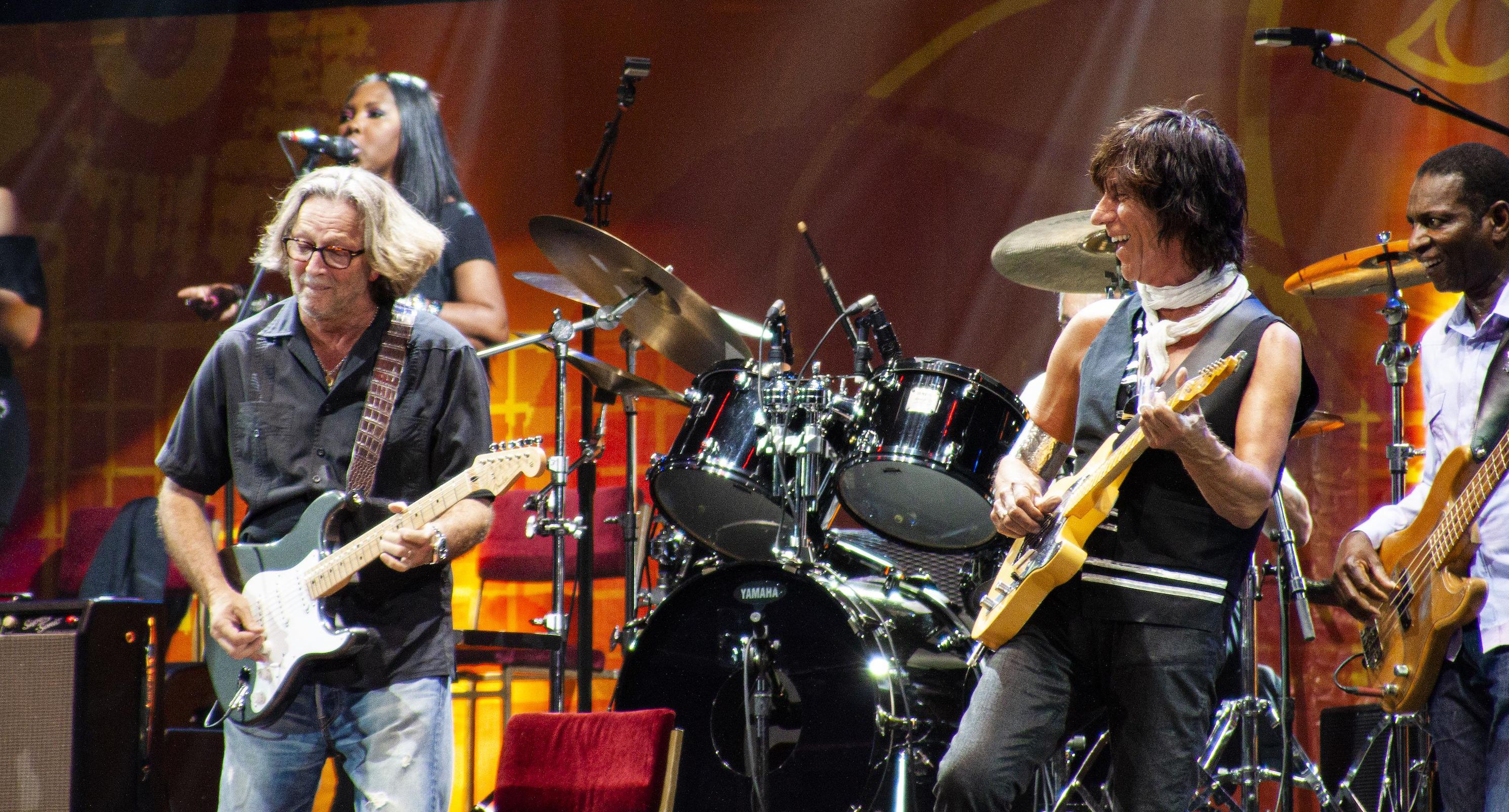
Longtime friends Jeff Beck and Eric Clapton share the stage at the 2010 Crossroads Guitar Festival.
Photo by Chris Kies
And the die was cast. Although he went on to make albums and cut singles with exceptional vocalists—perhaps most notably a soulful 1985 version of the Mayfield gospel song “People Get Ready,” with Rod Stewart, that’s become a classic—from that point on Beck dedicated himself primarily to instrumental music.
The next year’s follow-up, Wired, built upon Blow by Blow’s success with performances of Charles Mingus’ “Goodbye Pork Pie Hat” and Jan Hammer’s “Blue Wind” that also set radio afire. More important, though, was the arrival of the Fender Stratocaster on its cover. For the rest of his life, Beck and Stratocasters were mostly inseparable onstage and in the studio. And by using banks of amps and unsparing volume, he crafted a unique sound on the single-coil instrument, huge and compelling, with a horn-like fluidity and endless, sustained tone.
His technique on the Strat’s vibrato arm was extraordinary. It was as if it was grafted to his hand, or, at least, seemingly never left it. His subtle—and often radical—bending and pulling of notes with the bar made his playing even more voice-like, able to carefully craft and negotiate micro- or macro-tonal changes effortlessly. His intimacy with the Strat made for some truly uncanny performances.
In a ’90s concert at the Great Woods Amphitheater in Mansfield, Massachusetts, I saw Beck use the whammy bar alone to play a slow, lovely feedback melody through his array of amps, and then point the guitar’s headstock straight down into the stage and push himself into the air by placing his hands on the rounded back end of the body. When he touched down, he tossed the guitar—still feeding back—into his arms, hit two notes that revealed where the tuning had drifted, and flawlessly picked up the melody he’d been playing before his acrobatic stunt.
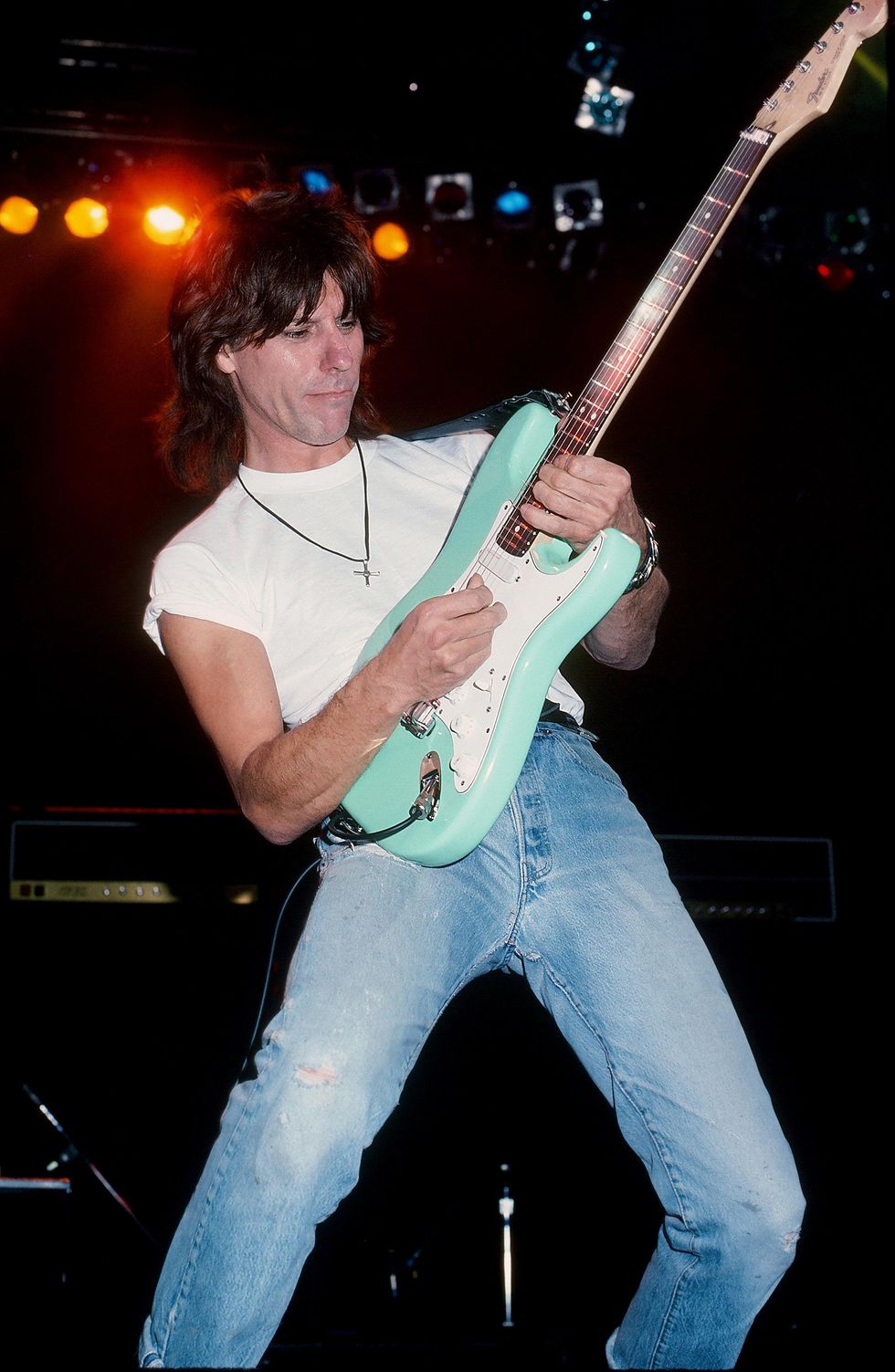
Beck’s romance with the Stratocaster caught fire during the recording of 1976’s Wired album.
Photo by Ken Settle
Beck continued to make excellent studio albums—most notably There and Back, Jeff Beck’s Guitar Shop, Jeff, Emotion & Commotion, and Loud Hailer. He also racked up high-level session credits, recording with Roger Waters, Jon Bon Jovi, Kate Bush, and Tina Turner. And he accumulated eight Grammy Awards—seven for Best Rock Instrumental Performance. His most recent album was 18, a 2022 collaboration with Johnny Depp. Beck’s final public performance was touring behind that release, on November 12, in Reno, Nevada.
After Beck’s family announced his death on January 11, fellow guitar virtuoso Eric Johnson shared his thoughts on social media: “Hearing about Jeff Beck is a shock. He was one of the most original guitarists I ever heard. He never conformed to status quo guitar or conventional playing, always reaching for a new dimension, which he achieved multiple times. He was the most expressive lyrical storytelling guitarist there ever was and that’s why non-musicians loved him. He garnered more affection from audiences than other guitar heroes because he had such a musical poetry to his playing.
“I believe that he and Jimi Hendrix were the most inventive and original rock guitarists there ever was. I had the gift of being able to visit with Jeff a few times and that is a treasured memory in my life. The guitar world will go on, but it won’t be the same without the most inventive 6-string visionary we have been graced with on this planet. Joyous wishes to you, Jeff, as you soar on to your next magnificent adventure. Thank you for teaching me and inspiring me to want to play guitar.”
JEFF BECK LIVE Cause We've Ended As Lovers
Jeff Beck plays his tribute to Roy Buchanan, “’Cause We’ve Ended as Lovers,” at Ronnie Scott’s club in London in 2007 with what is arguably his most notable band of the past 20 years, featuring bassist Tal Wilkenfeld, drummer Vinnie Colaiuta, and keyboardist Jason Rebello.
Photo 1
My goal with this little series was to show you what’s possible and how you handle such a project, step by step, and in a sensible order. In time, you can adopt and develop your own techniques, getting better from guitar to guitar.
To enjoy a little humor before we start, check out one of my favorite videos about aging guitars from Chicago Music Exchange (“CME Custom Relic’ing: Add Years of Abuse to Your Brand New Guitar!” on YouTube). But please, do not take it too seriously!
“You can decide if you only want a slightly aged look or if you want to bash it up like hell for a heavy-used relic look.”
When it comes to dings and dongs, you don’t need much for a good result. I usually only use a round metal bar and a collection of old and obsolete keys (Photo 1). The metal bar should be a massive one—hollow ones don’t work well because of their kickback behavior. I prefer a small but heavy one because it gives me a lot of control when using it. In my key box, I have a mix of mortice and cylinder keys in different sizes. I found this collection of old and obsolete keys on eBay for virtually nothing many years ago and it still works great for me.
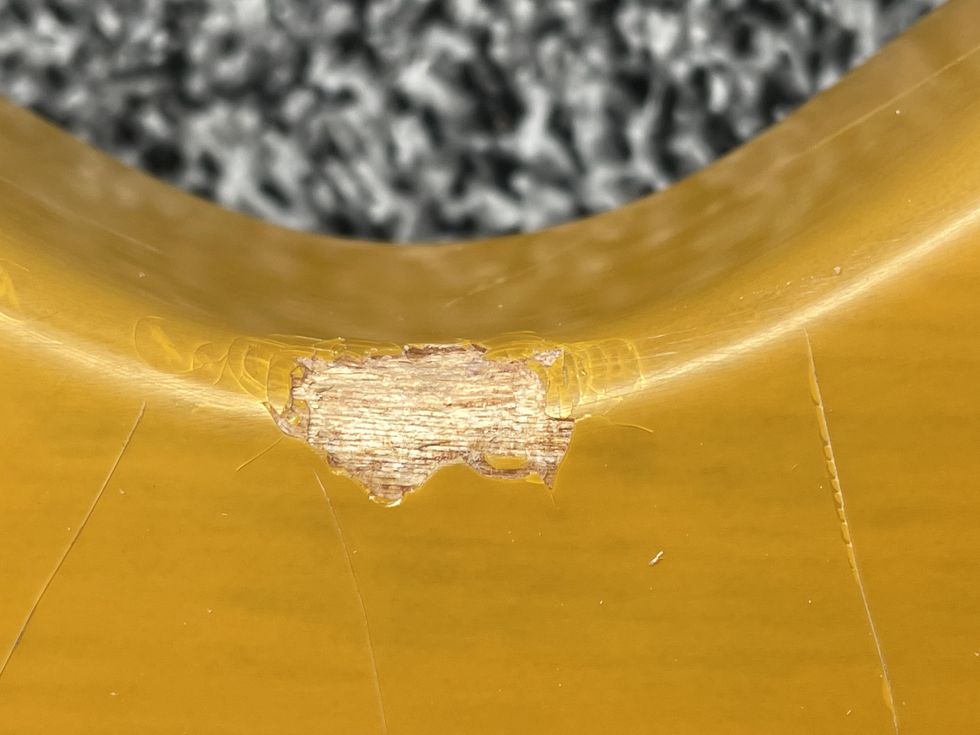
Photo 2
Let’s start with the metal bar. Hold the guitar in playing position and start tapping on the edges with the metal bar to create a random pattern of dents. It’s easy to control the effect with your hand. If you hit the edges slightly, you create a slight dent. The heavier you hit, the deeper the dents, and with some very hard hits you can crack the lacquer to create the typical spots exposing bare wood (Photo 2). Start tapping the edges slightly and see if you like the effect. Work your way up to more damage if you want more. Don’t forget: Less is more if you want to make it look authentic.
I receive the best results when tapping in a rhythmically constant pattern of about 45 degrees with the bar. If you want to get a cheap used-guitar body on eBay, it’s a good idea to get some training on this. It’s not difficult to do, but it helps to have some experience before tapping the real deal. Please do yourself a favor and wear goggles and gloves, because if you crack and burst the lacquer, it can jump off with high speed, and you don’t want to get any in your eyes. Just as you don’t want any splinters of wood in your fingers. Tap the body, the headstock, and the neck if you like.
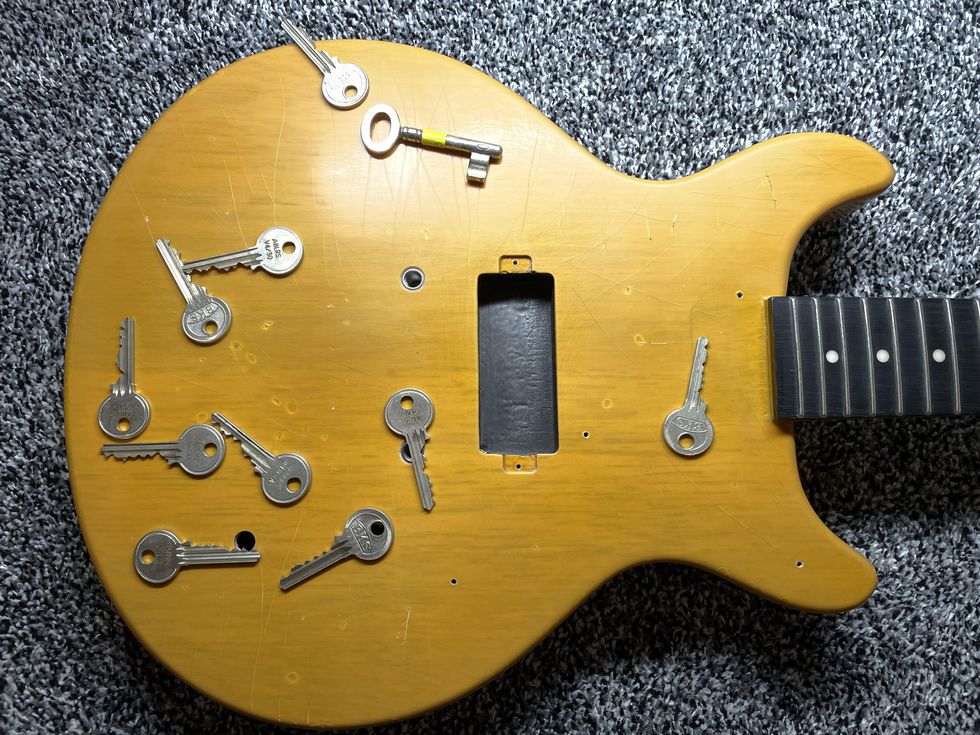
Photo 3
If you’re done and satisfied with your work, it’s time to bring in the keys (Photo 3). If you want to leave some spots on the guitar free of dings and dongs, you’ll need to cover and protect this area with strong cardboard or the like. A piece of paper or thin cotton won’t work; the keys will win. Because the keys will jump off the guitar, it’s a good idea to lay the guitar flat on a carpet or somewhere that the keys can’t disappear. You know the “confetti effect” after a New Year’s Eve party? No matter how often you clean your room, you’ll still find some confetti right before Easter. It’s the same with the keys; they’ll jump off in any direction and gone they are.
Anyway, the process is very simple. Your guitar is lying flat on the ground, and you simply drop the keys on the guitar. You can do this one by one or all at once. I usually use the individual keys first, followed by some massive shots of several keys at once. You can simply hold them above the guitar and let them fall, or you can smash them. Be creative and see what you like best. I usually leave out the fretboard with this, covering it with a piece of carpet. But if you like, you can also treat the fretboard this way.
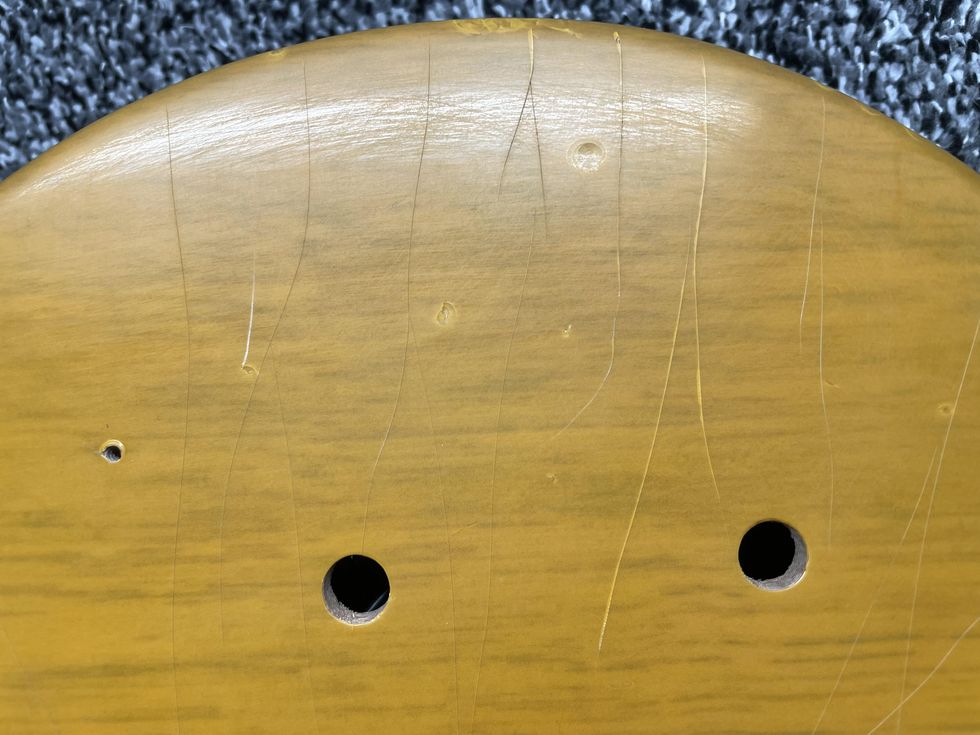
Photo 4
Don’t be in a hurry. It will take some time to do it right, so don’t stress yourself. You can see some of the dings and dongs I made with keys while treating the Harley Benton in Photo 4.
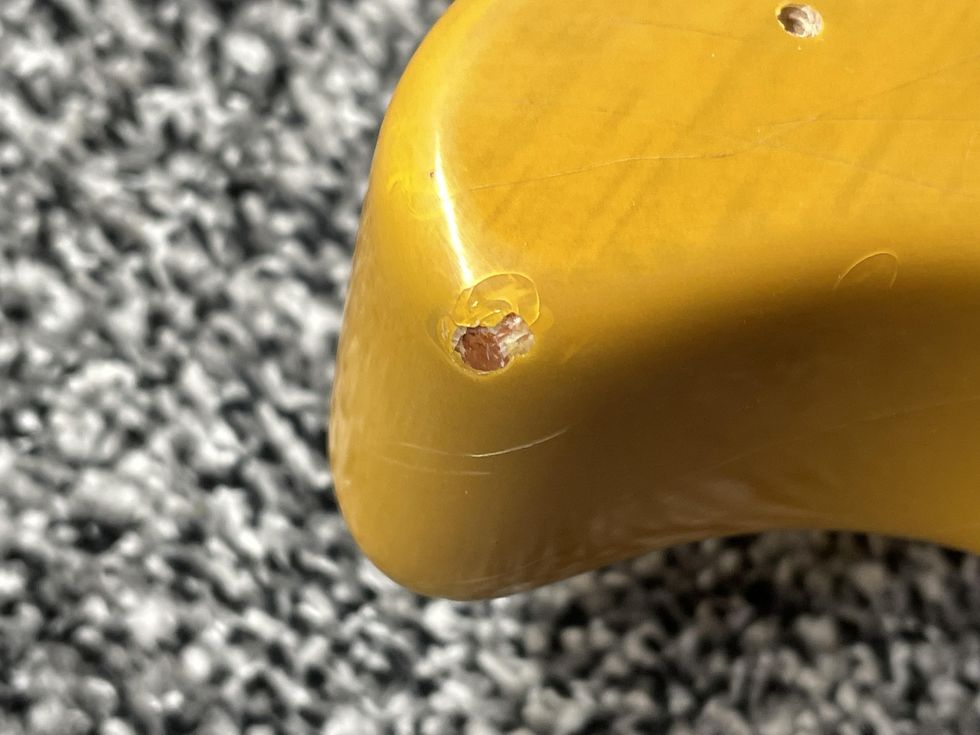
Photo 5
Remember the wood-aging dye from the last part of this series? You’ll need it now to add 50-plus years to the exposed wood. Depending on the size of the spot, you can use a small brush or a Q-tip to put the dye on. Before doing this make sure you remove all loose parts from the lacquer. I simply use a small flat screwdriver and a brush for this. Depending on how dark you want the exposed wood, you’ll need to repeat the process with the dye. Because the body of the Harley Benton guitar is already a dark mahogany, you won’t need much of the dye (Photo 5 and Photo 6).
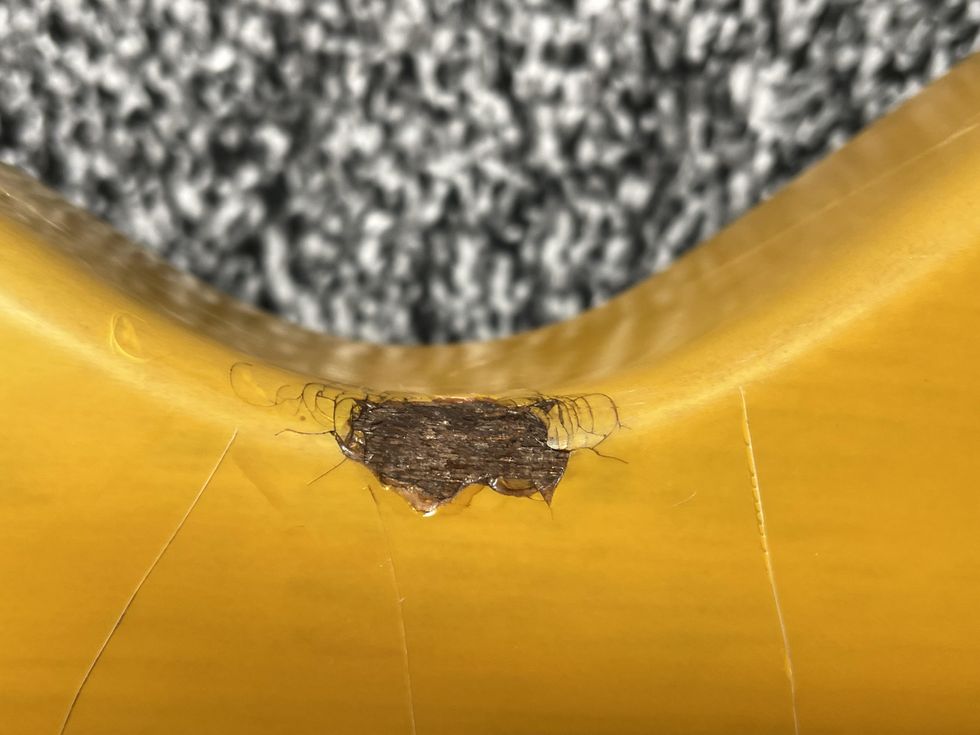
Photo 6
Congratulations, you’re done aging your first guitar all alone with your bare hands. If you have the chance to look at some vintage guitars, you should. Over time, you’ll get an eye for how old guitars look and you’ll find typical signs of age and wear that you can duplicate for your own projects. This relic’ing guitar project will soon be available as a Premier Guitar eBook, with all steps in one place and downloadable as a PDF.
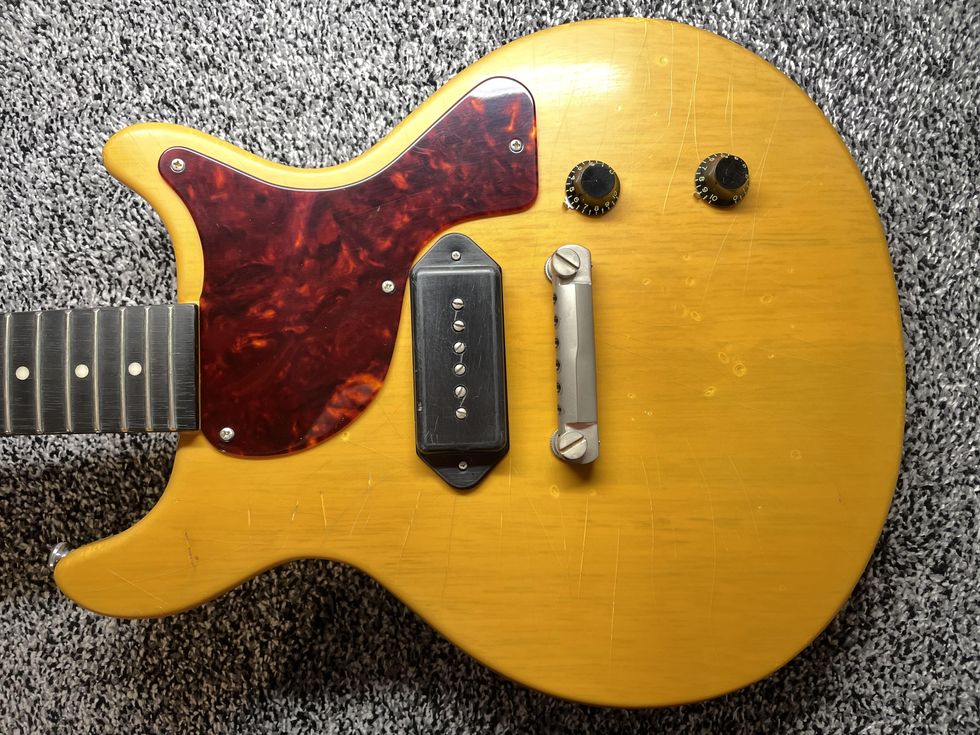
Photo 7
Our finished Harley Benton DC-Junior double-cut that we used to demonstrate the individual relic’ing steps is a cool-looking and great-sounding guitar (Photo 7). I decided to auction it, donating all the money to my local animal shelter, which is usually bursting at the seams this time of the year.
Next month, we’ll have a deeper look into some typical Gretsch wiring basics, so stay tuned. Until then ... keep on modding!
You may already know there are three main types of microphones: dynamic, condenser, and ribbon. Dynamic, or moving coil, mics are the least expensive, but also the most rugged. They handle loud sound sources like drums and guitar amps with ease. You’ve seen these mics many times, because most mics used in live performance are dynamic, but they also get heavy use in the studio.
Shure SM57
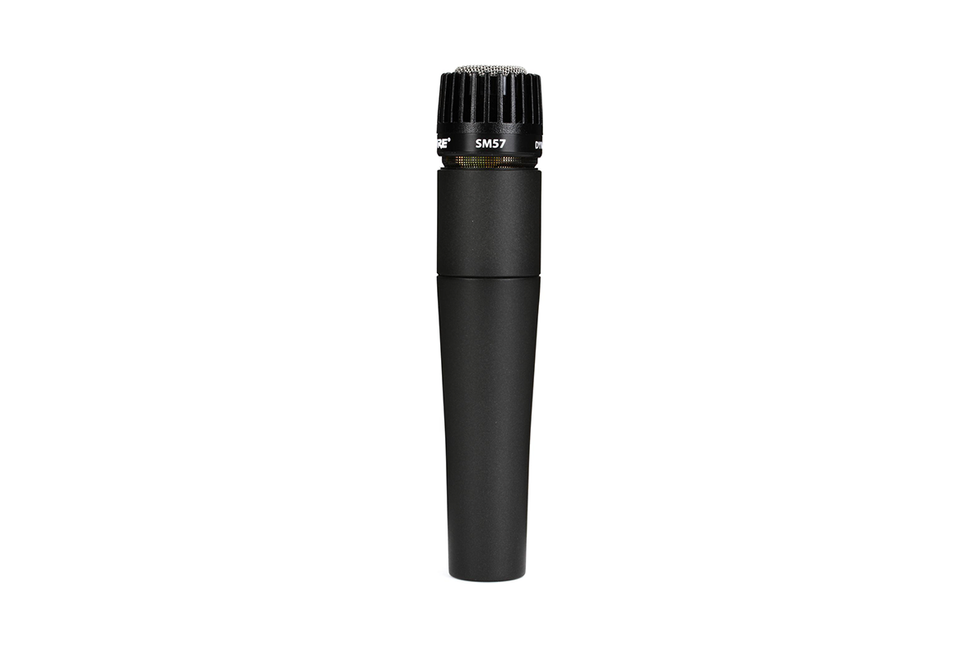
Shure SM57 and SM58 dynamic mics set the industry standard. The SM58 ($99 street) is widely used for vocals onstage but also works well on guitar cabinets, snare drums, and toms. The SM57 ($99 street) is a similar dynamic mic aimed at recording instruments more than vocals, since it lacks the 58’s ball grille, which is designed to reduce vocal plosives. I’ve heard very good recordings of acoustic guitar made with an SM57. In fact, you can track any instrument with one of these workhorse microphones and come up with a good sounding final product. Buy each of these very versatile recording tools.
Shure Beta 52A
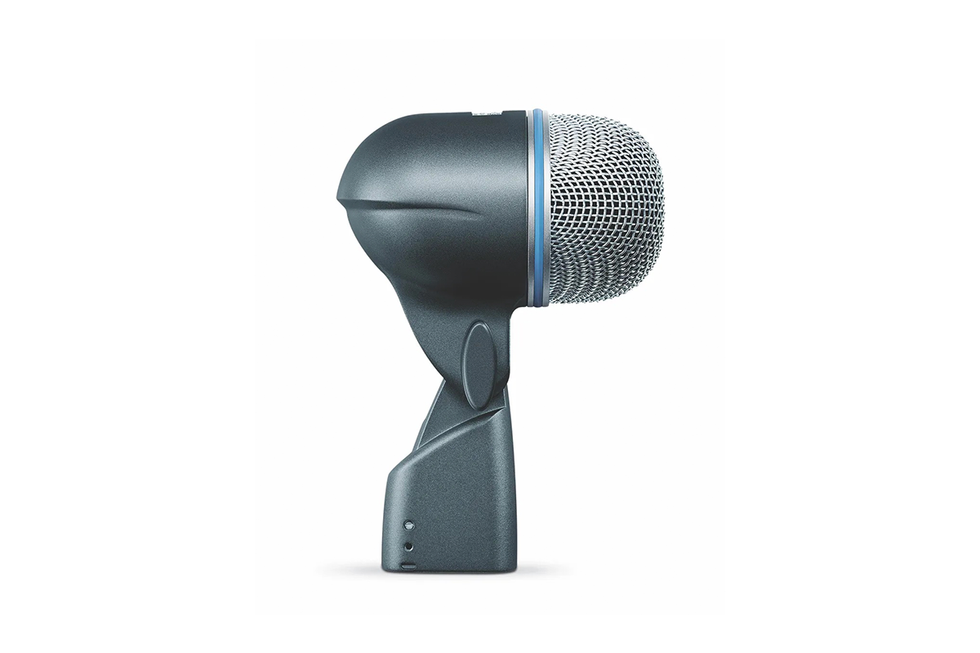
Another Shure product, the Beta 52A ($199 street), is a specialty mic made to capture kick drums, emphasizing low frequencies. You need one of these, too. The Beta 52A is supercardioid, which means it has a tighter pickup angle and offers good side rejection. This mic is also useful on bass cabinets, tuba, or trombone, and sounds good on floor toms, too.
Condenser microphones are often the most expensive, although they range from $89 to $8,499. Condensers are the most sensitive to dynamics and can also handle loud sound sources. They are used on many instruments—especially for vocals and acoustic instruments, and as drum overheads. Most vocalists prefer a condenser mic in the studio because these mics capture nuanced performances. They often have multiple pickup patterns (omnidirectional, unidirectional, and bidirectional or figure eight), which can be helpful. Condenser microphones need a low-voltage power source, called phantom power, to operate. But the good news is phantom power is found on almost every mixing console and on every interface. Just remember to turn it on when using a condenser.
You don’t need to spend thousands on mics to begin recording demos and even albums.
Audio-Technica AT2021
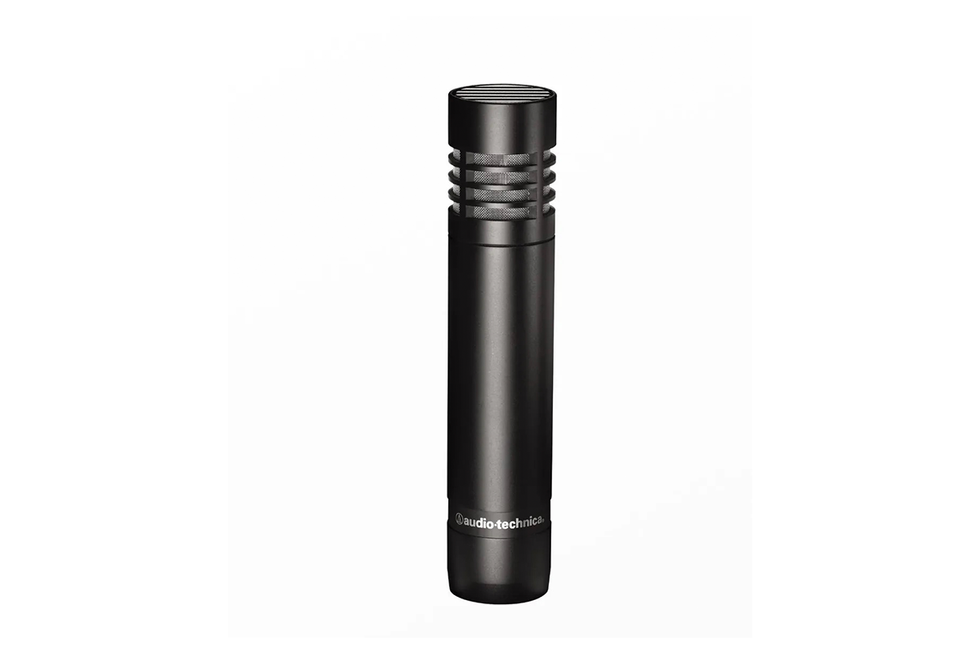
A great starter condenser is the Audio-Technica AT2021 ($89 street). This small diaphragm mic is excellent for acoustic instruments, including guitar. They also work well as drum overheads. Audio-Technica makes some other high-quality, affordable condenser mics, too. I recommend buying two AT2021s. Then, you’ll have two drum overhead mics that will also sound great recording various acoustic instruments.
AKG P420
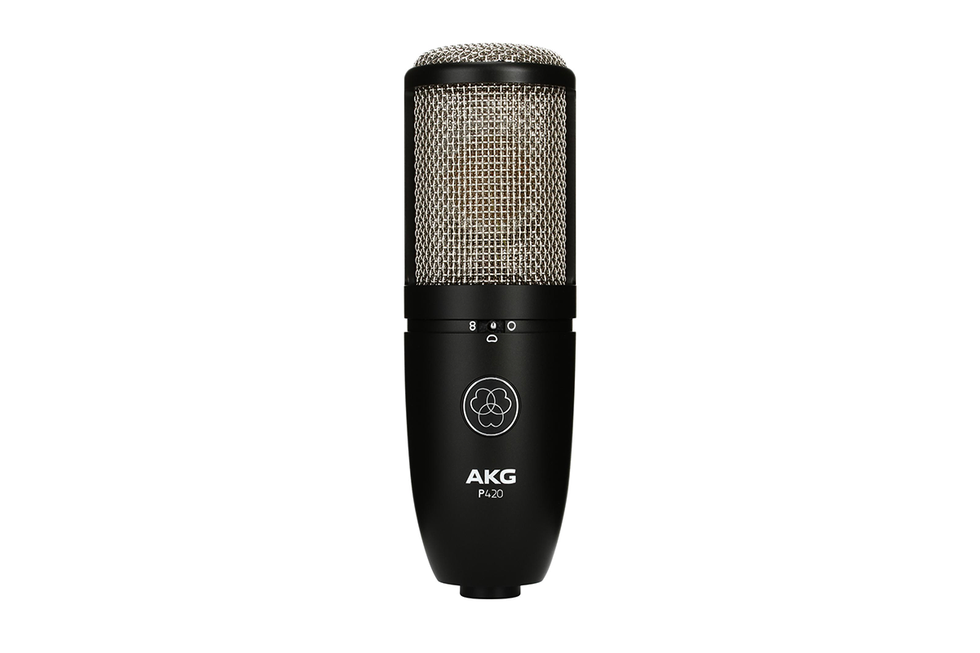
A large-diaphragm condenser mic is what most singers prefer in the studio, for its sensitivity to the nuances of vocal performances. They are also used on acoustic instruments, including horns, upright bass, and piano. The AKG P420 ($229 street) is an excellent vocal microphone that can be set for all three pickup patterns. And the omnidirectional pickup pattern can be useful when recording an entire ensemble or vocal group.
Radial ProDI
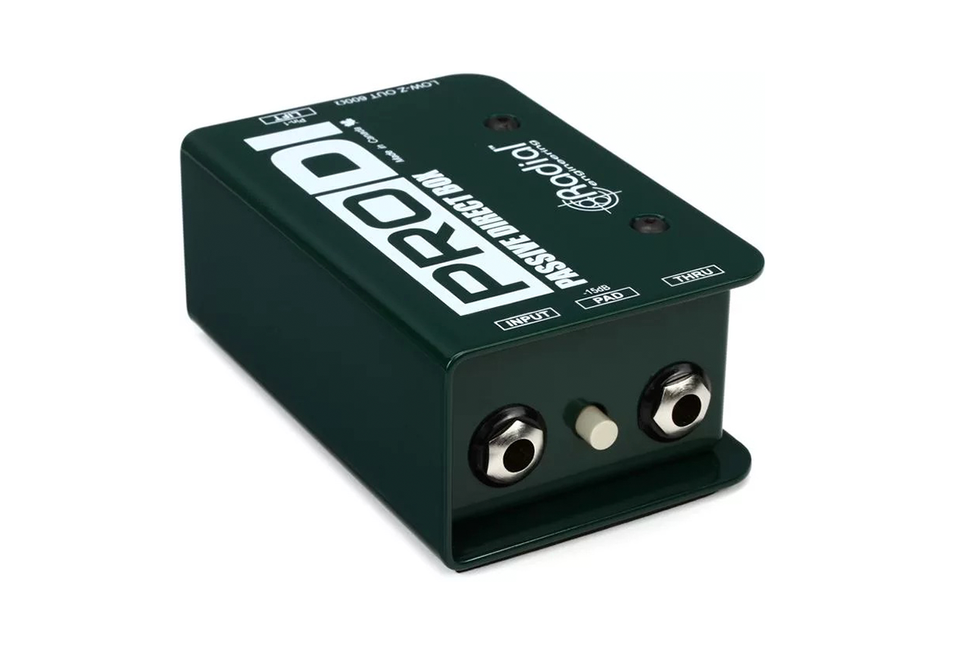
If you’ve played a gig on acoustic guitar, you already know what a direct box, or DI, does. In the studio, DIs are used to record high-output instruments such as keyboards or bass without distorting. It’s always good to have one on hand. Radial makes high-quality DIs, and I recommend the Radial ProDI 1 ($129 street) for its simplicity and efficiency.
Our total cost for these six mics and direct box is $933. Not bad for a basic, easy-to-find home studio mic selection that’ll get you started. And remember, when you’re ready, there’s a myriad of other manufacturers and mics out there to explore. To say nothing of plugins and hardware.
PS: Ribbon mics are the most fragile. They are often used for specific voices or instruments like brass and woodwinds, or a string section, and they are not as versatile as the other mic types. But ribbon mics do have a nice low frequency bump, and the word “warm” is often used to describe their sound. Because they are not as versatile as dynamic and condenser microphones, ribbon mics can always be added to your collection after you get the basics covered.