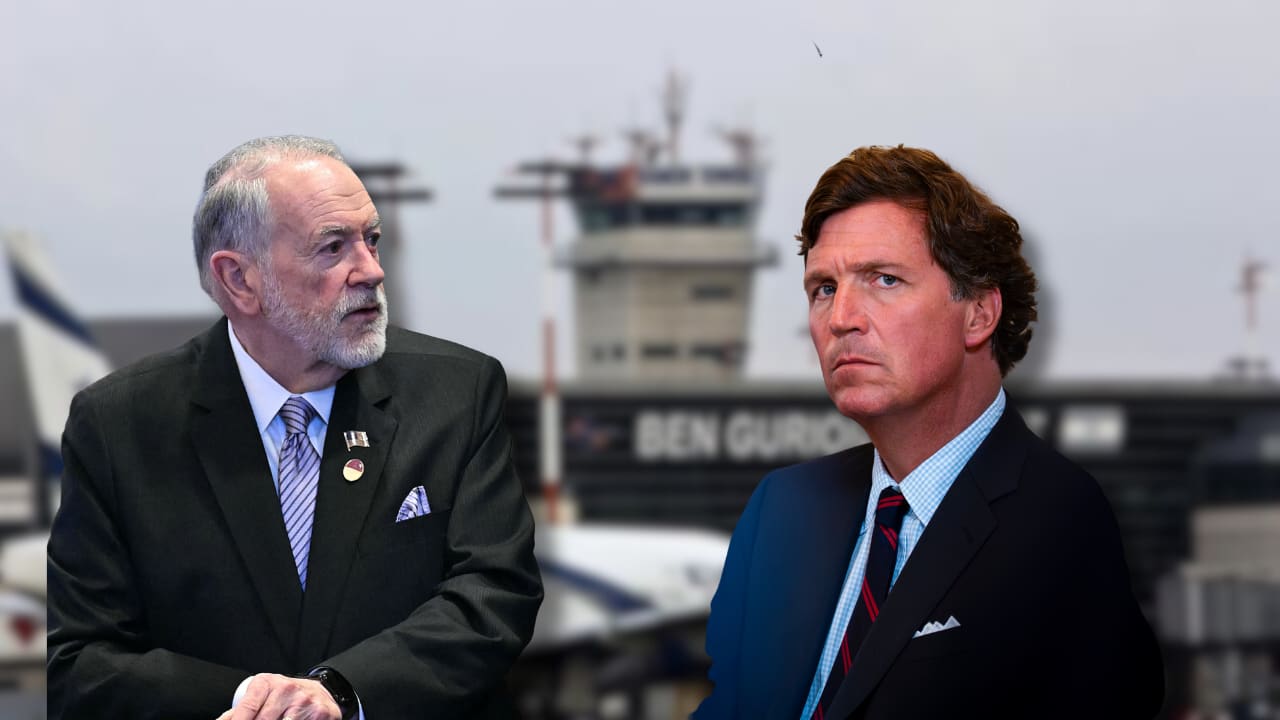
A recent interview between American commentator Tucker Carlson and US Ambassador to Israel Mike Huckabee has led to a number of controversies. One of the most important reactions in the Middle East has been a number of countries condemning the US Ambassador’s remarks.
The interview has led to a debate in some sectors about how views on Israel and the Middle East are shaping US policy, and also how religious views have shaped policy in the region.
Even though many people who have commented on the interview generally saw only negative points about it, ranging from negative views of Carlson to negative reactions to Huckabee’s statements, the fact is that there were a few positive points in the conversation.
Two people sat down in an amicable format and discussed controversial topics in a mostly polite manner. There was no shouting or extremism. This was a respectable interview, and it shows that people with very different viewpoints can speak about them in a calm manner.
Lately, some interview shows have been chosen to present scenarios where several guests are gathered, resulting in a shouting match.

Shouting as a media tool
Shouting may be good for ratings, but none of the listeners will end up learning anything.
For instance, during the Gaza war, did anyone really learn anything from the shows that included extreme reactions and opinions, such as: “Israel is doing genocide!”; “No, it isn’t, you’re an antisemite!” Did anyone learn anything? The public was mostly made less educated.
Did the Carlson-Huckabee interview educate us? It certainly provided a few insights into key discussions about the recent war, Israel and US policy, including a discussion about civilian casualties in Gaza.
Carlson pressed the Ambassador on the number of casualties in the Strip, as well as the number of children killed. What this reveals is the continuing problem of relying solely on the data of the Hamas-run health ministry in Gaza.
While some people mostly reject the numbers of that ministry, they refuse to provide any alternative ones. Even today, with the IDF running half of Gaza and a new US-backed peace plan, there is no alternative health ministry.
When people in Gaza are killed, there is no one to document it as a reliable independent source. How can 2 million people be denied the right to have basic documentation about their lives?
Another revealing discussion regarding the interview was focused on the question of Jewish rights to Israel and issues relating to Christian Zionism, a part of the talk between the two personalities that led to countries in the region condemning the US Ambassador’s remarks.
Ostensibly, the question relates to an interpretation of the Biblical Land of Israel stretching from the Nile to the Euphrates. The way the Ambassador’s comments were related to the region were seen in the article by Turkey’s Anadolu. “US Ambassador to Israel Mike Huckabee argued that Israel has a biblical right to the land stretching from the Nile to the Euphrates rivers, saying, ‘It would be fine if they (Israel) took it all,’ on a podcast released Friday.” The question this raises is whether Biblical interpretations should guide police regarding modern-day Israel.
Before discussing the issue of the Bible and Zionism and what it means for modern politics, it’s worth looking now at the negative points that came out of the interview.
Around a dozen countries say that they “affirm their countries’ categorical rejection of such dangerous and inflammatory remarks, which constitute a flagrant violation of the principles of international law and the Charter of the United Nations, and pose a grave threat to the security and stability of the region.”
The quote came from a joint statement by the Ministries of Foreign Affairs of the United Arab Emirates, the Arab Republic of Egypt, the Hashemite Kingdom of Jordan, the Republic of Indonesia, the Islamic Republic of Pakistan, the Republic of Türkiye, the Kingdom of Saudi Arabia, the State of Qatar, the State of Kuwait, the Sultanate of Oman, the Kingdom of Bahrain, the Lebanese Republic, the Syrian Arab Republic, and the State of Palestine, and the secretariats of the Organization of Islamic Cooperation (OIC), the League of Arab States (LAS), and the Gulf Cooperation Council (GCC).
The official organs wrote to “express their strong condemnation and profound concern regarding the statements made by the United States Ambassador to Israel, in which he indicated that it would be acceptable for Israel to exercise control over territories belonging to Arab states, including the occupied West Bank.”
Many of these countries are US allies and partners, and several of them have peace with Israel. Among the involved states, a number of them are also considered key to the current US-Iran talks, and currently host US military bases.
What these countries manifested is that they were concerned by the US Ambassador's comments in the interview, and claimed that Huckabee's affirmations contradicted the policies of Trump's administration.
Why a discussion of Bible, Zionism matters
Support for Zionism and Israel among some Christians has sometimes been rooted in understandings of the Old Testament, which helped lead to support for the Balfour Declaration in 1917.
Israel’s Foreign Ministry notes, regarding the declaration, “Moreover, far from acting alone, Great Britain was actually part of a major international consensus supporting Zionism, the aspiration of the Jewish people to restore their independence and sovereignty in the Land of Israel. Prior to issuing the declaration, Great Britain coordinated with its allies.”
It should be recalled that the declaration’s actual language is rooted in more than just generalizations about returning Jews to the Land of Israel. “His Majesty’s Government view with favour the establishment in Palestine of a national home for the Jewish people, and will use their best endeavours to facilitate the achievement of this object, it being clearly understood that nothing shall be done which may prejudice the civil and religious rights of existing non-Jewish communities in Palestine, or the rights and political status enjoyed by Jews in any other country.”
What is clear from the policies that underpinned support for Zionism and the underpinnings of modern Israel is that it is not just a Biblical discussion; it is rooted in rights as well.
What the Carlson-Huckabee discussion appears to have missed is a wider discussion of how this debate about the Bible relates to modern-day policy.
Israel is not the only country in the region whose nationalist history is tied up in ideas of a “greater” nationalism. Greek and Turkish nationalism also have wider claims than the modern-day states, and Arab nationalism once envisioned one large state in the region.
Turkey speaks of the Mediterranean as the “Blue Homeland.” Kurds would like to have a Kurdistan. Talk about “greater Israel” therefore does not exist in a vacuum.
However, in a region with overlapping claims, it clearly provokes strong reactions. Understanding the interplay between modern borders and policy and the Biblical discussion of the roots of Zionism clearly is a sensitive discussion and should be approached with that sensitivity.
There were lessons to be learned from the Carlson-Huckabee interview, and they should be discussed.
Carlson has been critiqued over the last several years for his apparent shift in his views on Israel, but this shift among some right-leaning US commentators is not only related to Carlson.
The Gaza war led to a deep discussion in American right-leaning and Christian circles about this, including among supporters of Israel.
Some have accused this discussion of becoming influenced by antisemitism, and there was also a wider discussion about how Evangelicals relate to Israel and whether there are shifting views among younger Evangelicals on Israel, in part due to the Gaza war and other trends.
The Carlson-Huckabee interview is a window into this discussion, even if some would prefer not to look out that window. It is also a window that many countries in the region and others are looking through.