
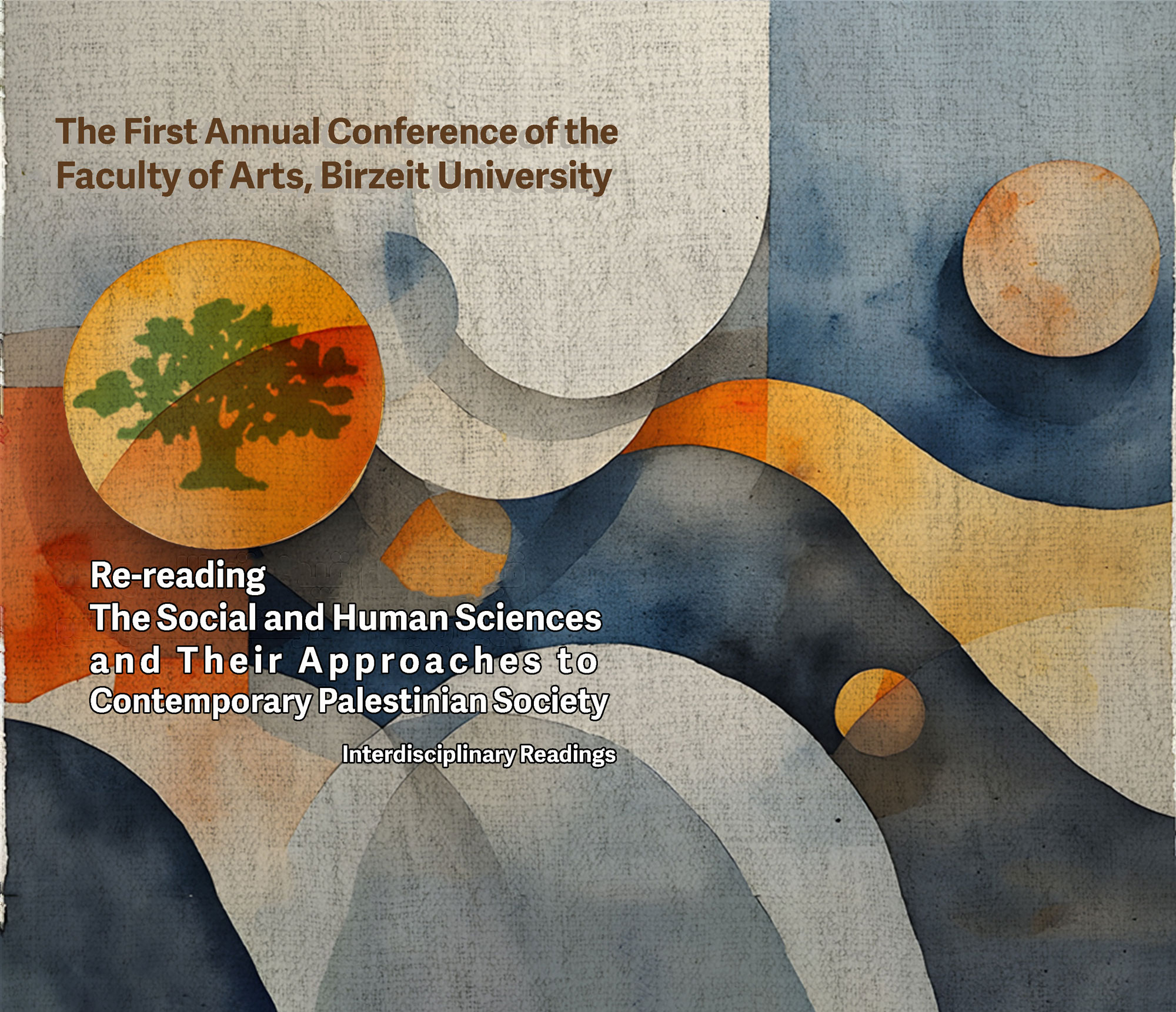
The First Annual Conference of the Faculty of Arts, Birzeit University
Re-reading the Social and Human Sciences and Their Approaches to Contemporary Palestinian Society
Interdisciplinary Readings
6–7 April 2026
Institute of Law Annex, Hall 243 / Birzeit University
Conference Concept
The Faculty of Arts at Birzeit University is organizing its first annual conference with the aim of contributing to the production of renewed readings in the social sciences, humanities, and languages, in order to examine the most significant transformations that have taken place in Palestinian society, as well as changes in teaching methods and curricula in the social sciences, humanities, and languages, and their analytical approaches. The conference seeks to study social phenomena and issues from multiple perspectives across the social sciences, humanities, and languages, through interdisciplinary and intergenerational research approaches, employing a renewed critical methodology. The objective is to diagnose these issues, re-examine, analyze, and deconstruct them based on comprehensive quantitative and qualitative data, and to generate critical and forward-looking perspectives that may indicate key future research trends in the foreseeable horizon.
Background Paper
The social sciences and humanities bear a fundamental responsibility in societies worldwide to rethink and understand ongoing social transformations, propose future visions, and examine the state of these disciplines in light of contemporary changes—particularly digital linguistics and the digitization of the social sciences.
This importance is amplified in the Palestinian context, given the urgent need to reconsider the role of the social sciences and humanities and their impact on individuals, as well as to direct research agendas toward closer engagement with Palestinian societal issues, scholarly communities, and current knowledge needs. This is pursued through addressing a range of pressing issues within the social, cultural, and political landscape.
Accordingly, the conference welcomes renewed critical research approaches that engage with debates surrounding knowledge production, its grounding and renewal, and its capacity to generate its own reference frameworks, research tools, and methodologies, as well as its relationship to local knowledge. It also seeks to examine the relationship of these approaches to epistemic liberation from the colonial condition experienced by Palestinian society, and to question their ability to align the social sciences and humanities with the realities of their society.
Furthermore, the conference aspires to open scholarly debates on the social sciences, humanities, and languages and their approaches in light of the challenges of the digital age and their effects on Palestinian society, digital linguistics, and virtual worlds; the use of technology in education; and the digitization of the social sciences and humanities. It aims to present developmental visions for these disciplines and to address challenges imposed by the digital era, including perspectives on “the future of languages in the digital age,” “media technologies and digital archiving,” and “social media and the social and human sciences.”
The conference also seeks to anticipate future roles for the humanities in studying societal issues, offer critical readings of teaching practices, curricula, and linguistic and epistemic references, and explore ways to enhance scientific research in the humanities as a societal priority—supporting it and advancing its quality, particularly applied research in the social sciences, humanities, and languages, through proposing appropriate solutions and alternatives.
Conference Themes
First Theme:
This theme welcomes interdisciplinary readings aimed at identifying major societal transformations and changes that have affected Palestinian society, its land, people, and communities at the social, economic, and political levels. It seeks to provide new analytical intersections for understanding epistemological and methodological shifts in light of current events, most notably the repercussions of the ongoing genocide on Palestinian society. The theme emphasizes tracing diverse processes and dynamics, with particular focus on the impacts of the ongoing genocide—especially in the Gaza Strip—and its manifestations, including epistemicide, urban destruction, cultural erasure, educational devastation, and health system collapse.
Second Theme:
This theme examines the state of the social sciences, humanities, and languages, their teaching methods, bodies of knowledge, reference frameworks, and their relationship to Palestinian society, its scholarly communities, and educational realities, as well as their impact on teaching and learning. It also addresses contemporary transformations arising from the digital age and critically interrogates these disciplines, with particular attention to challenges related to language, translation, and digital archiving.
Third Theme:
This theme explores new technologies and their role in reshaping the lives and knowledge systems of younger generations in Palestinian society, diagnosing intergenerational gaps, and examining the effects of machine learning, artificial intelligence, and new digital tools on data collection, analysis, dissemination, and their social and educational applications. It also studies alternative forms of knowledge production by examining new modes of visual and auditory communication in Palestinian society and their relationship to traditional knowledge production.
Call for Papers
The conference invites Palestinian academic researchers specializing in the social sciences, humanities, and languages to submit paper proposals.
Proposals are to be submitted in Arabic, with the possibility of accepting proposals in English, via email at: [email protected]
Applicants are requested to submit proposals of approximately 500 words, along with five keywords, and to include their personal information, institutional affiliations, and research institutions.
Important Dates
-
Announcement of the Call for Papers: 15 November 2025
-
Submission Deadline for Proposals: 24 January 2026
-
Notification of Acceptance: 10 February 2026
-
Submission of Final Papers: 24 March 2026
