Join GitHub today
GitHub is home to over 20 million developers working together to host and review code, manage projects, and build software together.
[css-variables] User Agent properties and variables #1693
Comments


 and others

css-meeting-bot
commented
Aug 4, 2017
|
The CSS Working Group just discussed The full IRC log of that discussion<dauwhe> Topic: dino suggestion on writing modes<astearns> s/writing modes/variables/ <astearns> github: https://github.com/w3c/csswg-drafts/issues/1693 <dauwhe> dino: [approaches podium] <dauwhe> ... I'll explain it backwards <dauwhe> ... we're proposing a new var function <dauwhe> ... instead of exposing user custom properties <dauwhe> ... these are defined by the user agent <dauwhe> ... "contstant" means you can''t change it <dauwhe> ... user wants to control type size on iphone <dauwhe> ... css can't detect that <dauwhe> ... you can query the UA value, and then use calc to respond <dauwhe> ... User agent properties <glazou> s/contstant/constant <dauwhe> ... rest is similar to CSS variables <dauwhe> ... I show lots of examples... font size, foreground/background color... <dauwhe> ... like user pref for black background/white text <dauwhe> ... some dyslexic folks want low contrast <dauwhe> ... so CSS could query UA and then respond <dauwhe> ... or we could use safe areas when projecting to screen of different size <dauwhe> glazou: it's coming from UA and system? <dauwhe> dino: yes <glazou> q+ <dauwhe> iank_: could you draw the safe area on the blackboard <bdc> q+ <dauwhe> dino: this has been a concept in TV <dauwhe> ... some TVs you wouldn't see the whole frame <dauwhe> ... so there was a title safe area, where you know pixels would always be visible <dauwhe> myles: modern TVs fake this, <dauwhe> dino: if you have a circular display, the safe area might be in the middle <astearns> ack myles <astearns> q+ <Florian_> q+ <dauwhe> glazou: I like this <dauwhe> ... open question: could be extended to system colors? <astearns> ack glazou <gregwhitworth> q+ <dauwhe> ... we'd have to find common names for system colors on all platforms <melanierichards> q+ <Florian_> q- <dauwhe> ... 2nd thing: I'd like to see a 2nd part with JS elements to detect system change events <dauwhe> dino: you can't do MQ <Florian_> q+ <dauwhe> glazou: being able to detect theme change, or that you switched to night view.... would be color <astearns> ack bdc <glazou> s/would be color/would be cool <dauwhe> bdc: like underlying idea of prefers-reduced-motion MQ... <dauwhe> ... so why do we want a new thing? <dauwhe> dino: unlike MQ, you want to know a value <dauwhe> ... given one of these values, tell me when it changes <dauwhe> bdc: i don't see a difference <dauwhe> Florian_: i don't think so <dauwhe> ... reduced motion is not about make things slower... it's about doing something else <dauwhe> dino: for reduced motion, sometimes we fade in instead of moving in <dauwhe> ... we're generally not removing animations <glazou> q? <dauwhe> astearns: I want to ask about support <glazou> ack astearns <dauwhe> dino: this raises issue on css var spec <dauwhe> ... but I don't know where the property lists go <dauwhe> astearns: if we don't have access for @supports, how do we author? <dbaron> you could always do @supports (color: constant(foobar)), no? <astearns> ack gregwhitworth <dauwhe> gregwhitworth: these are defined by the UA <dauwhe> ... how are we not going to end up with the -webkit- prefixes unless we agree on everything? <dauwhe> dino: these are new properties <dauwhe> ... just like a normal property <dauwhe> gregwhitworth: they'll be standardized? <dauwhe> dino: yes <fremy> q? <fremy> q+ <dauwhe> ... we want them to be universal <Rossen> q+ <dauwhe> dino: don't know if they should be prefixed with -- <glazou> ack melanierichards <astearns> ack melanierichards <dauwhe> ... so they know they can't set, maybe it's ++ <surma> q+ do we need `constant`? <dauwhe> melanierichards: let's say the ua stores the value <surma> q+ <dauwhe> ... the user hasn't overwritten defeault value of foo <dauwhe> ... would it be undefined? <dauwhe> ... as a user, I'd only want the value when it was overwritten by the user <dauwhe> dino: good question <astearns> ack Florian_ <dauwhe> Florian_: it's a nice hammer we have here, we should be careful with it <dauwhe> ... the examples of things are less comfortable with, as they could be solved in other ways <dauwhe> dino: I'm mostly interested in font size and inset ones <dauwhe> Florian_: for font size, why don't you change REM <dauwhe> TabAtkins: REM is font size on root element, this is initial value <astearns> q? <dauwhe> Florian_: this will be one rem if not overridden? <dauwhe> Florian_: for inset, we've been discussing a similar problem, and were trying to solve some other way? <dauwhe> dino: haven't looked at other solutions <dauwhe> myles: what's the other one <melanierichards> s/as a user, I'd/as an author, I'd/ <dauwhe> Florian_: first, a media query for shape, another is another MQ about 'if I place something there, is it visible?' <dauwhe> ... third is using shape inside: display <Rossen> q? <astearns> ack fremy <dauwhe> ... let's not rush into defining through this, as it might prevent us from exploring other solutions <dauwhe> fremy: I have same concern as surma <dauwhe> ... why don't reuse var function? <dauwhe> ... we could use namespace for var function <surma> q- <dauwhe> ... so we don't need new function <dauwhe> ... just variable under new namespace <dauwhe> dino: i don't mind <dauwhe> ... but we used the name constant to remind user they can't change it <dauwhe> ... under the hood it uses same code as variables <astearns> ack Rossen <dauwhe> fremy: I think it's better to reuse namespace inside var <dauwhe> Rossen: thumbs up on the idea <dauwhe> ... we've had lots of requests <dauwhe> ... in terms of getting font size and background colors <fremy> fremy: e.g. { color: var(user preferred-color) } <dauwhe> ... respond to high contrast, etc <Florian_> var(system safe-area-inset) <dauwhe> ... would be insteresting to see the path forward <dauwhe> ... and to summarize how much stuff you want to expose <Bert> q+ to ask do you need the word "constant"? Isn't 'contant(foo)' easier written as 'foo'? <glazou> q+ <dauwhe> TabAtkins: performance would be better than variables <dauwhe> ... you don't control the values <dauwhe> plinss: what about UA changing while you're animating? <SimonSapin> q+ fallback <dauwhe> dino: we should have current color blink text :) <SimonSapin> q- fallback <SimonSapin> q+ <astearns> ack Bert <Zakim> Bert, you wanted to ask do you need the word "constant"? Isn't 'contant(foo)' easier written as 'foo'? <dauwhe> Bert: constant looks like an identity function. can't you use the ID itself? use "fontsize"? <dauwhe> Florian_: we need comma fallback <dauwhe> fremy: if you have properties like font-family you couldn't use it <dauwhe> TabAtkins: this would add an unlimited set of global keywords to CSS <dauwhe> ... functions prevent that <dauwhe> gregwhitworth: one should be scroll-bar-width <dauwhe> ... arrow color, <astearns> ack glazou <dauwhe> glazou: I want to expand on unlimited sets of global name <gregwhitworth> q+ <dauwhe> ... we want to make sure nothing is shipped until everyone agrees on how it works <astearns> zakim, close queue <Zakim> ok, astearns, the speaker queue is closed <dauwhe> ... let's keep it clean <dauwhe> TabAtkins: you only need a few smart devs with houdini, then everyone can use libraries <dauwhe> glazou: it's like what fremy said, it's a namespace <dauwhe> ... I think we can reach consensus on the names <dauwhe> astearns: two more <astearns> ack SimonSapin <dauwhe> SimonSapin: what about fallback? <dauwhe> dino: you could do comma zero <astearns> ack gregwhitworth <SimonSapin> SimonSapin: fallback same as in var()? <SimonSapin> dino: yes <dauwhe> gregwhitworth: I think our biggest request is high contrast, which we map to system colors <dauwhe> ... it became a problem because not everyone does high contrast theming <dauwhe> ... we may have foreground/background, do we need accent color and accent color2? <dauwhe> ... I foresee problems <dauwhe> ... so fallback is what you get <dauwhe> dino: I hear general agreement <dauwhe> ... concerns about constants vs var with namespace <dauwhe> ... melanierichards wants to know when user explicitly change <dauwhe> ... them, someone else wants to ahve events <dauwhe> myles: unset is same as "i don't know what you're talking about" <dauwhe> astearns: general consensus that this is interesting |

|
I was just talking to @heycam about this -- and one question he brought up is whether we should pull in most/all of the non-boolean media queries and allow them to be specified as variables. Do people want to write calc expressions based on things like the |

ausi
commented
Aug 8, 2017
Isn’t this already possible with the |

tomhodgins
commented
Aug 8, 2017
•
Edited 1 time
-
 tomhodgins
Aug 8, 2017
-
Aug 8, 2017
|
Would
When you say Cursory experimented with exposing:
Scrollery experimented with exposing the following values:
And then the most fun was exposing values related to HTML elements as CSS variables with Varsity like:
In my experiments I would use JavaScript to supply, and keep updated, the values for these special CSS variables, and then tried to incorporate these variables in my CSS. Many of these techniques aren't things that these 'User Agent Properties' would enable, but I'm sharing some of these here because what they are, and the way they would be used seems so parallel. Perhaps the CSSplus experiments can validate the usefulness of these 'User Agent Properties' and these 'User Agent Properties' being suggested and add some merit to the idea of exposing more of these values from the browser to CSS using CSS Variables as an interface:
So hopefully that helps support the idea with some examples of something kind of similar, and gives an idea of what the CSS might look like when integrating these 'global CSS variables' into designs :D |

It's not a bad idea; I'm down for it. It would just mean we'd have to be a little careful about naming conflicts between MQs and other UA-vars, but I don't think that's a huge issue. (Alternately we could namespace, but I don't think that's necessary.) |
|
Also: I really want to hook this functionality for custom JS things; the syntax is already super compatible. Just create a map hanging off of document or CSS or something, require the keys to be |
tomhodgins
commented
Aug 10, 2017
|
I had a little brainstorm about exposing JS properties of elements to CSS via CSS variables so authors can make use of a little more situational awareness when writing styles. I've been toying around with this idea for a while, but this thread about User Agent properties gave me the motivation I needed to get it published :D There are a few fun code examples in the README and on the demo page: https://github.com/tomhodgins/varius#examples I wonder if a value handoff between JS and CSS like this via an interface of CSS variables could help give CSS more power without needing to extend CSS features |
This was referenced Aug 15, 2017
 smfr
added
the
Agenda+
label
smfr
added
the
Agenda+
label
Sep 13, 2017

|
Now that the iPhone X has been announced, the suggestion to add safe-area-insets is more clear. The idea is that a page needs to know how to avoid the rounded corners and notch at the top or side of the screen (depending on orientation). The term "safe area" has been around for a fair while in TV, and we think it makes sense here. Since the value can change depending on orientation, it needs to be exposed directly to the style sheet - hence the proposal for CSS constants. |

|
I think we had three major things to decide on:
|

tobireif
commented
Sep 13, 2017
Why would Apple deem it OK to place this burden on web developers? |
We're not requiring them to do this. By default we'll avoid the notch by insetting everything. However, if the author wants their page to use the full area, they can opt in but then need to avoid the corners. |

madrobby
commented
Sep 13, 2017
•
Edited 1 time
-
 madrobby
Sep 13, 2017
-
Sep 13, 2017
|
Why don't you just add a property to And then the UA can just fill up the space as needed with stuff that's normally cut off? This way the developer could just place elements outside the normally available viewport, e.g. render a header element that should extend to the edges of the screen with negative margins. Potentially browsers that support this could add CSS units that are 1/100th's of the safe area (analogous to vw/vh). This could be useful not only for iPhone X, but also for things like circular watch screens, etc. |


I think that is the whole point of the proposal for "Use Agent Variables", the value of the variables we are talking about would be exactly similar to variables containing the size of the safe/unsafe area. I don't want to discourage talking about render-safe-area and other proposals at all, but in a different issue (such that the current issue can stay focused on ironing out the user-agent variables proposal). |

alessiomaffeis
commented
Sep 13, 2017
|
I agree with @grorg reasoning about the default behaviour and the new proposed properties, but still, ideally neither the user, nor the developer should need to bother with this. |

bundyo
commented
Sep 13, 2017
|
For colors there are already the so called System Colors, that do work in some browsers and OSes (namely IE and Firefox, never tested in Edge). The Background, Highlight and HighlightText colors also work in Windows Phone's IE and one can do a fully adaptive app theme, that mutates with the currently selected background and highlight in the OS - something not possible in iOS/Android. If these constants are going to be implemented in all browsers, I'm all for that. |

ry5n
commented
Sep 13, 2017
|
Could this help work around the non-tappable area at the bottom of the viewport in iOS Safari? As a designer of web apps I would love a way around that. |
This has obvious parallels to the Round Display stuff; we should make sure these work in compatible ways. But like @FremyCompany said, this is a different issue and the specifics should be discussed in a different thread.
I also strongly prefer
I'd prefer we make a new spec for this that's intended to be where most of them sit. Like Selectors is for selectors - most of them live there, but a few do live in other specs. |

dpogue
commented
Sep 13, 2017
iOS 11 uses |
We've done that, via a viewport tag. The problem is that we can't just extend objects - because it doesn't always look correct. Also, many objects are snapped to the edges anyway (think of a top or bottom bar), so they need to know how much padding to include in those objects in order to know they are showing content without being clipped. After a lot of experimentation, we concluded that the best thing to do was to give authors the ability to extend to the full viewport and avoid edges if they want to, but we'd do the right thing otherwise. Note that this discussion is orthogonal to the |
|
/me dons fire retardant suit Note that |
Yep, agreed. As mentioned, we use the |

heycam
commented
Sep 14, 2017
|
Minor suggestion: |
dpogue
commented
Sep 14, 2017
|
For anyone curious about how this works in practice on the iPhone X (both the |
I have got a problem here, and my problem varies ;) More precisely, the values that we are discussing here are not going to be constants. The scrollbar width can be updated on Windows and it is very likely we will end up toggling them off for instance when you detach your keyboard and got to tablet mode. Similarly, when you enable an high-contrast theme, "constant" colors are going to change. Even the proposed notch-safe space will depend on the screen orientation, I assume. All in all, I have not seen any argument to convince me we should invest in adding a new function instead of a namespace for existing value references. |
|
TLDR: "global variables" != "constants" |
tobireif
commented
Sep 14, 2017
|
Hi Dean
You had written "a page needs to know how to avoid the rounded corners and notch" - that sure sounded as if each page is required to know how to avoid the rounded corners and the notch.
Thus on/beside each page that doesn't opt in (as the myriads of existing unmaintaned web pages ever created up to now) there will two thick white bars, correct? https://twitter.com/thomasfuchs/status/907764896829452288 Although the white bars are stylable (albeit in a limited way it seems https://twitter.com/thomasfuchs/status/907770902338785280 ), and although though there might be CSS in the future for intentionally-fuller-area pages for dealing with the notch, ideally web developers wouldn't have to bother with Apple's notch or Apple's white bars - at least in my opinion. |

Cykelero
commented
Sep 14, 2017
|
@tobireif, I agree that in addition to giving authors explicit control over how the screen shape is handled, Safari on an iPhone X should by default display pages in a way that takes the notch and rounded corners into account in a reasonable fashion, so that authors are not required to make changes to have their pages properly displayed on the device. You also seem to be making the argument that's Apple's current answer to this problem (letterboxing the page using the background color, to avoid unexpectedly clipping content in pages not designed to take into account the screen shape) is a completely unfit way to handle the problem. Why do you think that is the case, and what alternative do you suggest? To me, clipping content by default—to avoid ungainly, unexpected letterboxing—has far more breaking potential, potentially hiding important areas of content or interactive elements. Without allowing any clipping to occur, it's hard not to end up with blank areas around the page; any ideas as to handle these better is appreciated. |

basiclines
commented
Sep 14, 2017
|
How should behave this UA Properties/Constants when writing direction is RTL instead of LTR?
|
dpogue
commented
Sep 14, 2017
Those refer to the left and right of the physical device screen, regardless of writing direction |
tobireif
commented
Sep 14, 2017
Ideally there wouldn't be a notch. That is my opinion. No notch, no issues The notch issue is not caused by a force of nature, but it has been added based on a decision by Apple. That is the issue. Now that they did add the notch, it sure is sensible to limit the default viewport to the safe area (although as default color for the side-bars, black-like-the-notch-etc might be better than glowing bright white), and it also is sensible to also offer an option for using the full area (plus constants for handling the notch etc). I'm not arguing anything. I'd like to have had a vote (or better a veto Now we can only deal with the issues, which I sure will do |
madrobby
commented
Sep 14, 2017
|
For the benefit of anyone finding this looking for actionable advice on how to deal with the iPhone X viewport issues, here’s a great write-up on using |

eeeps
commented
Sep 14, 2017
|
What @FremyCompany said. @tabatkins had to explain to me that there are two axes of variablilty: changing over tree context and changing over the lifetime of the document. |
Yeah, what eeeps said - they're constant over the page, as opposed to refs that can vary from element to element.
A big difference is that these are usable in places other than properties and animations - you should be able to use these "constants" in MQs and such. (Again, because they're constant across the page, and so don't care about what context they're being used in.) I'm loathe to say "var() is only allowed on elements normally, but you can use it wherever you want if you use this particular type of var name" - much better for everyone if it's a totally distinct name. |


|
From http://stephenradford.me/removing-the-white-bars-in-safari-on-iphone-x/:
Unless I'm mistaken, this will break when the phone is rotated. It also assumes that the right inset will be the largest, and that padding by the largest value on all sides will look fine. To avoid this kind of error, should we have We might also consider ways to get the max/min inset value, via a generic |
dpogue
commented
Sep 14, 2017
|
It's worth pointing out that these do work in |

The inset values adjust when you rotate, so it probably won't break on rotation, but it is indeed wrong.
If it's possible to have variables/constants produce multiple values, then yes, it would help avoid wrongly over-applying a single edge's value.
CSS calc(), min() and max() are super useful with this, they are already in the CSS Units and Values Level 4 Editor's Draft. https://drafts.csswg.org/css-values/#funcdef-min Besides the use you describe, it's often useful to padding or margin to the minimum of the inset or a fixed padding for the case where there's no inset. |

danieltj27
commented
Sep 14, 2017
|
To me, this could be easily avoidable by having WebKit support a new meta tag that either 'respects full viewport' (so takes the notch into account) or instead on the WebKit/Safari side, just indent the corners to line up the corners and notch so there's no need to inset. Surely that's the most backwards compatible and on-breaking way forward? This seems very overkill for supporting one platform by implementing more CSS properties that is only useful for iOS Safari (on iPhone X). Something to the effect of: |
|
@danieltj27 see the references to viewport-fit in this issue. |

tysonmatanich
commented
Sep 15, 2017
|
I'm really hoping this 'notch' thing is just a very short-lived phase that doesn't last. However, I do expect to see more rounded screens. It could be helpful to have the corner radius values as a relative length unit (like em and rem). Perhaps something like
But then again, the values for each corner could be different. Also, we should consider that a UI may want to respond differently to non-square corners than to a 'notch' protruding into the viewport. |
tysonmatanich
commented
Sep 15, 2017
|
Also, anyone know how Essential plans to treat the 'notch' in their phone's viewport? |
dpogue
commented
Sep 15, 2017
|
As Dean mentioned, the concept of a "safe area" isn't specific to the iPhone X and also applies to things like TV screens. This issue is specifically about defining a way for user agents to expose those values (and others, such as user requested font size) to web pages. Discussion around the idea of |
 grorg
referenced this issue
grorg
referenced this issue
Sep 15, 2017
Open
[css-variables] Add User Agent properties and constant() #1817
tysonmatanich
commented
Sep 15, 2017
|
Good to know. Safe area for a TV seems quite different than the iPhone X / Essential phone 'notch'. |
|
I've filed a pull request for the constant() and UA properties part of this issue. There will be a separate pull request for the safe-area-insets (when I work out where they should go). |
|
I'll note that the iPhone X notch isn't the only special thing that a user agent might want to tell the author to avoid. It could be an on-screen overlay button or keyboard, or a picture-in-picture video that is being played by another app on the system. There are many reasons why the User Agent might want to tell the author of the page that content might be occluded and non-interactive in a particular region. |
|
@othermaciej Yeah, custom properties support multiple values. Here's an ugly demo. |

JayPanoz
commented
Sep 15, 2017
|
OK so I’ve been following this issue for a while and there are some details for which I’d like clarifications if possible. Sorry if some were addressed or implied (and cc-ing @dauwhe and @TzviyaSiegman since that will probably impact the Publishing Working Group and the personalization Task Force at some point). The first question is quite simple: who will be able to create and set those constants? For instance, I assume But what if you have an intermediary layer managing documents like, say iBooks or Google Play Books? They have sepia and night modes, their own font-size user setting, and a couple of extras options which OSs and browsers might not offer ( I guess that if the apps are using a web view, they might be able to create and set them. Correct? But what about cloud versions? Sorry if that is unclear to me, I was kinda super happy when I discovered this proposal as it could help with user settings (both apps and authors) and I guess I need an answer as whether this could fit in there or not. To be fair, this should probably be global variables since they will change at runtime. On a related note, PDF version 2 is using HTML and CSS to make documents more accessible, so PDF apps might offer such options at some point (and PDF is still a popular format). Another question: how will this possibly relate to COGA Semantics to Enable Personalization? People might not like Reading Systems (and I kinda get the reasons why), but if it proved anything, it’s that when user settings have a GUI in the app’s chrome, user will override a lot of authors’ styles (and expect those user settings to be available). On the other hand, authors tend to hate when their entire stylesheet is removed (reader modes, which sometimes fail spectacularly with more than basic documents). Consequently, I can clearly see how User Agent properties could help, although the burden would be put on authors. Now, this proposal deals with user settings (but this section is not yet developed), so back to the first question. |

diligiant
commented
Sep 15, 2017
•
Edited 1 time
-
 diligiant
Sep 15, 2017
-
Sep 15, 2017
|
@grorg IMHO unless Safari supports CSS Level 4 min/max at the same time, it will be tough to accommodate the complex positioning rules we have today.
I hope you mean varying safe-area-inset-* when Safari's bars come and go. |
Those don't tend to obscure content. They can be scrolled away, unlike the notch. What you're talking about is a better fit for |
diligiant
commented
Sep 15, 2017
|
@jakearchibald the bottom bar does (try positioning something at 95vh). It disappears when you start to scroll but initially, you have no way to know where the visible content ends. |
|
@diligiant this information is best exposed by |
diligiant
commented
Sep 15, 2017
•
Edited 1 time
-
diligiant
Sep 15, 2017
-
Sep 15, 2017
|
@jakearchibald I won’t contradict you :) Do you treat the keyboard overlay similarly? The drawback being it can’t be handled with pure CSS. |
|
@diligiant On Android & iOS, the keyboard just reduces the viewport size, you can still scroll down to the area that the keyboard may have obscured. This means When @grorg mentioned "overlay keyboards", I took that to mean something that overlays the viewport, so even if you scroll right to the bottom of the page, the keyboard will still be obscuring content. In this case |
diligiant
commented
Sep 15, 2017
|
@jakearchibald I'll be very interested to read @grorg explanations as I have the feeling |
We agree! If it's something that changes the size/position of the viewport, such as a keyboard, a URL bar, or a pinch-zoom, If it's something that obscures content but does not change the viewport, such as physical screen shape, overscan, a picture-in-picture overlay, or an overlaying keyboard, the proposed solution is See https://developers.google.com/web/updates/2017/09/visual-viewport-api#layout_viewport_vs_visual_viewport for a description of the layout vs visual viewport. The iOS & Android keyboard changes the visual viewport, whereas the notch requires the user to adjust layout so content moves out of its way. |
|
Again, can we please move discussion about the new iPhone's notch/corners (which isn't specific to the iPhone anyway) to another issue. It's not directly germane to the general discussion of UA-defined constants/globals. |
|
Should there be a standardized set of constant names with an expected meaning, or is that all up to the UA? I believe @grorg's pull request only defines the mechanism, but not any specific constant names. |
|
@othermaciej I think the names Apple intends to use should be standardised. Otherwise, it's all the problems of vendor prefixes without the minor benefit of an actual vendor prefix. FWIW the proposed naming seems good. |
grorg
referenced this issue
Sep 15, 2017
Open
[css-round-display] Add safe area properties/constants #1819
Yep, we agree. See https://bugs.webkit.org/show_bug.cgi?id=167000 |
 Loirooriol
referenced this issue
Loirooriol
referenced this issue
Sep 16, 2017
Closed
[css-values] Radians considered useless without π #309
|
Replying to @tabatkins
Ok, so I gave this another round of thoughts, and I agree that I can see the value in having a different function name to make it clear the places where the replacement will work are not the same. I still think this isn't needed, but I can see the value. I really do not like the name
The other thing is that this is utterly verbose. If you have to use this multiple times in a calculation, having to type I remember that when I think this proposal matches that description: some value replacement that happens to be globally the same (but could be globally invalidated as a result of a value change). I would therefore propose we rename these variables to "globals" instead of "constants" and use Opinions? |

bkardell
commented
Sep 17, 2017
|
Hmm... Are you at so worried that $ here could lead to even more confusion? |
tomhodgins
commented
Sep 17, 2017
|
To me, the term body {
color: constant(fontColor);
}
body.home {
color: red;
}It's not looking "constant" in any sense of the word, plus it's confusing on another level with The body {
color: constant(fontColor);
background: constant(backgroundColor);
}or body {
color: $(fontColor);
background $(backgroundColor);
}or body {
color: browser(fontColor);
background: browser(backgroundColor);
}Given these examples, the presence of The second example, using But given the third example, That's my 2¢. This is a great idea for a feature, getting the naming right (or wrong) could be the difference between empowering authors and bewildering them. |

devatrox
commented
Sep 18, 2017
|
Why not follow the idea of currentColor? body {
color: userForegroundColor;
} |
|
|
devatrox
commented
Sep 18, 2017
•
Edited 1 time
-
 devatrox
Sep 18, 2017
-
Sep 18, 2017
|
I get that, but it is a predefined value that the dev can't directly manipulate (indirectly he can in this case). The values proposed here can also change constantly (no pun intended) depending on device orientation, environment, settings, whatever, so it is merely an alias to some value defined in the UA. The difference between currentColor and userForegroundColor is just the scope, as one uses EDIT: The newly proposed |
Because a browser needs to track all these values one by one, and that is costly in terms of code to write and combinations to test. The advantage of reusing the infrastructure of var(...) is that it is generic and can be detected very easily at parse time. |
If I understood @tabatkins properly, while some of these values will come from the browser, some can also come from JavaScript using the proposed $(--my-global) syntax. If I misunderstood that then my point is moot, of course,
Well, it's because you don't know this is allowed in CSS. That's something you would learn as part of learning CSS in the future even before you start learning about SASS. |
Yes, this isn't even a question. Without standardization, this is just vendor-specific, and thus worthless. (And thus should be protected behind whatever your vendor-specific-code mechanism is: prefixes or flags or what-have-you.)
Because keywords need to be tracked and monitored for collisions; there are places where we accept arbitrary keywords (like A function, on the other hand, can be handled globally without collision; we don't and will never allow user-defined functions with arbitrary names (they'll be
I'm fine with this; it does indeed match the use-case I was trying to reserve |

zhouqicf
commented
Sep 20, 2017
•
Edited 1 time
-
 zhouqicf
Sep 21, 2017
-
Sep 21, 2017
|
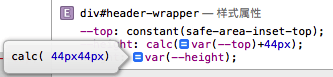
Because i using calc() with no spaces around the |

dpogue
commented
Sep 20, 2017
The constants do work in They also work in gradients: |
css-meeting-bot
commented
Sep 20, 2017
|
The Working Group just discussed
The full IRC log of that discussion<dael> Topic: User Agent properties and variables<dael> github: https://github.com/w3c/csswg-drafts/issues/1693 <dael> smfr: Apple is proposing constantst which are UA defined variables. They're supplied by the UA and not assignable in CSS. Work everywhere variables work. We intend them for metrics that are of interest to web authors to layout their pages. You can imagine one for things like scrollbar. <dael> smfr: Ones we're most interested in is iPhone 10 where it tells authors how to avoid rounded corners. <dael> smfr: Two aspects to this discussion. Is the constant function the right name. Second part is should we have a specific set and list them out? <dael> TabAtkins: Hitting hte second one. You cannot have this as a feature and have a bunch of UA specific values. It doesn't help authors <dael> smfr: I agree <dael> TabAtkins: Values need to be in spec. You can have UA ones behind a flag, but general set of values need to be specified and interop. <dael> smfr: We agree. <Rossen_> Bert: please reply back to this email (https://lists.w3.org/Archives/Member/w3c-css-wg/2017JulSep/0160.html) and let us know what help you need from the rest of us <dael> TabAtkins: I love this and this is great. One bit I think I disagree. This should be usable wider than variables. You should be able to use a global in a MQ or something. It shouldn't be limited to use in properties. <dael> smfr: I think that's reasonable <gregwhitworth> florian: you're really quiet <dael> florian: I'm not sure. 2 reasons. If it's not like variables we need to decide how it works. We'd have to invent a new thing. Also, it's not crazy to imagine that this might have different values per element in the DOM, like what's the default font and that's language dependent so you need a DOM. I'd be careful about expanding it. <dael> TabAtkins: That sort of thing would not be super compat with how we're thinking about this. BUt if we did something like that I would be fine to say in that case it's an invalid reference. Same as using color in a link MQ. <dael> florian: Okay. <dael> smfr: One concern with using this in MQ. WE found authors often want them in conjunction with min and max. So that gives you feature creep where you want min and max in MQ. <dael> TabAtkins: Calc is allowed per spec, which you and then do min and max <dael> smfr: Does any browser? <dael> TabAtkins: Dunno. <dael> smfr: If it's in spec, it's reasonable. <dael> TabAtkins: You might as well be able to. It makes sense. <dael> TabAtkins: Regarding names, I'm fine with constant, but thread had people object to that. They suggested global which was fine to me too. <dael> TabAtkins: fremy also pointed out this is the use case I was trying to reserve $ for. So that might work. <dael> smfr: I do'nt like $ b/c if someone doesn't know CSS it looks like magic. I think 'constant' is way easier. <dael> florian: I think we want the extra param on it so if we have $ and function. <tantek> "you can't google it" is an interesting critique of any new symbol-based syntax <dael> TabAtkins: A function names $ so $(stuff) <tantek> "dollarsign(stuff)?" <Rossen_> dollar-sign() <dael> fantasai: These are environment variables so you could use the entity. <fantasai> env() because these are environment variables <florian> +1 to env() <dael> myles: Other programming languages let you use $ for things that do vary. <dael> Chris: I quite like env option. It's an environment vairable. <dael> TabAtkins: Expcet we want people be able to set the custom ones. <dael> Chris: Ah. <dael> TabAtkins: We recognized a lot of variables are a single global set at the root and the entire enharetence machine for that is a lot. We're working on If a variable is only set on the root we pop it in a seperate storage area. This would let authors declare this sort of thing. <dael> TabAtkins: So you set it once and you have a global variable across the page. <dael> smfr: So you want the same syntax for that and these? <Rossen_> q? <dael> TabAtkins: Names would have to be -- prefix to distinguish name space <Bert> q- <dael> fantasai: How to declare? <Rossen_> Bert, yes let's take that over mail <dael> TabAtkins: Options. Suggested JS API so you can monitor in JS and watch for changes so you can respond to them. If we have that structure it will give you read only access to these. We can allow write access too if it's in the right form. That's the basic. <dael> fantasai: That's not a good answer. <dael> TabAtkins: That's the basic. <dael> fantasai: I don't consider that basic. <dael> TabAtkins: Secondary is an @'function name' rule in your stylesheet. Give it a name and a value. It looks same as property, but as an @ rule. Only problem there is if you want to respond to changes we need to expose it in some JS API. So you either delve into CSSOM or we have to do some mapping between a JS object. <dael> TabAtkins: I have suggestions to this in a thread from where dino is suggesting edits. <dael> TabAtkins: Current idea is the big JS API can also be used from JS to demote both user and UA defined ones. @global lets you do it in stylesheets and they grow a similar map-like object that's a proxy. Therefore if you need to watch the values you can do so, but if you want to set up in JS you can do that. Whichever is best for you you have access to. <dael> smfr: How does that impact the naming? <dael> TabAtkins: Not at all. Whatever the function name is the @rule is similar. <dael> smfr: Does it promote any of the options? <dael> TabAtkins: I don't think so. Any of the ones we've come up with are available and reasonable to read <bkardell_> lol <dael> smfr: Can we try and resolve on a name? <smfr> options: constant(), const(), env(), global() <dael> Rossen_: I head env and global in the running <dael> smfr: Let me type them. <dael> smfr: Those (a few chats before) <bkardell_> I will go against the grain and say I like const() actually <dael> Rossen_: So constant and const since they do change can we rule those out? <florian> prefers env, ok with global <dael> fremy: global is what I prefer. I quite like the $, but of those global is most clear to authors. <bkardell_> prefers env <dael> Rossen_: I see some people saying env, some people global. Which is easier to understand for non-english? <dael> ??: I voted for env <dael> Chris: THe problem with env is it doesn't work for everything that TabAtkins does <bkardell_> author-env variables like bash <bkardell_> yes, what tab said ! <dael> TabAtkins: It's the same as for what bash uses. <Chris> I like env <dael> Rossen_: Let's try and resolve on env. Let's get this one on the books for now. <dael> Rossen_: Objections to renaming what was constant variables to environment variables using env()? <Chris> also can we please stop u-turning on names because it really impacts deployment <dael> smfr: I'm not particularly happy because we have an impl, but I guess we can change. <Chris> bikeshedding considered harmful <dael> TabAtkins: Given there is 0 spec text, I think we'd be angry if you pull a we can't change due to impl. <dael> RESOLVED: rename what was constant variables to environment variables using env() <dael> Rossen_: Did we resolve on the list of predefined? <dael> smfr: Well what spec do they go in? <dael> fantasai: variables <dael> Rossen_: variables l2? <dael> TabAtkins: Either own or variables. variables 2 is good. <dael> Rossen_: Makes most sense given how far variable spec is. <dael> Rossen_: Obj adding this as ED of variable L2? <tantek> seems reasonable <fantasai> sgmt <Chris> +1 to variables-2 <bkardell_> +1 <fantasai> s/sgmt/sgtm/ <dael> RESOLVED: Add this as an ED of variables L2 <dael> Rossen_: Editor? <dael> smfr: I think I'd like to say dino will do it. <dael> TabAtkins: He put text together so he self-volunteered <dael> Rossen_: Obj? <dael> RESOLVED: Add dino as an editor of variables L2 with TabAtkins <dael> Rossen_: Now that we know what we're calling them and where, what will be the initial set of predefined values? <dael> Rossen_: Should we take this back to github? <dael> florian: I think so <dael> smfr: We'd at least like safe area top, botoom, left, right <dael> TabAtkins: Let's get a list in GH <dael> fantasai: I think we can resolve on those 4 values. <dael> s/botoom/bottom <dael> Rossen_: Objections to adding the initial set as safe area top, bottom, left and right? <dael> RESOLVED: The initial set as safe area top, bottom, left and right |
 css-meeting-bot
removed
the
Agenda+
label
css-meeting-bot
removed
the
Agenda+
label
Sep 20, 2017
|
@zhouqicf Your screenshots show you using calc() with no spaces around the |
 fantasai
added
the
css-variables-2
label
fantasai
added
the
css-variables-2
label
Sep 20, 2017


|
I have a few questions. First, I am presuming the request included making it clear “that there is no way for the developer to set these properties”. And now, I see interest in doing the opposite. which is to make these properties settable. I also see interest in making these properties exposable to So, if these properties are settable, how do we distinguish the non-settable ones? The ol’ double-dash? That makes me wonder. If And if that is possible, would we need Then, if these properties are assignable and also available to EDITED: That last example, which I accidentally left un-finished. |
|
I notice the resolution didn't include the proposed multi-value env(safe-area-inset), is that intentional or just wasn't considered at the time? |
|
@othermaciej #1819 (comment) – I agree with @grorg here. Although it works well for simple examples, it isn't as useful as I initially thought. I guess we just have to watch out for anyone advocating patterns that would break on rotation, or future devices. |
This was referenced Sep 23, 2017

CadenP
commented
Nov 2, 2017
|
Perhaps it's too late, but I had a thought regarding the name choice. What about My only issue with it would be that it is almost too similar to |
|
We're locked and loaded to ship env(), and there was a WG resolution on that, so we'd really prefer that it not change again. |
CadenP
commented
Nov 2, 2017
|
Ah, very good. Then don't mind me! |
This was referenced Nov 5, 2017

jkuss
commented
Nov 9, 2017
|
Can anyone give me guidance on how to get at these new constant/env() properties from javascript? |

kiding
commented
Nov 15, 2017
•

|
@jkuss This is actually quite interesting. I believe at this moment WebKit, being the only User Agent shipped with this functionality, offers no JS API to directly obtain Being UA-specific things, it sort of makes sense that I know this problem is right in the middle of a standardization minefield, and probably out-of-scope of CSSWG, but it doesn’t particularly seem in-scope anywhere else. |

grorg commentedAug 4, 2017
•
Edited 1 time
-
 grorg
grorg
Aug 4, 2017
Here is WebKit's proposal for a new type of property and variable.
User Agent Properties
This specification defines an open-ended set of properties called
User Agent properties, which, among other things, are used to define the substitutionvalue of
constant()functions.Name: (various)
Value:
<declaration-value>Initial: (nothing, see prose)
Applies to: all elements
Inherited: yes
Percentages: n/a
Media: all
Computed value: specified value with variables substituted (but see prose for "invalid variables")
Canonical order: per grammar
Animatable: no
A User Agent property is not specified in a style sheet. User Agent properties
instead define variables, referenced with the
constant()notation.For example, a page that wants to use the user's requested font sizing, and page
background:
Unlike other CSS properties, User Agent property names are case-sensitive.
User Agent properties are not reset by the all property. If a style rule attempts to
define a value for a User Agent property, it is ignored.
Using Cascading User Agent Variables: the 'constant()' notation
The value of a
User Agent propertycan be substituted into the value of anotherproperty with the
constant()function. The syntax ofconstant()is:The
constant()function is used in the same manner, and follows the same rules,as the
var()function.Defined User Agent Variables
user-font-size: User's requested font sizeuser-background-color: User's requested background coloruser-foreground-color: User's requested foreground colorsafe-area-inset-top: Inset, as a<length>from the top of the viewport to the title-safe content area.safe-area-inset-right: Inset, as a<length>from the right of the viewport to the title-safe content area.safe-area-inset-left: Inset, as a<length>from the left of the viewport to the title-safe content area.safe-area-inset-bottom: Inset, as a<length>from the bottom of the viewport to the title-safe content area.