BBC Arabic does stealth ‘clean-up’ after CAMERA Arabic complaint

A post by CAMERA Arabic.

In late October we posted a report by CAMERA Arabic concerning BBC Arabic’s promotion of an “educational” project by environmental engineer Omar Asi: an Israel-free, child-friendly map of “Palestine” from the river to the sea:

BBC Arabic radio promotes Israel-free map of ‘Palestine’ for children

During Asi’s interview with the BBC Arabic radio show “Dardasha Layliya”:

  1. He elaborated on several of the areas of “Palestine” featured on his map including Jaffa and the Negev, both of which are internationally recognised as Israeli territory.
  2. He spoke disapprovingly of the geographical education children from the “interior of Palestine” (i.e. Israeli Arabs) are getting, namely the fact they are being exposed to “maps of Israel” rather than “maps of Palestine”.
  3. He revealed that the map contains a reference to the autobiography of a Hamas mass-murderer Abdullah Barghouthi, currently imprisoned in Israel. Barghouthi is a bomb-maker who was given 67 consecutive life sentences for his part in the murder of 66 Israelis in numerous suicide bombings during the early 2000s.
  4. He expressed his conviction that the illustrations of places on the map would prompt children to find out more about stories behind them which relate to the Palestinian national struggle.
  5. He received full and complete support for his campaign from the show’s host Heba ‘Abd al-Baqi who wished him and his team the best of luck and stated he was calling “from Palestine”. At no point during the interview did Abd al-Baqi challenge, criticise or contextualise Asi’s ideas.

In conclusion, this BBC Arabic radio item normalised the negation of Israel’s right to exist within any borders and denied the right of Israeli Jews to live peacefully while exerting their right of self-determination in their homeland. Asi’s mention of Abdullah Barghouthi also mainstreamed implied support for terrorism against Israeli civilians.

All of the above is a breach of BBC’s editorial guidelines regarding impartiality and offensive speech, as well as a breach of BBC’s style guide regarding the use of the term “Palestine”.

In late November, not long after a CAMERA Arabic submitted a complaint about the item to the BBC, it was mysteriously removed from BBC Arabic’s Soundcloud channel and Facebook webpage. Notably, the other two items aired in the same programme on October 24th still appear on both the Soundcloud channel and the Facebook webpage (the first link leads to the opening item of the show which includes a short description of the map item – the second of the three – at 0:40). 

Although CAMERA Arabic has yet to receive any response to the complaint submitted in November, it would appear that somebody at BBC Arabic took action to hide evidence that this embarrassing item had existed in the first place.


Reviewing BBC coverage of the Likud leadership primary

How much coverage would one consider it necessary for the BBC to give to the topic of leadership primaries in one political party in a foreign country?

BBC coverage of the Likud leadership primary which took place on December 26th included the following:

December 26th:

BBC News website:

Israel’s Benjamin Netanyahu in party leadership challenge

BBC Radio 4:

‘Today’programme – the first item in the opening news bulletin was a report by Barbara Plett Usher (from 01:39 here).

BBC World Service radio:

‘Newsday’ – the lead item (from 00:37 here) was a four-minute interview with Israeli journalist Noga Tarnopolsky.

‘Newshour’ –  the lead item was a four-minute report (from 00:12 here) by Barbara Plett Usher.

December 27th:

BBC News website:

Israel’s Benjamin Netanyahu comfortably wins party leadership challenge

BBC Radio 4:

‘Today’ programme – a report from Barbara Plett Usher (from 33:44 here) and an additional report from the same journalist in a news bulletin (from 1:03:38 here).

BBC World Service radio:

‘Newsday’ – a four-minute and twenty-second report from Barbara Plett Usher (from 14:09 here).

‘Newshour’ – a report by Barbara Plett Usher (from 45:04 here).

Yes, the BBC apparently really did consider it efficient use of public funding to produce at least nine multi-platform reports in two days on the topic of a leadership poll conducted by one political party in a foreign country in which less than half of the 116,000 members eligible to vote returned a predictable result.

BBC WS radio misrepresents the IHRA definition of antisemitism

h/t SG

The December 22nd edition of the BBC World Service radio programme ‘Boston Calling’ – titled “The allegiance edition” – included an item (from 08:56 here) described in its synopsis as follows:

“Also, we look into President Trump’s latest executive order, which relies on a controversial definition of anti-Semitism…” [emphasis added]

The working definition of antisemitism which the BBC World Service found fit to portray as “controversial” is that produced by the International Holocaust Remembrance Alliance (IHRA) which has been adopted by governments and bodies around the world.

Presenter Carol Hills (of PRI) chose to introduce the item with an unexplained reference to ‘allegiance’ which might well be considered inappropriate given the subject matter of antisemitism.

[emphasis in italics in the original, emphasis in bold added]

Hills: “In these divided times there are still some things we agree on. Few people, for example, would not agree that antisemitism is bad and that we should do something about it. But the agreement ends there because as soon as you start asking people what is antisemitism, who is guilty of it and what to do about it, that’s when you run into disagreements and in some cases allegiance comes into question. This became clear after President Trump signed his latest executive order. Our own Rupa Shenoy has more.”

Rupa Shenoy – also of PRI – began with a superficial description of the executive order signed on December 11th which is ostensibly the subject matter of her report.

Shenoy: “Hanukkah came early at the White House as President Trump recounted what he’d done for the Jewish people and said he was adding to that legacy by signing a powerful executive order.”

Recording Trump: “This action makes clear that Title VI of the Civil Rights Act which prohibits the federal funding of universities and other institutions that engage in discrimination applies to institutions that traffic in antisemitic hate.”

Shenoy: “He noted that Congress and the previous administration had tried to do something similar but those efforts stalled.”

Recording Trump: “But this year there’s no roadblock because I’m doing it myself. It’s much easier.”

Shenoy: “And Trump made the intent of his order clear.”

Recording Trump: “This is our message to universities: if you want to accept the tremendous amount of federal dollars that you get every year, you must reject antisemitism. It’s very simple.”

Shenoy: “The order recommends that universities define antisemitism with this specific language as -quote – a certain perception of Jews which may be expressed as hatred towards Jews including – quote – rhetorical and physical manifestations of antisemitism. Ken Stern helped craft that definition originally for the International Holocaust Remembrance Alliance.”

Ken Stern did not ‘help craft’ the IHRA definition. He did help write – along with some eight others – its predecessor for a now defunct EU agency called The European Union Monitoring Centre on Racism and Xenophobia. Seeing as Stern has repeatedly voiced his opinion that the IHRC is not suitable for use on campuses because he regards them as a special ‘free speech’ environment, the views he expresses in this report do not come as much of a surprise.

Stern: “It was never intended as something to police speech on campus.”

Shenoy: “Because he says there’s no similar definition of racism for example. And Stern says the Department of Education has made clear that Title VI already covers Jewish students.”

Stern: “Jewish students are being targeted regardless if they’re pro-Israel or anti-Israel, simply because they’re Jewish. That’s something that’s actionable and a concern. But the use of this definition is part of a long-standing pattern to try to curtail political speech about Israel.”

Shenoy then brought in a second voice supporting the same view – but failed to meet BBC editorial guideline requirements to inform audiences of the “affiliations, funding and particular viewpoints” of her contributor and the organisation she currently represents.  

Shenoy: “Others have come to the same conclusion about Trump’s executive order. Lara Friedman is president of the Foundation for Middle East Peace.”

Friedman: “What it says is when it comes to criticising Israel, Jews equal Israel, Israel equals Jews. If you are on campus and you only talk about Israel and you’re criticising Israel, you are by definition antisemitic. Under the definition offered here the Palestinian historic and lived narrative becomes antisemitism.”

Shenoy: “She says the order’s goal is to send a message to university administrators and organisers.”

Friedman: “We are watching you and we will make your life miserable; cost you time, there’ll be reputational costs, all of that. You could lose your federal funding if you dare cross the line so don’t even go near the line.”

Shenoy: “Friedman says Trump’s executive order is aimed at campus protests across the country that Trump sees as connected to a larger worldwide movement to boycott Israel called BDS. That’s short for boycott, divestment and sanctions.”

As is inevitably the case in BBC content, audiences did not receive any sort of explanation concerning the BDS campaign – including the particularly relevant fact that what that campaign ultimately seeks to achieve is the end of Israel as the Jewish state.

Recording Trump: “And as president I want to be very clear. My administration vigorously condemns the BDS campaign against Israel.”

Shenoy: “This is Trump earlier this week [actually December 8th] at the Israeli-American Council’s national summit in Florida.”

Recording Trump: “But sadly BDS has also made disturbing headway on American college campuses – you know that, don’t you? Here with us today is Adela Cojab, a recent graduate of New York University who courageously stood for Israel in the face of hostility and bigotry…”

Shenoy: “Adela Cojab got on stage and told the audience she was suing NYU because it failed to protect Jewish students from harassment. Now she tells me she feels validated by the presidential order.”

Cojab: “By signing this order he just expanded the definition of protected groups and it includes Jewish students of course. And that tells Jewish students everywhere that what they’re going through isn’t normal, it’s not OK. And it just clarifies that they can stand up.”

Shenoy: “And Cojab pushes back against the argument that the executive order will stifle free speech.”

Cojab: “I think that the process can very much not be antisemitic. I criticise Israel openly because I have thoughts but there’s a difference between criticising Israel and Israeli policy and Israeli administration and criticising Israel’s right to exist. Because when you say that you’re anti-Zionist you’re saying that you’re against Israel’s right to exist, which is destroying Israel.”

Having apparently brought in Cojab to balance the two voices already heard, Shenoy then promoted a third view opposing the executive order. She did not however bother to clarify to listeners that her interviewee is a member of ‘Students for Justice in Palestine’ (SJP) which is one of the main proponents of BDS on US campuses.

Shenoy: “And creating a hostile environment for students, she says. For their part many campus activists for Palestinian rights say they’re not backing down. Nick Galloway is a graduate student at the University of Maryland who’s participated in demonstrations for years.”

Galloway: “They can’t stop us from getting together and fighting for justice and fighting for BDS.”

Shenoy: “He says Trump’s executive order might intimidate some Palestinian or Muslim students on campus from protesting. But Galloway adds that it also might invite a backlash.”

Galloway: “It’s going to strengthen the resolve of student organisers to [unintelligible] that.”

Shenoy: “But the divisions over Israel, Zionism, Palestinian rights and free speech aren’t going away any time soon. Trump’s executive order will have to play out on college campuses and likely court rooms across the country.”

To sum up, BBC audiences heard three voices opposing the US president’s executive order and just one in favour. In breach of BBC editorial guidelines they were not informed of the agendas of the organisations with which two of those voices are associated and neither were they given any relevant background information concerning the BDS campaign which they support.

Most egregiously, listeners were told that the IHRA working definition of antisemitism is “controversial” and that its adoption means that people who “talk about Israel” and criticise Israel “are by definition antisemitic”. That of course is completely false. As Dave Rich of the CST has pointed out, the IHRA definition does not “repress” freedom of speech at all.

“The IHRA definition does no such thing, stating plainly that ‘criticism of Israel similar to that levelled against any other country cannot be regarded as anti-Semitic.’ This leaves room for the full range of rational, evidence-based opposition to Israeli laws, policies and actions. It doesn’t allow for the kind of obsessive, irrational hatred that depicts Israel as a Nazi state of unparalleled cruelty that needs to be wiped off the map, or that sees “Zionist” conspiracies behind everything from 9/11 to the poisoning of Sergei and Yulia Skripal, and for good reason: because, as the IHRA definition recognises, antisemitism sometimes includes ‘the targeting of the State of Israel, conceived as a Jewish collectivity.’”

If the BBC’s partners at PRI are not capable of portraying the IHRA working definition of antisemitism in a manner that meets BBC editorial guidelines on accuracy and impartiality, that content should obviously not be rebroadcast on ‘Boston Calling’.

Related Articles:

Guardian op-ed: presidential order on antisemitism only supported by right-wing Jews (UK Media Watch) 


More BBC multi-platform exploitation of Christmas

The December 28th edition of BBC Radio 4’s ‘From Our Own Correspondent’ – titled “The Meaning of Home” – included another example of the BBC’s decidedly desperate exploitation of Christmas for the promotion of politicised reporting. The item is described in the synopsis as follows:

“The story of the nativity often inspires people to show compassion to the homeless around Christmas. Pregnant women and new mothers are particularly vulnerable. But the challenges of new life don’t end with finding a safe place to stay. On the occupied West Bank, Jeremy Bristow recently travelled with a group of female medics to visit the minority Arab Bedouin population.”

Presenter Kate Adie introduced the item (from 22:23 here) thus:

Adie: “Far from home, vulnerable and nowhere to stay, the Christmas story reflects what is still a worldwide problem and acts as a reminder to us all to help. But the challenges of a new life don’t end with finding a safe haven. On the occupied West Bank Jeremy Bristow recently travelled with a group of medics to visit a community from the minority Arab Bedouin population.”

Quite what the BBC imagines is the connection of Bedouin tribes from the Arabian Peninsula, who took over parts of the Judean Desert during the period of Ottoman rule, to the nativity story is unclear. 

The story told by Jeremy Bristow to Radio 4 listeners is almost identical to that appearing in an article published on the BBC News website’s ‘Middle East’ and ‘Stories’ pages on December 25th under the headline “The Christians helping Bethlehem shepherd families give birth safely”.

“Jeremy Bristow discovers that an ancient Christian order is providing maternity services for some of the poorest people in the Bethlehem area – the sheep-raising Bedouin.”

Both the written and audio accounts begin with the promotion of artificial linkage between the Christmas story and the topic of Bristow’s report – a Bedouin tribe located a 25 kilometre drive away from Bethlehem.

“We drove through Beit Sahour, a suburb of Bethlehem. “Beit” in Arabic means ”house”, and “sahour” means “night watch”. As tradition has it, this is close to the place where an angel once appeared before three star-struck shepherds and announced the imminent birth of a saviour. But today’s shepherds, the Bedouin, live further out of town.”

Ignoring the fact that sheep rearing is by no means confined to the Bedouin sector, Bristow goes on to tick the BBC’s boxes with an entirely unrelated reference to ‘settlements’.

“The rock-strewn desert landscape is occasionally overlooked by glistening white Israeli settlements straddling the high ground above.”

BBC audiences are told that:

“All the women and children seeking treatment from the mobile medical team on this occasion were Bedouin from the al-Rashaydah tribe, whose members are scattered across a dozen countries from Tunisia to Oman. They gave their name to this village when they were moved here by the Israeli authorities, in their third resettlement since they were forced to leave historic grazing grounds near the Dead Sea in the early 1970s. […]

Al-Rashaydah, like many villages in the occupied West Bank, is surrounded by land controlled by Israel. The Bedouin are forbidden to graze their livestock there.”

Bristow does not bother to inform his audiences that under the terms of the Oslo Accords, the village of Al-Rashaydah is under Palestinian Authority control or that the proximate area to the east is a nature reserve established under the same agreement. He does not explain how the claim that they are “forbidden to graze their livestock” squares with his previous description of the Al-Rashaydah Bedouin as “today’s shepherds”. In fact a Palestinian website’s description of a nature reserve to the west of the village states that it used for grazing sheep and goats (as well as tourism) and mentions Al-Rashayda by name.

BBC audiences are told that:

“In both Israel and the West Bank the once self-sufficient Bedouin have become increasingly dependent on outside support. They see themselves as second-class citizens. Unemployment is high, educational achievement is low and there are high rates of infant mortality, premature births, anaemia, and stunted growth in children…”

However no information is provided concerning the cultural aspects of such phenomena – for example:

“…Bedouins largely remain a traditional society organized into tribes in which men are responsible for decision-making. There are high rates of consanguinity (60%), often between first cousins, and polygamy (25%). Women are often undereducated and do not work outside of the home. In some families, women are restricted from leaving the home without a male chaperone, which may interfere with timely utilization of health services. Many Bedouin women suffer from nutritional deficiencies, putting them at risk for delivering prematurely and for certain congenital malformations. In addition, Bedouin children suffer from nutritional deficiencies, especially anemia, which together with crowded living conditions is a risk factor for contracting infectious diseases. Bedouins have a high fertility rate and nearly half of the births in the Negev are in this population despite comprising 30% of the population. Women tend to give birth frequently and the interpregnancy interval is short, which can lead to preterm delivery, low birth weight, an increased risk for congenital malformations, and infant mortality.”

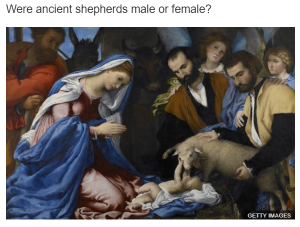
A sub-heading in the written report poses the question “Were ancient shepherds male or female?” and is accompanied by an image of the nativity scene.

Readers once again find the suggestion that the Bedouin are somehow connected to the nativity story. [emphasis added]

“The gospel of Luke says: “And there were in the same country shepherds abiding in the field, keeping watch over their flock by night. And, lo, the angel of the Lord came upon them.”

It wasn’t only nomadic Bedouin who kept sheep in ancient times, villagers did too, says Joan Taylor, professor of Christian Origins and Second Temple Judaism at King’s College London. The shepherds could be male or female, “and often in antiquity, as today, they were children”.

The Greek word used by Luke to refer to the shepherds is “gender-inclusive”, she adds.”

At the bottom of the written article readers are offered a link to a highly problematic article first published in 2014.

“A Palestinian Christian family that preaches non-violence from a farm in the West Bank is battling to hold on to land it has owned for a century. Now surrounded by Israeli settlements, the family is a living example of the idea of peaceful resistance.”

As we see, the BBC’s brazen multi-platform exploitation of Christmas for the promotion of one-sided political narratives continues apace.

Related Articles:

The BBC’s biased Bethlehem binge continues

BBC politicisation of Christmas continues on WS radio

BBC News again self-conscripts to Banksy’s Israel delegitimisation

BBC WS radio airs anti-terrorist fence falsehoods

BBC Radio 4 religious show airs anodyne report on Palestinian Christians

Documenting five years of BBC politicisation of Christmas


The BBC’s biased Bethlehem binge continues

Yesterday we documented an overtly politicised Christmas report by Barbara Plett Usher which was aired on BBC World Service radio’s ‘Global News Podcast’ on Christmas Eve.

BBC politicisation of Christmas continues on WS radio

An extended version of that audio report was also broadcast on three additional BBC radio programmes on December 24th with the following introductions:

[emphasis in italics in the original, emphasis in bold added]

1) BBC Radio 4, ‘Today’ (from 46:37 here)

Mishal Husain: “Now, Bethlehem relies on tourists at this time of year and this Christmas looks like being the best for some years after a time of relative peace. It is a Palestinian city in the West Bank which is feeling the economic effect of the Israeli occupation. Israel has restricted movement out of the West Bank and confiscated some Palestinian land to build Jewish settlements and what it calls a security barrier around the city. Barbara Plett Usher reports from there.”

2) BBC World Service radio, ‘Newshour’ afternoon edition (from 45:04 here)

Tim Franks: “Bethlehem is preparing for what it hopes will be the best Christmas in years as the city now boasts a fragment of wood believed by some to have formed part of Jesus’ manger. The relic’s been returned from the Vatican where it’s been since the 7th century. But even with that boost, the biblical town revered as the birthplace of Jesus Christ remains fragile. The once thriving local Christian community is dwindling – partly because of the economic effect of the Israeli occupation with restrictions on freedom of movement which Israel argues are for security reasons, which Palestinians say damage not only their economy but their dignity as well. Barbara Plett Usher has more from the town in the spotlight this Christmas.”

3) BBC World Service radio, ‘Newshour’ evening edition (from 36:59 here)

Julian Marshall: “Pilgrims from around the world are preparing to begin Christmas celebrations with midnight mass in Bethlehem, believed by Christians to be the birthplace of Jesus. Modern Bethlehem is a Palestinian city in the Israeli occupied West Bank. Its holy sites are administered by the Greek Orthodox and Latin patriarchies. But the once thriving Palestinian Christian community has dwindled. Israel has restricted movement out of the West Bank and confiscated some Palestinian land to build Jewish settlements and what it calls a security barrier around the city. Palestinians say these measures significantly harm their freedom and their economic prospects. Barbara Plett Usher has more from the town in the spotlight at Christmas.”

Once again we see BBC journalists using the term “Israeli occupied” without any mention of the fact that Bethlehem came under complete Palestinian Authority control twenty-four years ago in December 1995.

Yet again listeners were not informed that no “restrictions on freedom of movement” existed until the Palestinians chose to launch the second Intifada in the year 2000 and they heard nothing at all about the Palestinian terrorism that murdered and wounded thousands of Israeli civilians and which brought security measures such as checkpoints and the anti-terrorist fence into existence.

The BBC practice of describing an area still subject to negotiation under the terms of an agreement signed by the Palestinians as “Palestinian land” was once again in evidence, as was promotion of the false claim that there is a wall “around Bethlehem”.

And yet again BBC audiences were not provided with the context which would enhance their understanding of why the Palestinian Christian community is ‘dwindling’ – including the issue of Palestinian Authority persecution and discrimination – or any significant information concerning Bethlehem’s economy beyond the trite politicised slogans blaming Israel.

The extended version of Barbara Plett Usher’s report (a filmed version of which was also aired on BBC television on Christmas Eve) includes an interview with a man dressed up as Santa in Manger Square during which listeners heard that “Bethlehem is a city of peace” despite the fact that it has been the source of many terror attacks and plots. The part of Plett Usher’s report describing St Catherine’s church and an Airbnb in Deheishe are expanded and we discover that she badgered more than one American tourist in order to promote her own political agenda.

Plett Usher: “What comes to mind when you come to Bethlehem? What’s the main impression?”

Tourist 1: “Oh well it’s overwhelming because of just how…I mean this is where our lord saviour was born and, my goodness, I mean this is it where everything started.”

Plett Usher: “But what about the wall around Bethlehem now? The big cement wall – what do you think of that?”

Tourist 1: “Oh yes, that was substantial of course and you can tell that people that lived in the old times, how protected they felt by the big wall and how amazing it is today.”

Plett Usher: “It’s a new wall but anyway…”

Tourist 1: “Oh, that’s a new wall?”

Plett Usher: “Yes.”

Tourist 1: “Oh OK, it’s a new wall then. That so it’s about the future as well.”

Tourist 2: “We’re from the US, yes.”

Plett Usher: “And what do you think of Bethlehem?”

Tourist 2: “Ah, it’s beautiful.”

Plett Usher: “What about the politics? Do you know…”

Tourist 2: “I don’t know much about it. All I know is my saviour Jesus Christ. That’s all I know. That’s all I care about. I just want to learn more about him. Yeah, and my eyes are open now that I’m here.”

Plett Usher: “What have you seen now that your eyes are open?”

Tourist 2: “Oh well, it’s as if I was coming to life, so yes.”

There is of course nothing novel about a BBC journalist exploiting the ‘season of goodwill’ to promote her own political agenda which includes misinformation about a structure built to protect Israeli civilians of all faiths and ethnicities from Palestinian terrorism. Many BBC employees have done the exact same over the years while studiously avoiding any serious reporting on the topic of the beleaguered Christians living under Palestinian Authority and Hamas rule.

Related Articles:

BBC politicisation of Christmas continues on WS radio

BBC News again self-conscripts to Banksy’s Israel delegitimisation

BBC WS radio airs anti-terrorist fence falsehoods

BBC Radio 4 religious show airs anodyne report on Palestinian Christians

Documenting five years of BBC politicisation of Christmas


No BBC News follow-up on incident it reported in November

BBC News website coverage of Operation Black Belt included a report published on November 16th under the headline “Israel-Gaza: Israel vows to investigate civilian death claims”.

“Israel’s military has said it is investigating “harm caused to civilians” from an air strike it launched in Gaza.

Palestinian medics said eight members of one family died in the strike, among them five children.

Israel said the attack targeted the home of Rasmi Abu Malhous, who it called a militant commander from the group Palestinian Islamic Jihad (PIJ).

It said no civilians were expected to be in harm’s way.”

The report told readers that:

“The missiles hit an open sandy area, obliterating what neighbours and relatives described to the BBC as flimsy tin-roofed buildings inhabited by 22 people – the families of two brothers.

There were conflicting local accounts about whether one of them may have been linked to Islamic Jihad.”

On December 24th the IDF published the results of that investigation.

“As part of the investigations, the strike which killed eight members of the A-Sawarkah family, including five children, were killed in the bombing of their home in Deir al-Balah was also investigated.

According to the investigation, the compound was approved by the Southern Command last June and vetted several times later (lastly just days prior to the operation) as an active military compound used by the PIJ with military activity being conducted in the compound in the past as well as during the two days of fighting during Operation Black Belt.

The investigation also stated that when planning and carrying out the attack, it was estimated that no civilians will be harmed as a result of it.  Nevertheless, the investigation clarified that even though military activity was conducted in the compound, it was not a closed compound, and in reality civilians were present there.

According to the military, the investigation focused on actions “that could have brought forward information about civilian activity in the compound, in addition to the military activity that was carried out in the compound.”” [emphasis added]

To date BBC audiences have not been informed of the findings of that investigation, including the use of the location for terrorist activity during that period of conflict. That means that – as has often been the case in the past – the BBC’s ‘permanent public record’ does not provide the public with the full range of information. 

Related Articles:

BBC claims that Israel targeted a centre for the disabled in Gaza shown to be inaccurate

BBC reports on Wafa hospital shown to be inaccurate

Revisiting BBC reporting of civilian deaths in Gaza on July 28th 2014

Revisiting BBC reporting on July 2014 Shuja’iya market incident

BBC politicisation of Christmas continues on WS radio

The December 24th edition of BBC World Service radio’s ‘Global News Podcast’ included yet another example (from 13:00 here) of the BBC’s politicisation of Christmas.

Presenter Alex Ritson introduced the report by Barbara Plett Usher.  

[emphasis in italics in the original, emphasis in bold added]

Ritson: “Bethlehem – regarded as the birthplace of Jesus – typically sees a tourism boom at Christmas and this year looks like it could be one of the busiest in recent memory. But as a Palestinian town in the West Bank, Bethlehem is also feeling the economic effects of the Israeli occupation. Israel has restricted movement out of the West Bank and confiscated some Palestinian land to build Jewish settlements. Barbara Plett Usher reports from the holy city.”

Bethlehem of course came under complete Palestinian Authority control exactly twenty-four years before this item was aired, in December 1995. Listeners heard nothing at all about the Palestinian terrorism which made security measures necessary but the BBC practice of describing an area still subject to negotiation as “Palestinian land” was once again in evidence.

Plett Usher: “There’s an enormous Christmas tree in Manger Square, sparkling with many, many, many lights and the place is packed with people coming for the opening of the Christmas fair. Lots of kind of anticipation, excitement, Christmas cheer. This is really when Bethlehem comes into its own. This is really Bethlehem’s time of the year. There’s plenty of good cheer. Tourism is a bright spot despite dark times for the Palestinian economy.”

Plett Usher avoided informing listeners that the Palestinian Authority’s economic woes are largely self-inflicted and that they are the result of its insistence on paying salaries to terrorists and their families.

Plett Usher: “Across the square in the Church of St Catharine’s [sic] a procession of priests in a cloud of incense is descending to the grotto where Jesus is said to have been born. This happens every day but this Christmas is special because they have a piece of the manger – a gift from the Vatican. It’s a tiny splinter but a big boost for Bethlehem’s Christians, decimated by waves of emigration.”

Plett Usher made no effort to enhance her audience’s understanding of the context to those “waves of emigration”.

Obviously unable to distinguish between concrete and cement, Plett Usher went on to promote the false notion of Bethlehem being ‘squeezed’ by security measures for which she once again failed to provide any context.

Plett Usher: “Tourists vastly outnumber the Palestinian Christians. They roll into the little town of Bethlehem past what Israel calls its security barrier – the towering cement wall, as residents call it – as part of a system of controls that’s squeezing Bethlehem into an ever-shrinking space. That doesn’t stop the tide of visitors but many know more about the past than the present.”

Listeners then heard Plett Usher badgering a tourist in order to promote her own political activism while advancing the false claim that there is a wall “around Bethlehem”.

Plett Usher: “What comes to mind when you come to Bethlehem? What’s the main impression?”

Tourist: “Oh well it’s overwhelming because of just how…I mean this is where our lord saviour was born and, my goodness, I mean this is it where everything started.”

Plett Usher: “But what about the wall around Bethlehem now? The big cement wall – what do you think of that?”

Tourist: “Oh yes, that was substantial of course and you can tell that people that lived in the old times, how protected they felt by the big wall and how amazing it is today.”

Plett Usher: “It’s a new wall but anyway…”

Tourist: “Oh, that’s a new wall?”

Plett Usher: “Yes.”

Tourist: “Oh OK, it’s a new wall then that so it’s about the future as well.”

photo credit: Adam Levick

Refraining from informing listeners that it is located on land purchased by Jews before 1948, Plett Usher then visited a ‘conflict tourism industry’ site in the Deheishe refugee camp. Listeners were of course not informed why ‘refugee camps’ still exist in an area under Palestinian control for nearly a quarter of a century.  

Plett Usher: “Not everyone can avoid the politics or wants to. So this is Deheishe refugee camp. Ahmed has come to take me to his Airbnb. Ahmed Fararja is renting a room near Bethlehem to a young Slovenian student, Clara Suroneg [phonetic]. She’s the latest adventure tourist to respond to his advertisement offering an alternative kind of holiday.”

Clara: “The refugee camp is actually like a…they’re all connected between each other, you know, all the people know each other and in the end of the day you see that you really think in the same ways but you come from two different places in the world.”

Plett Usher: “It’s that connection to the world that Ahmed is looking for.”

Ahmed: “You know the people here are not…most of them are not allowed to go outside and especially to the outside world and they see the outside world in your eyes.”

No effort was made to counter that propaganda by informing listeners that thousands of Palestinians “go outside” every day. Plett Usher closed her report with another politicised portrayal of Bethlehem’s economy.

Plett Usher: “There’s a children’s choir now in Manger Square. Business is really booming here this year. But you never know; next year could be a bust. When you can’t control your own space, things are very fragile. The one constant is faith. The faith of things hoped for, if not yet seen.”

Once again we see the BBC indulging its own political activism by exploiting Christmas to produce blatantly partial reporting which hinders audience understanding of the topic.

Related Articles:

BBC News again self-conscripts to Banksy’s Israel delegitimisation

BBC WS radio airs anti-terrorist fence falsehoods

BBC Radio 4 religious show airs anodyne report on Palestinian Christians


Revisiting the BBC’s promotion of Amnesty International

The recent publication of a report concerning Amnesty International by David Collier provides an opportunity to revisit the issue of the BBC’s promotion of that NGO.

Throughout 2018 Amnesty International was the second most quoted and promoted foreign NGO in BBC reporting on Israel and the Palestinians. Coverage of the arrest and trial of Ahed Tamimi included quotes from Amnesty International and even promoted a link to the NGO’s related campaign webpage. A BBC News website live webpage covering the ‘Great Return March’ featured quotes from Amnesty International and the organisation was quoted in a BBC Sport report about a cycle race and later the same month in another report.

That editorial policy was also evident in earlier years – for example:

BBC’s Connolly ‘contextualises’ Hamas torture and execution (spoiler – it’s Israel’s fault)

BBC amplification of Amnesty’s lawfare agenda again compromises impartiality

BBC WS ‘Newshour’ amplifies Israel delegitimising lawfare campaign

BBC’s Middle East editor promotes Amnesty International’s Gaza report

BBC lends its shoulder to Amnesty’s cart of politically motivated defamation – part one

BBC lends its shoulder to Amnesty’s cart of politically motivated defamation – part two

BBC website now promoting flawed Amnesty report as a ‘related story’

BBC uses photo of exploited child to promote anti-Israel propaganda

Although BBC editorial guidelines on impartiality have long stipulated that audiences should be provided with information concerning the “affiliations, funding and particular viewpoints” of contributors – including charities – in over seven years of monitoring we have never been able to document the BBC’s provision of such information in relation to Amnesty International.

Related Articles:

No BBC coverage of Amnesty International’s antisemitism vote

The BBC returns to an old obsession

Long-time readers may recall that back in early 2013 the BBC exhibited something of an obsession with one Israeli football club.

The BBC, football racism and Israel

Obsession: four BBC ‘Beitar’ articles in under a week

As was noted here at the time:

“Yes – there is a serious problem with a group of racist fans of one football club out of dozens – most of which (as even acknowledged in the BBC article on the subject) have players from many different religious and ethnic backgrounds – in a country which includes players from minority ethnic and religious groups on its national teams

Deplorable as the racism among some fans at Beitar Jerusalem is, its existence makes Israel no different and no worse than most countries on the planet which have also failed to eliminate racism from football. It certainly does not justify the over-generalised headline “Football racism fears in Israel” or the placing of two separate reports on two home pages of the BBC News website for a relatively prolonged period of time. 

Unless, that is, this incident is being exploited to try to advance a specific narrative about an entire country.” 

In 2016 the BBC’s Middle East editor promoted an irrelevant comparison – and false equivalence – between incitement and glorification of terrorism sanctioned and organised by the Palestinian Authority and its main party Fatah with the behaviour of a specific group of Israeli football hooligans.  

“Hate-filled Palestinian rhetoric against Israel is not hard to find. It cuts the other way too.

Fans of one of Jerusalem’s professional football clubs, which has roots in a right-wing Zionist youth movement, are notorious for chanting “Death to Arabs” during games.”

On December 20th the BBC returned to the topic of the Beitar Jerusalem football club in a flurry of reports by BBC Sport’s Alex Capstick.

A written report headlined “Beitar Jerusalem: How do you change ‘the most racist’ club in Israel?” was published on the BBC Sport website and on the BBC News website’s ‘Middle East’ page.

A filmed report titled “How Beitar Jerusalem’s football club owner took on racism and won” was also posted on the BBC News website’s ‘Middle East’ page and in its ‘Crossing Divides’ section. That film promotes the following bizarre claim:

“In Israel pulling people together in a common cause is difficult.”

The BBC World Service radio programme ‘Newshour’ included an item on the same story (from 14:05 here) with presenter Tim Franks telling listeners that:

“One of the more unpleasant football matches I’ve ever attend was fifteen years ago in Jerusalem where the top club, Beitar, had a truly terrible reputation for a hardcore of racist fans and so they proved to be, screaming ‘death to Arabs’, waving blood-curdling banners – you get the ugly picture. But when the high-tech business mogul Moshe Hogeg became the new owner, he decided to take the numbskulls on and his at-time confrontational style seems to be working.”

The filmed report tells viewers that Beitar Jerusalem is “the only one [team] in the top division never to have selected as Arab player”. However none of Capstick’s reports inform BBC audiences just how prevalent Muslim players actually are in Israeli football teams – including the national squad which is currently captained by Circassian footballer Bibras Natkho.

Obviously the BBC continues to find it more ‘newsworthy’ to promote the exception to the rule by continuing to focus audience attentions on one particular Israeli football club.

BBC WS radio airs anti-terrorist fence falsehoods

In addition to the BBC News website’s written puff piece relating to the latest agitprop in Bethlehem from Banksy, the corporation also promoted the same story on television and radio.

Listeners to the BBC World Service radio programme ‘Newshour’ on December 22nd heard an item (from 33:52 here) which not only gave uncritical amplification to what is clearly no more than an exercise in delegitimisation of Israel but also gravely misled BBC audiences.

Presenter James Menendez introduced the item.

[emphasis in italics in the original, emphasis in bold added]

Menendez: “The British street artist Banksy has made a big name for himself with his witty, provocative and usually political graffiti. His most famous images have been widely reproduced. Perhaps less well-known is his campaigning against Israel’s separation barrier: the high wall dividing Israel and the West Bank and in places cutting deeper into Palestinian territory. The UN’s highest court has advised that it contravenes international law.”

Menendez made no effort to inform listeners either at that point or any other in the four and a quarter minute item that – despite his description of a “high wall” – over 95% of the anti-terrorist fence is made of wire mesh.

His claim that in places the fence cuts ‘deeper into Palestinian territory’ fits in with the BBC narrative according to which areas that the Palestinians agreed under the terms of the Oslo Accords would have their final status determined through negotiations with Israel (in this case locations in Area C) are described using the pre-emptive phrase “Palestinian territory”, which is of course unhelpful and even misleading to audiences.

Predictably Menendez made no effort to inform listeners that the cited ICJ advisory opinion was marred by politicisation before continuing with a coy description of ownership as “an interest”:

Menendez: “Well it turns out Banksy has an interest in a small hotel in Bethlehem called the Walled Off Hotel – that’s walled off, not Waldorf – and has just produced a new work to sit inside the lobby. It is a Christmas manger scene called ‘the scar of Bethlehem’ and it shows the manger by Israel’s separation barrier which appears to have been pierced by a blast, creating the shape of a star. Well the hotel manager Wissam Salsaa has been telling me more.”

Salsaa: “The holy family is just a classical holy family but the background of the holy family is a replica of the separation wall that Israel built round the Palestinian cities and of course there’s a big part of it around the town of Bethlehem. And on the middle there is a kind of shell hole carved the wall as a scar. So this nativity scene…I mean it looks like the star of Bethlehem but Banksy called it the scar of Bethlehem.”

Menendez refrained from telling listeners that Israel did not build a “wall” – or a fence – “round the Palestinian cities” at all – including Bethlehem. Indeed, the BBC presenter proceeded with the false claim that “the wall runs through Bethlehem”:

Menendez: “And the background that people should understand as well is that – as you say – that the separation barrier, the wall, runs through Bethlehem but specifically runs right round the back of your hotel. I mean I think all the rooms overlook the barrier; is that right?”

As the B’tselem map below shows, the anti-terrorist fence (marked in red, with planned construction in purple) does not ‘run through’ Bethlehem at all – that claim is a complete falsehood.

Salsaa: “Yes, the Walled Off hotel – a hotel that was created by Banksy in 2017 – located about 4 meters away from the separation wall. It is known as the hotel with the worst view in the world. Usually our room sells according to the view: the worse the view is, the more expensive the room becomes.”

Menendez made no effort to clarify that the location of the propaganda exercise that is the hotel was selected precisely because of its proximity to the small section of the anti-terrorist fence made of concrete at that location.

Menendez: “But how has this work gone down in Bethlehem? What’s been the response to it?”

Salsaa: “Yeah I mean I heard some of the responses. I think people so appreciative to this contribution by Banksy to Bethlehem because Christmas started in Bethlehem but unfortunately we in Bethlehem we don’t live normal Christmas because of our situation. So it’s putting the spotlight on our pain.”

Menendez then came up with the falsehood that no terror attacks have taken place “for…three years now”. Since the beginning of this year alone 218 attacks have taken place in Jerusalem and on the Israeli side of the ‘green line’ – some of which were perpetrated by residents of PA controlled areas in Judea & Samaria.  

Menendez: “Israel of course says the barrier is necessary to prevent terror attacks and there hasn’t been one for, what, three years now. I mean have they got a point do you think?”

Salsaa: “Building the wall?”

Menendez: “Yeah, building the wall, yeah.”

Salsaa: “Actually I mean if you come over here and you could see in your eyes that there are thousands of Palestinians – Palestinian labourers – sneak into Israel every day to go and work. They use ladders and grappling hooks to climb the wall. So I don’t think that the wall could prevent terrorism or violence. I completely disagree with that.”

The Palestinians who illegally enter Israeli territory do so – according to Israel’s former Chief of Staff – in places where the anti-terrorist fence has yet to be constructed rather than in locations where a ‘wall’ has to be climbed. Salsaa went on – unchallenged by Menendez – to promote more baseless propaganda.

Salsaa: “Beside that, the wall is not built on a border. So like if you look at the map of the wall you would see that the wall is strangling for example Bethlehem; is converting Bethlehem into an open-air prison. So the wall is not the border. You cannot talk about the border between two countries. You are talking about a different set-up, OK, and this is the problem. Of course I mean security is important for everyone. We talk about peace; peace should be for everyone. So walls cannot be an answer for the circumstances of the conflict that we are living in.”

Menendez: “And given the way things have been going, do you have any optimism that the wall will come down any time soon?”

Salsaa: “Well honestly I mean…yeah I mean the political situation are not so much encouraging but of course as human beings we should have some hope and the hope that I have is a big support by Banksy and through art we try to speak out and raise our voice. The set up of the Walled Off Hotel and the activities have been mainly led by Banksy in our part of the world are so essential in promoting creativity and positive way of resistance instead of violence. So today we Palestinians can raise our voice in a very positive way.”

Menendez closed the item at that point, with BBC audiences having been exposed to over four minutes of totally unchallenged and entirely one-sided propaganda concerning the anti-terrorist fence, without even one mention of the hundreds of Israeli civilians murdered in the attacks which were the reason for its construction.

Related Articles:

BBC News again self-conscripts to Banksy’s Israel delegitimisation

Media turn Banksy’s small Anti-Israel installation into major news (CAMERA)

BBC’s ME editor says “there haven’t been all that many” terror attacks in Israel