Glogo dailykoselections
Charlotte Mayor Jennifer Roberts

Charlotte Mayor Jennifer Roberts’ tough first year in office didn’t get any better this week. In early 2016, Roberts and the city council passed a non-discrimination ordinance that prompted the GOP-led North Carolina state legislature to respond by passing a piece of anti-LGBT legislation known as HB2, which earned the state national scorn and multiple boycotts by high-profile businesses.

Even though HB2 likely contributed to the defeat of Republican Gov. Pat McCrory last month, Roberts, a Democrat, reached an agreement with state lawmakers to help them undo the damage. Under this deal, if Charlotte repealed its non-discrimination law, the legislature would respond by repealing HB2—or so Roberts thought. The city council went ahead and voted to roll back the ordinance, and even took out text that would have made its own repeal contingent on the legislature repealing HB2. The legislature responded by doing nothing and going home. Why Roberts and the council would agree to this after Republicans in the state capitol just showed they have zero respect for either democracy or Democrats is beyond mystifying.

Roberts is up for re-election next year, and she looked vulnerable in the Democratic primary even before this new debacle. In addition to the HB2 mess, there was unrest in the city after Keith Scott, a 43-year-old black man, was killed by police in September. A few weeks ago, state Sen. Joel Ford formed an exploratory committee ahead of a possible primary bid, and Charlotte Mayor Pro Tem Vi Lyles also formed an exploratory committee last week.

Last week, before the HB2 blowup, the Charlotte Observer took a look at the emerging race. Like Roberts, Lyles voted for both the non-discrimination ordinance and the recent repeal. However, Lyles met with GOP legislators months ago about a possible joint repeal, and she’s shown more of a willingness to accommodate them than even Roberts had. But if anything, Ford sounds even more accommodating: While he expressed opposition to HB2, he’s argued that Charlotte never should have passed its ordinance in the first place when it was clear the legislature would act in response.

Both of Roberts’ potential primary opponents also have criticized her handling of the aftermath of Scott’s death. Lyles argued at the time that Roberts didn’t work well with the council during the crisis and went too far when she publicly criticized Police Chief Kerr Putney. Ford also says that Roberts was wrong to criticize Putney, but he’s also lashed out at Lyles, trying to portray her as part of a city establishment that isn’t working. Charlotte will hold its party primaries on Sept. 12; if no one takes more than 40 percent of the vote, there will be a runoff Oct. 10.

While Charlotte is a Democratic city, the GOP came relatively close to winning in both 2013 and 2015 (mayors serve two-year terms). No Republicans have stepped up to run in November yet, but City Councilor Kenny Smith recently confirmed that he’s “seriously considering” the race. Smith is far from a moderate, slamming the non-discrimination ordinance as “social engineering” on the part of liberals. Smith has also argued that Roberts didn’t do a good job communicating with the city during the unrest after Scott’s death. He has not, however, set a timetable for making any announcement about his plans.

DKE open thread banner (orange)

Daily Kos Elections will be going on a modified schedule for the final weeks of the year. We'll be back to publishing the Digest regularly starting Jan. 3. In the meantime, we'll be posting a daily open thread, and we may post news updates occasionally.

Thursday, Dec 22, 2016 · 6:05:47 PM +00:00 · Jeff Singer

Pres-by-CD: We drop in on Michigan and Mississippi for our project to calculate the presidential election results by congressional district. We have a chart of all 435 congressional districts here, which also includes results from 2012. That's the page you'll want to bookmark, since we're updating it continuously. We'll be pushing out new data on a rolling basis as the final results are officially certified and the precinct-level election results we need for our calculations become available.

Michigan was another rough Midwestern state for Team Blue in 2016. While Barack Obama beat Mitt Romney by a wide 54-45, Donald Trump defeated Hillary Clinton 47.6-47.4. Trump carried the exact same nine congressional districts in victory that Romney won in defeat, while Clinton took the same five Obama seats: All 14 Michigan seats are represented by the party that won them in the presidential race.

Two Obama seats were notably closer in 2016. While Obama carried the Flint-based 5th by a wide 61-38, Clinton won it by a modest 49.7-45.5. Democratic Rep. Dan Kildee, who easily defeated a weak GOP foe, is a potential candidate for governor in 2018. While Team Blue would still be favored if he left, the GOP may decide to make a play for it. The 9th in suburban Detroit also shifted from 57-42 Obama to 51-44 Clinton. Democratic Rep. Sander Levin is 85 and could retire soon, but this seat is probably still blue enough that Democrats could hold it without him.

Democrats targeted a few GOP-held seats in 2016, but Trump decisively carried all of them. The 8th District, which is based around Lansing, went from just 51-48 Romney to 51-44 Trump, and GOP Rep. Mike Bishop won 56-39. Democrats started the cycle with high hopes that Republican Rep. Tim Walberg could lose in the 7th District, a seat located along Michigan’s southern border that also backed Romney just 51-48. But this district went for Trump by a punishing 56-39, and Walberg turned back a well-funded challenge from state Rep. Gretchen Driskell 55-40

Democrats also made a play for the open 1st District, which includes the Upper Peninsula. Romney won the seat 54-45, but Team Blue hoped that a strong campaign from well-funded ex-state party head Lon Johnson and some ticket splitting could propel him to victory against Republican Jack Bergman. But Trump’s 58-37 win made a Democratic pickup all but impossible, and Bergman won 55-40. National Democrats also showed some interest in Paul Clements, who was challenging longtime GOP Rep. Fred Upton in a Kalamazoo seat that Romney won just 50-49. But Trump took the 6th 51-43, and Upton won 59-36.

None of the other GOP-held seats look like particularly good targets for Democrats, with one possible exception. The suburban Detroit 11th District didn’t move much, going from 52-47 Romney to 50-45 Trump. However, Democrats haven’t had much luck recruiting a viable candidate here in the past, and wealthy GOP Rep. Dave Trott is an intimidating target.

We turn next to Mississippi, but there were no surprises there. Clinton carried the 2nd District 64-35, while Trump took each of the other three seats with more than 60 percent of the vote. 

Thursday, Dec 22, 2016 · 7:20:28 PM +00:00 · Jeff Singer

Omaha, NE Mayor: Republican Mayor Jean Stothert is seeking re-election in the spring, and Democratic state Sen. Heath Mello recently jumped in the non-partisan race to face her. It’s possible other notable candidates will run, but Mello earned an endorsement this week from outgoing Democratic Rep. Brad Ashford, who ran for this post as an independent in 2013. 

Thursday, Dec 22, 2016 · 7:26:29 PM +00:00 · Jeff Singer

San Antonio, TX Mayor: Bexar County Democratic Party Chair Manuel Medina has been flirting with a 2017 bid against Mayor Ivy Taylor, a conservative Democrat, for a little while. Medina hasn’t officially entered the race yet, but he recently formed an exploratory committee and has announced he’ll fund it with $250,000 of his own money. Local races are non-partisan, but Medina is hoping that San Antonio’s Democratic lean will carry him to victory. Medina is arguing that Taylor is really a Republican and too close to Donald Trump and that City Councilor Ron Nirenberg, who entered the race earlier this month, is a centrist. All the candidates will compete on one ballot in May, and if no one takes a majority, there will be a runoff. 

Thursday, Dec 22, 2016 · 7:56:21 PM +00:00 · Jeff Singer

Charlotte, NC Mayor: Charlotte Mayor Jennifer Roberts’ tough first year in office didn’t get any better this week. In early 2016, Roberts and the city council passed a non-discrimination ordinance that prompted the GOP-led state legislature to respond by passing a piece of anti-LGBT legislation known as HB2, which earned the state national scorn and multiple boycotts by high-profile businesses.

Even though HB2 likely contributed to the defeat of Republican Gov. Pat McCrory last month, Roberts, a Democrat, reached an agreement with state lawmakers to help them undo the damage. Under this deal, if Charlotte repealed its non-discrimination law, the legislature would respond by repealing HB2—or so Roberts thought. The city council went ahead and voted to roll back the ordinance, and even took out text that would have made its own repeal contingent on the legislature repealing HB2. The legislature responded by doing nothing and going home. Why Roberts and the council would agree to this after Republicans in the state capitol just showed they have zero respect for either democracy or Democrats is beyond mystifying.

Roberts is up for re-election next year, and she looked vulnerable in the Democratic primary even before this new debacle. In addition to the HB2 mess, there was unrest in the city after Keith Scott, a 43-year-old black man, was killed by police in September. A few weeks ago, state Sen. Joel Ford formed an exploratory committee ahead of a possible primary bid, and Charlotte Mayor Pro Tem Vi Lyles also formed an exploratory committee last week.

Last week, before the HB2 blowup, the Charlotte Observer took a look at the emerging race. Like Roberts, Lyles voted for both the non-discrimination ordinance and the recent repeal. However, Lyles met with GOP legislators months ago about a possible joint repeal, and she’s shown more of a willingness to accommodate them than even Roberts had. But if anything, Ford sounds even more accommodating: While he expressed opposition to HB2, he’s argued that Charlotte never should have passed its ordinance in the first place when it was clear the legislature would act in response.

Both of Roberts’ potential primary opponents also have criticized her handling of the aftermath of Scott’s death. Lyles argued at the time that Roberts didn’t work well with the council during the crisis and went too far when she publicly criticized Police Chief Kerr Putney. Ford also says that Roberts was wrong to criticize Putney, but he’s also lashed out at Lyles, trying to portray her as part of a city establishment that isn’t working. Charlotte will hold its party primaries on Sept. 12; if no one takes more than 40 percent of the vote, there will be a runoff Oct. 10.

While Charlotte is a Democratic city, the GOP came relatively close to winning in both 2013 and 2015 (mayors serve two-year terms). No Republicans have stepped up to run in November yet, but City Councilor Kenny Smith recently confirmed that he’s “seriously considering” the race. Smith is far from a moderate, slamming the non-discrimination ordinance as “social engineering” on the part of liberals. Smith has also argued that Roberts didn’t do a good job communicating with the city during the unrest after Scott’s death. He has not, however, set a timetable for making any announcement about his plans.

Thursday, Dec 22, 2016 · 8:14:49 PM +00:00 · Jeff Singer

SD-Gov, SD-AL: The other day, Sioux Falls Mayor Mike Huether announced he was leaving the Democratic Party to become an independent. Later on Monday, Huether expressed interest in running for governor. Huether also said he was also looking at running for South Dakota’s only House seat, which GOP Rep. Kristi Noem is leaving behind in 2018 to run for governor, though he could instead return to private life. Huether said he doesn’t have a timeline for when he’ll decide but knows he’ll need to make up his mind soon. 

Thursday, Dec 22, 2016 · 8:20:08 PM +00:00 · Jeff Singer

TN-Gov: There are a battalion of Republicans who might run for this open seat in 2018, but Tennessee’s Democratic bench is far smaller. However, state House Minority Leader Craig Fitzhugh recently expressed interest, saying he’s “going to check it out a little bit.” Ex-Nashville Mayor Karl Dean and wealthy real estate developer Bill Freeman, who took a close third place in the 2015 contest to succeed Dean, have also both talked about running for Team Blue.

Thursday, Dec 22, 2016 · 8:40:50 PM +00:00 · Jeff Singer

CA-34: So downtown Los Angeles, you like congressional candidates, eh? Well, have all the congressional candidates in the world! Hahahahahaha!!!

Ok, that’s a slight exaggeration. But three more candidates have jumped in the upcoming special election to succeed California Attorney General-designate Xavier Becerra in this safely blue seat. We have Los Angeles County prosecutor Steven Mac; Alejandra Campoverdi, who was deputy director of Hispanic media in the Obama White House; and SEIU organizer Raymond Meza.

A number of other Democrats are also in. State Assemblyman Jimmy Gomez has earned support from a number of local House members as well as Sen.-elect Kamala Harris. Gomez is joined by labor activist Wendy Carrillo; Sara Hernandez, a former city council aide who said she raised $150,000 before she even announced she was in; Arturo Carmona, a former strategist for Bernie Sanders; and former Los Angeles Board of Education member Yolie Flores, a so-called "school choice" advocate. The special election hasn’t even been called yet, so there’s plenty of time for more candidates to get in. James Coco, are you mad yet?

There is no party primary in California special elections. Instead, all the candidates will run on one ballot; in the likely event that no one takes a majority and wins the seat outright, the top two candidates proceed to the general. Hillary Clinton carried this seat 84-11, so it’s likely that two Democrats will advance to round two.

Thursday, Dec 22, 2016 · 8:48:54 PM +00:00 · Jeff Singer

Special Elections: One last special for 2016, which is inexplicably being held Dec. 27. Here’s Johnny Longtorso:

Iowa SD-45: Democratic state Sen. Joe Seng died back in September, and this is the special to replace him in Davenport. The candidates are Democratic state Rep. Jim Lykam; police officer Michael Gonzales, a Republican; and Defense Department employee Severin Gilbert, a Libertarian. This seat went 68-31 for President Obama in 2012.

Why is this special being held two days after Christmas? Thank GOP Gov. Terry Branstad, who is also Donald Trump’s pick to serve as ambassador to China.

Thursday, Dec 22, 2016 · 8:51:06 PM +00:00 · Jeff Singer

Minneapolis, MN Mayor: Minneapolis Mayor Betsy Hodges, a Democrat, is up for re-election next fall, and she’s already attracted a few notable opponents. Former Minneapolis NAACP President Nekima Levy-Pounds, a prominent member of the local Black Lives Matter movement, entered the race last month. This week state Rep. Raymond Dehn, who is close to local Rep. Keith Ellison, announced he would also run. And while City Councilor Jacob Frey hasn’t declared he’s in yet, he will hold an event on Jan. 3 that sources close to him tell City Pages will be his campaign kickoff. Frey is a strong fundraiser: At the beginning of 2016, he had $100,000 in his campaign account, compared to just $11,500 for the incumbent.

Hodges hasn’t had an easy tenure since she was first elected in 2013. Most notably, a black man named Jamar Clark was fatally shot by police last year, and Hodges’ response has come in for criticism. Levy-Pounds in particular has made this a focus, arguing that someone needs to hold cops and local government responsible. Hodges’ weak warchest also isn’t exactly scaring off potential rivals.

In Minneapolis, all the candidates will compete on one November ballot, where voters will be allowed to rank their top three choices. As the city’s own website explains, if no one takes a majority of the vote, “Candidates with no mathematical possibility of winning (including the candidate with the lowest number of first-choice votes) are defeated, and votes for those candidates are transferred to the next ranked candidate on those ballots.” The process continues until someone takes a majority.

However, it’s possible the field will get smaller before November. The local Democratic Party will hold its endorsement convention on June 24. Many activists and politicians take this endorsement very seriously and will drop out of the race if someone else gets it. However, no one received the endorsement in the crowded 2013 mayoral race, leading to a wide-open race that featured 35 candidates. Hodges won 37 percent of first-choice votes, giving her a large lead over fellow Democrat Mark Andrew, who earned 25 percent of first-choice votes, but Hodges was not formally crowned the winner until the 33rd round of the instant runoff.

Thursday, Dec 22, 2016 · 9:04:50 PM +00:00 · David Nir

ND-Sen: Democratic Sen. Heidi Heitkamp, who'd reportedly been under consideration as Donald Trump's agriculture secretary, now says she's "likely" to remain in the Senate, which may have been her plan all along. An earlier New York Times report said that unnamed Republicans were growing worried that Heitkamp never had any intention of joining the Trump administration and was just playing the president-elect to earn positive headlines back home. If so, mission accomplished.

Heitkamp did not, however, address whether she plans to seek a second term in 2018, an incredibly daunting prospect. But she did say that she's "very, very honored to serve the people of North Dakota" and said she hopes that doing so would "always be my first priority."

Thursday, Dec 22, 2016 · 9:18:06 PM +00:00 · David Nir

OH-Sen: The radical anti-taxers at the Club for Growth backed state "Treasurer" Josh Mandel during his first unsuccessful bid for Senate in 2012, and now they're supporting his second attempt to unseat Democratic Sen. Sherrod Brown. On Wednesday, the Club issued a formal endorsement of Mandel, a day after they released a poll from Basswood Research showing him with a big head start in a pair of hypothetical GOP primary matchups. In a one-on-one with Columbus-area Rep. Pat Tiberi, Mandel leads 60-12, and in a head-to-head with state Sen. Matt Huffman, who hails from Lima in the state's northwest, Mandel is up 62-8.

Daunting, right? Well, not exactly. The primary is a very long time off, and Mandel has already run statewide three times; Cleveland.com, Tiberi and Huffman never have. In fact, just 5 percent of respondents have no opinion of Mandel, while half don't know Tiberi and 61 percent draw a blank on Huffman, so it's entirely unsurprising that Mandel would begin the race with a considerable name recognition advantage.

The question now is whether either Huffman, who is the outgoing state House Speaker Pro Tempore, or Tiberi, who is close to Gov. John Kasich, will join the fray. If they do, Mandel can expect that gap to close.

Thursday, Dec 22, 2016 · 9:21:50 PM +00:00 · David Nir

PA-Sen: This is an actual quote from Republican Rep. Pat Meehan, who is considering a bid against Democratic Sen. Bob Casey in 2018:

"Lots of rich people have asked me to enter the race."

Keep going ….

Thursday, Dec 22, 2016 · 9:34:50 PM +00:00 · David Nir

NY-Gov: Outgoing Republican Rep. Richard Hanna, who chose to retire rather than seek re-election this year, now says he's considering a bid for governor in 2018. While Hanna would be one of the GOP's best bets in a general election, good luck winning a primary. During his time in Congress, Hanna was one of, if not the only, genuine moderate in the Republican caucus, and he frequently criticized his own party in harsh terms. He's kept that criticism up, saying in a new interview that New York Republicans have embraced candidates who are "extreme members of the far, almost alt-right." Ouch.

And one of those extremists is Assemblywoman Claudia Tenney, who just won the open-seat election in Hanna's district last month. Hanna was incredibly hostile throughout the entire campaign toward Tenney, who nearly unseated him in a 2014 primary despite getting badly outspent. Indeed, Hanna might very well have lost to Tenney this time, who kicked off a second bid before Hanna announced his retirement, and it might have contributed to his decision to retire.

So Hanna's own history shows that in an intra-party contest, he'd have a very hard time against one of these crazies that he hates. It's long past time that he seriously consider switching to the Democrats.

Thursday, Dec 22, 2016 · 9:51:35 PM +00:00 · Jeff Singer

DE State Senate: Democrats will hold a 11 to 10 majority in the Delaware state Senate when it convenes in January… but not for long. Democratic state Sen. Bethany Hall-Long was elected lieutenant governor in November, and there will be a special election in early 2017 to replace her in the 10th Senate District, which is located just south of Newark. If the GOP flips SD-10, they’d take control of the state Senate for the first time since the 1970s—and, crucially, be able to block incoming Democratic Gov. John Carney and Democrats in the state House from enacting their agenda.

SD-10 backed Obama 59-40 in 2012, and our preliminary numbers say it supported Hillary Clinton by a smaller 54-41 margin. However, Hall-Long only beat Republican John Marino 51-49 in 2014, and special election turnout is unpredictable enough as it is. The GOP has nominated Marino for the special, which will likely be held in February. Local Democratic Party committee members have nominated former New Castle County Council President Stephanie Hansen (there is no primary for Delaware legislative special elections), who served from 1996 to 2001 and is currently an environmental attorney.

Thursday, Dec 22, 2016 · 9:51:56 PM +00:00 · David Nir

OH-Gov: GOP Rep. Jim Renacci recently said he was "looking at options" for a possible statewide run but wouldn't confirm whether he was weighing a bid for governor or Senate. Politico seemingly clarified matters with a report on Thursday saying that Renacci had been calling donors to tell them he was interested in a gubernatorial run, according to two unnamed "people briefed on the conversations."

But it sounds like we're in the middle of a game of telephone, because later that same day, a spokesperson said that Renacci was "seriously considering a statewide run"—which could include a run for either Senate or governor—and would not confirm Politico's story. This is definitely our least-favorite type of story to cover, and it's also just so pointless. What does Renacci gain by playing these games? Absolutely nothing.

Thursday, Dec 22, 2016 · 10:10:34 PM +00:00 · David Nir

MT-AL: Here's an important detail about the expected special election for Montana's at-large congressional seat: There won't be primaries on either side. Instead, as we often see in other states (most notably New York), party leaders on both sides will convene at some unspecified date in the future to hand-pick their nominees.

And Republicans will have plenty of candidates to choose from. State Sen. Ed Buttrey, who'd been mentioned as a possible Senate candidate, and state Sen. Scott Sales both announced on Monday that they'd run for this seat, which would become vacant if and when GOP Rep. Ryan Zinke gets confirmed as Donald Trump's interior secretary. KTVQ's Mike Dennison describes Buttrey as hailing from the party's "moderate bloc," noting that he sponsored the bill that successfully expanded Medicaid in Montana last year, while Sales used to run the local chapter of the Koch brothers' Americans for Prosperity.

A third candidate, businessman Eugene Graf, also says he's in. Graf has no political experience, but he's become a prominent member of the homebuilders lobby and is Montana's representative to the National Association of Home Builders. Meanwhile, state Sen. Matt Rosendale, who just won election last month to the post of state auditor, says he's considering a bid, as are state Rep. Daniel Zolnikov, conservative newsletter author Gary Carlson, and wealthy businessman Greg Gianforte, who lost to Democratic Gov. Steve Bullock in November. State District Court Judge Russell Fagg says he's thinking about it, too, but he'd have to resign from the bench in order to proceed. Finally, Paul Ryan's press secretary, AshLee Strong, isn't ruling out the race.

For Democrats, state Rep. Amanda Curtis is the first to take the plunge. You may remember Curtis as the candidate who stepped in to run for Senate in 2014 after then-Sen. John Walsh, who'd been appointed to fill the seat of former Sen. Max Baucus, dropped his election bid following a plagiarism scandal. She got crushed 58-40 that fall by GOP Rep. Steve Daines, but the same party leaders who tapped Curtis two years ago would once again be choosing a nominee in the special election, so she might have the inside track.

And with Curtis making a go of it, that might change the calculus for Denise Juneau, who ran against Zinke this year but lost 56-41. Juneau is a capable fundraiser, though, and she might be the Democrats' strongest option in spite of her recent loss. However, she doesn't appear to have said anything publicly since the news of Trump's choice of Zinke broke. The Billings Gazette did, however, catch up with former state Sen. Larry Jent, who understandably says he's not interested "at this time" after getting pasted 68-32 in a bid for attorney general last month. That's not exactly a no, but it's pretty darn close.

P.S. As far as that strange Montana law that purported to allow the governor to pick an interim replacement for members of the House who resign, everyone in the state agrees it's unconstitutional and plans to ignore it.

Thursday, Dec 22, 2016 · 10:19:03 PM +00:00 · David Nir

FL-Gov: Republican Will Weatherford, a former speaker of the state House who'd been considering a run for governor, now says he won't join the race. Weatherford cited his four young children, but he was also a vocal critic of Donald Trump, something that would put him in poor standing with a lot of GOP primary voters. Weatherford had previously said he needed to decide by the end of the year, and remarkably, he actually kept his word!

Friday, Dec 23, 2016 · 12:03:32 AM +00:00 · Jeff Singer

IL-Gov: On Tuesday, GOP Gov. Bruce Rauner contributed $50 million of his own money to his campaign committee. Rauner is extremely wealthy so it’s no surprise he’s planning to spend this much; in fact, it will be a surprise if Rauner spends only $50 million from his fortune. However, Rauner may be making this huge contribution early to try and scare some potential Democratic foes out of the race. Of course, anyone who actually wants to run against Rauner should have already taken his limitless warchest into account.

Rauner and his allies have also launched some attacks on two possible Democratic foes. Last week, Rauner’s campaign sent out a robocall to voters linking rich guy J.B. Pritzker to both imprisoned ex-Gov. Rod Blagojevich and state House Speaker Michael Madigan, the state GOP’s two favorite Democratic boogeyman. Most notably, the narrator argues that “Pritzker told Blagojevich he wanted to be appointed to the U.S. Senate, and in exchange Blagojevich wanted J.B. to personally raise tens of millions of dollars for him,” and features audio from an FBI recording where Blago is heard declaring that “I betcha J.B. can raise me money like that. If I can get J.B. to do somethin' like that is it worth, ah, givin' him the Senate seat? Incidentally, he, he asked me for it. Don't repeat that.” 

As the Chicago Tribune notes, the call later featured a portion where Blagojevich asks an aide who is close to Pritzker and the aide admits that he doesn’t know, an indication the two weren’t actually in contact and that the governor only hoped that Pritzker was interested in helping him raise money; shockingly, that did not make it to the robocall. Pritzker is probably the only Illinois Democrat capable of outspending Rauner (Pritzker’s estimated net worth is $3.4 billion to Rauner’s $500 million), so it makes sense for Rauner to try and deter him from running by giving him a taste of what attacks would await him. Rauner may also be hoping that, even if he can’t scare off Pritzker, he can at least make him less appealing to Democratic leaders.

The Illinois Republican Party also fired off a web ad this week at another potential Democratic candidate, businessman Chris Kennedy. The video shows Kennedy angrily confronting reporters at the Democratic National Convention, and unfavorably compares him with his father, Robert F. Kennedy, and other famous Kennedys. As attacks go, that’s pretty weak.

Friday, Dec 23, 2016 · 1:05:17 AM +00:00 · Jeff Singer

House: Every cycle, a few former members of the House run for their old posts again, and 2018 probably won’t be different. The National Journal’s Ally Mutnick catches up with some members who lost re-election in 2016 (or in one case, unsuccessfully ran for the Senate) and while some seemed much more interested in a comeback than others, no one definitively said no. Here’s a seat-by-seat rundown:

● CA-17: Rep. Mike Honda lost an all-Democratic general election to Ro Khanna 61-39 in this safely blue Silicon Valley seat. Honda didn’t rule out another bid, saying he wanted to see “what kind of job Ro does” and how his constituents feel about a comeback.

● FL-07: Republican Rep. John Mica lost to Democrat Stephanie Murphy 51.5-48.5, and says he won’t discuss his future until his term ends on Jan. 3. Mica ran a horrible campaign, refusing to so much as hire a campaign manager. Matthew Isbell says that Hillary Clinton won 52-44 here, so while Mica ran a bit ahead of Donald Trump, D.C. Republicans would almost certainly prefer someone who would actually take a campaign seriously running here next time. 

● FL-13: GOP Rep. David Jolly, who lost to Democrat Charlie Crist 52-48, said that there’s a “very good chance” he’ll run here again, though he also said he was looking at some statewide races. Jolly has an awful relationship with the party leadership and the NRCC didn’t spend any ads to help him, so Team Red almost certainly would rather have someone else running here.

While Obama carried this St. Petersburg seat 55-44, Matthew Isbell says that Clinton won just 49-46 here. It’s unclear if the GOP could actually get someone they like better to run here if. Until Jolly pulled the plug on his Senate bid and decided to run for re-election just before the filing deadline, it looked like no credible Republicans would face Crist, so the GOP’s choices could again be Jolly or Some Dude. However, more Republicans may be interested now that the seat looks less hopelessly blue.

● IL-10: Republican Rep. Bob Dole doesn’t seem to be tired of our “Bob Dold!” jokes yet, saying he hasn’t “closed any doors” on a 2018 bid. If Dold runs, this will be the fourth time he’d face once and future Rep. Brad Schneider in as many cycles: Schneider narrowly unseated Dold in 2012, Dold won their rematch in 2014, and Schneider defeated him 53-47 last month. Dold ran far ahead of Trump, who lost this suburban Chicago seat 62-33, but a win wouldn’t be easy without another GOP wave. However, it’s not clear if anyone else could give Schneider a tough race here. Incoming NRCC Chairman Steve Stivers spoke highly of Dold to the National Journal and made it clear he wants to see him run again. Bob Dold!

● NC-02: After court-ordered redistricting chopped up GOP Rep. Renee Ellmers’ old Raleigh seat, she ran for the new 2nd District and lost the primary to fellow Rep. George Holding 53-24. Ellmers said she has “no idea” if she’ll run again. 

● NE-02: Democratic Rep. Brad Ashford, who lost to Republican Don Bacon 49-48, said he “would consider” running again, adding that, “It’s something I enjoy doing too much to ever say never.” Donald Trump carried this Omaha seat by a narrow 48-46.

● NH-01: GOP Rep. Frank Guinta, who lost to once and future Democratic Rep. Carol Shea-Porter 44-43, responded to questions about another run with a, “Where is this coming from?” but refused to actually say he wouldn’t run again. Guinta and Shea-Porter have already faced off four times, with Guinta unseating her in 2010 and 2014 and Shea-Porter winning in 2012 and last month. But the national GOP would almost certainly like to turn the page on Guinta, who earned embarrassing headlines last year when he paid an FEC fine for an illegal 2010 six-figure loan from his parents. Guinta only narrowly won re-nomination and he lost his seat while Trump was narrowly winning 48-47 here.

● NJ-05: GOP Rep. Scott Garrett lost to Democrat Josh Gottheimer 51-47 even as Trump was winning this North Jersey seat 49-48, and said he doesn’t know what he’ll do next. Garrett is another congressman with a bad relationship with the NRCC (he infamously said he wouldn’t support them because they backed openly-gay candidates), and they won’t miss him if he never runs again.

● NV-03: GOP Rep. Joe Heck, who left this seat behind to unsuccessfully run for the Senate, says he “sincerely” doubts he runs here again. Trump won this suburban Las Vegas seat 48-47, and Democratic Rep.-elect Jacky Rosen will likely be a top GOP target with or without Heck. Heck is a well-regarded candidate, and Stivers listed Heck along with Dold as one of the outgoing members he'd most like to see try again.  

● NV-04: GOP Rep. Cresent Hardy lost to Democrat Ruben Kihuen 49-45 while Clinton was winning his North Las Vegas seat 50-45. Hardy only said he “hadn’t thought about it at all” and, “You never say never.” Hardy isn’t a particularly strong fundraiser, but it’s unclear if the NRCC prefers someone else or is interested in having him back.

Friday, Dec 23, 2016 · 1:09:20 AM +00:00 · Jeff Singer

Site News: That’s a wrap on 2016. The Daily Kos Elections Live Digest will return on Jan. 3. Happy holidays, and thank you for following us in this messed-up year! 

Daily Kos Elections will be going on a modified schedule for the final weeks of the year. We'll be back to publishing the Digest regularly starting Jan. 3. In the meantime, we'll be posting a daily open thread, and we may post news updates occasionally.

DKE open thread banner (white)

Daily Kos Elections will be going on a modified schedule for the final weeks of the year. We'll be back to publishing the Digest regularly starting Jan. 3. In the meantime, we'll be posting a daily open thread, and we may post news updates occasionally.

Tuesday, Dec 20, 2016 · 9:53:36 PM +00:00 · David Nir

OH-Sen: The radical anti-taxers at the Club for Growth backed state "Treasurer" Josh Mandel during his first unsuccessful bid for Senate in 2012, and they're now signaling their support for his second attempt to unseat Democratic Sen. Sherrod Brown. Though the group hasn't yet issued a formal endorsement for Mandel's second go-round, they've released a poll from Basswood Research showing Mandel with a big head start in a pair of hypothetical GOP primary matchups. In a one-on-one with Columbus-area Rep. Pat Tiberi, Mandel leads 60-12, and in a head-to-head with state Sen. Matt Huffman, who hails from Lima in the state's northwest, Mandel is up 62-8.

Daunting, right? Well, not exactly. The primary is a very long time off, and Mandel has already run statewide three times; as Cleveland.com's Andrew Tobias notes, Tiberi and Huffman never have. In fact, just 5 percent of respondents have no opinion of Mandel, while half don't know Tiberi and 61 percent draw a blank on Huffman, so it's entirely unsurprising that Mandel would begin the race with a considerable name recognition advantage.

The question now is whether either Huffman, who is the outgoing state House Speaker Pro Tempore, or Tiberi, who is close to Gov. John Kasich, will join the fray. If they do, Mandel can expect that gap to close.

Tuesday, Dec 20, 2016 · 10:39:27 PM +00:00 · David Nir

ME-Gov: Michael Shepherd of the Bangor Daily News has done some heroic work in actually contacting potential candidates for governor to find out whether or not they're interested in running, rather than just reciting another list of random names. Here's the rundown for Democrats:

• Former Senate President Justin Alfond goes from "mentioned" to "considering";

• Secretary of State Matthew Dunlap gets added to the list as "considering";

• Rep. Chellie Pingree, former state House Speaker Mark Eves, former state Rep. Adam Goode and wealthy businessman Lucas St. Clair get added to the list as "not ruling it out";

• State Senate Minority leader Troy Jackson goes from "mentioned" to "not running"; and

• former state House Speaker Hannah Pingree (daughter of Chellie) is also not running.

A few other Democrats are also weighing bids, most prominent among them state Attorney General Janet Mills, who in the past hasn't ruled out a run (and didn't respond to Shepherd's request for comment). Now, on to Republicans:

• Rep. Bruce Poliquin and state Department of Health and Human Services Commissioner Mary Mayhew go from "mentioned" to "not ruling it out";

• state Senate Majority Leader Garrett Mason, state Sen. Roger Katz, and former state House Minority Leader Josh Tardy get added to the list as "considering"; Tardy says he hopes to make a decision by summer; and

•  and state Senate President Mike Thibodeau is apparently a "no"—Shepherd only says that he has "ruled out a run in the past."

The big name looming over the GOP field is Sen. Susan Collins, who in the past hasn't ruled out a bid and offered a similarly non-committal statement to Shepherd this time. It sounds like she's prepared to make everyone wait her out, though, which could drive some people nuts—and inspire some opponents to get into the race so that they can start raising money and building a campaign, regardless of what Collins decides.

Finally, there's the question of potential independent candidates. Maine elections often feature third-party candidacies that attract a sizable share of the vote, and some have even won (in particular, Sen. Angus King, who previously served two terms terms as governor). The most prominent independent to emerge in recent, years, liberal-leaning Eliot Cutler, had said last year that he was taking a "vow of abstinence" from electoral politics after winning just 8 percent of the vote in his second gubernatorial bid in 2014. Cutler has now re-upped that pledge after a fashion, saying that as long as he holds his current job with the University of Maine, he won't seek office.

But businessman Shawn Moody, who took 5 percent in an independent run for governor in 2010, isn't ruling out another try, while former state Sen. Dick Woodbury, who won several terms in the legislature running without a party banner, says he's not likely to enter the race but hasn't formally closed the door.

Tuesday, Dec 20, 2016 · 11:08:19 PM +00:00 · David Nir

ME-Gov: There's also been one huge change to Maine law that could directly impact the role that independents play in this race (and every other). Last month, Mainers voted to institute instant-runoff voting in all of the state's elections, meaning that independents no longer need to fear playing spoiler. But how that'll play out is hard to say.

On the one hand, it might encourage more independent bids, but on the other, it could also have the opposite effect. There will only be one Democrat and one Republican on the general election ballot, but if a ton of indies get in, they could split the vote between themselves, creating a sort of third-party clown car.

That prospect could in turn discourage independents from running if they think they'll be competing over a thin slice of the pie. Since Maine is the first state to experiment with instant-runoff voting on this scale (and still has yet to determine how it'll implement this new system), we have a lot yet to learn about the effects it can have.

Tuesday, Dec 20, 2016 · 11:23:04 PM +00:00 · David Nir

MT-AL: Here's an important detail about the expected special election for Montana's at-large congressional seat: There won't be primaries on either side. Instead, as we often see in other states (most notably New York), party leaders on both sides will convene at some unspecified date in the future to hand-pick their nominees.

And Republicans will have plenty of candidates to choose from. State Sen. Ed Buttrey, who'd been mentioned as a possible Senate candidate, and state Sen. Scott Sales both announced on Monday that they'd run for this seat, which would become vacant if and when GOP Rep. Ryan Zinke gets confirmed as Donald Trump's interior secretary. KTVQ's Mike Dennison describes Buttrey as hailing from the party's "moderate bloc," noting that he sponsored the bill that successfully expanded Medicaid in Montana last year, while Sales used to run the local chapter of the Koch brothers' Americans for Prosperity.

Meanwhile, state Sen. Matt Rosendale, who just won election last month to the post of state auditor, says he's considering a bid, as are state Rep. Daniel Zolnikov, conservative newsletter author Gary Carlson, and wealthy businessman Greg Gianforte, who lost to Democratic Gov. Steve Bullock in November. Finally, Paul Ryan's press secretary, AshLee Strong, isn't ruling out the race.

For Democrats, the person everyone wants to hear from is Denise Juneau, who ran against Zinke this year but lost 56-41. She doesn't appear to have said anything publicly, though, since the news of Trump's choice of Zinke broke. But the Billings Gazette did catch up with former state Sen. Larry Jent, who understandably says he's not interested "at this time" after getting pasted 68-32 in a bid for attorney general last month. That's not exactly a no, but it's pretty darn close.

P.S. As far as that strange Montana law that purported to allow the governor to pick an interim replacement for members of the House who resign, everyone in the state agrees it's unconstitutional and plans to ignore it.

Tuesday, Dec 20, 2016 · 11:31:57 PM +00:00 · David Nir

SD-Gov: Sioux Falls Mayor Mike Huether held a press conference on Monday to announce that he's leaving the Democratic Party to become an independent, a possible precursor to a 2018 gubernatorial bid, when South Dakota's governorship will be open. Huether refused to answer any questions about his ambitions, but this isn't the kind of move you make if you're content being mayor of the state's second-largest city. Huether would still face a hell of a difficult time if he sought statewide office, though, unless Democrats don't nominate a candidate of their own—and even then he'd face steep odds in a state this red.

Tuesday, Dec 20, 2016 · 11:42:28 PM +00:00 · David Nir

FL-Gov: Outgoing Democratic Rep. Gwen Graham had sounded very much as though she expects to run for governor in 2018, but in her final news conference as a member of the House on Monday, she said that she's delaying a decision while her husband undergoes treatment for prostate cancer. Graham hadn't previously offered a specific timetable, though, so it's not clear how long of a wait she has in mind.

Wednesday, Dec 21, 2016 · 12:15:20 AM +00:00 · David Nir

RI-Gov: The other week, attorney Clay Pell's name came up as a possible primary challenger to Democratic Gov. Gina Raimondo, whose popularity is in doubt. Now Pell is refusing to rule out a bid, saying only that he's "really focused on the 2016 election." (Pell was a presidential elector and made these remarks before the Electoral College cast its vote on Monday.)

Pell, the grandson of the late Sen. Claiborne Pell (who was responsible for the student loan program that bears his name) made a late bid for governor two years ago and came in third with 27 percent of the vote, a race that Raimondo won with 42 percent. (Former Providence Mayor Angel Taveras took 29.) Perhaps Pell might think a different outcome is possible this time, but we don't actually know for sure how damaged Raimondo is since there's been no reliable polling of Rhode Island.

But Raimondo's definitely experienced some high-profile stumbles, such as the brutal reaction to the state's botched rollout of a new tourism slogan ("Rhode Island: Cooler and Warmer"), which was mercifully given a quick death. She also owes her rise in politics to her successful effort as state treasurer to cut pensions five years ago, a move that shot her to prominence and may have saved the state's badly underfunded retirement system but left many angry, especially within organized labor.

This pock-marked track record may explain why a sizable number of Republicans are considering gubernatorial bids in 2018, and it could also inspire an intra-party challenge to Raimondo from the likes of Pell. Still, though, it would be helpful to see some hard data before concluding Raimondo's in trouble.

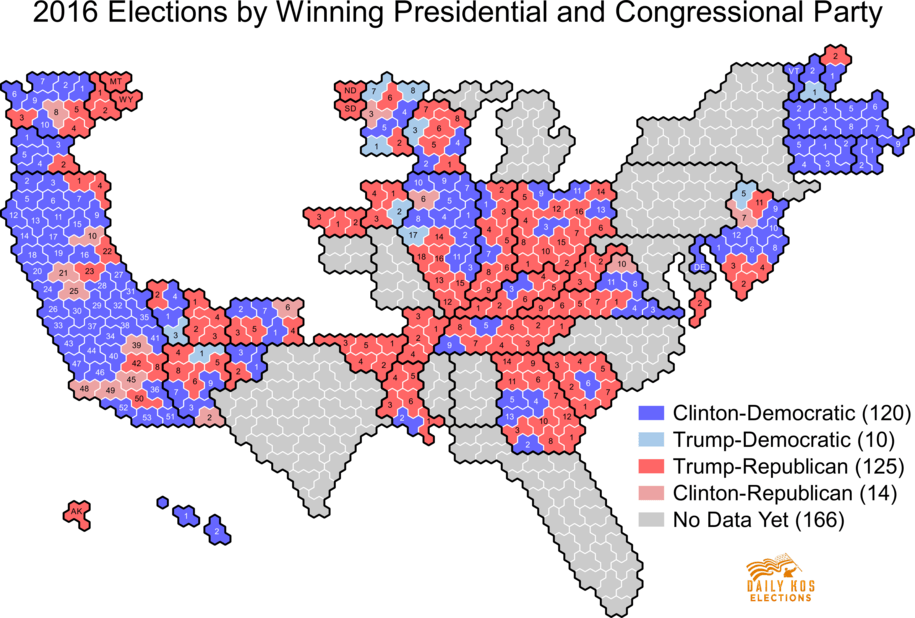
Hexmap of 2016 congressional districts by presidential and House winning party

Leading Off

Pres-by-CD: We continue on to New Jersey and some little state called California for our project to calculate the presidential election results by congressional district. We have a chart of all 435 congressional districts here, which also includes results from 2012. That's the page you'll want to bookmark, since we're updating it continuously. We'll be pushing out new data on a rolling basis as the final results are officially certified and the precinct-level election results we need for our calculations become available.

Campaign Action

We'll start with New Jersey before venturing into California's 53 congressional districts. (And they say New Jersey gets no respect.) Hillary Clinton carried the Garden State 55-41, a bit of a drop from Barack Obama's 58-41 win in 2012. Clinton won seven of the state's 12 congressional districts while Obama took eight, and there were quite a few swings in one direction or the other.

While Obama won the 2nd District in South Jersey by a wide 54-45, Donald Trump carried it 51-46. Longtime GOP Rep. Frank LoBiondo has consistently won easily here, and while Team Blue will have a much better shot at flipping this seat when he retires, Trump's win is an indication that the GOP will have a good chance to hold on. The 3rd District also swung from 52-47 Obama to 51-45 Trump. This seat opened up in 2014, but wealthy Republican Tom MacArthur decisively held this district for his party during the GOP wave, and Democrats didn't field a viable candidate this cycle.

House Democrats flipped one New Jersey seat last month, but it wasn't the one that went from Mitt Romney to Clinton. While Democrat Josh Gottheimer unseated Republican Rep. Scott Garrett 51-47, Trump won the 5th District in North Jersey 49-48, not a huge drop from Romney's 51-48. Instead, it was the 7th District in the central part of the state that went from 52-46 Romney to 49-48 Clinton. National Democrats didn't target GOP Rep. Leonard Lance this cycle and he won 54-43, but he may be a target in the future. The 11th in the north is historically Republican turf, but while Trump still won it 49-48, it was a noticeable swing from Romney's 51-47. However, it won't be easy at all for Democrats to defeat GOP Rep. Rodney Frelinghuysen, who hails from one of the oldest political families in America.

Now it's (deep breath) California time.

Read More

Republican Gov. Pat McCrory finally signed House Bill 17, which is the second half of a flagrantly undemocratic Republican power grab following the governor’s loss to Democratic Attorney General Roy Cooper in the 2016 elections. The new law dramatically limits the authority of the governor to independently staff the executive branch, giving much of that power to the Republican-dominated legislature itself.

North Carolina's governor has the ability to appoint the heads of key departments concerning transportation, natural resources, the environment, and more. However, this new law requires that these posts be subject to state Senate approval. Since the legislature is hopelessly gerrymandered to produce a Republican majority, that simply means Republicans will institutionalize a veto over any Democratic appointees.

Similarly, in this same law, Republicans slashed the number of executive branch appointees from roughly 1,500 to 425. After McCrory took over from Democratic Gov. Bev Perdue in 2013, the Republican legislature dramatically increased the number of these appointments, meaning this reversal is yet another transparently cynical ploy to retain power. That leaves Republican officials in charge of key regulatory decisions. To give you a sense of the kinds of things the GOP targeted, the legislature even tacked on a measure to abolish car-emissions testing requirements to this package.

Republicans also completely eliminated the governor’s authority to appoint members of the state Board of Education and to the University of North Carolina system’s board of trustees, a move that could subject the UNC system to serious sanctions by accrediting authorities. Instead, the GOP’s changes give the legislature itself the authority to appoint board members and transfer other powers to the superintendent of public instruction—a Republican elected official. Under McCrory, Republicans have tried to eviscerate public education so that they can privatize and profiteer off of it, so this is very much in keeping with the GOP’s past behavior.

This law and the related one that took away Cooper’s control over the state and county boards of elections represent a stunning repudiation of democracy itself. A legislature that owes its existence to an unconstitutional gerrymander is trying to usurp the powers of a governor who was chosen by the people, despite the GOP's best efforts to suppress the vote of minorities. Republicans have deemed any attempt at governance by the Democratic Party as illegitimate and are taking extreme actions—any that they can—to prevent Democrats from exercising any political power.

Daily Kos Elections will be going on a modified schedule for the final weeks of the year. We'll be back to publishing the Digest regularly starting Jan. 2. In the meantime, we'll be posting a daily open thread, and we may post news updates occasionally.

Monday, Dec 19, 2016 · 5:28:10 PM +00:00 · Jeff Singer

Pres-by-CD: We continue on to New Jersey for our project to calculate the presidential election results by congressional district. We have a chart of all 435 congressional districts here, which also includes results from 2012. That's the page you'll want to bookmark, since we're updating it continuously. We'll be pushing out new data on a rolling basis as the final results are officially certified and the precinct-level election results we need for our calculations become available.

Hillary Clinton carried New Jersey 55-41, a bit of a drop from Barack Obama’s 58-41 win in 2012. Clinton won seven of the Garden State’s 12 congressional districts while Obama took eight, and there were quite a few swings in one direction or the other.

While Obama carried the 2nd District in South Jersey by a wide 54-45, Donald Trump carried it 51-46. Longtime GOP Rep. Frank LoBiondo has consistently won easily here, and while Team Blue will have a much better shot at flipping this seat when he retires, Trump’s win is an indication that the GOP will have a good chance to hold on. The 3rd District also swung from 52-47 Obama to 51-45 Trump. This seat opened up in 2014, but wealthy Republican Tom MacArthur decisively held this district for his party during the GOP wave, and Democrats didn’t field a viable candidate this cycle.

House Democrats flipped one New Jersey seat last month, but it wasn’t the one that went from Mitt Romney to Clinton. While Democrat Josh Gottheimer unseated Republican Rep. Scott Garrett 51-47, Trump won the 5th District in North Jersey 49-48, not a huge drop from Romney’s 51-48. Instead, it was the 7th District in the central part of the state that went from 52-46 Romney to 49-48 Clinton. National Democrats didn’t target GOP Rep. Leonard Lance this cycle and he won 54-43, but he may be a target in the future. The 11th in the north is historically Republican turf, but while Trump still won it 49-48, it was a noticeable swing from Romney’s 51-47. 

Monday, Dec 19, 2016 · 6:20:33 PM +00:00 · Stephen Wolf

International Digest: Following Donald Trump’s victory and the United Kingdom’s surprise vote to leave the European Union earlier in 2016, observers were bracing for the worst in Austria’s Dec. 4 presidential election, where the xenophobic far-right appeared poised to win. Fortunately for progressive forces, left-leaning independent Alexander Van der Bellen instead scored a decisive victory while campaigning on a platform of tolerance and inclusion. You can read about Austria and other key countries in the December edition of our International Elections Digest, which also covers the upcoming French presidential election, a major Italian constitutional referendum, South Korea’s bizarre presidential scandal, and more.

Monday, Dec 19, 2016 · 8:34:04 PM +00:00 · David Nir

CA-34: Yolie Flores, a former member of the Los Angeles Board of Education, just became the latest candidate to enter the race for California's soon-to-be-vacant 34th Congressional District, making her at least the fifth Democrat to join the field. Flores served a single term on the board, leaving office in 2011. She's a so-called "school choice" advocate, and on her LinkedIn profile, she lists an award from the group Democrats for Education Reform, aka Useful Idiots for Charter Schools. Also running are state Assemblyman Jimmy Gomez, former Los Angeles City Council aide Sarah Hernandez, former Bernie Sanders staffer Arturo Carmona, and labor activist Wendy Carillo.

Monday, Dec 19, 2016 · 8:44:01 PM +00:00 · David Nir

FL-23: Oh great. Law professor Tim Canova, a vocal Bernie Sanders supporter and belligerent Iran hawk, says he's "seriously considering" a second bid against Rep. Debbie Wasserman Schultz, whom he unsuccessfully challenged in this year's Democratic primary. Canova raised an insane sum from fellow Sanders backers who wanted to take their anger out on Wasserman Schultz over her perceived support for Hillary Clinton during the presidential primaries and forced the congresswoman to take her own race seriously.

But despite her immolation on the national stage this summer when she was forced to step down as DNC chair just before the Democratic convention, Wasserman Schultz still handily defeated Canova, 57-43. It's hard to see how he could do better in two years' time.

Monday, Dec 19, 2016 · 8:56:55 PM +00:00 · David Nir

GA-06: Outgoing state Rep. Taylor Bennett, who narrowly lost his bid for re-election in November after a miracle special election victory last year, has apparently said no to run for Congress. The Atlanta Journal-Constitution says that Bennett won't run in the expected special election to replace GOP Rep. Tom Price in Georgia's 6th District, though the linked article doesn't feature a direct quote from Bennett. However, reporter Greg Bluestein says that Bennett texted him to say he was out.

That leaves three Democrats in the race: former state Rep. Sally Harrell, former state Sen. Ron Slotin, and Some Dude Joshua McLaurin. So far, only one Republican state Sen. Judson Hill, is running for this seat, which Mitt Romney won handily but Donald Trump carried by just a 48-47 margin. However, several others are considering. All candidates from all parties will run together on a single ballot, with the top two vote-getters advancing to a runoff in the likely event that no one clears 50 percent in the first round.

Monday, Dec 19, 2016 · 9:43:44 PM +00:00 · David Nir

SC-05: Donald Trump's parade of horribles continues, with his announcement that he'll nominate GOP Rep. Mick Mulvaney as head of the Office of Management and Budget. Mulvaney is a founder of the nihilist Freedom Caucus and has a foaming hatred of government spending, and now he's gonna be the guy to put together the president's budget proposals. Terrific!

Mulvaney hadn't completely ruled out running for governor, but this obviously takes that prospect off the table. It also means we'll have another special election in the making. As recently as six years ago, South Carolina's 5th Congressional District was held by Democratic Rep. John Spratt, but he got washed out in the same 2010 wave that washed Mulvaney in. Now the seat is solidly red: It went 57-39 for Trump, after going 55-44 for Mitt Romney. Democrats made an effort to see if they could put the district back in play this year, when a former Joe Biden aide named Fran Person ran against Mulvaney. But Person wound up trailing the top of the ticket with a 59-39 loss, so there isn't much reason for hope here.

Still, those daunting numbers haven't completely deterred Person, who told The State that he'll consider a second bid "after Christmas." State Rep. John King, another Democrat, says he's looking, too, as is state Sen. Vincent Sheheen, who was the Democratic nominee for governor in both 2010 and 2014. In a Facebook post, Sheheen didn't rule out a bid, but he didn't exactly sound enthused, either, trashing national Democrats for acting "like a bunch of sissies who are all tied up in the latest debate about political correctness instead of focusing on how to help put bread on the tables of the people in my community." He really wants to go to Congress to join people he thinks so highly of?

In any event, plenty of Republicans are sure to be interested in succeeding Mulvaney, and several have already said so. They include state Rep. Ralph Norman, who lost to Spratt in 2006 (by a 57-43 margin, amazingly enough) and says he'll run if Mulvaney is confirmed. Former state GOP chair Chad Connelly says he'll "make a decision after Christmas," while state Rep. Gary Simrill says, "My family and I will be discussing this opportunity." And state House Speaker Pro Tempore Tommy Pope, who hasn't ruled out a gubernatorial bid, also isn't shutting the door on a congressional run, though he did say, "I do not anticipate that the Pope family would be going to Washington."

P.S. For "House of Cards" fans, the character played by Kevin Spacey, Frank Underwood, eventually becomes president but he starts off as a congressman from, yes, South Carolina's 5th District. Underwood is a Democrat, so this is just one of many unrealistic things about the show.

Monday, Dec 19, 2016 · 9:54:47 PM +00:00 · David Nir

MT-AL: Nazi leader Richard Spencer says he's thinking about making a bid for Montana's at-large congressional seat, which is expected to become vacant with GOP Rep. Ryan Zinke's pending nomination to run the Department of the Interior. Spencer is best-known for coining the term "alt-right" in an effort to rebrand the white supremacist movement. Last month, he hosted a conference for fellow travelers in Washington, DC, where he declared, "Hail Trump!" and was greeted with enthusiastic Nazi salutes from the audience.

Plenty of other Republicans could run for this seat, but after Donald Trump—whom Spencer deeply admires, of course—no one should be willing to say that Spencer couldn't win. And don't expect the GOP to put up much resistance. When asked how he'd greet a Spencer candidacy, the head of the Montana Republican Party, Jeff Essmann, would only say, "I don't get a vote in the process, I just chair the meeting." In other words, he'd have no problem with it. This, by the way, is how we wound up with Trump.

Monday, Dec 19, 2016 · 10:09:02 PM +00:00 · David Nir

ND-Sen: With West Virginia Sen. Joe Manchin getting passed over for job in the Trump administration, Democrats are now waiting to see whether North Dakota's Heidi Heitkamp also stays in the Senate. According to the New York Times, Republican leaders have been pushing Trump to tap a Democratic senator for his cabinet, but he hasn't played along, picking former Texas Gov. Rick Perry over both Manchin and Heitkamp to head the Department of Energy.

Heitkamp is still reportedly under consideration for agriculture secretary, but former North Dakota Sen. Byron Dorgan says Heitkamp has "indicated she will not join" Trumpworld, in the words of the Times. In fact, unnamed Republicans are now fretting that Heitkamp and Manchin have never had any intention of abandoning the Democrats and have just been playing Trump to earn positive headlines back home. This is, of course, the kind of game politicians have played since the dawn of time, but it just feels unaccountably gross when Trump’s involved. We'll have to see if anyone cares either way in two years' time.

Monday, Dec 19, 2016 · 10:42:34 PM +00:00 · David Nir

IA-Gov: While Lt. Gov. Kim Reynolds is set to take over the top spot once Gov. Terry Branstad is confirmed as Donald Trump's ambassador to China, some of her fellow Republicans are still thinking about challenging her in 2018's primary. Cedar Rapids Mayor Ron Corbett, who'd reportedly been considering a gubernatorial bid, announced on Monday that he won't seek re-election to his current post and is indeed contemplating a run against Reynolds. Corbett also offered an unusually specific timetable of sorts, promising he'll deliver a "surprise" when he gives a speech in Cedar Rapids on Feb. 22. Who knows? Maybe he’ll announce he's writing a book.

Meanwhile, despite Iowa Democrats' serious woes of late, there are quite a few names already in circulation, and the Quad City Times mentions a few new ones: state Sens. Jeff Danielson and Steve Sodders, and outgoing state Senate Majority Leader Mike Gronstal, who just lost his own bid for re-election last month and saw his chamber fall to the Republicans. None have spoken publicly, though.

Monday, Dec 19, 2016 · 10:58:49 PM +00:00 · David Nir

SC-Gov:  Lt. Gov. Henry McMaster is, like Iowa's Kim Reynolds (see our IA-Gov item above) one of those lucky second-in-commands who's about to get a major leg up on 2018 once his boss joins the Trump administration. But as McMaster waits for Gov. Nikki Haley to become Donald Trump's U.N. ambassador, he, like Reynolds, still faces the prospect of an intra-party challenge. Several Republicans are still considering bids, and now state Attorney General Alan Wilson confirms he hasn't ruled one out, either. Previously, a spokesperson had said as much, but now Wilson himself tells the National Journal's Zachary Cohen that he's taking a "wait and see" approach to the situation. It's not clear what developments Wilson might be waiting on, though.

Monday, Dec 19, 2016 · 11:04:26 PM +00:00 · David Nir

OK-Gov: For the first time, GOP Lt. Gov. Todd Lamb has spoken on the record about running for Oklahoma's governorship in 2018, when Gov. Mary Fallin will be termed out. Lamb says he's "leaning" toward a run, and at least unlikely most politicians who pretend to act coy when asked about their ambitions, he acknowledged that a bid "is not even in the back of my mind ... it's in the front of my mind." However, several other Republicans have the race at the front of their minds, too—whether they're admitting it or not.

Tuesday, Dec 20, 2016 · 1:40:50 AM +00:00 · Jeff Singer

Pres-by-CD: We have one more state for today, a tiny place you may know of as California.

Clinton carried California 62-32, a stronger margin than Obama’s already-dominant 60-37 2012 win. Clinton carried 46 of the Golden State’s 53 congressional districts; winning five Romney seats while losing none of the districts Obama took. Of California’s 14 Republican House members, seven of them sit in Clinton seats, while no Democrats hold Trump turf. We’ll start by looking at those seven Republicans.

National Democrats targeted four Republican incumbents in the state, but they each won even as Clinton was taking their seats. The 10th District, which includes Modesto and Merced, backed her 49-46, not very different than Obama’s 51-47 win here. However, Republican Rep. Jeff Denham held off Michael Eggman 52-48. Clinton carried the 21st around Fresno 55-40, an improvement on Obama’s 55-44 win. However, her coattails did little to hurt Republican Rep. David Valadeo, who blasted past Democrat Emilio Huerta 57-43

The 25th, which includes the Antelope Valley north of Los Angeles, swung from 50-48 Romney to 50-43 Clinton. But Republican Rep. Steve Knight turned back an expensive campaign to unseat him and won 53-47. Finally, the suburban San Diego 49th District went from 52-46 Romney to 51-43 Clinton. But while Democrats spent heavily against the hated Rep. Darrell Issa, he still pulled off a thin 50.3-49.7 win against Democrat Doug Applegate, who has already announced he’s running again in 2018.

A trio of other Republicans sit in seats that Clinton ended up carrying, but they each easily won against underfunded opponents. Rep. Ed Royce’s 39th District, which includes Fullerton in Orange County, went from 51-47 Romney to 51-43 Clinton. The 45th, which includes Irvine, dramatically shifted from 55-43 Romney to 50-44 Clinton. This seat was so foreboding that Democrats didn’t make a play for it when it was open in 2014, and freshman Rep. Mimi Walters had no trouble in 2016 either, but this could be a future Democratic target. 

Finally, the 46th around Huntington Beach and Newport Beach and the home of Bluth's Original Frozen Banana Stand, went from 55-43 Romney to 48-46 Clinton. Republican Rep. Dana Rohrabacher has rarely had trouble winning re-election, but he hinted earlier this year that he’s considering retiring in 2018. Until recently, this seat looked like it would be an easy GOP hold, but that may not be true anymore. Even if Rohrabacher stays, Democrats may be encouraged to target the Putin-friendly incumbent. Trump only carried seven of California’s 53 seats, but he easily took those seven. The closest Trump seat was the Central Valley’s 22nd District, which went from 57-42 Romney to 52-43 Trump.

Most of California’s Democratic congressmen had little to fear in 2016 from Republicans. (Defeated Rep. Mike Honda lost his safely blue seat to another Democrat in the general.) The once exception was Rep. Ami Bera in the Suburban Sacramento 7th District, who turned back Republican Scott Jones 51-49 even as his seat went from just 51-47 Obama to 52-41 Clinton. Bera had a poor relationship with labor and got some bad headlines after his father was sentenced to prison for trying to illegally funnel money to Bera's campaign. Bera is very well-funded and could scare off future GOP foes, but aspiring Republicans will be at least encouraged by how far Bera ran behind the ticket. The GOP also made a play for the open Santa Barbara 24th, which had gone for Obama 54-43. However, Clinton carried the seat 57-36, and Democrat Salud Carbajal prevailed 53-47.

A few Democrats who faced tough races in 2012 or 2014 may be in luck in the future. Obama carried Ventura County’s 26th 54-44, and Democratic Rep. Julia Brownley narrowly won in 2012 and 2014. However, Clinton took the 26th by a wide 58-36, and Brownley had little trouble against her weak GOP foe. Democratic Rep. Scott Peters, who represents the 52nd in San Diego, is another incumbent who had tight back-to-back races those years. However, the 52nd went from 52-46 Obama to 58-36 Clinton, and Peters beat Karl Rove protégé Denise Gitsham 57-43. The 36th around Palm Springs also swung from just 51-48 Obama to 52-43 Clinton. But Democratic Rep. Raul Ruiz decisively held on during the 2014 GOP wave and easily dispatched another underfunded GOP state legislator this year, so he wasn’t exactly looking like a viable GOP target for the future.​

Campaign poster for Green Party-backed President-elect Alexander Van der Bellen, which translates as "Only together are we Austria."

Leading Off

Austria – president (Dec. 4)

Right-wing populists and far-right nationalists have seen a surging tide of support in both Europe and the U.S. in the last two decades, and 2016 saw such forces win breakthrough victories with Donald Trump's election and the United Kingdom's vote to leave the European Union in June. These stunning outcomes left observers bracing for the worst in Austria's long-delayed presidential runoff. However, progressives scored a decisive victory when center-left Green Party-backed independent Alexander Van der Bellen defeated far-right Freedom Party candidate Norbert Hofer by a 54-46 margin.

This election was actually the second time that Van der Bellen defeated Hofer. The two had squared off in a May runoff after squeezing out more centrist candidates in the first round. Van der Bellen won that bout by a razor-thin 0.7 percent, but Austria's highest court later invalidated the results over improper ballot-counting procedure and ordered a re-do election. The repeat runoff itself had to be delayed after physical problems with ballot materials, leaving Austria without a president for months.

Austria's election had more than a few parallels to the American presidential election. Hofer campaigned on a stridently Islamophobic, anti-immigrant platform, a centerpiece of which was his hostility to the EU, although he did not formally call for Austria to exit the union—at least not yet. Van der Bellen, on the other hand, advocated a pro-EU position and campaigned in defense of pluralism, using the tagline "Only Together Are We Austria," as you can see in the poster above—very reminiscent of Hillary Clinton's "Stronger Together" slogan. The far-right dominated in rural areas, working-class suburbs, and with men, while the center-left did well with women and in well-educated cities with more exposure to multiculturalism.

Austria uses a parliamentary system, meaning the president is mostly a figurehead, but the position is not entirely without power. Indeed, Hofer had pledged to use the president's authority in unprecedented ways if elected. In particular, he was eager to force early elections for parliament, the country's true power center, because Hofer's Freedom Party was poised to surge to first place according to recent polls. Thankfully, that potential outcome has now been averted, but parliamentary elections are still due to happen by 2018 at the latest, meaning mainstream forces can't rest easy in Austria.

As one scholar noted, Europe's liberals just over a decade ago were aghast when the ultra-xenophobic Jean-Marie Le Pen made the French presidential runoff in 2002 even though he lost in an 82-18 landslide, but now they're seemingly breathing a sigh of relief at a mere 54-46 defeat in Austria in 2016. Other European countries face key national elections coming up in 2017 where the extreme right is expected to see a rise in support, and France will once again be a key battleground—see our item on the French elections below. But while Austria was able to hold back the tide and prevent Hofer from becoming Europe's first elected far-right head of state since World War II, France might not be able to do the same.

Read More
Republican North Carolina Governor Pat McCrory(C) arrives at Trump Tower December 7, 2016 in New York. / AFP / Bryan R. Smith        (Photo credit should read BRYAN R. SMITH/AFP/Getty Images)
Outgoing North Carolina Gov. Pat McCrory (R) at—where else?—Trump Tower (Dec. 7, 2016).
Republican North Carolina Governor Pat McCrory(C) arrives at Trump Tower December 7, 2016 in New York. / AFP / Bryan R. Smith        (Photo credit should read BRYAN R. SMITH/AFP/Getty Images)
Outgoing North Carolina Gov. Pat McCrory (R) at—where else?—Trump Tower (Dec. 7, 2016).

LEADING OFF

North Carolina: Last month, Democrat Roy Cooper unseated Republican Gov. Pat McCrory, while Democrats also gained a majority on the state Supreme Court, breaking the Republican stranglehold on North Carolina’s state government. Now, though, Republicans have used the pretext of a lame-duck special legislative session—ostensibly convened for disaster relief—to advance a slew of measures that radically curtail the authority of the governor and even the high court itself. This nakedly partisan plot is unprecedented in modern state history. Indeed, you have to go back to the 1890s to find a parallel, when reactionaries violently introduced Jim Crow after a multiracial coalition of progressives briefly won power.

The scope of the GOP’s war on democracy is stunning. In this special session, Republicans enacted a new law that removes the governor’s party’s control over all the state and county boards of election. That same measure also makes previously nonpartisan state Supreme Court races into partisan contests and requires state constitutional challenges to first go before the Republican-dominated state Court of Appeals. The legislature has passed another bill awaiting McCrory’s signature that would require state Senate approval for the governor’s cabinet appointees. This bill would also slash the governor’s number of executive branch appointees from 1,500 to 425 and eliminate the governor’s ability to appoint members of the state Board of Education and the University of North Carolina’s board of trustees.

Under McCrory, Republican legislators had already put North Carolina on the front lines of the battle against voting rights. Almost immediately after the United States Supreme Court gutted a key provision of the Voting Rights Act in 2013, McCrory signed America’s most sweeping voter suppression law in half a century, which included a strict voter ID requirement, the end of same-day registration, and cutbacks to early voting opportunities. Republicans literally ordered data on which voting methods black voters used more and eliminated them. The law was so extreme that a federal court said it “targeted African Americans with almost surgical precision” when it struck it down in July.

Republicans had previously gerrymandered the legislature so aggressively that they won veto-proof majorities in 2012 despite losing the popular vote, and they easily maintained them in 2016 despite McCrory’s loss. A court in 2016 struck down those maps as unconstitutional racial gerrymanders, meaning that North Carolina Republicans are using an illegally obtained legislative majority to usurp the powers of the fairly elected new Democratic governor. Democracy relies on electoral losers recognizing the legitimacy of the victor, and this breathtaking power-grab can only be described as a full-blown legislative coup designed to subvert democracy itself—and reinstate a new era of Jim Crow.

Below we examine the details of each of the GOP’s new changes to North Carolina law.

Read More

Nada Surf — “Jules & Jim”

Welcome to the Daily Kos Elections Live Digest, your liveblog of all of today's campaign news.

Please note: This is a 2016 and 2020 Democratic presidential primary-free zone

Friday, Dec 16, 2016 · 6:01:32 PM +00:00 · Jeff Singer

WI-Gov: GOP Gov. Scott Walker is publicly considering seeking a third term in 2018, but we’ll need to wait a bit for him to make his plans clear. Walker says he won’t announce what he’s doing until after he signs the state budget in the summer of 2017. However, Walker also said he was holding a fundraiser this week, and would be having more next year,” so it certainly sounds like he plans to run again. An early November poll from Marquette gave Walker a bad 42-51 approval rating, but if he runs again, he’ll have plenty of time and money to change that.

Friday, Dec 16, 2016 · 6:06:23 PM +00:00 · Jeff Singer

ME-Sen: A little while ago, the Bangor Daily News reported that state Sen. Eric Brakey, who worked for both Ron Paul and Rand Paul’s presidential campaigns, was planning to kick off a bid against independent Sen. Angus King in early 2017. Brakey himself now says that, while he won’t be running for governor in 2018, he “might have something to say in the new year” about a potential Senate bid against King, who caucuses with the Democrats in D.C. 

Friday, Dec 16, 2016 · 6:23:09 PM +00:00 · Jeff Singer

MD-Gov: Outgoing U.S. Secretary of Labor Tom Perez has reportedly been torn between challenging GOP Gov. Larry Hogan in 2018 and running for chair of the Democratic National Committee next year, but he announced he was going with door number two on Thursday. The DNC vote will be held in February and if Perez wins, we can definitely cross him off the potential gubernatorial candidate list.

However, it’s unclear what Perez will do if he doesn’t become DNC chair. Several notable Maryland Democrats have made noises about challenging Hogan in two years, but no one has jumped in yet. Polls have shown Hogan with strong approval ratings, but Maryland is a very blue state, and the governor’s detractors hope that a backlash against Donald Trump will hurt him. If Perez loses his DNC bid and wants to run against Hogan he may not clear the field, but it’s unlikely that anyone else will have had enough time to consolidate enough support to make a Perez primary campaign futile. 

Montana Rep. Ryan Zinke (R) at Trump Tower
Campaign Action

Leading Off

MT-Sen, MT-AL: On Thursday, Donald Trump said he'd nominate GOP Rep. Ryan Zinke, Montana's lone member of the House, to serve as his secretary of the interior. Assuming the appointment goes through, that would set off a special election for Zinke's House seat, and, it would seem, it would also eliminate Zinke as a potential challenger to Democratic Sen. Jon Tester in 2018. Zinke would be one of the GOP's strongest Senate options, so it's no surprise to see that at least one unnamed Republican operative is trying to keep his name alive for the race, but it would be pretty difficult to keep this slot open while Zinke goes and spends at least a year in Washington under Trump's tutelage.

And this being Montana, there are plenty of other Republicans who could run against Tester instead. Politico runs down a whole bunch: state Auditor-elect Matt Rosendale, Secretary of State-elect Corey Stapleton, Attorney General Tim Fox, state Sen. Ed Buttrey, and rich guy Greg Gianforte, who just lost his bid for governor last month. The National Journal adds several more names: state House Speaker Austin Knudsen, Public Service Commissioner Brad Johnson, and state Superintendent of Public Instruction-elect Elsie Arntzen—in other words, basically everyone. And Fox, they say, issued a statement that didn't rule out a bid.

As far as the race to replace Zinke, there's a weird wrinkle. Apparently, under state law, Democratic Gov. Steve Bullock is permitted to make an interim appointment from a list of three names provided by the state GOP, but the secretary of state says that this law runs afoul of the Constitution, which requires special elections to fill House vacancies. That does indeed seem to be the case, though the statute has never been challenged in court—but it almost certainly would be if Bullock attempted to proceed. (Presumably, the Republican Party could also simply refuse to send him a list to choose from.) Bizarrely, the law only passed last year, so it's not like this is some ancient relic everyone forgot about.

Anyhow, once that issue gets cleared out of the way, quite a few Republicans will undoubtedly take a hard look at running for Zinke's seat. Anyone on the roster above could conceivably make a House bid instead of going for the Senate, especially since it would be a much easier lift. Roll Call's Simone Pathé specifically suggests Arntzen and Stapleton, who both lost the GOP primary for this seat to Zinke in 2014, and she also tosses in Rosendale.

And would Democrats try making a play here once again? The national party backed outgoing Superintendent of Public Instruction Denise Juneau earlier this year, and she wound up raising a lot of money but lost her challenge to Zinke by a wide 56-41 margin. That was somewhat better than Hillary Clinton, who lost 56-36, but Gary Johnson took a sizable 6 percent of the vote in Montana, which could explain all the difference. Just before the Zinke news broke, Juneau said she wouldn't rule out another bid, but we haven't heard from her since.

Read More