Israel’s rich biblical history can be found in the country’s archaeology. The Jerusalem Post shares the latest on archaeological excavations at significant biblical and historical sites in Israel and the region.
But when did Christians start traveling to places in Israel associated with events described in the Bible for religious reasons?
Analysis of teeth of individuals who lived in Megiddo then show that the Canaanites imported exotic food from India and Southeast Asia.
Such is the understanding of Israeli archaeologists and masons who, drawing on relics and historical texts, have recreated the sacred flooring so it can be experienced today.
Finding the Holy Grail is the Holy Grail of archaeological finds.
Findings could add to historians’ understanding of those who lived near the Sea of Galilee in the early Islamic period.
Hundreds of ceramic oil lamps – two bearing symbols of the menorah – and stone lamp molds for their production, were found along with terracotta figurines.
Researchers revealed that a seal sold in a market for a couple of shekels to a professor at Ben-Gurion University of the Negev (BGU) is in fact the earliest seal discovered in Israel.
While it is possible that Goliath was quite tall and even may have dwarfed most of his contemporaries, he was still a normally sized human being, at least by today’s standards.
The menorah was discovered in the 1980s in Judea and Samaria.
Israel's project is very archaeologically focused, especially given the rich history that lies beneath the surface of much of the country, especially in cities thousands of years old.
The phenomenon of cave churches and how they influenced later Christian worship and architecture is just beginning to be studied seriously and in depth.
This excavation is now focusing on figuring out how this pagan altar came to be part of the church wall and what the inscription on it means.
The bead was so well preserved, that when the boy brought the bead to the supervising archaeologist, he initially wrote it off as likely being an unidentified modern object.
This spot was first suggested as the home of Jesus and his family in the 19th century.
Archaeologists from Haifa and San Diego had to get creative to work on their collaborative excavation without actually travelling due to quarantines.
"These two victims were perhaps seeking refuge when they were swept away by the pyroclastic current at about 9 in the morning."
The archaeologists think that the fort was built by the kingdom of Geshur, an ally of King David.
Although Apollo is an Olympian deity of the Greek and Roman cultures, it is highly probable that the person wearing the ring with Apollo’s portrait was a Jew.
Aryeh Shimron found out that the nails were the same ones taken from the Caiaphas site, and were also used to crucify someone. And they have bone on them.
The ancient jars were discovered inside a water hole at the Khirbet Kafr Mer archaeological site at Beit El.
The students who have just begun their studies in the 2020-2021 academic year are all Ethiopian Israelis with Bachelor's degrees, who are eager to preserve and study their heritage.
The study explores how the detailed study of trash can lead to wide-ranging conclusions about the economic and agricultural life of a community.
The Jerusalem latrine was found in the Christian Quarter of the Old City, close to the Church of the Holy Sepulchre in 1996 during excavations of a cesspool in the courtyard of a Spanish school.
The findings from the cave have been dated to between 420,000 and 200,000 years ago, or the Lower Paleolithic period.
“It’s important to understand that the refining of copper was the high tech of that period."
Kibbutz campaign triumphs in attempt to house ancient mikveh
The tefach, an ancient unit of measurement, was used by ancient Israelites.
Each artifact yielded information which can help unravel mysteries of this era.
Archeologists working in Nefud Desert noticed the footprints left in the sediment amid hundreds of footprints by animals.
The finding, a complete inkwell dating to the end of the Second Temple period, was made at the Horvat Brachot excavation site in Gush Etzion.
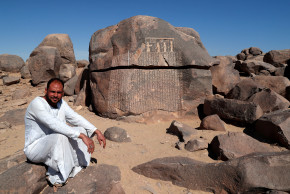
A granite inscription reveals that seven years during the reign of the ancient Egyptian king Djoser, the Nile failed to go through its annual flooding cycle, causing a devastating drought and famine.
Researchers used state-of-the-art image processing and machine-learning technologies to analyze the texts, along with police forensic methods.
Putting an archaeological excavation on hold does not come without costs, as, according to Manor, "there is an increased risk of site deterioration, both from the elements and plundering."
Archeologists agree that Bethsaida, which was mentioned many times in the New Testament, was a town in the Galilee region but its exact location has proved to be a source of controversy.
The hotel, located near the Annunciation Church at the heart of the city, has been previously used as a garage for buses owned by the Afifi family who runs the Nazareth Transport and Tourism company.
It is likely that the fortress was build some 3,200 years ago to protect the local Caanites inhabitants from foreign incursions, possibly from the Philistines.
The Damascus Crowns were promised to be given back to rabbi Hamra, who would place them in the future, in a Syria Jewry cultural center.
“Israel has many archaeological sites which are really important for understanding human evolution."
A group of Israeli and German archaeologists have recently shed new light on the following chapter of the history of the area and its commercial development.
The researchers have been able to pin down the moment of the destruction to 586 BCE, when the Babylonians conquered Jerusalem and devastated its temple.
First documented in the mid-19th century, Tel Rosh presents remains dating back to periods spanning over the millennia.
Among other structures, the researchers unearthed a 16th century market, a well, water cisterns, remains of several buildings dating back between the 17th and the 19th century.
The COGAT archaeology unit is in charge of the management, preservation and access to the archaeological sites in the West Bank, and specifically in Israeli-controlled Area C.
The soap making workshop was not the only finding that offered insights on the life in the region in the 9th century CE: the materials to play very popular board games were also uncovered.
“Cremation could have allowed those ancient inhabitants of the site to have more space for the living, instead of devoting it to the dead.”
The previously unknown section of the Incense Route was unearthed in 2018 west of the eastern range of Mount Grafon.
"I really want to send young female archaeologists the message that they can combine career and family and should not give up their dreams,” Tel Aviv University Prof. Oded Lipschits told the 'Post.'
How accurate is the Bible in its portrayal of the size of Salomon's Kingdom?
Pottery unearthed in the area reveals a mixture of Canaanite, Phoenician and even Cypriot influences.
Yuval Baruch has headed the Jerusalem division at the Israel Antiquities Authority for over ten years.
Archaeological findings indicate a concentration of the phenomena in the region of Jerusalem and the Judean hills.
A small site found near Dimona has presented an abundance of flint tools carved with the special ‘Nubian Levallois’ technique.
The discovery offers new insights on the itinerary that our ancestors followed on their way to spread around the globe.
From the Ten Commandments on, the warning against creating and worshiping physical depictions of the divine is one of the most recurring themes in the Bible.
Ashkelon has over 3,800 years of history.
Framework used to pinpoint site involves historical records, archaeological remains, and environmental studies.
"Some think that the history of Israel should be written only by relying on sources outside the Bible."
Atlit Yam and Bene Beraq – located in the Sharon Plain - date back to the pre-pottery Neolithic C, when pottery was not manufactured yet.
"The observation of a unique medical condition and the discovery of a related archaeological object could help explain one of the most bizarre accounts in the Bible."
The structure was sealed later in the Byzantine period under the floors of a large building about 1,400 years ago and was left untouched for centuries.
Remains of over 180 houses were also revealed by the researchers, together with many agricultural installations including dams, cisterns, wine presses and a pigeon tower.
Moreover, the ship also offers important insights in terms of ship construction techniques.
Here are some of the archaeological sites located in the West Bank.
There are about 6,000 sites of historical and archaeological importance in the parts of Area C that are supposed to transfer to the Palestinians on July 1.
The findings of their research were published in the academic journal Scientific Reports on Wednesday.
The research also led to the discovery of a previously unknown theater-like structure.


 JPOST Digital Library