Forecasts

Dollar Drives to Ten-Month Lows as U.S. Data Continues to Disappoint

Price Action, Swing & Short Term Trade Setups

Connect via:

Dollar Drives to Ten-Month Lows as U.S. Data Continues to Disappoint

Fundamental Forecast for USD: Neutral

This was a big week for the Greenback as the two biggest items on the calendar were USD-related. As has become the norm of recent, a relatively hawkish Federal Reserve was unable to inspire any lasting strength in the currency while U.S. data continued to disappoint. Markets’ attention has been focused squarely on economic prints out of the U.S. economy of late, and as we discussed two weeks ago, this has done Dollar bulls very few favors as data continues to print below expectations.

On Wednesday and Thursday, Fed Chair Janet Yellen testified in front of Congress as part of the bank’s twice-annual Humphrey-Hawkins testimony. Matters appeared to kick-off even before Chair Yellen’s opening statement was read at 10:00 AM on Wednesday, as the Monetary Policy Report to Congress that was released at 8:30 AM seemed to catch trader’s attention as the final paragraph of the report reiterated the ‘Fed Put’ that has helped to keep equity prices elevated. The ‘Fed Put’ is the idea that the Federal Reserve will loosen monetary policy in response to equity market declines, very similar to the ‘Greenspan put’ from 1987 in response to the S&L crash, or the ‘Bernanke put’ in response to the 2007-2008 Financial Collapse. The final paragraph in Wednesday’s report essentially said that the Fed could quickly go back to QE if necessary; effectively nullifying the fear that the bank has divorced their monetary policy stance from near-term equity market performance.

The response in U.S. equities was robust, as bids drove prices back towards fresh all-time highs in both the Dow and the S&P 500. The move in the U.S. Dollar, however, was rather weak as we had a simple test of ten-month lows without any significant continuation to speak of. That, however, started to show-up on Friday morning when we got even more disappointing U.S. data. Inflation came-in flat versus an expected .2% gain, and retail sales fell by .2% against the expectation for a .1% gain. This inspired another wave of selling in the Dollar as prices, again, broke down to fresh lows.

This appears to be a significant pain point for the Greenback at the moment. As we discussed two weeks ago, U.S. data has disappointed for much of 2017, and that’s created questions behind just how aggressively the Fed might be able to hike. As we walked into the year, expectations were flying-higher as the Dollar drove up to fresh 14-year highs, but since then – those higher expectations have only led to bigger disappointment as actual economic performance has simply been unable to keep pace. Meanwhile, growth and inflation has started to show with more consistency in Europe and the U.K., and this has led to even more deductive weakness in the Greenback as traders shift rate hike bets in the Euro and British Pound.

Next week brings no high-impact data out of the United States, and on Saturday the Federal Reserve enters the ‘quiet period’ before their next rate decision on July 26th. The bigger market-wide events are rate decisions out of Europe and Japan along with an updated inflation print out of the U.K.; and this will likely be where the bulk of market participants’ attention remains. From what we’ve seen of recent – both the ECB and the BoJ have made efforts to talk-down their currencies and, if they’re effective next week, this could bring a modicum of strength to the U.S. Dollar that would essentially amount to a retracement of the ‘bigger picture’ bearish trend.

The forecast for USD will be set to neutral for the week ahead.

--- Written by James Stanley, Strategist for DailyFX.com

To receive James Stanley’s analysis directly via email, please SIGN UP HERE

Contact and follow James on Twitter: @JStanleyFX


Euro Waits for Draghi as ECB to Keep Rates Unchanged

News events, market reactions, and macro trends.

Connect via:

Euro Waits for Draghi as ECB to Keep Rates Unchanged

Fundamental Forecast for EUR/USD: Neutral

- The ECB meets this week, but it is an off-cycle meeting for staff projections, so no change in policy is expected. ECB President Draghi’s press conference is in the spotlight.

- Profit taking in the Euro is possible if the ECB takes issue with the rally in the exchange rate and underperformance in energy prices in recent weeks.

- See our Q3’17 EUR/USD forecast at the start of the new quarter.

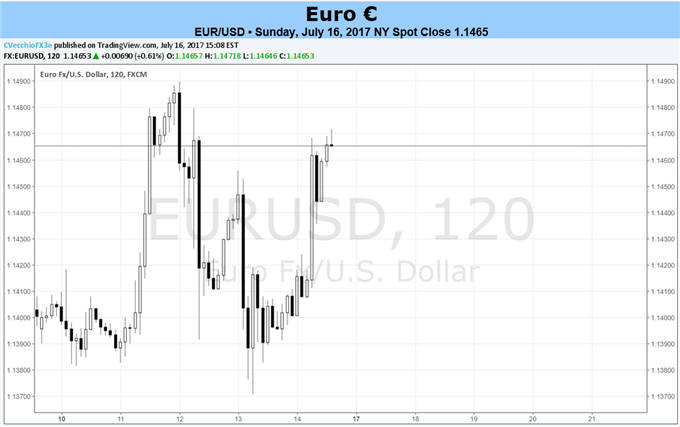
The Euro took a step back last week, even as the US Dollar suffered broadly, perhaps exposing the Euro as a currency whose good fortune has been priced in. The most recent driver, higher sovereign bond yields on the back of hawkish commentary from European Central Bank officials, had run its course.

Even with the ECB set to meet this Thursday for the July meeting, a lack of new staff economic projections (SEPs) should keep a lid on interest rate speculation. As a result, with the ECB set to keep rates unchanged, traders should be focusing on President Mario Draghi’s press conference for clues as to what the central bank will do next.

With the ECB quiet for some time about the FX channel, the Euro had been given some breathing room to rally against its peers. Yet the Euro’s strength may only be tolerated for so long. The ECB’s technical assumption for EUR/USD in 2017 is 1.0800; it closed last week just above $1.1450. Brent Oil, the energy input the ECB bases their inflation forecasts around, is forecast at $51.60 per barrel for 2017. Energy prices are underperforming the ECB’s forecast by -5.2%.

A few more months of a stronger Euro, weaker energy prices, and persistent underperformance in inflation readings, and it’s easy to envision the ECB taking issue with the market’s hawkish interpretation of the policy adjustments being made. For now, it seems officials are suggesting that a step down in the QE program could come as soon as September.The key point is that it’s just not going to be this week. Due to the fact that the ECB is one of many central banks that have fallen into a predictable pattern of when policy action is most likely to arrive – only when forecasts are updated – this means that September or December will likely be when any significant issues are raised.

Market positioning would dictate that a move lower in the Euro on Thursday around the ECB rate decision would be of the profit taking variety. Certainly, the Euro long trade is getting crowded (relatively speaking). According to the CFTC’s latest COT report, there were 83.8K net-long contracts held by speculators in the futures market for the week ended July 11, the highest level since the week ended May 3, 2011.

In lieu of new staff forecasts, ECB President Mario Draghi’s press conference will carry additional weight as market participants try to read between the lines. Given the recent pattern of President Draghi trying explicitly to prevent a sharp correction higher in core sovereign yields after ECB rate decisions, the Euro may be hard pressed to find bullish drivers on Thursday.

See our Q3’17 Euro forecast - check out the DailyFX Trading Guides.

--- Written by Christopher Vecchio, Senior Currency Strategist

To contact Christopher, email him at [email protected]

Follow him in the DailyFX Real Time News feed and Twitter at @CVecchioFX.

To receive this analyst’s reports, sign up for his distribution list.


Yen Plunge May Resume as the Bank of Japan Asserts Dovish Stance

Fundamental analysis, economic and market themes

Connect via:

Yen Plunge May Resume as the Bank of Japan Asserts Dovish Stance

Fundamental Forecast for the Japanese Yen: Neutral

  • Markets are testing BOJ resolve even as cautious reflation emerges
  • Yen may fall on firmly dovish BOJ stance, threat of greater stimulus
  • Read our Q3 forecast to see what will drive longer-term Yen trends

What do retail traders’ buy sell decisions say about the Yen price trend? Find out here.

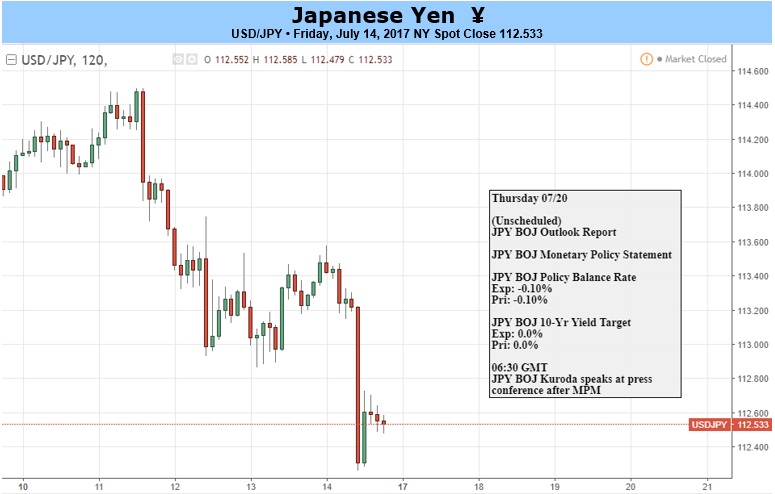
The Yen finds itself at something of a crossroads as the Bank of Japan mulls competing economic trends ahead of next week’s monetary policy announcement. On one hand, policymakers’ steadfast commitment to an ultra-dovish posture even as growth gathers steam seems to have finally created the backdrop for reflation. On the other, the central bank’s tactics may be starting to look self-defeating.

Japanese economic activity trends seemed to turn a corner in the fourth quarter of 2016, with the rate of expansion across the nonfarm sector (manufacturing and services) steadily accelerating thereafter. Not surprisingly, local stocks have risen in tandem, seemingly reflecting better earnings prospects.

The BOJ’s refusal to entertain tightening even against this backdrop has kept the currency firmly locked in as a funding currency, meaning optimistic investors are happy to borrow cheaply in Yen terms to buy higher-returning assets. That has meant depreciation, which has in turn helped boost inflation. Indeed, growth pickup over the past 9 months has been accompanied by a rise in the BOJ’s target core CPI gauge.

However, the markets have their own tightening mechanisms at play. The risk-on mood has translated into capital flows out of the safety of government bonds (JGBs), pushing yields higher alongside share prices. In an apparent bid to prevent this increase in borrowing costs from snuffing out reflation, the BOJ committed to capping the rate on the benchmark 10-year JGB near 0 percent.

The markets are now testing the central bank’s resolve. On July 7, it was forced to intervene with its first large fixed-rate bond purchase offering in five months as the 10-year rate hit the highest level since February. If policymakers are to sustain the nascent reflationary trend, they will need to convince markets of their wherewithal to contain borrowing costs as faster growth and a weaker Yen do their work.

A small step in this direction may be to downgrade inflation expectations even as the GDP growth forecast is nudged higher. The BOJ has tiptoed in this direction since the beginning of the year however and the latest need for intervention suggests the approach is insufficiently potent. The appearance of a global tightening push, with the likes of the BOE and ECB seemingly near a turning point, may further undercut it.

On balance, this means the BOJ may need to resort to heavier artillery. Recently disappointing economic news-flow may have defused the need an immediate shake-up of the policy mix, deflating the risk-on swell a bit dialing back upward pressure on bond yields. Signaling the clear prospect of stimulus expansion seems necessary however. In fact, a status-quo announcement may well result in unhelpful Yen gains.


British Pound: All Eyes on the Inflation Data

Financial markets, economics, fundamental and technical analysis.

Connect via:

British Pound: All Eyes on the Inflation Data

Fundamental Forecast for GBP: Neutral

Traders in the British Pound will be focused on Tuesday’s UK inflation data for June in the week ahead.

Broadly speaking, there is likely to be little change in either the headline inflation figure of 2.9% year/year or the core number of 2.6% but a small dip is possible and, either way, the steady climb in the growth of the consumer price index could now be near its peak.

That would certainly strengthen the position of the doves on the Bank of England’s monetary policy committee, who only just outnumbered the hawks pressing for an interest-rate increase at their last meeting. With news likely too in the coming week of stronger UK retail sales, the impact on the British Pound could well be negative.

However, GBP/USD is at an interesting technical juncture; pushing up again against strong resistance in the 1.3000/1.3100 area in late European trading Friday.

Chart: GBP/USD Five-Minute Timeframe (July 14, 2017)

British Pound: All Eyes on the Inflation Data

Chart by IG

So the key question is would a benign inflation print and stronger retail sales figures put the sellers back in control and send GBP/USD bouncing back off that resistance or will the resistance be broken, lifting GBP/USD into a new uptrend?

So traders should watch the charts closely. If the 1.30/1.31 resistance breaks, GBP/USD will almost certainly move higher. If it doesn’t, expect the pair to move lower. If the inflation data are higher, the MPC hawks will gain ground, helping the British Pound, but if they’re lower the currency will lose the gains it made last week.

--- Written by Martin Essex, Analyst and Editor

To contact Martin, email him at [email protected]

Follow Martin on Twitter @MartinSEssex

For help to trade profitably, check out the IG Client Sentiment data

And you can learn more by listening to our regular trading webinars; here’s a list of what’s coming up


Gold Prices Rebound From Key Support As Yellen Softens Rate Expectations

Short term trading and intraday technical levels

Connect via:

Gold Prices Rebound From Key Support As Yellen Softens Rate Expectations

Fundamental Forecast for Gold: Bullish

Gold prices rebounded this week with the precious metal rallying 1.33% to trade at 1228 ahead of the New York close on Friday. The advance has been supported by continued weakness in the greenback with the DXY down more than 0.7%.

The June Consumer Price Index (CPI) & Retail Sales figures came in shy of consensus estimates on Friday, fueling another sell-off in the dollar. The data comes on the back of this week’s semi-annual Humphrey Hawkins testimony before congress where Fed Chair Janet Yellen cited a more dovish outlook on monetary policy. The committee judged that “because the neutral rate is currently quite low by historical standards, the federal funds rate would not have to rise all that much further to get to a neutral policy stance.” At the same time, Yellen left the door open for further easing measures should market conditions deteriorate.

The commentary suggests that while the Fed does see the economy gathering pace, Yellen and Co may be concerned that the central bank will lack the ammunition to respond to another crisis given the current policy stance- shifting the focus to the balance sheet off-load. As such, markets have seen a slight re-pricing in expectations for a December hike with Fed Fund Futures now pricing a 39% likelihood for a 25bps increase in the benchmark interest rate. U.S. data is light next week and for gold prices, the focus remains on the sharp reversal seen this week off support.

Gold Prices Rebound From Key Support As Yellen Softens Rate Expectations
  • A summary of IG Client Sentimentshows traders are net-long Gold - the ratio stands at +4.55 (82.0% of traders are long)- bearishreading
  • Long positions are 0.4% higher than yesterday but 5.6% lower from last week
  • Short positions are 4.7% higher than yesterday and 5.2% higher from last week
  • While broader retail sentiment continues to point lower, positioning is less net-long than yesterday and compared with last week.The recent changes in sentiment warn that the current price trend may soon reverse higher despite the fact traders remain net-long. That said, I would be looking for support on a pullback in price.

Learn how to use Gold sentiment in your trading.Get more information on Sentiment here Free!

Gold Weekly

Gold Prices Rebound From Key Support As Yellen Softens Rate Expectations

Last week we noted that, “the break below basic trendline support extending off the late-January lows shifts the medium-term focus lower in gold prices with the decline now testing initial support at the confluence of the 50% retracement and the late-February low-day / low-week close at 1204/09.” That support zone held into the start of the week with initial weekly resistance seen around ~1240. A breach above parallel resistance extending off the 2016 highs would be needed to mark resumption of the broader uptrend.

Gold Daily

Gold Prices Rebound From Key Support As Yellen Softens Rate Expectations

“Daily resistance stands with the 50-line / 200-day moving average / June 26th swing low at 1232/35.” We’re testing that level into the close of the week with a breach here targeting the monthly open (1241) backed by the upper median-line parallel / 100-day moving average at ~1247. Broader bearish invalidation stands at 1258.

Join Michael for his bi-weekly Live Webinar on the Foundations of Technical Analysis- Register for Free Here!

Gold 240min

Gold Prices Rebound From Key Support As Yellen Softens Rate Expectations

Gold Prices Rebound From Key Support As Yellen Softens Rate Expectations

A closer look at price action sees gold continuing to trade within the confines of this descending pitchfork formation with prices rebounding sharply off the median-line early this week. The advance is now approaching parallel resistance / former swing lows into 1235 which is backed closely by more significant resistance at 1240/41 (also the monthly open). Heading into next week the focus remains higher while above 1219. Bottom line: I’ll be looking to fade weakness early next week targeting a rally toward the upper parallels- We’ll have to reassess price action there to determine whether the advance will materialize into a more meaningful reversal in prices.

Want to learn more about Multi-timeframe analysis? Click here for Michael’s three part trading series.

---Written by Michael Boutros, Currency Strategist with DailyFX

Follow Michaelon Twitter @MBForex contact him at [email protected] or Click Here to be added to his email distribution list.


USD/CAD Post-BoC Weakness to Persist as Bearish Momentum Gathers Pace

Central bank policy, economic indicators, and market events.

Connect via:

USD/CAD Post-BoC Weakness to Persist as Bearish Momentum Gathers Pace

Fundamental Forecast for Canadian Dollar: Bullish

Even though the economic docket remains fairly light for the week ahead, USD/CAD may continue to exhibit a bearish behavior as market participants digest the fresh developments coming out of the Bank of Canada (BoC).

The dollar-loonie exchange rate is quickly approaching the 2016-low (1.2461) as Governor Stephen Poloz and Co. deliver the first rate-hike since 2010, and the Canadian dollar may continue to appreciate against its U.S. counterpart as the BoC appears to be on course to implement higher borrowing-costs over the coming months.

USD/CAD Post-BoC Weakness to Persist as Bearish Momentum Gathers Pace

Join the DailyFX Team LIVE to Cover Major Market Themes & Key Event Risks

With the Canadian economy now projected to grow an annualized 2.8% in 2017, the BoC may layout a more detailed exit strategy the as ‘output gap is now projected to close around the end of 2017, earlier than the Bank anticipated in its April Monetary Policy Report (MPR).’ The material shift in central bank rhetoric suggests Governor Poloz and Co. may even consider a series of rate-hikes especially as ‘the factors behind soft inflation appear to be mostly temporary.’

At the same time, mixed data coming out of the U.S. economy accompanied by the cautious rhetoric from the Humphrey-Hawkins testimony have dragged on interest-rate expectations, with Fed Fund Futures back to highlighting a 50/50 chance for a move in December. In turn, narrowing expectations for three Fed rate-hikes in 2017 may foster a longer-term bearish outlook for USD/CAD as Chair Janet Yellen notes ‘the federal funds rate would not have to rise all that much further to get to a neutral policy stance.’

USD/CAD Daily Chart

USD/CAD Post-BoC Weakness to Persist as Bearish Momentum Gathers Pace

DailyFX 3Q ForecastsAre Available in Our Trading Guides

USD/CAD remains at risk for further losses as both price and the Relative Strength Index (RSI) preserve the downward trends from earlier this year. Moreover, the bearish momentum appears to be gathering pace as the RSI pushes deeper into oversold territory, with the dollar-loonie exchange rate largely eyeing the 1.2620 (50% retracement) hurdle as it clears the June 2016-low (1.2654). Next downside hurdle comes in around 1.2420 (23.6% expansion), which sits just under the May 2016-low (1.2461).

USD/CAD Post-BoC Weakness to Persist as Bearish Momentum Gathers Pace

Check out the new gauge developed by DailyFX based on trader positioning.

Retail trader data shows 73.3% of traders are net-long USD/CAD with the ratio of traders long to short at 2.74 to 1. In fact, traders have remained net-long since June 07 when USD/CAD traded near 1.3481; price has moved 6.2% lower since then. The number of traders net-long is 1.6% higher than yesterday and 3.4% higher from last week, while the number of traders net-short is 7.5% lower than yesterday and 1.4% higher from last week..

Sign up for David's e-mail distribution list


Australian Dollar: More Gains May Be Too Much to Ask

Financial markets, economics, journalism and fundamental analysis.

Connect via:

Australian Dollar: More Gains May Be Too Much to Ask

Fundamental Australian Dollar Forecast: Neutral

  • The Aussie was a currency market star last week
  • Between market reaction to Fed Chair Yellen and stronger iron ore prices it couldn’t lose
  • Next week may not see it build on these gains

Join us and join in with live, interactive coverage of all major Asia/Pacific economic data at the DailyFX webinars

The Australian Dollar enjoyed a better week than might have been expected last week, mostly thanks to the broad-based US Dollar weakness which came along with Federal Reserve Chair Janet Yellen’s Congressional testimony. (Full disclosure: it enjoyed a better week than I expected before the fact).

Whether Ms. Yellen was really being especially less-hawkish or more-dovish on monetary policy when she said that the Fed was prepared to continue, or intensify, stimulus measures if inflation were seen to wilt is at this point moot. Markets clearly thought that she was and acted accordingly.

The Australian Dollar was arguably a special beneficiary of this. With Australian rates at record lows and likely to remain so well into next year, it makes sense that any roll back of prospects for tighter Fed policy should support it.

However, perhaps the Fed isn’t the only thing helping AUD/USD, even if it seems to be the main prop of the moment. Base metal prices have done well recently, in part thanks to news that China’s demand for iron ore has risen. The price of this key Australian export is at ten-week highs, even though it remains well down for 2017 as a whole.

Wherever it comes from, there’s a tailwind behind the Aussie as it moves into a new week.

The first big risk event will come Monday with the release of China’s Gross Domestic Product numbers for the second quarter. The markets are looking for a chunky 6.8% annualized gain and it will be interesting indeed to see how the actual result affects the Aussie. The initial reaction will probably mirror the strength or weakness of the number, but the extent to which this price action holds will show us the way in which China is driving the currency now.

Investors will also have sight of the Reserve Bank of Australia’s last set of policy-meeting minutes. That July 4 meeting saw the RBA leave rates at record lows and decline to join the more hawkish chorus sung by many developed market central banks. Thursday’s official unemployment from Australia will also draw the crowds. The labor and housing markets appear to be the RBA’s main monetary policy watchpoints.

If all the economics line up as expected, it’s hard to see a meaningful fall for the Australian Dollar this week. That said, a fair amount of good news could now be in the price and so a neutral call is probably warranted.

Australian Dollar: More Gains May Be Too Much to Ask

--- Written by David Cottle, DailyFX Research

Contact and follow David on Twitter:@DavidCottleFX


New Zealand Dollar: Interest Rates on Hold Indefinitely

Financial markets, economics, fundamental and technical analysis.

Connect via:

New Zealand Dollar: Interest Rates on Hold Indefinitely

Fundamental Forecast for NZD: Neutral

  • The Reserve Bank of New Zealand will keep its official cash rate at 1.75% Thursday and maintain its neutral bias.
  • The New Zealand Dollar needs a new catalyst after its recent rally ran out of steam.
  • Check out the DailyFX Economic Calendar and see what live coverage of key event risk impacting FX markets is scheduled for the week on the DailyFX Webinar Calendar.

The New Zealand Dollar is in a rut and is unlikely to break out either upwards or downwards as the central bank’s official cash rate looks set to remain at 1.75% for months and perhaps years to come. The Reserve Bank of New Zealand meets on Thursday morning local time and a rate move would be a huge surprise.

Instead, RBNZ Governor Graeme Wheeler will likely emphasise not just that rates will not be changed for a long time yet but also that the bank’s bias is strictly neutral, with an equal chance of the next move being an increase or a decrease. That could be as far away as late next year.

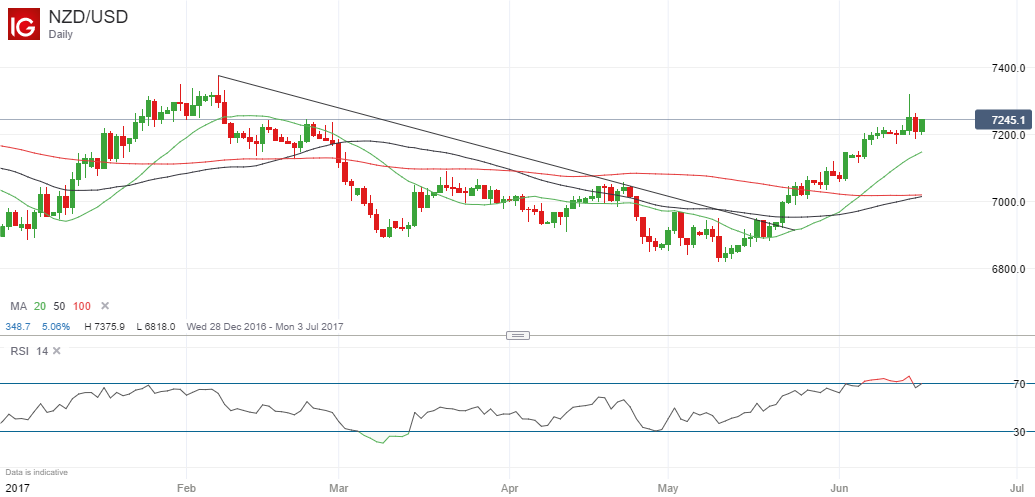
Chart: NZD/USD Daily Timeframe (2017 to Date)

New Zealand Dollar: Interest Rates on Hold Indefinitely

Chart by IG

As the chart above shows, NZDUSD has been climbing since mid-May. However, that rally has run out of steam and for the past few sessions the pair has traded sideways. That’s despite news last week of lower-than-expected GDP growth of 0.5% quarter/quarter in Q1.

The data imply that GDP growth this year could be nearer 3.0% than 3.5%. However, core inflation in New Zealand remains subdued and headline inflation is only just above the midpoint of the RBNZ’s 1%-3% target range.

This all suggests a neutral bias for NZD, although IG Client Sentiment data suggest that NZDUSD could resume its uptrend once the current consolidation period ends.

New Zealand Dollar: Interest Rates on Hold Indefinitely

Retail trader data show 20.2% of traders are net-long with the ratio of traders short to long at 3.96 to 1. In fact, traders have remained net-short since May 24, when NZDUSD traded near 0.69967; the price has moved 3.5% higher since then. The number of traders net-long was 1.5% higher on Friday than on Thursday and 14.1% lower from last week, while the number of traders net-short was 15.4% higher than Thursday and 34.1% higher from last week.

We typically take a contrarian view to crowd sentiment, and the fact traders are net-short suggests NZDUSD prices may continue to rise. Traders were further net-short than Thursday and last week, and the combination of current sentiment and recent changes gives us a stronger NZDUSD-bullish contrarian trading bias.

--- Written by Martin Essex, Analyst and Editor

To contact Martin, email him at [email protected]

Follow Martin on Twitter @MartinSEssex

What will drive the currency majors in 2017’s second half? Check out the freeDailyFX Quarterly Forecasts


Advertisement