2018 In Retrospect.
I decided to have a glance back over 2018 and pull together a range of images from the best / most enjoyable posts I’ve created over the twelve months. Which post is your favourite and how many do you remember ?
We start, back in January, with the four posts on John Minton, this being one of them. What a talented chap.

Great work by Scottish artist William Crosbie.

Slightly more contemporary work from Robin Heighway-Bury.

Beautifully crafted thoughts of the seashore from Kirsty Elson.

Forgotten artist in two parts, features the work of Roland Collins.

Wildlife woodcuts from Agnes Miller Parker.

Another female perspective of land and sea from Joan Eardley.

Textile and design repeats from Enid Marx.

Fun travel posters from Graphic Designer Abram Games.

Two posts and more posters from Reginald Montague Lander.
.
American sixties artist Charles Wysocki brought us Trucks and a glimpse of life in that era.

A little modern made nature from Mister Finch.

A glimpse of ceramic nature from Ann Wynn Reeves.

An inspirational trip back in time to Ryedale Folk Museum in Hutton Le Hole.

Also a splash of Vintage from Morecombe by the Sea.

Three established artist treats in October from Brian Wildsmith,

Edward Bawden and a fabulous book from the Mainstone Press.

and lastly Disney background artist Walt Peregoy.

November Illustration from Tom McNeely.

More recently some stunning woodcuts from Gwenda Morgan.

Contemporary work by John Jay Cabuay.

Timeless illustration from LeWitt and Him.

Ceramics from Lena Peters and finally…

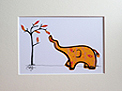
A few pieces of my own, which will be available to purchase next year through Fishink on Etsy.

Which pieces do you like and why ? Anything you would like to see made in clay from my work ?

Thanks for following Fishinkblog this year.
This is the Eighth year it’s been running and even though I really love writing and curating the posts, it doesn’t get any easier to find the time to do it all. I do appreciate your feedback, likes and comments, it makes the whole experience much more fun to do, so thanks for leaving a word every now and then and if you have any thoughts on how Fishinkblog could be even better, then do let me know. Have a look through the posts you might have missed by clicking on the links above the images, and pass Fishink blog onto a new friend this year so we can grow into a bigger art community from across the globe. It’s great to have you with me.
Have a great 2019 and I’ll be back in a few weeks time.
Gwenda Morgan Beautiful Woodcuts
Happy Christmas Eve to one and all from the UK. Strangely I’m still not feeling so Christmassy this year but I’m sure come tomorrow I will be enjoying some great food, company and feeling good about the year ahead. I wonder what kind of celebrations you, my readers will be having wherever you are reading this? Do let me know, and wherever you might be I hope this finds you well, healthy and in a peaceful time.
Thank you for following Fishink Blog this year and please keep the comments rolling in, it does make a difference and helps make me feel that all the hard work that goes into these posts isn’t falling on silent ears lol.
I wish you all a wonderful festive break and look forward to catching up again in a few weeks time in 2019. All the very best, Craig

Gwenda Morgan (1908 – 1991) was born in Petworth, her father having moved there to work at the ironmongers Austens, of which he later became the proprietor. Following school in Petworth and at Brighton and Hove High School. From 1926, Gwenda studied at Goldsmiths’ College of Art in London.

From 1930 she attended the Grosvenor School of Modern Art in Pimlico where she was taught and very strongly influenced by the principal, Iain Macnab. The Grosvenor School was a progressive art school, and the championing of wood engraving and linocuts fitted with its democratic approach to the arts.

The main body of her work drew upon the landscape and buildings around Petworth and the neighbouring South Downs. Her work was inspired by that of Iain Macnab, Percy Douglas Bliss and the Sussex-bred Eric Ravilious.

Throughout the Second World War she worked in the Women’s Land Army just outside Petworth. Her record of those years was published by the Whittington Press in 2002 as The Diary of a Land Girl, 1939-1945. It is a poignant record of the determination to carry on whatever the weather or wartime deprivations.
Here’s an excerpt from Christmas Eve.


She was a Fellow of the Royal Society of Painter-Etchers & Engravers, an Honorary Member of the Society of Wood Engravers, and a Member of the National Society of Painters, Sculptors and Engravers, and she showed work at their annual exhibitions. She also exhibited at the Royal Academy and at the Redfern Gallery.

Her prints are held in the collections of the Victoria and Albert Museum and the British Museum in London, the Ashmolean Museum in Oxford, and the Fitzwilliam Museum in Cambridge, among others.


Some of her work has a wonderful sense of movement… even the still life woodcuts!


I feel that Gwenda’s work is somehow timeless, like this image above called ‘Winter Arrangement’, it feels like it could have been created last week and not over 60 years ago, as it was originally engraved in 1954!

Here’s a great shot of Gwenda with her family.

Lovely depictions of rural lifestyles at that time.


Happy Christmas.
Save
John Jay Cabuay Illustrating a sixties world today
Hi everyone, wow what a busy week this is turning out to be, so much so that I completely missed my chance to post out on the last two mornings so here we have a Wednesday post instead. I hope you’re all well and enjoying the pre-holiday rush!
John Jay Cabuay is a New York City illustrator. He has a beautiful sixties feel to his work, but with a contemporary twist.

His illustrations have graced the covers of newspapers, magazines, and book jackets worldwide.


A graduate of the Fashion Institute of Technology,

He says : – “ Learning how to draw from the model has helped me to grow in different directions and, it has given me opportunities to feature my skills in different markets and different continents from Japan and across oceans to South Africa. ”

His work also encompasses illustration for children.




He was featured in a book by Taschen called “100 illustrators” a book about the 100 important illustrators around the globe.

Stunning work, what do you think readers ?
Le Witt and Him

Having met in a Warsaw café in 1933, two Polish-born artists Jan Le Witt and George Him, built upon a friendship to become the highly successful collaborative design partnership Lewitt-Him. It’s so difficult to accurately say which partner created what, so I’ve created this post for both artists, working together.
George Him was born Jerzy Himmelfarb in 1900 to a Polish-Jewish family in Lodz, Poland. After schooling and further education in Warsaw Him studied Roman Law in Moscow but left in 1917 when the Russian Revolution forced the closure of the university he was attending. He moved to Bonn and by 1924 had completed a PhD at the University of Bonn on the comparative history of religions before deciding to study graphic art in Leipzig. George studied at the Leipzig Academy of Graphic Art but even before he graduated in 1928, he was already undertaking commercial commissions. He returned to Poland where, in 1933, he changed his name and also established a design partnership with Jan Le Witt. Working as Lewitt-Him, the two established a distinctive design style which combined cubist and surrealist elements, often in a humorous context. Their most notable work in Poland were illustrations for an experimental poetry group known as Skamander.
The first work that brought the team success was the 1934 graphic presentation of three poems by Julian Tuwim: “Locomotives”, “Rzepka” and “Bird radio”. This book was reprinted several times and also appeared in translation to French and English.

Him and Le Witt worked together in Poland for several years before, in 1937, they relocated the Lewitt-Him design business to London, following an exhibition of their work there by the publishers Lund Humphries. The pair quickly gained commercial contracts with London Transport and Imperial Airways as well as illustrating children’s books, such as The Little Red Engine Gets a Name (1942) by Diana Ross.


They settled here and soon found that they were among a growing number of talented artistic emigres.

George continued his practice as freelance designer and design consultant, active in all fields of graphic design, publicity, exhibitions, corporate identity, book design etc.


In London during World War II the partnership received notable commissions for information and public safety posters from, among others, the General Post Office, the Royal Society for the Prevention of Accidents and the Ministry of Information.


George was naturalized as a British citizen in 1948 and the Lewitt-Him partnership enjoyed great success.


Notable commissions included designing the giant umbrella tree for the Wet Weather section of the 1946 Britain Can Make It exhibition…

… and the Guinness Clock Tower for Battersea Park Pleasure Gardens and murals for the Education Pavilion of the 1951 Festival of Britain. (More info on the clock here)

The Lewitt-Him partnership was dissolved in 1954, when Jan decided to focus on developing his abstract paintings and artworks. George continued to work as a commercial designer.

Among the advertising campaigns he illustrated was the 1950’s Schweppeshire campaign for the Schweppes drinks company. He also designed the point of sale merchandise to be used in the shops.

His other clients numbered several airlines, including Pan-American Airways, El Al and American Overseas Airlines plus the publishers of Punch and Penguin Books. He continued to illustrate books but also designed exhibition stands, such as the Australia stand at the 1960 Ideal Home Exhibition and large window displays, notably for the De Bijenkorf store in Rotterdam and the 1961 Christmas windows for the Design Centre in London.


From 1969 until 1977, Him taught graphic design at Leicester Polytechnic. Him was an active artist up until the very end of his life. Two retrospective exhibitions of his work have been held, one in 1976 at the London College of Printing and another in 1978 at the Ben Uri Gallery in London. In 1977 Him was awarded the Francis Williams Book Illustration Award and in 1978 became a Royal Designer for Industry.

Jan Le Witt (1907–1991) was a Polish-born British abstract artist, graphic designer and illustrator. He had a long professional partnership with George Him.

As a design company, Lewitt-Him brought an innovative use of colour, abstraction and symbolism to commercial design. They established a reputation for fine poster work during World War Two and for exhibition displays.
After the partnership Jan, who had become a British citizen in 1947, abandoned graphic design to work with Sadler’s Wells Ballet, creating sets and costumes for their performances.
A wonderful collaboration that lasted over 20 years. What do you think readers ?
Lena Peters Ceramics and Storytelling
Last years UK Young Artist of the Year Award winner Lena Peters, has combined her love of ceramics with storytelling. She cleverly interweaves her passion for history and nature. These elements merge with her interest in folklore and mythology making her work dance between the real and the unreal, creating illustrative objects which work to embody a narrative.

There’s a wonderful interview over on Melody Vaughn’s site and it’s well worth a read
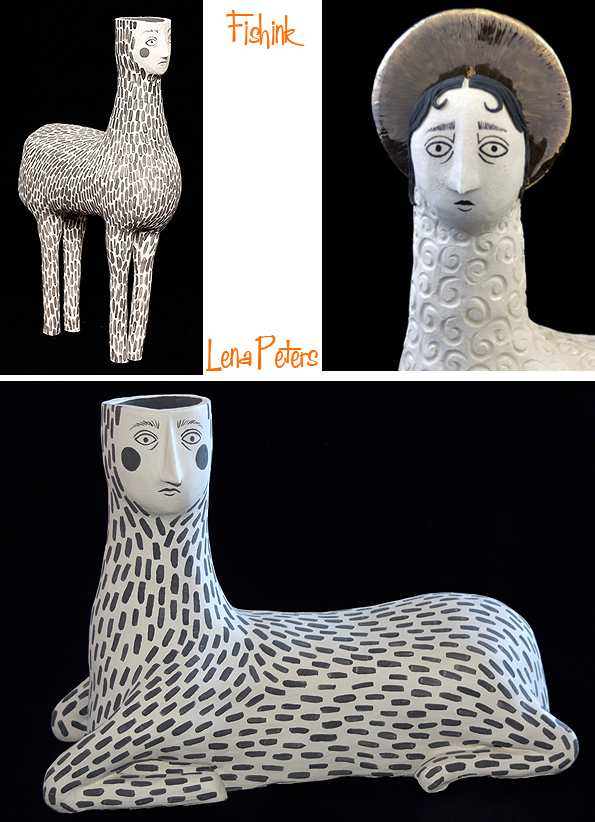
Lena’s has a fascination with the British Museum and grew up near Sheffield in the Peak District, surrounded by tales of magic and woodland sprites. You can see where her interest in creating her ceramic creatures has come from.

I love the coiled pots and bold imagery that has been formed by scraping away one layer of coloured slip to reveal the colour beneath.

There’s an exhibition on of Lena’s work called ‘Saints and Spirits’ between 21st November – 21st December 2018 at the David Gill Gallery, 2-4 King Street, London, SW1Y 6QP. Drop in and enjoy.
More about Mary Blair

In a blog concerned with mid century art, the artist Mary Blair is bound to crop up a fair few times. I recently came across another book about her by John Canemaker. Entitled ‘Magic Color Flair. The World of Mary Blair.
It was created for the Walt Disney Family Museum 2014 Mary Blair exhibit, of the same name, and is an authoritative collection of Blair’s life and work including the precocious paintings she made as a student at the renowned Chouinard Art Institute; the enchanting concept drawings she created for numerous Disney films; her lovely illustrated Golden Books, which are still treasured today; and the rarely seen but delightful advertisements, clothing designs, and large-scale installations that she devised later in life.
Curated by Academy Award winning animator John Canemaker and annotated with fascinating information about her artistic process, ‘Magic Color Flair’ is a bold, lively look into the work of an equally bold and lively creative, whose invaluable influence and keen eye helped shape some of the world favorite Disney experiences.
As I’ve already got the ‘Art and Flair of Mary Blair’, I may have to place this one under ‘future investments’.

After a little research I stumbled across this piece below which was sold at auction originally from Mary’s estate and dated 1966. It is said to be an early study for Mary’s tiled murals called ‘Tomorrowland’.

Here’s what the murals turned out to look like.

Such a wonderful array of colour, movement, style and well plain joy to be honest !

She had a great talent for bringing design and illustration to a large marketplace, in a friendly and creative way.


A few more snippets of Mary’s work I’d not seen for a while.

Some old favourites for Alice in Wonderland,


Peter Pan and Cinderella.


The classic rags to riches story.


I love Mary’s great sense of colour, style and application of paint.

Some mid fifties advertising and an early sketch for some Indian and African inspired designs.


You can also see a short sixties film about the making of the tiled murals for Mary’s designs here. I’ve also created more posts about Mary which you can see by clicking on the links under Mid Century Artists on the right side of my blog. Thank you.
Fishink Ceramics at the Sale Arts Trail ‘Yule Do’
Hello everyone and apologies for the late posting this week. It’s been a very busy few days with getting everything ready for the designer fair I did last Saturday. I must say the church (St Pauls in Sale) looked great and there was so much amazing work from a wide variety of artists.
I was kept pretty busy throughout the day, so much so that I only grabbed a few minutes to scoot around and take a few images.

Very creative layouts from the makers who were selling from table tops laid out across the upright pews.

This was my stand, and I was pretty pleased with how it looked in the end.

The wall hanging, flat ceramics sold well, so much so that when a couple of stall holders popped around near the end of the fair to buy a piece they’d had their eye on, the items had gone! I’ll be making some more and hope to be back at Sale Arts Trail in summer 2019.

In the meantime, you can head over to my shop on Fishink Shop on Etsy (which I’ll be adding to very soon) or contact me directly ([email protected]) if there’s anything you wanted to purchase for yourself and I can send you a photo and sell securely through Paypal.

Thanks again to the organisers Jo, Sophie and Catherine for another great event, and to everyone who came along, purchased something and helped keep us designers in business. It really does make a difference #justacard.
For a full list of the exhibitors see