Speak at our events in 2020
If you’re thinking of
starting, our developing your speaking career,
our Call for
Presentations for all of our 2020 events, across
design, development, product, leadership, and people/talent/culture
are now open–with our Code and Code
Leaders conference CFPs closing February 14th.
And, we’d love to hear your proposals for
our 2020 conferences.
We want you to succeed
Whether you’re very experienced, just starting out, or anywhere
in between we’re keen to help you develop your capability as a
speaker. Numerous people who’ve started on our stages have ended up
speaking at events all over the world. Regardless of your ambition,
there are few steps you can take to develop your career more
significantly than preparing and delivering a talk in a room of
your peers.
If you’ve been to our conferences, you’ll know there’s a mix of
longer (around 45 minute, usually invited),
and shorter (around 20 minute) presentations. 20 minutes
is an ideal time to address one thing
in some detail, while not being an overwhelming
first step as a speaker.
Some hints to give you a better chance of
acceptance
- If we see proposals we really like, we
start pencilling them in before the closing date. So it
pays to not wait until last minute.
- We’re also happy
for multiple proposals from the same
person.
- We provide detailed information about
the kind of sessions we’re looking for at
our speaking page.
- And past presentations are a good indication of the sort of
thing we’re looking for as well.
Want to talk a bit more about your
proposal?
We’re always happy to talk more–just email [email protected] and we
can discuss it more!
What are we looking for?
Code, our 2 day, single
track conference on front end engineering
Code focusses on
- key front end technologies like JavaScript, CSS, HTML, and
browser APIs (especially newer APIs people may not be so aware
of)
- areas of engineering practice like performance, security,
testing, debugging
- Computer science concepts
like algorithms, mathematics, garbage
collection, functional programming
In particular we have typically stayed away from specific
solutions, whether open source or commercial, no matter how widely
used and popular they might currently be. “How to do X with
Angular” (or React), for example, is well served elsewhere and
unlikely to be accepted for our conferences. We focus on long term
foundational technologies and practices.
Code Leaders, our 1 day
single track conference on engineering leadership
This focusses on the challenges facing professionals managing
and leading engineering teams. If you lead developers, we’d love to
hear from you about the challenges you face and the way you go
about solving them. This could be architectural, but
often covers more people focussed concepts.
Code and Code
Leaders take place late May 2020
in Melbourne
Call for
presentations for Code and Code
Leaders close February 14 2020
Product (Design
and Management) Conference
As we’ve recently announced, in 2020 we’re merging out Design
and Product conferences as a single 2 day, 2 track conference.
- For the product design track: We’re
looking for all things product design, beyond–every aspect of the
design lifecycle, from Research to UX, UI, IxD, visual design,
designops, and more.
- For the product management track: All
things
product–from building and leading product teams
to discovery, delivery, onboarding, growth and more. Share
your practical hard earned experience with your
peers.
We’re looking for topics relevant to current and aspiring design
leaders–hiring, mentoring, scaling design, communicating design,
ethics, and the other challenges design leaders face.
Product and Design
Leaders take place early July 2020
in Melbourne
Call for
presentations for Product and Design
Leaders close March 14 2020
Web Directions Summit 2020
The final event for 2020 is our annual Summit, with this year 4
tracks–Product Design, Product Management, Front end engineering
and for the first time
a People/Talent/Culture track (we’ve taken our
Culture conference and turned it into a 2 day track at Summit).
All proposals for our other conferences will be considered for
the relevant track at Summit, and we also accept proposals for
Summit as well.
Web Directions Summit takes place early
November 2020 in Sydney
Call for presentations for Web Directions
Summit close May 1 2020
What Do Speakers Get?
We cover speakers conference ticket (of course) and travel and
accomodation (if required). There’s a fantastic dinner which gives
speakers the opportunity to connect with one another, as well as
Gold ticket holders from the conference.
We also professionally video presentations, caption and transcribe
them, allowing speakers to showcase their work to a far wider
audience.
We’re really excited with the programs we’re lining up for 2020,
and can’t wait to hear your
proposals!
The post Speak
at our events in 2020 appeared first on Web Directions.
W3C DevMeetup 2019 report
On September 16, 2019, in Fukuoka, Japan, the W3C developer
relations team organized a developer meetup along the annual
W3C TPAC19 (Technical Plenary /
Advisory Committee) event (see report), where the global Web
community met to coordinate the development of Web standards.
Local Web designers and application developers from the Kyushu
island and all over Japan were encouraged to participate in the
meetup. In total, over 200 attendees came to listen to this year’s
exceptional speakers showing that the Web is
definitely an exciting development platform:
- Alice Boxhall, Software Engineer at Google, made the
case that accessibility and innovation actually go very well
together. Designing for accessibility leads to better solutions,
and in her presentation, Alice went through a few examples from
both recent and older history of technology where solving problems
for people with disability created solutions for everybody! See
Alice’s presentation video and slides.
- Ada Rose Cannon, Developer advocate at Samsung for the
Web browser Samsung Internet, explained the evolution of WebXR and
some of the important new features it brings to the Immersive Web.
See Ada’s presentation video and slides.
- Yutaka Obuchi, Pixiv’s engineer, focused
on the Web API that
help an implementation of 3D character viewer and how it could be
improved to make the Web an even better platform for 3D avatars.
See Yutaka’s presentation video and
slides.
- Lin Clark, Code Cartoonist and Principal Research
Engineer at Mozilla, demonstrated how Web Assembly can be used
beyond the browser to bridge code from different programming
languages and environments, via the proposed work on Web Assembly Interface Types. See
Lin’s presentation video.
- Melanie Richards, Program manager on Microsoft Edge,
explained how to optimize styles for forced color modes—like High
Contrast—using standards developed this year in the W3C CSS Working
Group. See Melanie’s presentation video and slides.
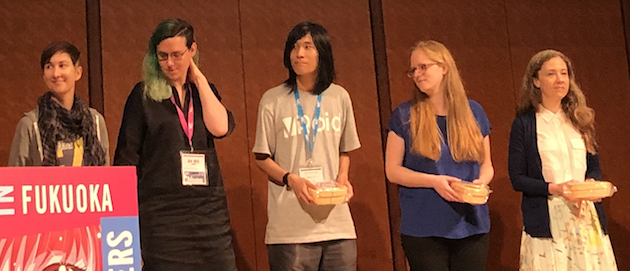
From left
to right: Lin Clark, Ada Rose Cannon, Yutaka Obuchi, Melanie
Richards, Alice Boxhall
Translating W3C resources into Japanese
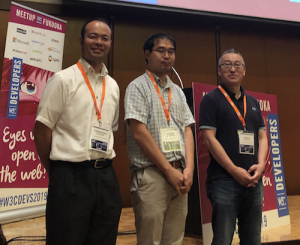
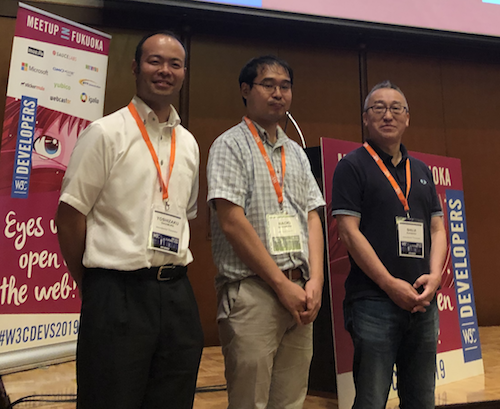
From left
to right: Yoshikazu Takamura, Momdo Nakamura, Shuji Kamitsuna
Another highlight of the event was the presence of three
representatives of the W3C Japanese translators community.
All together, they have translated an impressive number of W3C
resources, notably Web standards documents. As a result, more than
a quarter of the current 410+ W3C
recommendations are available in Japanese!
Sponsors
A big thank you to this year’s sponsors for making it possible
to organize the meetup: NTT Communications, Mozilla, Sauce Labs,
Miscrosoft, Yubico, WithYou, GMO Pepabo, StickerMule, Igalia, and
WebCastor.

Participants had the chance to look at a few demonstrations brought by the event’s
sponsors, such as an immersive telepresence experience between
Fukuoka and Tokyo. Other demonstrated topics were: tests of Web
performance thanks to WebDriver capabilities, standardization
beyond browser vendors, shared server service ‘Lolipop!’, Web
Authentication for better security, and an exploratory work about a
standard for digital comics on the Web.
W3C Developers
Please follow us on @w3cdevs to find out more about an
upcoming W3C’s staff and members presence in your region, to track
new Web technology development, and to understand how to contribute
to W3C work.
What are your #webstories?
Starting today, we
celebrate the 25th anniversary of the World Wide Web Consortium
(W3C). Sir Tim Berners-Lee, our Director and the inventor of the
World Wide Web, founded the Web Consortium on this day, 1 October
1994 to ensure the long-term growth of the Web, and since then, we
have worked to create a Web that is accessible to all,
whatever their hardware, software, network infrastructure, native
language, culture, geographical location, or physical or mental
ability; a Web that works for everyone, a Web which is good for
all.
At the occasion of our 25th year, we are re-introducing
ourselves to our community with some history, pictures, web
stories, tweets, and videos. I hope you join us in celebrating and
we invite you to share your birthday wishes and tell us your own
#webstories.
How can you participate?
We invite you, our community, to tell your #webstories.
Share your story of the web and your hopes and fears for
its future. If you’d be willing, share an image of
yourself, an early web page or something else which is meaningful
to you about your participation in the Web and/or the Web
Consortium.
In the spirit of the famous Proust
Questionnaire, you could build your #webstories from the
following questions:
- How did you come to the Web or the Web Consortium?
- What was the first time you used the Web or how did you first
encounter the W3C?
- Did you have a history with tech before the Web or has it
always been part of your life?
- What are you working on or focusing on now?
- What is your greatest fear for the Web?
- What is your greatest hope for the Web?
- What is your motto (for yourself or the web)?
Please use #w3c25 and/or #webstories on social networks to share
your story, share photos, screenshots, gifs, or videos – whatever
you prefer! If you wish to have your story “card” created, please,
send us two or three short
paragraphs, your picture, name, title and organization, and we will
be happy to add it to the #webstories.
Happy 25th birthday, Web Consortium! 
#webstories
Recently we asked some members of our community how they had
been drawn to the Web, their hopes and fears for the Web, and what
gets them excited about the web and its future
Amongst those we talked to were some who had helped build the
basis of Web technology and had been working in technology before
the Web was invented 30 years ago, as well as several people who
were born after the Web, have always used it and are helping to
build its future.
Not one person had the same journey leading us to the Web!
People came from all walks of life, many countries, but
every single one of us was amazed by the Web and continue
to be in awe of its potential. We all expressed that we
hold very dearly the goal of making the Web a better and safer
place for everyone. But please, see below for yourself!
Show Jun Murai’s full quote
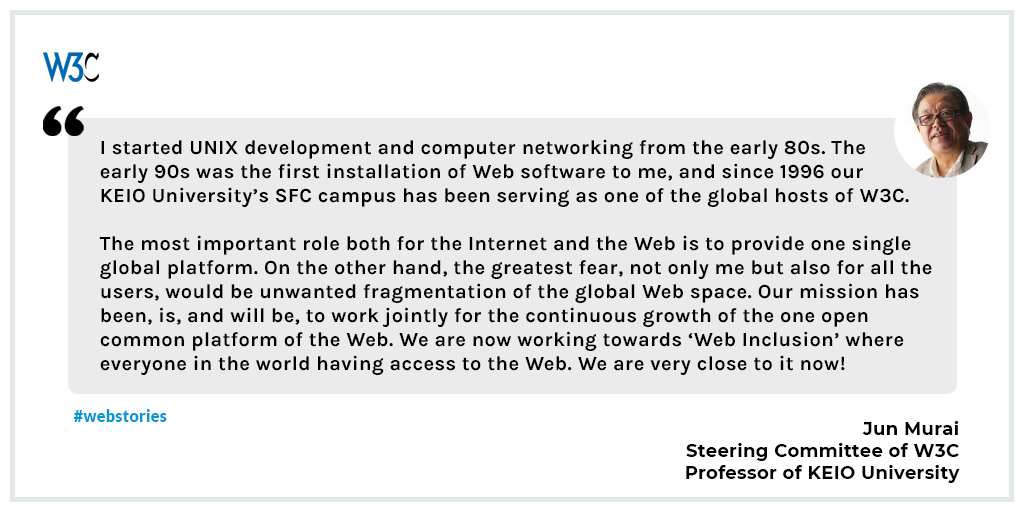
Jun Murai, Steering Committee of World Wide Web Consortium /
Professor of KEIO University: I started UNIX development and
computer networking from the early 80s. The early 90s was the first
installation of Web software to me, and since 1996 our KEIO
University’s SFC campus serving one of the global hosts of W3C. The
most important role both for the Internet and the Web is to provide
one single global platform. On the other hand, the greatest fear,
not only me but also for all the users, would be unwanted
fragmentation of the global Web space. Our mission has been, are,
and will be, is to work jointly for the continuous growth of the
one open common platform of the Web. We are now working for ‘the
Web Inclusion’ where everyone in the world having access to the
Web. We are very close to it now! Show Thomas Wisniewski’s full
quote 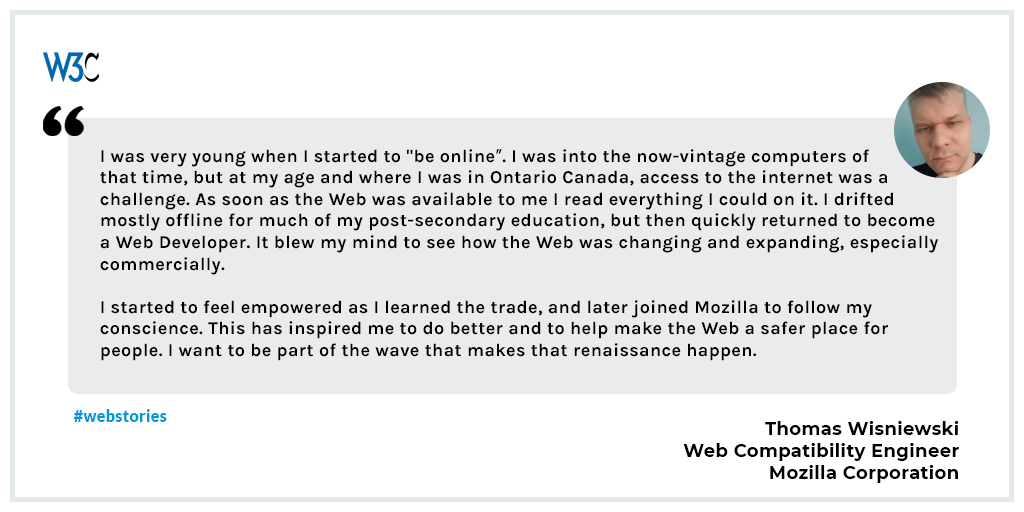
Thomas Wisniewski, Web Compatibility Engineer, Mozilla
Corporation: I was very young when I started to “be online”. I was
into the now-vintage computers of that time, but at my age and
where I was in Ontario Canada, access to the internet was a
challenge. As soon as the Web was available to me I read everything
I could on it. I drifted mostly offline for much of my
post-secondary education, but then quickly returned to become a web
developer. It blew my mind to see how the web was changing and
expanding, especially commercially. I started to feel empowered as
I learned the trade, and later joined Mozilla to follow my
conscience. This has inspired me to do better and to help make the
Web a safer place for people. I want to be part of the wave that
makes that renaissance happen. Show Helen Garneau’s full quote
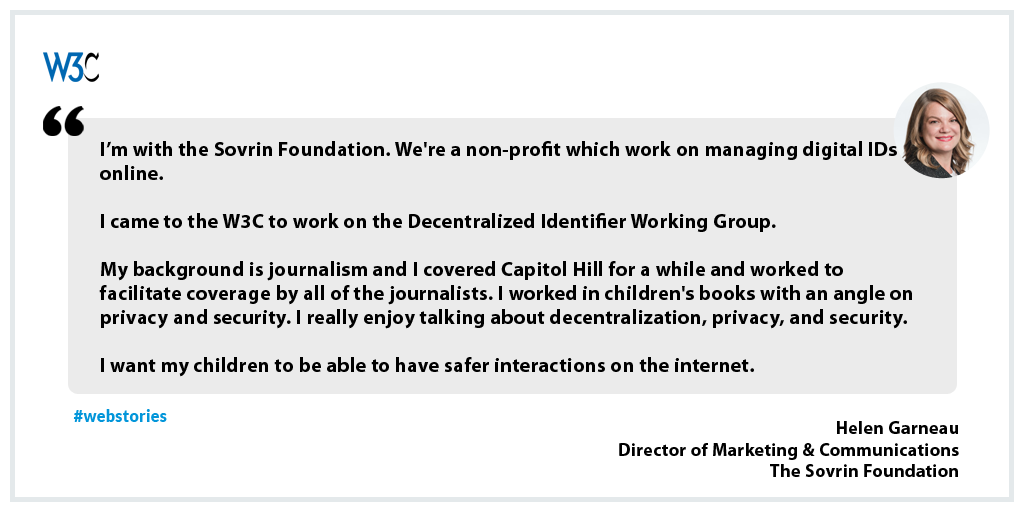
Helen Garneau, Director of Marketing & Communications, The
Sovrin Foundation: I’m with the Sovrin Foundation. We’re a
non-profit which work on managing digital IDs online. I came to the
W3C to work on the Decentralized Identifier Working Group.
My background is journalism and I covered Capitol Hill for a
while and worked to facilitate coverage by all of the journalists.
I worked in children’s books with an angle on privacy and security.
I really enjoy talking about decentralization, privacy, and
security. I want my children to be able to have safer interactions
on the internet. Show Rong Chen’s full quote 
Rong Chen, Chairman and Founder, Elastos Foundation: In 1987 I
was working on a technology which was like a testbed for the Web.
Now I represent my perception of what the new Web can be. WeChat is
like the Web in China but the drawback is that it is controlled by
one company. We are proposing a decentralized WeChat which will
lead from the WWW to the new Web. Show Wendy Reid’s full quote
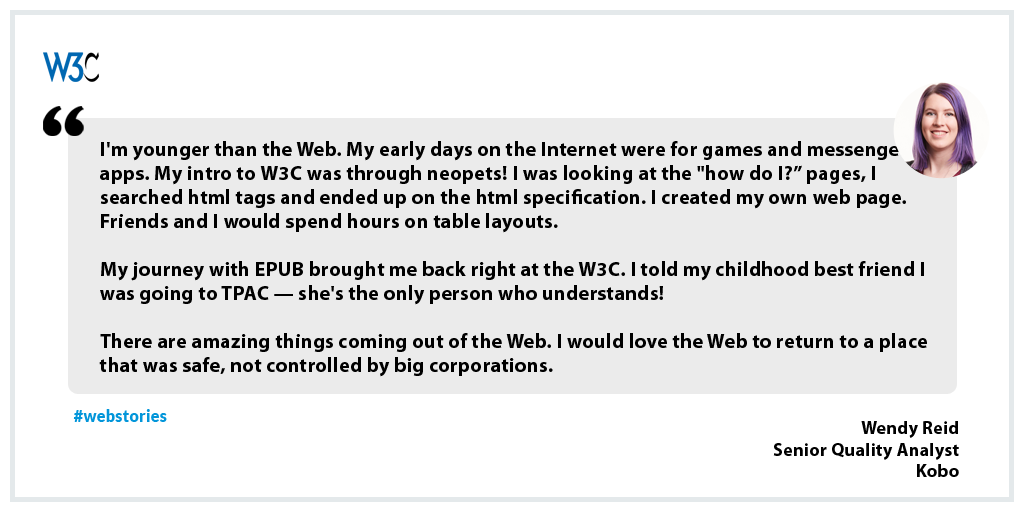
Wendy Reid, Senior Quality Analyst, Kobo: I’m younger than the
Web. My early days on the Internet were for games and messenger
apps. My intro to W3C was through neopets! I was looking at the
“how do I?” pages, I searched html tags and ended up on the html
specification. I created my own web page. Friends and I would spend
hours on table layouts.
My journey with EPUB brought me back right at the W3C. I told my
childhood best friend I was going to TPAC — she’s the only person
who understands!
There are amazing things coming out of the Web. I would love the
Web to return to a place that was safe, not controlled by big
corporations. Show David Ezell’s full quote 
David Ezell, Director of New Initiatives, Conexxus: I got out of
school with a master in performance and musical theory and I
thought I’d do that the rest of my life but I found the computer
lab and never left. I worked at a company that believed in web
standards and fueling convenience stores. This was before 1999 and
I was told “XML? don’t worry, it’s a buzz word” but then 1999, POS
(point of sales) needed to work with back offices. Of course, XML
is structured data. In 2007, Tim Berners-Lee (inventor of the Web
and W3C Director) talked at our 10th anniversary event as our
keynote speaker. He said “let’s talk about gas pumps” and all of
what they do is described by XML. We were looking for unicorns and
we found it. What are today’s unicorns? The Web of Things that can
help monitor a store as a unit factory. Decentralized Identifiers
(DID) could help buying a product without engaging with a brand.
Show Karl Dubost’s full quote 
Karl Dubost, Web Compatibility Engineer, Mozilla Corporation: I
started using the Internet before the Web. Why? I was using usenet
and I saw Tim Berners-Lee’s message announcing the Web. I started
to compile a server at Montreal University. I put a link to page B
on Page A and the other way around… and… MAGIC! I saw the potential
right away. I bored my friends to death evangelizing it. Today? I’m
still amazed. 30 years after the invention of the Web I find it
still mind-blowing.
I worked for 10 years at the World Wide Web Consortium, then
Opera, then a web agency, now Mozilla. My fear for the future of
the Web? Hyper-centralization of services, all the things that are
needed to put things online; threats to individuals; that it enable
searching, control, and mass surveillance. My hope for the future
of the Web is finding solutions in the protocols and the formats
that allow something more distributed. Show Jun’ichi Yoshii’s full
quote 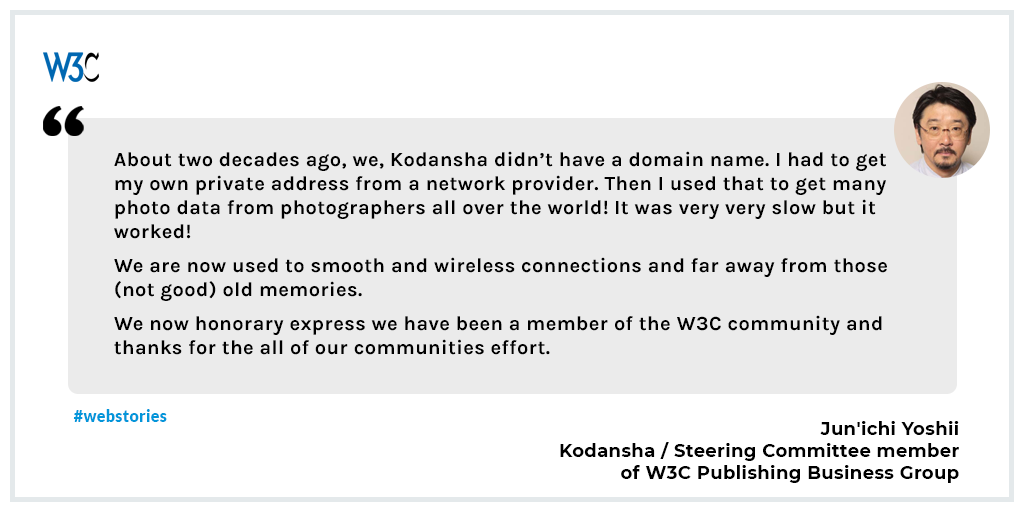
Jun’ichi Yoshii, Kodansha / Steering Committee member of W3C
Publishing Business Group: About two decades ago, we, Kodansha
didn’t have a domain name. I have to get my own private address
from a network provider. Then I used that to get many photo data
from all over the world’s photographers! It was very very slow but
it works! We are used to this smooth and wireless connections and
far away from those (not good) old memories. We now honorary
express we have been a member of the W3C community and thanks for
the all of our communities effort. Show Ralph Swick’s full quote
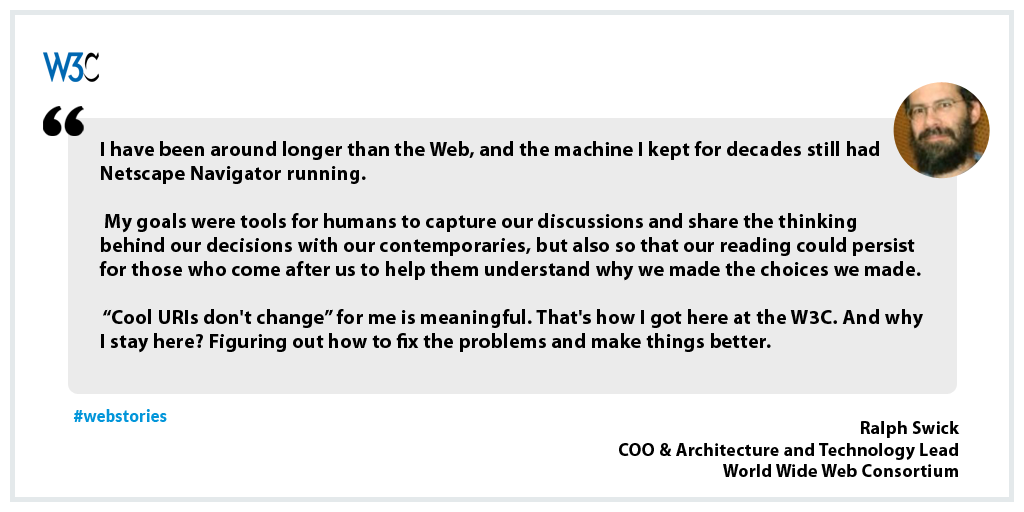
Ralph Swick, COO & Architecture and Technology Lead, World
Wide Web Consortium: I have been around longer than the Web, and
the machine I kept for decades still had Netscape Navigator
running.
My goals were tools for humans to capture our discussions and
share the thinking behind our decisions with our contemporaries,
but also so that our reading could persist for those who come after
us to help them understand why we made the choices we made.
“Cool URIs don’t change” for me is meaningful. That’s how I got
here at the W3C. And why I stay here? Figuring out how to fix the
problems and make things better. Show Coralie Mercier’s full quote
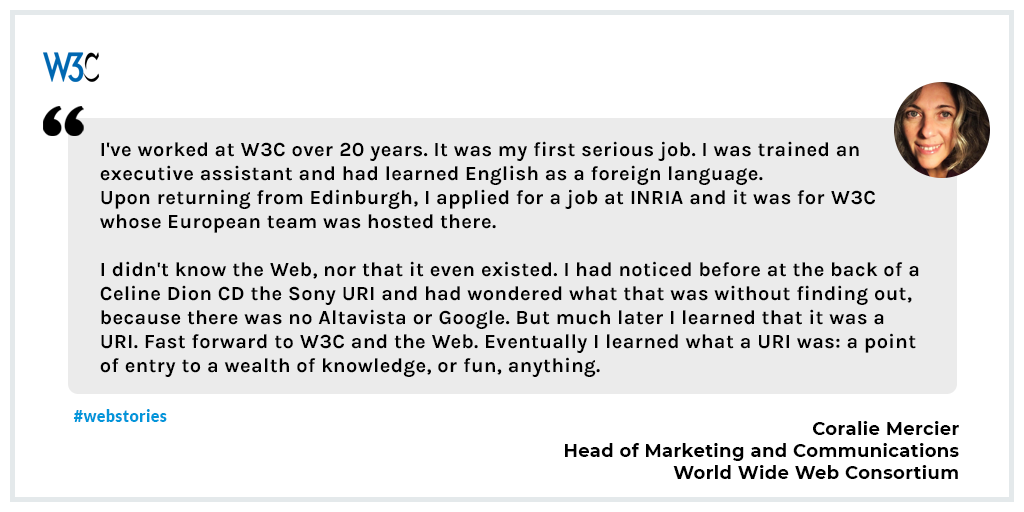
Coralie Mercier, Head of Marketing and Communications, World
Wide Web Consortium: I’ve worked at W3C over 20 years. It was my
first serious job. I was trained as an executive assistant and had
learned English as a foreign language. Upon returning from
Edinburgh, I applied for a job at INRIA and it was for W3C whose
European team was hosted there.
I didn’t know the Web, nor that it even existed. I had noticed
before at the back of a Celine Dion CD the Sony URI and had
wondered what that was without finding out, because there was no
Altavista or Google. But much later I learned that it was a URI.
Fast forward to W3C and the Web. Eventually I learned what a URI
was: a point of entry to a wealth of knowledge, or fun, anything.
Show Amy van der Hiel’s full quote 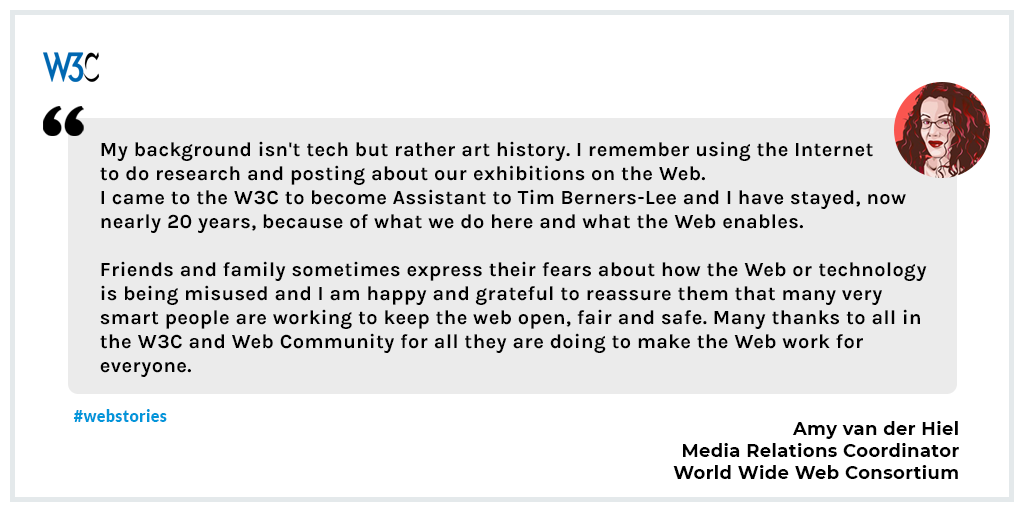
Amy van der Hiel, Media Relations Coordinator, World Wide Web
Consortium: My background isn’t tech but rather art history. I
remember using the Internet to do research and posting about our
exhibitions on the Web.
I came to the W3C to become Assistant to Tim Berners-Lee and I
have stayed, now nearly 20 years, because of what we do here and
what the Web enables.
Friends and family sometimes express their fears about how the
Web or technology is being misused and I am happy and grateful to
reassure them that many very smart people are working to keep the
web open, fair and safe. Many thanks to all in the W3C and Web
Community for all they are doing to make the Web work for everyone.
Show Bert Bos’ full quote 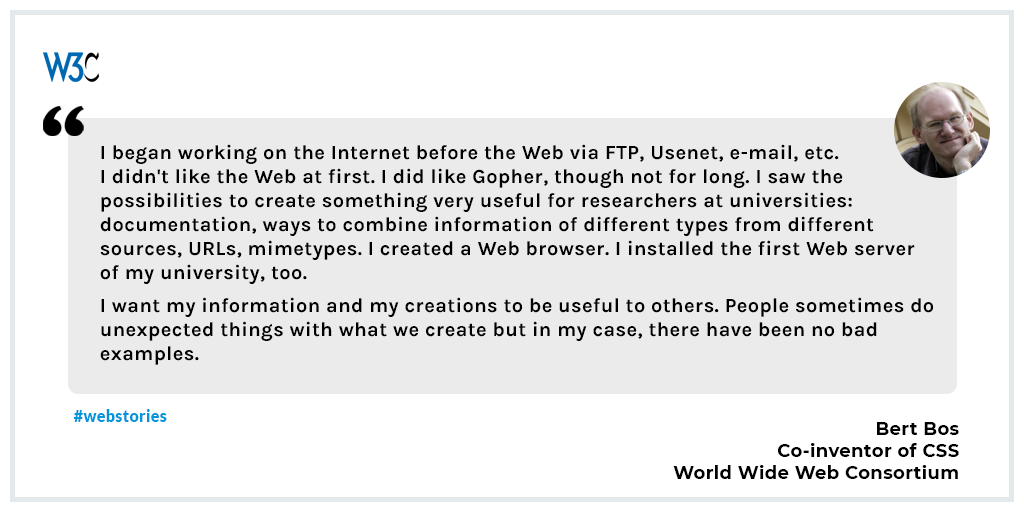
Bert Bos, co-inventor of CSS, World Wide Web Consortium
I began working on the Internet before the Web via ftp, Usenet,
e-mail, etc. I didn’t like the Web at first. I did like Gopher,
though not for long. I saw the possibilities to create something
very useful for researchers at universities: documentation, ways to
combine information of different types from different sources,
URLs, mimetypes. I created a web browser. I installed the first web
server of my university, too.
I want my information and my creations to be useful to others.
People sometimes do unexpected things with what we create but in my
case, there have been no bad examples. Show Naomi Yoshizawa’s full
quote 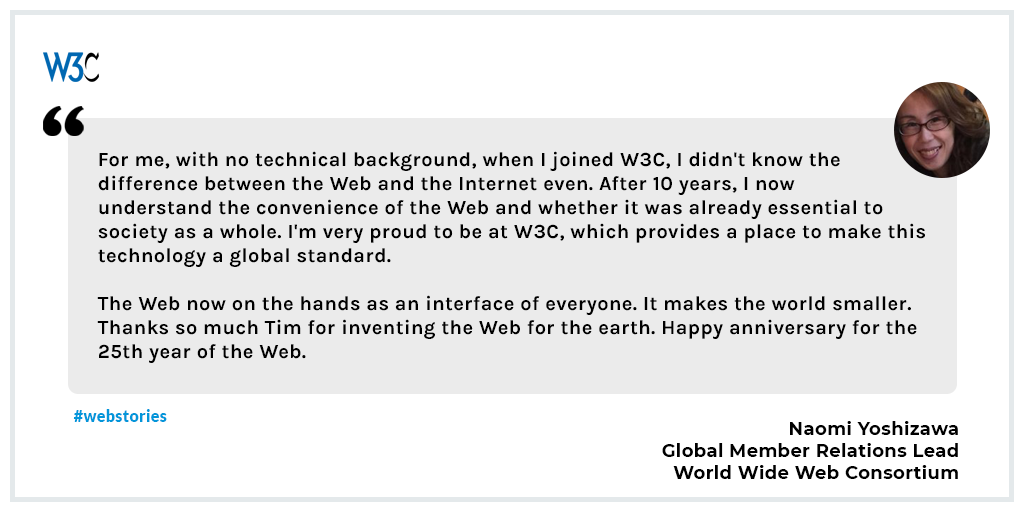
Naomi Yoshizawa, Global Member Relations Lead, World Wide Web
Consortium: For me, who has no technical background, when joined
W3C, I didn’t know the difference between the Web and the Internet
even. After 10 years, I now understood the convenience of the Web
and whether it was already essential to society as a whole. I’m
very proud to be at W3C, which provides a place to make this
technology a global standard. The Web now on the hands as an
interface of everyone. It makes the world smaller. Thanks so much
Tim for inventing the Web for the earth. Happy anniversary for the
25th year of the Web. Show Shadi Abou-Zahra’s full quote 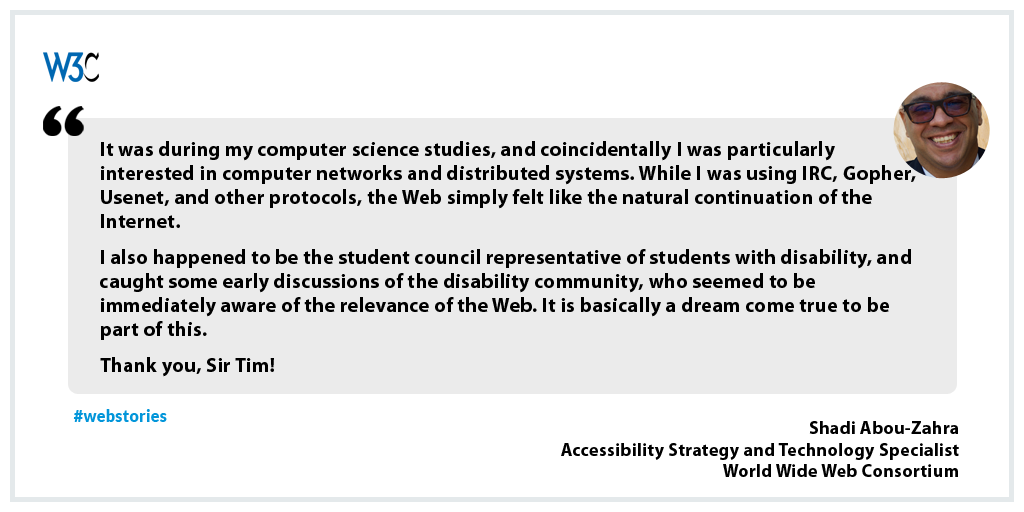
Shadi Abou-Zahra, Accessibility Strategy and Technology
Specialist, World Wide Web Consortium: It was during my computer
science studies, and coincidentally I was particularly interested
in computer networks and distributed systems. While I was using
IRC, Gopher, Usenet, and other protocols, the Web simply felt like
the natural continuation of the Internet. I also happened to be the
student council representative of students with disability, and
caught some early discussions of the disability community, who
seemed to be immediately aware of the relevance of the Web. It is
basically a dream come true to be part of this. Thank you, Sir
Tim!
![[Image: portrait of Hidde de Vries]](https://s3-eu-central-1.amazonaws.com/static-dotconferences-com/speakers_images/hidde-de-vries.png)

![[thumbnail images of a portrait and a still life with fruits]](https://www.w3.org/Style/CSS/images/diana-smith-purecss.jpg)