
#268: Spoiler Warning 3 – Rim of the Pit (1944) by Hake Talbot

Okay, here we go: Spoiler Warning Number 3 in which Dan from The Reader is Warned and I discuss Hake Talbot’s cavalcade of impossibilities, voted the second best impossible crime novel of all time back in 1981.
Except, well, this time we’ve done things a little differently…
Continue reading
#267: One Thrilling Night (1937) by Norman Berrow
 Sometimes I think it is possible to become jaded from reading too much of the same type of book. I signed up to this GAD blogging lark on my own initiative, and it’s the genre I prefer to read, but the need to get in at least one, and ideally two, a week to meet my own self-imposed deadlines can lead at times to a little disaffection creeping in. Thankfully, via the exemplary work of Fender Tucker’s Ramble House imprint, I have discovered the books of Norman Berrow, and so if my will be wandering I have the option of returning to the lightness and joy of his entertaining milieu. He’s not a plotter par excellence, but I find these books fun in a way that obviates my usual requirements in this direction. Prose before pose, dudes.
Continue reading
#266: ‘The Problem of the Emperor’s Mushrooms’ (1945) by James Yaffe – Five and a Half Alternative Solutions
I recently acquired one of the only 175 extant editions produced by Crippen and Landru of the short story ‘The Problem of the Emperor’s Mushrooms’ by James Yaffe, itself originally published in Ellery Queen’s Mystery Magazine in 1945. And in the same manner of reflection upon Paul Halter’s ‘The Yellow Book’ (2017) from a few weeks ago, I thought I’d have another look at a short story…though this time to suggest possible alternative explanations for the impossible poisoning contained therein.
Continue reading
#265: The Big ‘Fore!’ – Classic GAD Allusions in Stableford on Golf (2010) by Rob Reef [trans. Alan Gross 2013]
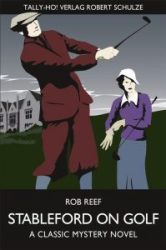
What the hell? This blog — preserve of the expired author, occupying as it does a dusty corner of the interwebs free from contemporary scrutiny — has now featured two living authors on consecutive weekends. Clearly I’m courting popularity. Next thing you know, there’ll be a guest post by Ed Sheeran [please note: I have no reason to believe a guest post by Ed Sheeran to be forthcoming]. And this one isn’t even an impossible crime. Where does this road lead? Rave reviews of Cozy Baking Mysteries? Who even am I any more?
Continue reading
#264: Death in the Dark (1930) by Stacey Bishop
 “There is no suspense in a bang,” said Alfred Hitchcock, “only in the anticipation of it.” This applies to Stacey Bishop’s sole detective novel because, well, it wasn’t a book a sizeable proportion of GAD readers were aware even existed until Locked Room International conjured this reprint fittingly out of the ether — when John Norris at Pretty Sinister hasn’t read it, you know it’s rare. As such, the gleeful anticipation of its release was undercut somewhat by the fact that we hadn’t even heard of it, and so there’s no weight of expectation: we are free, in this connected age of everything being on demand and everything being remembered, to come into this entirely without preconceptions.
Continue reading
#263: A Little Help for My Friends – Finding a Modern Locked Room Mystery for TomCat Attempt #2: First Class Murder (2015) by Robin Stevens

 Last week, I was moved to reflect
 At some point between 1940 and 1960, puzzle-oriented detective fiction began an inexorable shift into what has now become know as crime fiction, wherein plot machinations took a back seat and character, setting, and ambience became more prevalent. Where detective fiction was mostly interested in the fiendish puzzle, crime fiction was more about the challenge to the status quo, and the effect this has on the people involved. And Wilders Walk Away, Herbert Brean’s debut novel, might just be the perfect peak between the two, because I do not remember having read a puzzle that was so intricately invested in the status quo. What emerges is necessarily a little confused about what it wants to be.