Technologically and linguistically adventurous EFL teacher, trainer, writer and manager

Panic attacks can affect anyone. After my interview for the CELTA course which I was trained on, probably the easiest interview of my life, I was walking to my friend’s house thinking it over. As I walked I started to hyperventilate, and I thought I might be having an asthma attack. I couldn’t understand what was happening because although I have asthma, it causes coughing fits, not ‘normal’ asthma attacks. When I got to her house, I couldn’t really talk, and I couldn’t calm down. I started to get pins and needles in my fingers and toes, gradually moving up my limbs. She phoned 999 because neither of us knew what was going on. When the paramedic came, he gave me oxygen and explained what was happening. It took at least 15 minutes for me to start breathing normally again and for the pins and needles to go away. I suspect the thought that triggered the attack was probably me worrying that they wouldn’t accept me onto the course, though I already knew they had: it was my final year of university and my entire plan after my degree was based around getting a CELTA and becoming an ELT teacher. It has only happened to me once so far. I had the first steps towards another one when I was ill at New Year a few weeks ago, but thankfully my amazing best friend was looking after me, and falling sleep due to exhaustion meant I didn’t go all the way into the pit this time.

It's time to talk

Apparently, 2nd February is Time to Talk Day 2017, a UK event “to get the nation talking about mental health and keep the conversation going round the clock”. For a combination of reasons, mental health is an area I have become more and more aware of over the past couple of years, and I’ve been thinking of putting together a list of connected resources for a while. This seems like the perfect opportunity.

Two years ago, Laura Patsko described the conversation starters which she was given for Time to Talk Day 2015, something which you could use yourself or with students.

Phil Longwell made me aware of this year’s Time to Talk Day through his very open interview with teachersasworkers.org about how mental health has affected his life and career.

My panic attacks they come from the tiniest smallest thoughts—and if you don’t know anything about panic attacks you tend to think that panic attacks are something huge—that they are huge, really life-threatening situations but for me they can be the smallest things. It starts from a tiny thought—and that thought can be a trigger which sets you off. Then you’re into a cycle. A panic cycle, they call it.

The UK’s NHS website has a page explaining the symptoms of a panic attack, with a video showing how to tackle the vicious circle that starts it, and a link to tips for coping with a panic attack if you’re having one now.

Rebecca Cope has also had problems at work caused by anxiety attacks, and has written about them very movingly. If this happens to you (and I sincerely hope it doesn’t), you are not alone. Please please please do not be afraid to talk about it. There is nothing wrong with you. If you talk about it, then we can all help the stigma to go away and we can all try to move towards supporting each other and being there when things happen. By the way, as well as being a great writer, Rebecca is a talented artist, as can be seen here:

Four panels by Rebecca Cope: 1. A girl I once knew who always felt blue told me once with head bowed she was trapped by a cloud. 2. She said "I can't hide, even when I'm inside. As it rains I lose all of myself in the fall. 3. But after the rain I stand up again. And I watch the cloud die until there's nothing but sky. 4. No more rain, I'm free to live and be me." And for a while, at least, the cloud's darkness has ceased.

Elly Setterfield talks about her self-confidence issues and offers advice on what to do when you can’t stop criticising yourself, in which we learn about the inner critic, and how to respond to it constructively. She has also created an A-Z of self-care for teachers.

For those on the outside looking in, first, consider how lucky you are that you don’t have first-hand experience of this. Then read about how to support a friend who is struggling with their mental health.

A management perspective comes from The Secret DoS in You don’t have to be mad to work here, but it helps, which includes some key advice at the end of the post, and the important line:

Let’s be clear…mental health issues are simply health issues.

One of the things Phil mentioned in his post was the extra pressure that those of us living and working abroad add to our lives by choosing to move away from home, often into places where we don’t speak the language or understand the culture. Here’s an 8-minute talk on helping teachers settle in, which I did at the IH DoS conference a couple of years ago based on my own experiences of arriving in many a new place. It was designed for managers/employers and not directly related to mental health, but it might give you ideas of what to ask for/about on arrival, especially if anxiety is a problem for you.

Another area that can cause a lot of problems is work-life balance, which I have a lot of bookmarks related to. They include tips for getting a better balance yourself, and examples of what other people have done. This is one of my favourite reminders of what you can do to help yourself take a break:

50 ways to take a break

If you’d like to discuss mental health with your students, AllAtC has a B2+ level lesson plan based around mental health and employment. The Mental Health Friendly Initiative has run competitions for mental health lesson plans, though I’m not sure if they’re available to download. They have various resources for promoting social inclusion on their blog (thanks for recommending it Phil).

If you know of any other useful links or if any of these don’t work for you, please let me know so that I can update the post. Together we are all stronger.

10 years ago

10 years ago today I had an accident that changed my life, and which led to a life-changing event.

I was in South America in the middle of a year working as a British Council assistant in Paraguay. For our summer holidays I’d organised a three-week tour with my mum, followed by four weeks of solo travel in Patagonia, my first entirely self-planned trip. I’d been looking forward to it for a couple of months, and had come up with a rough itinerary of some key places to visit, but ultimately wanted to play it by ear.

On Friday afternoon I arrived in Ushuaia, checked in to the hostel, then immediately went to book the bus out of the town, as there was only one every two days and at that point there was no internet booking. With my seat booked for Wednesday, I knew I had four full days to fill. I also paid for a berth on the Navimag boat for a five day trip from Puerto Montt, in the north of Chilean Patagonia, about two weeks later, giving me two deadlines for later in my trip.

On a recommendation the next day I went to visit Glaciar Martial, at the top of a mountain with amazing views of the Magellan Straits.

Ushuaia - going up to Glaciar Martial

I’d been told it was an easy trip, so I was wearing my walking sandals. Initially it really was easy: a ski lift took you part-way, then you walked up a path next to a stream with the run-off from the glacier. At a certain point, however, it turned into a scramble. I decided to continue and got to a point where I could see this view, which seemed worth it 🙂

View of the Magellan Straits (with slightly bad photostitching!)

After sitting there for half an hour or so, I started back down the mountain. Walking down the scree was a challenge, but I was being careful. The problem came when I got back to the ‘easy’ part. Probably less than 10m after the path flattened out, I must have stopped concentrating and tripped over. I impacted my right knee, cried out, and found I couldn’t stand up. Luckily it was quite a busy path and a woman just behind me heard me and got to me a couple of minutes later. She asked me if I was OK, and when I said I couldn’t stand, she went to get help – one of the first times I was ever truly grateful I could speak the local language. It was coming to the end of the day, and the park rangers were moving up the path to ask people to leave, so in less than 10 minutes somebody was with me and radioing for help.

What followed was one of the most embarrassing experiences of my life. I was put onto a yellow mountain rescue stretcher, which was then strapped across the back of a quadbike and driven down the mountain, with one guy driving, and one walking at each end of the stretcher to make sure it didn’t hit anything. When it got to the car park at the bottom of the ski lift, the back of the waiting ambulance was surrounded by a ring of 30-50 people who wanted to see what was happening. Having previously never wanted to draw attention to myself in any way, this was mortifying for me at 21!

I was taken to the local hospital, where they did an X-ray and put a cast on, but didn’t give me any crutches, despite the fact that I couldn’t put my right foot on the ground, or even touch the ground without excruciating pain. It turned out I’d badly sprained my ankle and there was possibly a fracture, but it was unclear due to the swelling. On returning to the hostel, the receptionists were very helpful and managed to get crutches for me and move me into a room with a private bathroom, luckily available for exactly the number of nights I needed. This was my leg at 8pm:

My leg in a cast

I had to decide whether to continue travelling, return to Paraguay or give up completely and go back to the UK. Thanks to my mum, who was able to give me some money to help me with the now much higher budget I needed to continue, and the very helpful people at the hostel, it wasn’t difficult to decide that the best option was to keep going. I know that this experience is one of many that have made me realize that mentally we are all stronger than we think we are.

This is what day two of my travels looked like:

Ushuaia - Parque Nacional Tierra del Fuego

Being able to speak Spanish was a big help too. This day trip was possible because the receptionist and their friend drove me to the Parque Nacional Tierra del Fuego, gave me a personalized tour and helped me throughout the day. I also managed to fit in a boat trip in the Magellan Straits:

The lighthouse at the end of the world

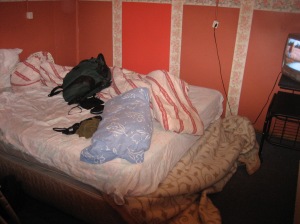
The next stage took me to Punta Arenas, after a pretty uncomfortable 12-hour bus journey, where somebody was nice enough to move so that I could have the only free seat on the bus next to me. On arrival, the taxi driver took me to the Blue House II hostel. My room was a bit messy (sorry!):

My room in Blue House 2, Punta Arenas (burnt down 36 hours after I left) :(

The people who ran the hostel were again incredibly helpful. I needed to have another X-ray and get my cast removed as it wasn’t set at a 90% angle – my screaming stopped the doctors from trying to get me to keep my foot in the right position. When I arrived in Punta Arenas on Thursday morning, they organized a taxi to the hospital for me. I discovered that it would be at least two weeks before I could get an appointment there, so returned to the hostel to try and work out what to do next. They managed to find a private clinic, but there was nothing available until Friday evening. After the exertion of the previous few days, rest seemed like a good idea.

A few hours later, there was a knock at the door to say that an appointment had become available that evening – did I want it? Another easy decision: of course I did. This was the good luck which I have no doubt saved my life.

The new X-ray showed that there was definitely a fracture:

My ankle x-ray showing a fractured fibula (I think!)

I was given what I called a ‘space boot’ (I’m sure it has a proper name in English, but doing all of this in Spanish meant I never knew it!) and sent on my way.

My space boot

Since it was clear I probably wasn’t going to see any more of Punta Arenas, I decided to leave a day early and head on to Puerto Natales. The people from Blue House II booked me a hostel there, and Saturday 3rd February found me on a day trip to the stunning Parque Nacional Puerto Natales.

Parque Nacional Puerto Natales

At one point, I was on the bus listening to the radio news with the driver while everybody else was walking to a waterfall. We heard a news item explaining that there had been a hostel fire in Punta Arenas the night before. No name was mentioned, but I wondered. My suspicions were confirmed as soon as I got back to the hostel in Puerto Natales: I was greeted at the door by the owner. “Blue House II burnt down this morning.”

The same night there had been a huge fire in Valparaiso, which destroyed some of the World Heritage Site there and killed. This dominated Chilean news, so it was hard to find information about the hostel fire. I subsequently discovered that ten out of the twenty-four or so people in the hostel had died, and because their passports and the hostel register were destroyed it took a while to identify their bodies. The fire began in the early hours the morning, when there was a short circuit in the wall between the kitchen and the breakfast room. It was a wooden building with no fire exits or fire alarms in place, so the combination of the time and the conditions meant it was difficult for anyone to escape, especially from the second floor. If I hadn’t been given the new appointment on Thursday, I would have been in the Blue House 2. The room I was staying in was next to the kitchen, and with my crutches, I’m pretty sure there is no way I would have got out.

This shook me up considerably more than the accident did. It really made me appreciate the fact that your life can end at any point, and you have no control over when that is, so you have to make the most of every day.

Before today, I didn’t know the names of any of the people who died, but I know I probably spoke to at least some of them. These are the English language articles I’ve just found about it, some of which I remember seeing before.

This Spanish language article from the day contains more details:

Spanish language media from later dates describes the justice procedure, both including a full list of the 10 victims and their ages:

There is also a YouTube video from the fire service attending the fire which I can’t watch.

This post started as something different, but I think it will end here.

In memoriam.

Incomplete thoughts

All of these are thoughts I want to turn into blog posts at some point, but for now, they’ll just remain as sentences and the thoughts will be pursued in my head. I know there are probably books and blogposts out there which build on some of these thoughts. I may even have read/be reading some of them, and they are shaping these thoughts. But I wanted to have a record of them to see where I am and where I’m going. I may not think any of these things in a few months. In no particular order, but numbered for ease of reference in case people choose to comment…

It’s not a pleasant thought, John, but I have this terrible feeling from time to time that we might all just be human.
– BBC Sherlock, series 4, episode 2

  1. The way I teach and the way I study languages are increasingly at odds with each other. Trying to pull back by changing my teaching, but it’s a long slog.
  2. I’m not comfortable with the term ‘freer practice’. I don’t think it does what it’s supposed to. I also almost never get to it anyway.
  3. Most of a language teacher’s job is nothing to do with the teaching of language, but is in fact about the building of confidence, moving students towards ‘It doesn’t matter’: It doesn’t matter if I make a mistake: the world will not end. It doesn’t matter if I don’t understand everything: we can all do more than we think we can.
  4. Learning to teach and learning a language have a lot in common, in the same way as learning any new skill. Time, patience and an acceptance that you will never be perfect all help.
  5. Prompted by Damian Williams at IATEFL 2016: Language awareness is two-fold: knowing about the language and having an instinct about what is correct. One skill which needs to be focussed on more is writing. Native speakers should be given guidance on how to do this once they’ve left school, not just non-natives. An English teacher should strive to have the best command of the language they are able to, and we should help them to develop this, not just teaching skills.
  6. I kind of think I finally get task-based learning. I’m trying it out. At least I think I am.
  7. There’s not enough of a focus on memorisation within lessons, especially before speaking/freer practice activities. How can students really internalise the language? This is an important step before we can expect them to use it.
  8. Maybe a good lesson shape: meaning-focussed task, build on some of the language students needed or an area you think they would benefit from, memorisation/ internalisation through some kind of challenge, another meaning-focussed task. Don’t expect them to use the language you focussed on: it’s there to be noticed, then actively used when the students’ language system is ready to absorb it after whatever incubation period is necessary. This may vary from student to student. Is that TBL? Dogme? None of the above?
  9. The way we approach grammar teaching across a series of levels confuses more than it helps and is incredibly inefficient in the long run. How can we introduce the more general rules proposed by Lewis in The English Verb as early as possible and help learners see connections? I’ve tried this sometimes, but only really with intermediate and above as a way of clarifying links between grammar structures. What about making that the first way the language is introduced? Would you need L1 to do this efficiently? (I suspect Danny Norrington-Davies may help here, though I don’t have the book yet, so I’m not 100% sure) [affiliate links]
  10. Prompted by Julie Moore at the IH AMT conference: we should differentiate more between the language we expect students to produce, and the language we just want them to understand receptively.
  11. Chunks, chunks, chunks. But how to teach and practise a large enough amount of them so that students really remember them other than through rote learning? And who decides/should decide which ones are worth learning?
  12. If we really want students to get lots of exposure to the language, then the easiest way to do it is probably through listening, since so many of us are plugged in all the time anyway, and it can serve as background noise to life. But then we need to teach students how to listen. And that includes connected speech. But that might not be what they need if they’re in an English as Lingua Franca environment. But then will they get enough listening anyway? But they might get most of their exposure through films, video games and music where connected speech is probably necessary. But but but…
  13. We can’t force our students to be motivated. But without motivation they will never really get anywhere. It’s exposure to the language that provides the tipping point across various thresholds. I’ve only ever really managed this in country, but so so many people don’t get that opportunity, but still manage to get to very high levels in foreign languages. I admire them and would love to know how they do it. Where do they find the time? It’s so much easier to watch, listen to and read things in my language. Two pages a night in a foreign language is enough for me!
  14. Training, blogs and methodology books should never be divorced from a current and up-to-date grounding in classroom teaching. It’s all well and good telling people how to do things, but if you can’t do it yourself, consistently, when you’re tired, overworked, and have a million other things to think about, then it’s all just wishful thinking. We all know deep down that e.g. coursebook-based lessons probably don’t reflect how languages are actually learnt. We all know there are a thousand other things we could do in the classroom that might be more efficient. But time. And sanity.
  15. There are things which are very wrong with the state of ELT and with our profession. We want to change them. But change takes patience and perseverance. Lead by example. Speak, do, don’t shout, show patience. Ranting and railing just get people’s backs up, and may even make people dig their heels in. Be patient. Change will come. Change has already come. Notice what we have done, not just what is yet to be done. Celebrate progress and others will want to celebrate with you.
  16. Mental bandwidth is a thing. You can only think about so many things at once. The balance of how you use your bandwidth changes as you build up experience and things become more automatic. Understanding this idea might help people not to be so hard on themselves.
  17. Training shouldn’t just be about teaching. It should include things about the day-to-day realities of being a teacher. How to manage your time. How to communicate effectively. How to manage your managers. How to find work. How to have a work-life balance. How to avoid ruts. How to stay sane.
  18. My job is not to pull, but to push. Push the school to where we think it should be. Push the teachers to achieve what they can as efficiently as possible. Push people together to strengthen everyone’s networks. Push myself to keep developing, so I can demonstrate what I believe, not just talk about it.
  19. If I really believe something, then I should show it through my actions. Incremental changes in my life have made me happier and healthier. There are more of these to be made, but I am in no rush. I will make them when I am ready. And if I don’t make them in time, then it’s nobody else’s problem but mine.
  20. You can learn from everyone. But you should not let what they think govern what is happening in your head. Your head is your space. You decide who and what to let in.

It looks like some of those thoughts were deeper than I suspected! Maybe this shows you some of my beliefs and principles. I always find that kind of thing hard to pin down. Maybe I’ll get round to writing more about some of these. Maybe not. But now at least some of them are out of my system. Happy New Year everyone!

After a year that has come across as pretty negative in many ways, it seems like a good idea to focus on the positives that have been thrown in my direction. Here are some of the things I’ve enjoyed in 2016:

Reading other people’s blogs

It feels like Elly Setterfield (aka The Best Ticher) has been blogging forever, but it turns out that she only started out in March 2016. In that time, she has produced various gems, including but not limited to beginner’s guides to teaching kids, teens and beginners, a series of posts about surviving summer school, and tips on some of the non-teaching aspects of being an EFL teacher, like what (not) to pack for your first job, avoiding illness, and spending Christmas abroad. They are full of useful, easy-to-understand tips. I also had the great pleasure of meeting Elly last week. We spent nearly three hours chatting, and it could have easily been much more 🙂

Teresa Bestwick has moved back into teaching from management this year, and has chosen a different area to focus on every fortnight for her professional development. Each Fortnightly Focus is a post on her blog, and has given me lots of ideas for how I could work on my own teaching and to pass on to my colleagues. It’s definitely something I’d like to play with if and when I ever return to a classroom full-time.

It’s always worth reading Michael Griffin’s blog. His series entitled ‘Please teach them English‘ was prompted by an initial post he wrote, then continued with the help of a few guest writers. It looked at the clash between teaching English and 21st century skills from the perspective of a teacher, a language school manager and two different students in the ‘class’. As well as the fact that it was thought-provoking, I particularly enjoyed the unusual form, as it was written as a series of emails and diary entries.

Laughing at YouTube

I’d never really watched that many videos on YouTube, but this year that changed. When I’m looking for five minutes of laughter, I find myself heading over to watch clips of James Corden and co., listen to interviews with Benedict Cumberbatch or relive old Kermodian rants. Here are a few of my favourites:

Attending conferences

Two conferences particularly stood out for me this year.

IATEFL is always the highlight of my year, and this one was especially good for me because it was in Birmingham, just 20 minutes away from where I grew up. As well as learning a lot (as always!), I got to relive memories of my childhood and share them with my friends. Here’s a video made by the organisers that gives a taste of the 50th anniversary conference:

TWIST 2016 was organised by the LangLTC school in Warsaw in November. It was probably the most representative conference I’ve ever been to, with what I considered to be an appropriate balance of male/female, native/non-native, theory/practical across their programme. It was also great to be able to introduce some of my colleagues to teaching conferences for the first time.

Going to the cinema

For the past couple of years I’ve had an unlimited card from my local cinema, which has enabled me to see a whole range of things. Particular highlights were:

  • Arrival

  • Zootopia (though I’d like to see it again in English!)

  • Deadpool (which also allowed me to Vancouver-spot!)

Learning

This year I’ve been able to make massive strides in my Polish, progressing to what I would guess is around low B1 level. A couple of months ago I decided to return to Mandarin as well, largely thanks to memrise. Having a few other people who are using the site and seeing their points each week is motivating me to do more – clearly I’m a sucker for some aspects of game-based learning!

2016 has also been the year when I’ve finally started to get a handle on task-based learning, something I’ve always wanted to find out more about but never really had time to. I dived into the world of MOOCs, and the Coursera one about TBL and reading started me off with really investigating TBL. I’m now reading Doing Task-Based Teaching [affiliate link] by Dave and Jane Willis to deepen my understanding, and am hoping to experiment with some of what I’ve learnt once I’m back in the classroom.

Working abroad

I’ve been lucky enough to take my first trips to Italy and Kazakhstan this year, both helped along thanks to people I’ve previously met (thanks Marcus, Julie and Iryna!) This enabled me to experience the beauty of Italy…

View from the Duomo terraces

View from the Duomo terraces, Milan

Varenna

Varenna on Lake Como

Bergamo from San Vigilio

Bergamo from San Vigilio

Venice - gondola and coloured entrance

Venice – gondola and coloured entrance

Verona - view from Castel San Pietro

Verona – view from Castel San Pietro

…and the warmth of the hospitality of Kazakhstan.

Aktobe collage - top left = blackboard with Sandy's name and dates of her visit, top right = teachers using Quizlet Live, bottom left = teapot and bowls, plus food, bottom right = Sheraton hotel and sculpture

Hopefully it won’t be the last time I go to either place!

At home

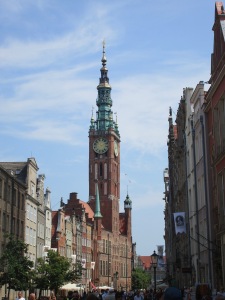
Exploring Poland has also led me to further appreciate how under-appreciated it is. A few days in Gdansk and Sopot with my friend showed me some of its beauty:

Gdansk town hall

Sopot

Even closer to home, it’s been a pretty momentous year for me as I became the owner of my very own flat, something which I wasn’t sure would ever happen. Now I finally have somewhere to put all of those ‘things for my future house’ I’ve been collecting on my travels…I just have to get them over to Poland from the UK!

But probably the biggest joy is watching my cousin and friends whose families are expanding. It may sometimes feel like my facebook stream is full of babies and small children, but quite frankly that’s infinitely preferable to some of the negativity that it’s been filled with at certain points in the year (and yes, I have been guilty of adding to this). When you see the pride and joy of a new parent, and the happiness of a child exploring and experiencing the freshness of the world, it’s hard to stay negative for long. The Internet can be a wonderful place.

So that’s my New Year’s Resolution: focus on the positives in life, and notice myself enjoying them. When it all gets a bit too much, move away, and come back to a post like this to remind myself of all of the things in life that are there to enjoy. Merry Christmas and a Happy New Year to all of you who read this blog, and thank you for your support!

Happy birthday IHJ!

The IH Journal has turned 20 this month, and to celebrate Dominique Vouillemin has edited a special edition of the journal pulling together the traditional columns and a selection of anniversary treats. His editorial gives you a taster of what’s available. The full edition is available for you to read online or download. My own contribution to the journal is called ‘Travelling back through our profession’, and was inspired by Chia Suan Chong and the TEFLology podcast. It’s on pages 36-37 of the journal, or is on the site.

ih-journal-20th-anniversary-cover

Here’s to the next 20 years!

500 (+1)

About two weeks ago I shared something without realising it was the 500th post to appear on this blog. Wow! That’s quite a scary thought.

Thank you to everyone who’s supported me throughout, to the people who’ve offered me advice on how to improve my blog, pointed out my typos, shaped my teaching ideas, shared and commented on my posts, and to those of you who are reading all of this stuff that I write. I find it constantly amazing and humbling to know that so many people have spent time visiting and using my blog. It started out as a way of building up a professional presence online (that seems to have worked!) and of sharing some of my assignments from my IH Certificate in Advanced Methodology. It’s developed into a place to share activities, offer advice (hmmm…), and appreciate my luck in being part of this career and this community. Although I haven’t managed to write as many posts over the last year, I’ve still got a lot of ideas, and I keep hoping I’ll be able to put more of them out there.

Here are a few stats for you:

  • 500 posts
  • 350 views/220 visitors so far today
  • 825,948 all-time views
  • 440,570 all-time (or at least since they started counting) visitors
  • 11,180 views on 1st May 2014, my best views ever in a single day (on a post I didn’t even write!)
  • 31 comments by Rachel Daw, my number 1 commenter!
  • 1,493 subscribed followers/606 WordPress followers (no idea how much of that crosses over…)
  • Useful links for CELTA: my most popular post this year (ever?)
  • And the one I find the most breathtaking: countries people have visited from in 2016 (white means no visitors from there so far):

sandy-millin-blog-world-map-of-visitors-2016

Thank you so much to everyone who has made this possible!

A lesson plan

Elly Setterfield has just written a very useful guide for beginner teachers with tips on how to plan on a daily basis. At the end she asked what her readers’ plans looked like. Here’s one of mine from last year, as I was working out a new style:

an-example-of-my-highlighted-plans-sandy

My planning has gone through many iterations, but I’ve now been using this style for over a year. I always use scrap paper, and put it straight into my box ready to go to the classroom as soon as it’s done. I rarely have time to plan in advance nowadays, and occasionally have no time to plan at all. As Elly recommended, you’ll see that:

  • I plan by hand
  • I highlight key things: pink is for things I tend to forget, yellow is for language checking/clarification (though I added that after this plan), green is for answers, and blue is for reminders to offer and give points in YL/teen classes
  • I underline in red any materials I’ll need, so I can do a quick check before the lesson to make sure I have everything. I normally write the plan first and produce my materials afterwards.
  • There is a note of approximate timing for each activity, plus a running total for the lesson. This almost never happens in the lesson, even when I add lots of extra time. I normally only skip one or two activities though, which is a lot better than it used to be!
  • It’s not necessarily clear to anyone else, though sometimes I add more detail if I know it’ll be the basis for somebody else’s plan later – we work with a lot of teachers who are fresh off CELTA.
  • There are various abbreviations on there, and I haven’t written out everything for exercises I use all the time.
  • It takes me about an hour to plan each lesson, give or take.

Previous versions of my plans included typing them up in my post-CELTA over-enthusiastic phase, often in way too much detail, and right at the other end of the scale, scrappy bits of paper with four or five words written on them, in my post-Delta I don’t have the energy for this phase 🙂 I feel like I’ve now arrived at a happy medium.

So what do your plans look like?

Simplified articles chart

Once upon a time, I created many different versions of charts to help students work out whether they needed articles or not. Some of them were very complicated because I tried to include way too much information in them. Then I went to the other extreme. Now I think I’ve found a happy medium:

Articles chart

Here’s the Powerpoint version for you to download.

The 90% figure in the box is obviously a complete guess. I’ve found that most article choices can be covered by the chart, though occasionally you have to be a bit creative about it! The box gives students a set of fixed phrases which they can learn to start them off with the exceptions that aren’t covered.

‘Normal noun’ is something like ‘republic’ or ‘kingdom’. This covers the use of phrases like ‘the Czech Republic’, ‘the United Kingdom’, and also ‘the University of Durham’, but not ‘Durham University’. By the way, does anyone know why the latter two uses operate differently when it comes to articles?

Countable > plural > specific covers ‘plural’ countries like ‘the United States’, but also groups of islands like ‘the Maldives’ or ‘the Canary Islands’.

Uncountable > specific covers deserts like ‘the Sahara’ and bodies of water which aren’t lakes, like ‘the Atlantic’, ‘the Sargasso Sea’. Lakes are an exception as they don’t normally take an article: ‘Lake Tahoe’, ‘Windermere’.

Hopefully this will be my final version of this, although I know I’ve definitely said that before…

On immersion

For the past six weeks or so I have been sharing a flat with a couple who only speak a few words of English and German. When I moved in my Polish was probably hovering around A2, having received a boost over the summer from my reading, writing and use of a grammar book. I was still quite hesitant about speaking, and had only really started to build my confidence during a weekend away organised by my flamenco teacher, again with a few people who didn’t speak any English but who still wanted to communicate with me. Both the people on the flamenco weekend and the couple I was living with were great interlocutors for me, patient, happy to rephrase and repeat themselves as much as necessary, and supporting me in trying to communicate my ideas. The woman I lived with was also very good at correcting me consistently which had a massive impact on my grammar.

One of two kittens entertaining us when we weren't dancing flamenco :)

One of two kittens entertaining us when we weren’t dancing flamenco 🙂

Six weeks on, it’s like I’m a different person. I feel like my Polish is probably now into B1. I can speak about most everyday things, my accuracy has improved in quite a few areas, and my confidence is at similar levels to my much stronger languages. I’m not normally shy about pushing myself to speak, which is why the last year has been so strange for me as I was very reluctant to speak Polish if I didn’t have to. I felt like I didn’t really know what language I was speaking in, and it was a real mix of Polish, Czech and Russian. I’m very glad to be past that point, and feel like I’m now in a very good place to continue improving.

On reflection, I’m also wondering whether having such a long (almost) silent period has also helped me to speak more fluently and more confidently at this point than at the same point with other languages. A year of building my vocabulary and listening to and reading whatever I could has certainly helped me improve my understanding, and I feel it’s also made me more accurate when I finally did speak, although I’m sure Czech and Russian probably also had something to do with it.

This is the most conscious I’ve ever been of my speaking progress, as I’ve either already been at least B2 when I’ve been immersed in a language, or I haven’t been in a complete immersion situation for more than a couple of hours at a time. Six weeks of having to speak Polish most mornings and evenings for at least a few minutes meant I had no choice but to communicate. Talking about things which were relevant to me and trying to explain things which had happened during a very eventful few weeks, sometimes with Mr. Google’s help, extended my language and provided a huge amount of motivation.

I know that it’s theoretically possible to create similar situations through the use of Skype conversation partners for example, but I’ve never had the motivation to do it before, confident that I’d eventually learn as much as I needed to through constantly plugging away at the language. After this experience of immersion, I think I might try harder to recreate it with the next language I want to study (not sure what yet!)

I’ve only had two or three Polish lessons, and I’m wondering just how much and how accurately I can learn without having any, even though I know I definitely want some at some point as I need correction. Watch this space…

Travelling back in time

Having recently recorded a lesson, I thought it would be interesting, if excruciating, to go back and re-watch myself teaching from mid-Delta. You can watch too if you want to join in the fun 😉

These are my impressions:

  • I’ve lost a lot of weight, and I’m so much happier and healthier for it! (Yep, that’s the first thing that struck me!)
  • My lessons flow much more now, with better pacing. There’s a dramatic reduction in the amount of time I spend at the board/doing open-class work.
  • I’m more confident when dealing with language now. Much less looking at a piece of paper to check things.
  • My God I was talking slowly! Although that may reflect the level of the students – I can’t remember if it was intermediate or upper intermediate, but I think I could have spoken at a more natural speed.
  • Everything was at the board here and open class. I’d be much less likely to do that now, unless I’m mopping up. I also appear to be telling the students lots of things, rather than checking if they already know it by getting them to discuss it in pairs.
  • My board work was already fairly well-organised, and I was using different colours to differentiate information. I can’t remember what happened in the rest of the lesson, but it looks like I’ve written everything on the board. That must have taken quite some time – time when I wasn’t paying attention to the students…
  • There wasn’t much thinking time for the students after some of my questions. The language appears to be appropriately graded.
  • The staging of the questions appears to be logical and the questions are all clear.

I wrote the above list while watching the video saved on my computer. I’ve just found the original blog post, and noticed some of my opinions/beliefs have changed too. For example “I think I was speaking at a manageable speed, using appropriate language, with some repetition, as you would get in normal language. I do speak faster to these students at times, but I feel in a grammar lesson it’s better to take your time.” which is not what I thought when watching it this time, especially when I realised they were upper intermediate!

Sandy at the board clarifying borrow and lend from a 2013 lesson

I also realised there’s actually another post about an intermediate class, this time with two videos. Here’s what I thought on watching those:

  • My instructions were fine, not as bad as I remembered, but not as good as they could have been. Some chesting of the handout, some instruction checking, instructions before handouts… I think the main problem with them seems to have been a lack of demos/examples.
  • The first time I was drilling without visuals, so students were saying, not reading. This is good! I also made everybody join in. Later in the lesson they were reading from the board though – no memorisation here. There were some supporting gestures and a bit of connected speech (‘to’/’from’) too, plus one example of drilling from phonemes. Now I suspect I’d put structures like “lend sth to sb” into a ‘real’ sentence, like “He lent the pen to her.”
  • I reminded students that “There’s never idle time in classes. That’s your remembering time.” Didn’t realise I was already doing that before – I thought that was a relatively new thing. There are also other bits of learner training: highlight the things you had problems with, use two colours to copy information and a reminder to use Quizlet, which was obviously a routine with this group as I didn’t have to tell them any more about it. I also must have used Edmodo with them, which I’m out of the habit of using with my students now (just some of my trainees).
  • Clear board work again 🙂
  • There was an opportunity for some dictionary work with the prepositions and the money words potentially.
  • I emphasised that the preposition should be learnt with the word: a bit of lexical chunking (though prompted by the book, and not sure I realised I was doing it)
  • Giving students the opportunity to work out the language themselves, although again in open class. Now I’d get students to discuss it in pairs first, then feedback in open class.
  • The borrow/lend focus included students’ names, making it a tiny bit more personal.
  • I made sure I had their attention during the clarification, and gave them separate writing time afterwards.
  • Wait time was better in this clarification than in the first video.
  • Nice bit of comparative linguistics about ‘borrow’ and ‘lend’ 🙂

So it turns out another benefit to recording yourself – you can come back to it later and see how much you’ve improved/developed/changed, just as you might by recording a student and saving it for the end of the year 🙂 Oh, and it wasn’t quite as excruciating as I thought it might be!

Tag Cloud