8 Ways to a Peaceful December in Interfaith Families
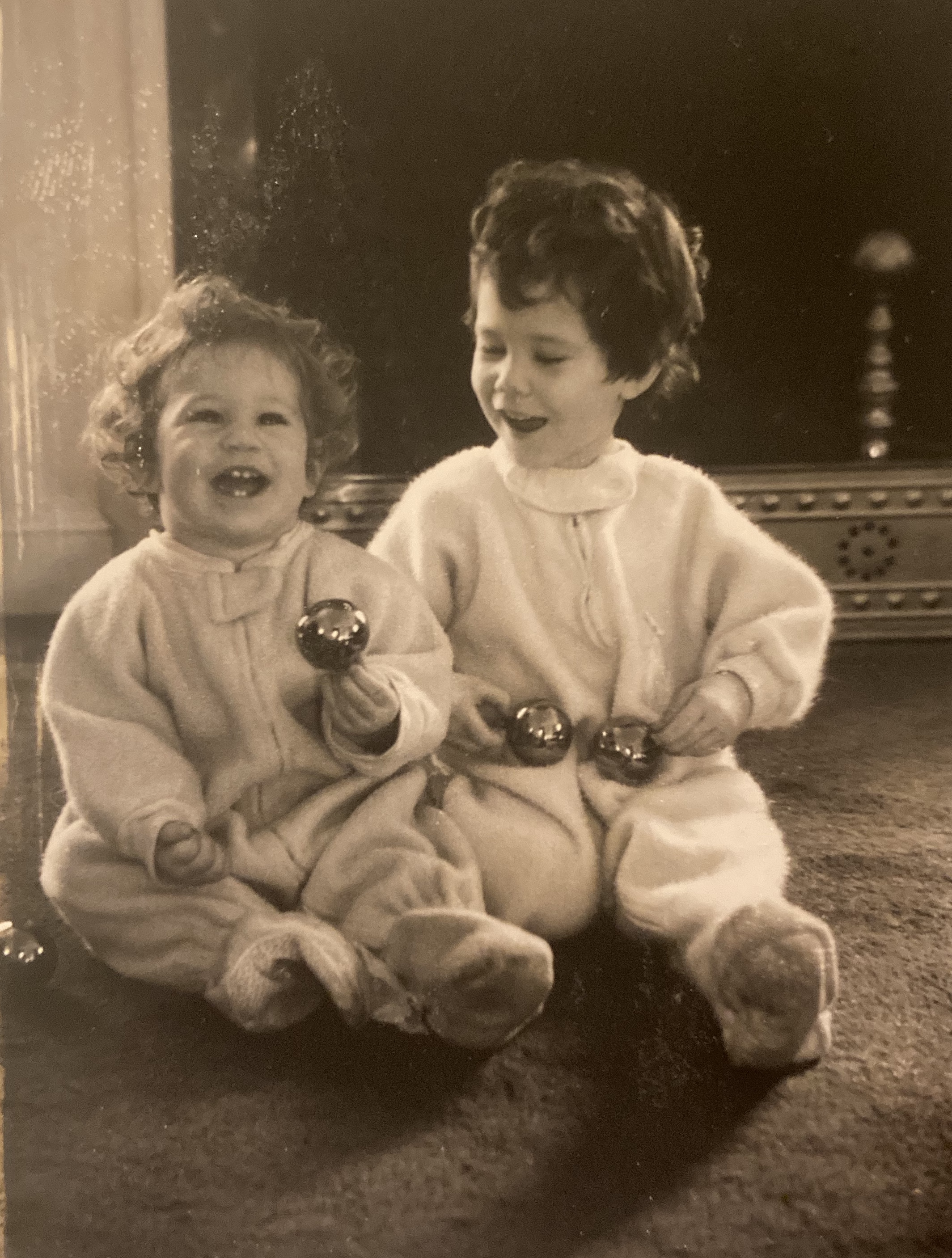
My little sister and I, in our interfaith family in 1964.
This year, the eight nights of Hanukkah start on December 25th. Although that may sound overwhelming, this year’s timing provides space for both holidays. By the time you light the first Hanukkah candles, Christmas celebrations (on Christmas Eve and morning) will be over. And, Hanukkah does not have to compete with the busy season of holiday concerts and office parties leading up to Christmas. Instead, it falls during the relatively quiet week after Christmas. And as an extra bonus this year, college kids will most certainly be home for the whole week of Hanukkah, instead of celebrating in their dorms without family in early December. (In general, I prefer the years when Hanukkah does not overlap with Christmas, so that each holiday gets a separate celebration).
Whether you celebrate one of those holidays, or both, or neither, all of us need to cultivate empathy for our partners and family members in December, while honoring our own needs, and being mindful of how this season can trigger both joy and sadness, no matter what religious traditions you celebrate.
I created The Interfaith Family Journal, to help any and every family figure out how to honor diverse religious or spiritual or cultural roots, and formative childhood experiences, while claiming and creating a plan for December (and every other month) that works for your family. The Journal traces a five-week process of writing prompts, discussion topics, and creative activities. The result is a unique resource for therapists, clergy, and families. Here, I distill from the Journal eight ways to plan for a deeper, more mindful, and peaceful season:
1. REFLECT
Ask yourself about how you experienced December as a child. What did you celebrate? How did you feel about Christmas music, decorations, movies, in American popular culture? Were you aware of being part of the religious majority or minority? How have those feelings changed over time?
2. DISCERN
Ask yourself which of your childhood winter holiday rituals you want to continue in adulthood, or take on in the future? What traditions do you want to transmit to your children? Is this because they have religious meaning, spiritual meaning, and/or cultural meaning for you?
3. INQUIRE
Ask your partner(s) or other intimate family members or co-parents how they felt during December as children. Do you understand how your childhood experiences overlap, or diverge? What are the differences? What are the synergies?
4. EMPATHIZE
Ask your partner, if you have one, which public expressions of the season–in public town displays, on the radio, on TV–might make them feel joyful, nostalgic, sad, or alienated, this year. Do you understand why? How has this changed for them, over time? Note that secular or cultural does not necessarily mean less important than religious or spiritual!
5. SENSE
No matter what religious (or non-religious) affiliation(s) or identity you have chosen for your family or children, are there multi-sensory December experiences that you would like to retrieve, or pass down, or take on? Music? Recipes? Crafts? If you have a partner, are they okay with tasting, smelling, hearing these with you?
6. PLAN
The number of celebrations can feel overwhelming in December, especially for interfaith families. Make a plan! Which holidays this month will you spend with which extended family members (and when)? Which will you spend with friends? And which will you spend with just any partner(s) and/or kids? Make sure any partners feel comfortable with the plan.
7. GIVE
Whether or not you celebrate Christmas or Hanukkah as a family, December can be an inspiring time to think about helping your community and to prepare for New Year’s resolutions. Community service can help to keep the midwinter blues at bay, and shifting from a focus on consumption to a focus on giving is a mental health move. Talk to your family members about starting a tradition of December giving, or December action, to help to heal your community and the world.
8. SNUGGLE
No matter which traditions you celebrate, the scientific reality is that this is the darkest and coldest time of year in the northern hemisphere. It is probably not a coincidence that near the midwinter solstice, we try to brighten our world with the Yule hearth, Christmas lights, Hanukkah and Kwanzaa candles, or firecrackers for the Chinese Lunar New Year. So be gentle with yourself, and with your family members, as we move through the darkest days of this difficult year, until we tilt again towards the sun.
The original version of this piece was written for Psych Bytes, in 2019.
Books featuring interfaith kids are still few and far between. So I welcome a new picture book centered on the fact that Hanukkah starts this year on Christmas Day. It’s a heartwarming addition to the small collection of books about families that celebrate both holidays. (And I have just added it to my roundup of many of those books all in one place, here).
Gingerbread Dreidels was written by Jane Breskin Zalben, an experienced children’s book author. As it happens, Zalben’s many books on Jewish family life and holidays, starring a bear named Beni, and a sheep named Pearl, were beloved in our household when my children were small, twenty years ago now.
Gingerbread Dreidels is a lovely depiction of a happy and well-adjusted interfaith family, giving equal respect to both family traditions. Both sets of grandparents arrive together to celebrate with their grandchildren. Both sets of grandparents cook traditional holiday foods. Both sets of grandparents join in singing a Hanukkah song, and a Christmas carol. And both sets of grandparents tell the central stories of their holidays. I deeply appreciate that in this story, each holiday is given its own space and integrity, even in a year when they fall on the same day–they are not mixed or mashed up, and to my great relief, no one mentions something called Chrismukkah.
I also love that the parents in this book are perfectly comfortable with letting the Christian grandparents explain that Christmas, in its origins, celebrates the birth of baby Jesus. Some books for interfaith children avoid mentioning the the religious foundations of Christmas. In my opinion, interfaith literacy benefits interfaith kids (actually, all kids), even when both parents are secular humanists (and even when the child is being raised Jewish). So I recommend this book for any and all families who celebrate both of these winter holidays. (If you really want to avoid mentioning the historical origins of the holidays, you can choose one of the books that stays on the surface–again, see your choices, here).
I also love that the brother and sister, Max and Sophie, fret a bit about how this year’s configuration of Hanukkah and Christmas will affect the number of gifts they receive. This is an honest depiction–we all know that most kids from Christian and/or Jewish families are going to think about gifts this time of year. But we also know, as adults, that they will remember singing together around the menorah, and around the tree, and the attention from grandparents, long after the gifts are outgrown and forgotten. As little Sophie declares, “The best gift is that we’re together.”
It is refreshing that this family is depicted as not the least bit confused or conflicted about their interfaith practice. And there are no outside voices in the book questioning or challenging the way they celebrate. If the story is less dramatic as a result, it frankly reflects the entirely positive interfaith family reality that more and more children experience.
It is also worth noting that the Jewish grandmother in this story is Black, and thus her son (and grandchildren) are mixed race. This fact, like their interfaithness, is not a big deal in the context of the story. In fact, it’s not mentioned in the text at all. Only in the author’s note do we learn that Grandma Gold is an Ethiopian-American Jew. As far as I know, this is the first picture book to clearly depict a Black Jewish member of an interfaith family, and mixed race interfaith children and grandchildren. While the Black grandmother in the story may seem at first glance like a performative inclusion, the significant overlap of interfaith and interracial families means this book will resonate with many families.
After the story ends, Gingerbread Dreidels includes a history of the dreidel, rules for playing dreidel, and a gingerbread recipe. There’s also a note from the author, explaining her motivation for writing the book, and how the Jewish, Christian, and Muslim holiday calendars work. The yearning for interfaith understanding and peace, felt by so many interfaith families, is evident in this note. For me, that peace feels farther away than ever this year. Nevertheless, interfaith children deserve books like Gingerbread Dreidels, infused with joy and warmth, centering their experiences. We can only hope that such books will help to inspire them to use their interfaith family skills to become interfaith bridge-builders and peacemakers in the world.
By now, if you live in a Jewish and Christian interfaith family, you are probably aware that the first night of Hanukkah this year falls on Christmas. And in my opinion, that timing is really not a big deal.
After many decades of celebrating both, I have experienced every configuration of the two holidays, on multiple occasions. Although Hanukkah usually falls earlier (between Thanksgiving and Christmas), I have experienced Hanukkah starting on Christmas Day in 2005, and Hanukkah starting on Christmas Eve in 1978 and in 2016. Since Hanukkah is celebrated almost exclusively in the evening, the overlap with Christmas Eve is actually a more complex logistical issue than overlap with Christmas Day.
Back in 2016, I was asked by the Woolf Institute in the UK to write a piece anticipating the convergence of the first night of Hanukkah and Christmas Eve. I adapted that piece in 2022 for the convergence of the last night of Hanukkah and Christmas Eve. And here, I adapt it once again for the convergence of the first night of Hanukkah and Christmas Day in 2024.
Why Do Jewish Holidays (Other Than Shabbat) Move Around?
The solar Gregorian calendar determines the timing of most Christian holidays, while both the sun and moon guide the Jewish calendar. So Hanukkah wanders through the secular calendar from late November to early January, and can start as early as Thanksgiving. As a result, each year interfaith families who celebrate both must choreograph the dance of Hanukkah and Christmas in a new way.
And each year I adapt my practice in order to give each holiday its own time and space and integrity. After more than 60 years of celebrating both holidays, I know that it can be done, without actually mixing or blending or fusing the two together. So here are my eight strategies for a nimble Hanukkah and Christmas dance this year:
1. Accept that balance occurs over the course of a year, not on each day. On Christmas, which lasts only one day in most homes, it’s natural for those who celebrate both holidays to lean into Christmas. So in a year like this one, when Hanukkah starts as Christmas is ending, why not shift the emphasis on Hanukkah to the subsequent nights, rather than attempting a big celebration on the first night? Sure, light the first candle, mark the overlap, but after a day of Christmas presents and feasting, wait to give Hanukkah its full due on the second to eighth nights.
2. When traveling for “the holidays,” check your interfaith packing list. If you are going to be staying with Christian family members, remember to pack the Hanukkah menorah and candles! (There’s a great children’s book about an interfaith family who forget to pack their menorah). In the the inevitable exhaustion at the end of Christmas Day, don’t forget to set aside a few minutes to gather everyone to light the first candle. This is a year to enjoy the synergy of that first candle and a sparkling tree, and talk about the common theme of light at the darkest time of year.
3. Give Hanukkah gifts later in the week. Rather than competing with Christmas on the first night, consider giving any major Hanukkah gifts on the last night. Some families like to emphasize books and clothes as Hanukkah gifts for children, rather than toys. In general, I have tried to resist the commercialization and competition between the holidays that has given rise to the idea of piles of Hanukkah gifts, especially for interfaith kids who celebrate both holidays. Be confident that when they are grown, children will remember lighting the candles, as much as any game or toy.
4. Time the parties. This year, Christmas lands in the middle of the week. So for families who celebrate both holidays but want to keep them separate, the following weekend is the obvious time for a Hanukkah party. This year, you could have a Hanukkah Shabbat with family and friends on the third night, or a traditional Hanukkah party on Saturday or Sunday, or a grand finale Hanukkah party on the last night which is New Year’s Day. Or, you can go for an elegant Hanukkah New Year’s Eve party on the seventh night, perhaps with caviar and sour cream on those latkes.
5. Tell the Hanukkah story. The religious freedom aspect of the Hanukkah story resonates in interfaith families drawn to social justice themes, and those themes may resonate more than usual this year. In the United States, we have been lucky to live in a time and place with civil marriage, separation of church and state, and the freedom to marry for love, and to celebrate either, or both, or any religion. For me, part of being an interfaith kid is the reminder that we need to stand ready to protect the right for everyone to marry without restrictions on race, gender, or religion.
6. Give to others. After Christmas morning, the first night of Hanukkah this year would be perfect for giving back, rather than piling gifts on gifts. Stress that both holidays encourage us to care for those in need. Let children know that the legend of Saint Nicholas has him giving to the poor and the hungry. Engage children in deciding what causes they want to support with charitable donations for both holidays this year.
7. Organize acts of service. Christmas encourages empathy for those who, like Mary and Joseph, must travel and seek shelter. Hanukkah provides an opportunity to reflect on how Jewish history compels us to resist tyrants. Celebrate these intertwined themes by planning and engaging in acts of service together, perhaps supporting migrants, refugees, and religious minorities in the new year. (I first wrote that sentence in 2016, and it feels all the more relevant now).
8. Try not to stress. As you move through the dance of Hanukkah and Christmas this year, don’t fret over a misstep or two. Many of us have forgetten to light candles on one night here or there. Many of us feel judged, or still judge ourselves, for how we mark December holidays. Everyone has a different comfort level with where to place the Hanukkah menorah in relation to the Christmas tree. Through it all, do your best to find the still, small moments of holiday peace and joy.
Last March, on instagram, I ran across a new website in the UK called My Mixed Heritage. And I noticed there was a quote from me on the “About” page! It was exciting to discover another interfaith kid out there, across the Atlantic, creating space for people with multiple religious ancestry. I got in touch, and learned that Dalia El Ariny is an anthropology PhD student in London. She grew up in an Egyptian/Muslim and Italian/Catholic family, in Milan, while I grew up with a Jewish parent and an Episcopalian parent, in Boston. She’s the same age as my younger son, so we also represent two very different generations. But we found we had so much in common, as interfaith kids.
We began zooming almost weekly–comparing notes, and then planning, and then creating together. We unveiled our joint project last week: “Interfaith Work and Interfaith Families: A Toolkit.” Our goal was to bring together interfaith organizations, interfaith families, and the academics who study us. And that’s exactly what we did at the zoom launch. In the Toolkit, we advocate for interfaith organizations to work more closely with interfaith families.
And now, you can read all about it in this Q&A with Dalia:
Susan: We live on two continents, come from two generations, and we come from different sets of interfaith (Abrahamic) traditions. Were you surprised that we felt such a sense of kinship, right away, as interfaith kids? And, what do you think were the common experiences that drew us together?
Dalia: I remember our first call lasted a ridiculous amount of time – three hours or something like this – and I emerged from it so refreshed and inspired. It all felt very natural. I remember thinking that it made sense that we hit it off so well, because despite our many differences we share a similar way to approach differences in general. This is also something I have found when talking with other people of interfaith background or in interfaith families.
What we share is not the content of the lived experience–for example, I have never celebrated Hanukkah and Christmas, nor has Susan celebrated Easter and Ramadan–but the dynamic of the experience is the same. Each of us grew up in a household where there were radical differences that needed to be wrestled with in the everyday, both of us dealt with expectations and demands coming from very different worlds, both of us found beauty in the “chaos” of our religious background, in the incoherences, compromises, agreements and disagreements, and both of us decided that it was a reality worth sharing with others.
Susan: I have long advocated for more academic research on interfaith families, and on interfaith kids in particular, so that’s another reason I was so excited to hear about your work. Tell us a little bit about the thesis you are just beginning now, and how you ended up with this topic?
Dalia: My research focuses on people who were raised in interfaith households, more than interfaith couples and families with young children, as there is already existing research on this topic. So, I’m looking at the children of interfaith families, who are now adults, and I ask them about their everyday lives, and sense of belonging and whether their interfaith upbringing has inspired them to become social change agents.
I always knew I wanted to study interfaith families for my PhD, largely because of my own upbringing in a Catholic Muslim family. However, the focus on interfaith children who are now adults—gosh, I need another term for this—and the connection between their background and social activism grew out of a series of encounters; the collaboration and friendship with you, Susan, being a particularly important one.
Susan: Years ago, I began writing about the idea that “legacy” interfaith bridge-building organizations need to acknowledge and learn from interfaith families. Our Toolkit makes that point, in a more comprehensive way, with a dozen pages of text and example boxes, and a resource section. Why do you think the time is right now? And how can we encourage adult interfaith kids in leadership positions to be more out and proud about their interfaith families and identities?
Dalia: I think interfaith organizations are already in a transformative phase. COVID was a significant watershed, at least in the UK. During that period of stasis, many practitioners began reflecting on the limitations of their own interfaith events and programs. Issues such as lower engagement from young people, a general decline in participation, and low diversity (e.g., racial, socio-economic, gender, etc.) began to be discussed. Now that these and other shortcomings of interfaith dialogue have been uncovered, organizations are trying to change the way they operate. They are in “listening” mode, and that’s why it is important for those of us in interfaith families to speak up now, and speak loudly.
This connects me to your question about how we encourage interfaith kids to be proud of their interfaith background. So many of us feel almost ashamed of it because we are often told we are neither one thing nor the other, and that we are confused and confusing for others. In the toolkit, we talk about this “fear of ambiguity.” I think sometimes we also have that fear regarding our own identities. That’s why it’s important to create spaces where we allow ourselves to explore that ambiguity fiercely rather than fearfully; spaces that allow us to ask questions, hear different answers and connect with others that have similar life experiences. Those of us who have already embraced their “mixedess”, as we call it here in the UK, need to start talking about it openly, so others will see that there’s nothing scary about it.
Susan: We write about the barriers that have existed, the reasons that legacy interfaith organizations have not always wanted to include interfaith families as part of their work, or even acknowledge that we exist. Could you summarize what we found in terms of those barriers?
Dalia: Ah! This is a long answer. I think there is a root issue, from which many of the barriers we discuss in the toolkit derive. This is the way we – in the UK, US and Europe – understand what “religion” is. Religion is often seen as an exclusionary belonging to one set of beliefs and practices. This is the basis for how we divide the world into “world religions.” With this view in mind, anything that bridges the boundaries between religions is seen as dangerous mixing, as an impurity; this is the fear of ambiguity I mentioned earlier.
Much of the work of interfaith organizations is based on this division of “world religions,” so they are skeptical of us, because we defy rigid boundaries. This is also why you don’t see many converts in interfaith dialogue or, for example, individuals practicing denominations of Christianity that were born from the interactions between European Christianity (brought by colonial missionaries) and indigenous religious traditions. To use an old term, you don’t see “syncretic” forms of Christianity because of what is felt to be supposedly “pure” and “impure” by religious and interfaith organizations, here in Europe and the US. The “world religions” system ignores that religions are traditions that change over time and across places. For example, the forms of Christianity we know now in Europe are the result of the Reformation period.
Susan: And could you list some of the suggestions we made in the Practical Actions section? What is it that we would like to see interfaith organizations do to change?
Dalia: The most important point for me is that interfaith organizations should move away from the tendency to ask individuals to represent an entire world religion–no one can do that anyway. Even a person born and raised in, say, a Muslim household, and who is a practicing Muslim, will never be able to represent this vast “thing” that Islam is, with all its branches, cultural differences, inconsistencies, and contradictions. This is not to say that we cannot talk about “a religion,” but rather that we should focus more on people’s everyday experiences and life stories, rather than trying to make them represent something that is neither static nor bounded.
This, I believe, is the key to meaningful change in how we approach interfaith dialogue. As a result, interfaith organizations will be able to plan events that better reflect the multilayered and multifaceted religious landscape we live in. Similarly, in academia, we need to let go of the idea that religion is a singular, fixed entity, as well as the reliance on rigid labels. We should start looking at interfaith families not just as isolated units, but in relation to the larger social landscape. What can these families and individuals teach us about issues like racism and islamophobia, or about new ways of understanding each other?
Susan: This transformation is already beginning. In the Toolkit, each section includes anecdotes and examples, including some that highlight ways that some interfaith organizations have begun to include interfaith families and identities. Could you do a shout-out to a couple of those?
Dalia: I love that Interfaith America has included in its 2024 Interfaith Innovation Fellows people with Spiritual identities and who are Seeker/Christian, Hindu/Buddhist, Interfaith, and Christian (UCC)/Spiritually Fluid. The complex and expansive identities in this cohort reflect the reality on the ground in the changing religious landscape. And they reflect an important shift away from the traditional model where there is one slot set aside for each Abrahamic or “world religion” in such prestigious programs, and those who would not fit into a slot would be ineligible. We need more of this. On the academic side, there’s a lot of important research that is being done which connects interfaith families with larger societal contexts, exploring the possibility for change they offer. For instance, In the toolkit we mention Francesco Cerchiaro’s research in Italy and Tanya Sadagopan’s upcoming book, in the US.
Susan: The next step will be to embed the Toolkit in a website. Our plan is that this can become a space for interfaith organizations, interfaith families, and the academics who study us–to connect across time zones and disciplines. If people want to contribute and engage, to send feedback, or an appreciative endorsement, or an anecdote about a barrier, or a positive example, where should they send it?
Dalia: As you mentioned, the toolkit is very much a living document and we want to include more voices and thoughts. So, send us a paragraph about your research in this field if you’re an academic. Or, send us a paragraph about a barrier you faced or a success you have had if you’re an interfaith organization trying to include interfaith families and identities. Or if you are someone from an interfaith family, or with a complex religious identity, send us a paragraph on an experience you’ve had interacting with an interfaith bridge-building organization. I think that’s the most important thing for me: I want people in interfaith organizations, research, and interfaith families to start talking to one another and working together.
Dalia El Ariny is the founder of MyMixedHeritage and a PhD candidate in anthropology at SOAS University of London. Her research explores how adults from interfaith backgrounds construct belonging through everyday interactions with multiple religious traditions.
Dozens of writers, including every expert on interfaith families that I know (and yes, I think I know all of them) have now weighed in on the hit rom com “Nobody Wants This.” The Netflix show is about a romance between a “hot rabbi” (played by Adam Brody) and a sex podcaster who is not Jewish (played by Kristen Bell). But even after reading a dozen opinion pieces on the show, I realized no one was looking at it from my perspective. So here we go!
The show, about a blond agnostic from a Christian family who falls for a (Reform?) rabbi, is eminently bingeable. It has snappy dialogue, good acting, a strong supporting cast, and chemistry between the leads. Salon even credited the show with “making religion cool again.”
Viewer, I binged it.
The show has received top ratings, but also plenty of criticism. Much has been written about the timeworn plotline: star-crossed lovers from two different cultures. It’s a tale at least as old as Romeo and Juliet, which in turn inspired the original script of West Side Story. (That musical was first written as “East Side Story,” about a Jewish boy and Catholic girl on the Lower East Side, although the writers then transposed the story to a clash of Puerto Rican and white neighborhoods on the West Side).
And, much has now been written about how “Nobody Wants This” is a “daring” (though not unprecedented) twist on this old plot, because the Jewish man is a rabbi. And, many writers have noted that both the Jews and Christians are portrayed as stereotypes. The Jewish women are brunette, strong, controlling, stubborn, demanding. The Christian women are blond, ditzy, sexualized, and less educated. And, they’re called shik**s, to the dismay of many writers.
But despite an avalanche of posts written about this hit show, I still have three questions I haven’t seen anyone else ask:
Why do we keep highlighting Jewish and ex-Christian pairings? I am so, so very tired of the stories that “just happen” to focus on Jews who fall in love with former Christians or people who “don’t really believe anything.” This selective perspective erases Christian culture and beliefs. In this show, we get so many heart-warming details about the richness of Jewish culture. And about the other partner’s culture, zero. In such pairings, it appears reasonable to expect the ex-Christian to give in to Jewish insistence on raising “exclusively Jewish” children. But continuing to focus on Jewish/none couples ignores and erases all other religions, and is not very helpful to interfaith couples in which the partner is a practicing Hindu, Muslim, Presbyterian, or Unitarian-Universalist.
Why do we keep pressuring people to convert? This show was created by Erin Foster, who converted to Reform Judaism before marrying her Jewish husband. So, she is drawing on her own experience in this show, and of course that is valid. In an interview this week she said, apparently while laughing, “I’m lovable. I converted to Judaism…It’s like the ultimate way to get your in-laws to love you.” The implication for interfaith families watching the show is stark: If you don’t convert, you aren’t lovable. But that does not reflect the reality (read my book) of interfaith partners who don’t convert but are beloved by their Jewish in-laws.
Where are my people? What are the chances that anyone would write (and get funding to create) a rom com about a rabbi who falls in love with a practicing Buddhist, Catholic, or Lutheran? Or, an everyday Jew and an everyday Christian who decide to raise their interfaith kids with an interfaith education? Such stories do exist in real life. And I’m waiting to binge them.
As an interfaith kid, and an interfaith activist, I was thrilled to see my friend and colleague Tahil Sharma take the stage to give a benediction at the end of night three of the Democratic National Convention (DNC). Tahil is a Hindu and Sikh “interfaith kid” who uses the handle @InterfaithMan. We have been working together on interfaith programming for many years. So in that moment when he appeared on stage, I felt included, represented, and yes, I felt hope.
Democratic presidential nominee Kamala Harris would not be the first person from a complex interfaith family in the White House. That would be President Barack Obama, who not only has both Christian and Muslim ancestry, but had formative experiences in Indonesia with a Muslim stepfather (not to mention having a Jewish half-brother and a Buddhist half-sister). But President Obama, in order to become our first Black president, in my estimation, had to repeatedly stress his Christianity and skirt deeper discussion of his formative experiences with Islam, in order to get elected back in 2008.
Today, interfaith families are becoming a more obvious demographic reality–one that cannot be ignored. At least one in five adults in the U.S. grew up in an interfaith family of some kind. And Vice President Harris, who was raised primarily by her Hindu mother, seems more comfortable claiming her Hindu and Christian formation. (Like President Obama, Vice President Harris clearly chose Christianity as her identity and affiliation). Of course, in the United States , it is probably easier to claim formative Hindu experiences, than to claim Muslim formative experiences.
Vice President Harris, as a Christian, with her Jewish husband Doug Emhoff, would break new ground as the first interfaith couple in the White House. And as someone from a Hindu/Christian interfaith family married to someone who is Jewish, they represent what I call an interfaith trifecta (which is increasingly common), moving us farther away from seeing religion as an either/or binary and towards an era of both/and.
I first wrote about Harris’s interfaith family when she ran for President in 2020. It was my most-read post that year, with thousands of views. In the last few weeks, hundreds of people have read that 2020 post, and other writers have published similar stories, in the wake of Harris’s rise to the nomination.
Tahil and Susan, Parliament of the World’s Religions, Salt Lake City, 2016
Watching last night’s benediction, with a Black preacher sharing the stage with Tahil, I felt deeply moved by the representation of Harris’s full interfaith family. Tahil was not afraid to claim both of his religions, and quoted from both Sikh and Hindu prayers. I am sure the national political press did not quite understand what was going on here. And they were probably further confused by Tahil’s keffiyeh. Meanwhile, those of us who are interfaith kids, and thus motivated to be interfaith activists and social change agents, standing up for all who are marginalized, were cheering.
Tahil and I have done a lot of work together over the years as interfaith activists pushing for representation of interfaith families and people who are multiple religious practitioners. We’ve appeared together on panels, met up at conferences across the country, and have been working on a new project recently. You can read our conversation about being interfaith kids, and find out more about his journey, on my blog, here.
Last night, Tahil cited Sikhi wisdom that inspired him to state “we are responsible to achieve equity,” and Hindu wisdom that inspired him to state “divisiveness is a choice.” He concluded, “May justice and peace evolve from their status as empty words, to become calls for action against the status quo of oppression.” These words speaks to me, as an interfaith family member inspired by my experience to be a social change agent. And to see Tahil being that change, on the big stage in Chicago, was everything.
Tahil and Susan, on a panel at Reimagining Interfaith, 2018, DC
Four years ago, at the end of my post on Harris’s interfaith family, I wrote, “I look forward to more people with rich and complex heritage and multiple religious claims and practices rising to prominence, and speaking to the benefits, not just the challenges, of our experiences.” Last night, I witnessed Tahil speaking in front of tens of thousands of people (with tens of millions watching online and on television). I witnessed what happens when a brave interfaith man draws on his interfaith roots to speak of oppression and justice and peace. This was the moment I had been waiting for–that moment I had written about, when people “with rich and complex heritage” would rise up and speak out. And if we can manage to elect President Harris, more of these moments are sure to follow.
As a lifelong Reform Jew, with eminent Reform rabbis in my family tree, of course I was glad today to see the Reform rabbinical school announce that they will finally begin accepting students who are in interfaith partnerships. As someone born into an interfaith family, I have been waiting for this news all of my life. As an interfaith families activist, I have been advocating for this change for decades. And I celebrate for friends who have been waiting to become Reform rabbis.
But.
The letter explaining the long-awaited change betrays a profound misunderstanding of the lived experiences of interfaith families. And, while I am all in favor of a repentance process for the harm done by the previous policy, the new policy (including a set of “expectations” that are basically unenforceable) will continue to do harm. As I see it, the letter draws on a number of harmful myths:
The myth that you can raise “exclusively Jewish” children in an interfaith family. The letter announcing the change states that rabbinical students are expected to maintain “an exclusively Jewish family” and adds a “new provision” that these students must raise their children “exclusively as Jews.” As anyone who is part of an interfaith family can attest, you cannot erase the religion and culture of a parent, or extended family, from the child’s experience. They will attend a beloved grandparent’s funeral in another religious tradition, a cousin’s baptism, an aunt’s wedding. These are intimate and formative experiences in the life of an interfaith child. You can choose one formal religious affiliation. But pretending that the other religious culture is not important, or does not exist, is a form of gaslighting.
The myth that interfaith education is dangerous. You can choose to only give your children formal religious education in one tradition. You can exclude educating them about the other religion and culture in your family, making the topic forbidden. But why would you do that, other than to conform to this policy? Everyone needs more interfaith education in this world. And children deserve to be educated about the religions and cultures in their family tree. Excluding any form of education seems just, well, unJewish.
The myth that interfaith families are a challenge, without any benefit. The new policy, and the language describing it, seem based in fear, control, and frankly, despair. There is no trace of understanding of the benefits–for rabbis, for their families, or for their communities–of the joy of living in an interfaith family. There is no hint of how Judaism might benefit from creating leaders who are interfaith bridge-builders and peacemakers because of their lived experiences doing this interfaith work 24/7 in their own families. What a lost opportunity.
The myth that you can promise to raise children a certain way. The new policy announcement refers to aligning with the “dominant” practice of Reform clergy of requiring a “provision that the couple agrees to maintain a Jewish home and raise their children within the Jewish faith.” Unfortunately, this promise is absurd. First, it is coerced, imposed on couples who are desperately seeking a rabbi to officiate at a wedding. Second, it is unenforceable. Life is long. A parent dies, a spouse falls ill, we lose our religion, we return, we discover new spiritual inspiration. We cannot promise where we will be in our own journeys, or in relation to our partner. We cannot anticipate how our children, even before they are teenagers, will have ideas of their own about the mysteries of life, and their affinity for text and ritual.
As interfaith families, we are the present and the future. We are the majority of marriages in the Jewish community since 2010. And half of the Jewish interfaith parents in many communities are choosing both religions. As Jewish leaders begin to rise from interfaith families, the landscape will change. We are here.
From time to time, I take a look at how “being both” interfaith families are being viewed by Jewish institutions. My point is that multiple religious practice is a statistically significant phenomenon in interfaith families that cannot be ignored or marginalized. And the statistics make the point for me, year after year.
Every year, a few new Jewish community studies come out, with demographics on Jewish families from particular cities or geographic regions. Most of the studies are done by the same research groups, and archived together in the Berman Jewish DataBank. These studies are funded primarily by local Jewish organization, in order to understand the communities they are serving. For an analysis of how the funding and the questions being asked skew the data, read my previous post on this topic.
Counting the Jammers
The good news is that there has been a slow evolution over time in these studies, towards recognizing that families and individuals are choosing more than one religion. For instance, recent studies have surveyed adults that researchers are now calling Jews of multiple religions (JMRs). JMRs identify as both Jewish and another religion. In my mind, and in my talks, I’ve started calling this group “Jammers.” (And then immediately, I start humming “and I hope you like jamming too“). The researchers who conduct these Jewish community studies now count JMRs as Jews, in addition to those who are “Jewish by religion” (JBRs) and “Jews of no religions” (JNRs), otherwise known as cultural or secular Jews.
This spring, a new community study of the Ann Arbor metropolitan area (Washtenaw County, Michigan) came out from the Brandeis University research group. They found that, of adult Jews in the Washtenaw study, 9% identified as Jews of multiple religions (JMRs). That’s an estimated 1500 people–a small but significant number.
And a whopping 23% of all Jewish children is the Ann Arbor study were being raised with two religions (1000 children). Of Jews in interfaith marriages, 42% are raising children only Jewish, and 39% are raising them with Judaism and a second religion. As the pie chart makes clear, in Ann Arbor area interfaith families, raising children with two religions (most likely, both family religions) is almost as popular as raising them with Judaism alone.
2022-23 Washtenah County Area Jewish Community Study, Brandies University
We’re Here
Below, I selected a number of the community studies released in the past five years. This table demonstrates some of the locations where more families are choosing two religions over just Jewish (Louisville, Toronto, Twin Cities), or almost as many are choosing both religions (Ann Arbor, western Massachusetts).
Yes, for this table I did cherry-pick the recent studies with a high percentages of “doing both” families. But the point I am making is that in many geographic locations, choosing both is a common and very significant choice. And religious institutions have yet to acknowledge, or try to understand, or engage with, this choice. Nevertheless, we’re here.
This week, I am celebrating the 5th anniversary of the publication of The Interfaith Family Journal. I am so proud of this little workbook. There is no other book anything like it. It provides support to couples and families of any or every religion, or none. I created the journal as a resource for therapists, clergy, and interfaith families. It encourages you to engage with family history, practices, and beliefs, from birth to death. And it seems to be appreciated by everyone who uses the writing prompts, the conversation guides, and the creative projects.
But don’t take my word for it! Read the reviews posted after publication:
“The questions asked get you to dig deep and make connections. “
“As I got deeper into the material, I learned that this wasn’t just a book that could help interfaith families, but ALL families.”
“This generous book invites all of us to dwell in the richness of life’s most enduring and meaningful questions.”
“The Interfaith Family Journal would be a perfect gift to any engaged couple!’
“It will make such a positive difference in the lives of so many families – of all configurations.”
The last five years have been frankly terrifying as we navigated the pandemic. And with the state of the world, and the national election looming, it may feel difficult to remain optimistic. In these times, we all need hope and inspiration. For me, our ability to build relationships across boundaries of religion and culture can still provide that inspiration.
So, I encourage you to share my sense of hope, and give the gift of this affirming resource to your therapist, your clergy, and friends and relatives entering interfaith relationships. And if you’ve already read it, please do help the book reach more people by posting a review. Thank you!
In 2023, after years of pandemic torpor, I somehow emerged into renewed energy and inspiration. So, drumroll, here are the top five Being Both 2023 highlights:
The Audiobook. This was the year I finally achieved the dream of publishing an audiobook for Being Both, just in time to celebrate the book’s 10th anniversary. Because accessibility is a social justice issue. Right away, the audiobook hit #1 in two different Amazon “Hot New Release” categories. Buy it now, on CD or download, for the therapists, clergy, and interfaith couples in your life. And for anyone who was waiting (10 years!) for the audiobook.
The Videos. After discovering that there were no videos on multiple religious practice for use in high school or college courses, I started making them. The “Got More Than One Religion?” series is available on youtube. Share them with teachers and professors you know who teach “world religions” in social studies or Religion 101 courses.
The Curriculum. I also discovered that there was no curriculum on multiple religious practice for high school teachers. So, with support from the Interfaith Center of New York, and in partnership with social studies curriculum expert Dr. Tim Hall, I created a teacher toolkit. Share it now with the high school social studies teachers in your life.
The Podcasts. I have been a guest on over a dozen podcasts since Being Both first came out, including several this year. The deepest conversation this year was probably with Addie Pazzynski, for her excellent podcast, Called to Be Multiple. Tune in!
The Course. After creating the videos and high school curriculum on multiple religious practice, I was invited by Rabbi Lex Rofeberg to facilitate a three-part online mini-course at Judaism Unbound’s UnYeshiva. “Jewish and…Buddhist? Pagan? Christian? Can You Do That?” starts in just three weeks. So, sign up now to join the conversation!




 Being Both