"A person cannot create something out of nothing, but she possesses a much more exciting ability, the ability to create one thing out of another thing. She creates new combinations and constructs out of the fragments and pieces of existence." ~Rav Shagar, "The Remainder of Faith," p.24.
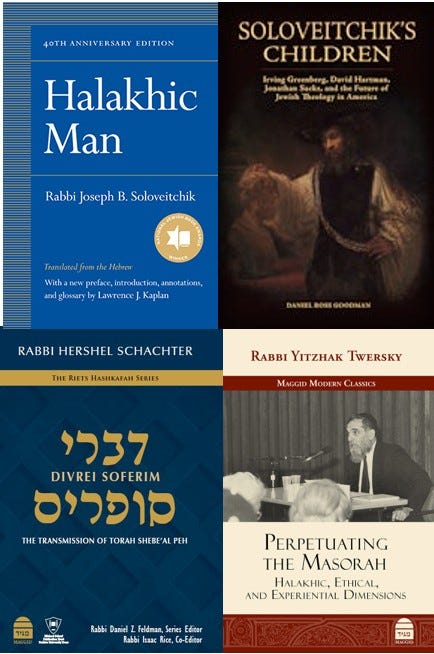
I’m very excited to share my new article, a review essay about “Rav Soloveitchik’s afterlife in the 21st century. The essay examines 4 new books by or about Rav Soloveitchik and his students: the new, 40th anniversary edition of Halakhic Man, Daniel Ross Goodman’s Soloveitchik’s Children, R. Hershel Schacter’s Divrei Sofrim, and R. Yitzhak Twersky’s Perpetuating the Mesorah.
The review tries to give a sense of each book, but my goal was to move beyond that and examine how each book relates to a key thematic binary in Rav Soloveitchik’s thought: autonomy and submission, or, in his language, majesty and humility. I show how each of the four can, to some degree or another, be mapped onto one of those poles, and in fact, how those poles are each central to the books in question.
If these are two critical poles in Rav Soloveitchik’s thought, however, I also show how the poles are coming apart in the works of his students.
The title of my essay draws on the opening line of William Butler Yeat’s poem, “The second Coming”:
Turning and turning in the widening gyre
The falcon cannot hear the falconer;
Things fall apart; the centre cannot hold;
Mere anarchy is loosed upon the world…
But what happens when the falconer is long gone, and the falcon becomes the caretaker of his legacy?
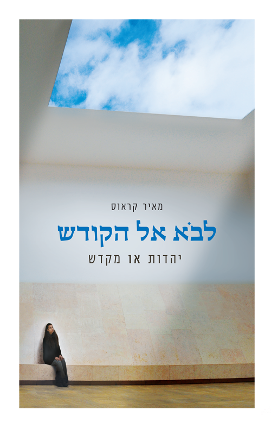
I am proud to share this article by Meir Kraus, which I translated and which went up on the LehrHaus earlier this week. I don’t agree with all of it, but I do agree with a lot of it, and most importantly, it directly raises questions that are often ignored.
The book explores the theological superstructure of the activist movement to rebuild the Beit Hamikdash in Israel today. Those wanting to know more about Kraus’ arguments can see him interviewed here or here.
The desire for the Beit Hamikdash exists in some theological tension with other elements of the Jewish tradition. Perhaps the best example of this is described in a paragraph from Kraus’ article discussing “traditional worship vs. worship in the Temple”:
“To highlight the difference between these two forms of worship, imagine how Yom Kippur looked in the Temple in contrast to how it has looked in the generations since the destruction of the Second Temple. Today, Jews primarily experience Yom Kippur as a day when they stand before God as individuals seeking atonement for their sins, hoping for forgiveness from, and purification before, God. Their primary means in this quest are fasting, repentance, prayer, and charity (teshuvah, tefillah, u-tzedakah). These tools help them experience an inner process of spiritual transformation and purification from sin. This experience takes place in the penitent’s heart, but also between the penitent and God. In contrast, Yom Kippur in the Temple is entirely about the actions of the Kohen Gadol, the High Priest, which aim at receiving atonement before God. The day’s worship (seider ha-avodah) succeeds or fails based on whether or not he fulfills the sacrificial rituals with exactitude in all their meticulous detail, and on this rests the promise of atonement from sin. Neither the individual Jews nor the religious community as a whole are in any way involved in the process.”
“The essence of the day atones”—so on some fundamental level, perhaps there is no difference between the two forms of Yom Kippur. However, in terms of how we actully experience Yom Kippur, a real tension exists between the two. Today, Yom Kippur consists primarily of individual communal fasting and prayer wherein every individual actively participates (barring exceptions for illness, parenting, etc.). In the Beit Hamikdash model, the process of atonement is enacted by the Kohen Gadol in the Beit Hamikdash. There’s not mitsvah of aliyah laregel for Yom Kippur—no reason to think most Jews would have been there to even spectate. We probably have more of an experience of the original Yom Kippur service reading the seder ha’avodah in mussaf than we would have had at the time. In contrast, now our fasting, tefillah, and communal participation are paramount. Do we want to go back?
This is just one example of theological tensions he explores. Others include the relationship of individual mitsvah observance and ethics, and the relationship between physical, geographic space and sancticty.
Do we want to go back?
The foreignness is real. Part of where I part ways with Kraus is that I don’t think that’s necessarily a problem. I’ll close by posting a passage from Franz Rosenzweig dealing with exactly this issue in context of the prayers for sacrifices said in the amidah every day:
“The difference between prescribed prayer and spontaneous prayer is that the latter is born out of the need of the moment, while the former teaches him who prays to feel a need he might otherwise not feel. This is particularly true of the prayers for the messianic age, insofar as they are not merely tuned to the desire for liberation from the pressure of the present Man is sufficiently rooted in all life, even the most difficult, so that, although he may have good reason to long for a partial change, he fears a radical one. And such a radical change, the radical change, is the messianic age, which will indeed set an end to the hell of world history, but also to its ambiguities and seeming lack of responsibilities. In the messianic age everything will become clearly visible, yet man shies away from this perfect clarity and the unequivocal responsibility it entails, just as he shies away from God’s nearness in death, a nearness he may earnestly covet without, however, bringing himself to relinquish his love of life, even of an imperfect and sinful life. For such change is much too radical! Yet he must learn to pray for this radical change even though that prayer may be difficult for him until the change actually occurs.
What Judah ha-Levi discovered when he woke from his dream and returned to the world was that God is with man even in our present world with its inadequacy and confusion, its half-measures and mirages; or, rather, that man is with him, or can find a way to him. If yearning were to forget what it already possesses it would be a lie, but if possession forgot to yearn-that would be death.”
–Nahum Glatzer, Franz Rosenzweig: His Life and Thought, 351–353; the passage is taken from Rosenzweig’s translations of and commentary on poems by R. Yehuda Halevi
Below is an excerpt from the first draft of the dissertation chapter I am currently writing, an excerpt which deals with Avraham’s purchase of a burial plot for Sarah, so I thought I would share this unedited excerpt in honor of this week’s parashah.
In an essay titled “Abraham Mourns Sarah,” Soloveitchik expounds upon the biblical narrative wherein Abraham purchases a burial plot for Sarah, and lays out what he sees as “Judaism’s view of property.”
The property rights of an individual are rooted in his basic right to work, to comply with God’s verdict, “By the sweat of your brow you will eat bread” (Gen. 3:19). Human labor, human fatigue and exhaustion, justify man’s claim to property rights. This belongs to Mr. X because Mr. X worked hard to get it. However, acquisition of goods without investing one’s labor, the sweat of the brow, is morally objectionable. In such a case, a property right is not perfect. When I buy goods, I exchange my labor for those goods. Money represents labor, the sweat and fatigue of the worker. Therefore the goods I buy are absolutely mine, while a gift which I received, lacking the catharsis of work and exhaustion, lacks the redemptive quality. (Out of the Whirlwind, 40–41)
Soloveitchik’s basic theory of acquisition and ownership is Lockean—labor, sweat, and fatigue turn an ownerless object into the property of the laboring, sweating individual. On Locke’s account, a person acquires goods by investing their labor into the goods, comingling something they already own—“the Plough-man’s Pains, the Reaper’s and Thresher’s Toil, and the Baker’s Sweat”—into the goods, thereby extending their ownership to those goods. Soloveitchik adds here a religious dimension, seeing “the catharsis of work and exhaustion” as “redemptive.” Similarly, in a parallel text, Soloveitchik refers to this form of acquisition as “acquisition by sacrifice.” Zionists pioneers sacrifices for the land, and thereby generate their property rights over both the land and its God. Abraham burying his beloved wife in the ground is when he truly acquires it, rather than when he merely exchanged money for it, creating “a grave… hallowed by the sweat and the fright.” If Locke sees acquisition as the mingling of labor into the object, Soloveitchik sees it almost as a sacrificial act. This is in contrast with means of acquiring property which do not involve labor or sacrifice. According to this text, such acquisitions are morally problematic and only partially effective. If a person receives an object as a gift, for example, they do come to own the object, but their property right is imperfect—a point Soloveitchik makes but the implications of which he fails to spell out.
The dynamics of the two forms of acquisition becomes clearer if we look at the two forms of property which result from them. Soloveitchik refers to the two forms of property as “sdeh mikneh” and “sdeh ahuzah,” terms which mean roughly “bought-and-sold land” and “inherited and bequeathed land,” respectively. Acquisition through “legal transaction” creates “legal rights” and a “formal-juridic” relationship between the acquirer and the object. Acquisition through labor and sacrifice creates an essential connection between the acquirer and the object, one which is “eternal.” In contrast to monetary exchange and legal transaction, labor and sacrifice create a bond between the acquirer and the object which removes the latter from the realm of interpersonal economy entirely—it belongs to them eternally. Soloveitchik clearly slides here between a philosophical discourse around property and acquisition, and a theological-existential discourse around essential relationships and values. He even applies the sacrificial acquisition model to how a Jew can “acquire” Jewish values—clearly a very different sense of “acquisition” than the sense of gaining ownership over a physical object. “Sacrifice” serves Soloveitchik as a broad enough concept to yoke together the act of physically transformative labor and the range of actions which demonstrate commitment to Judaism and Jewish values.
This post is just about a point I noticed in The Lonely Man of Faith recently, thanks to an ongoing dialogue about the book with a former student, Mikey Lerman. If you’re not interested in a close reading of The Lonely Man of Faith, maybe come back for the next post.
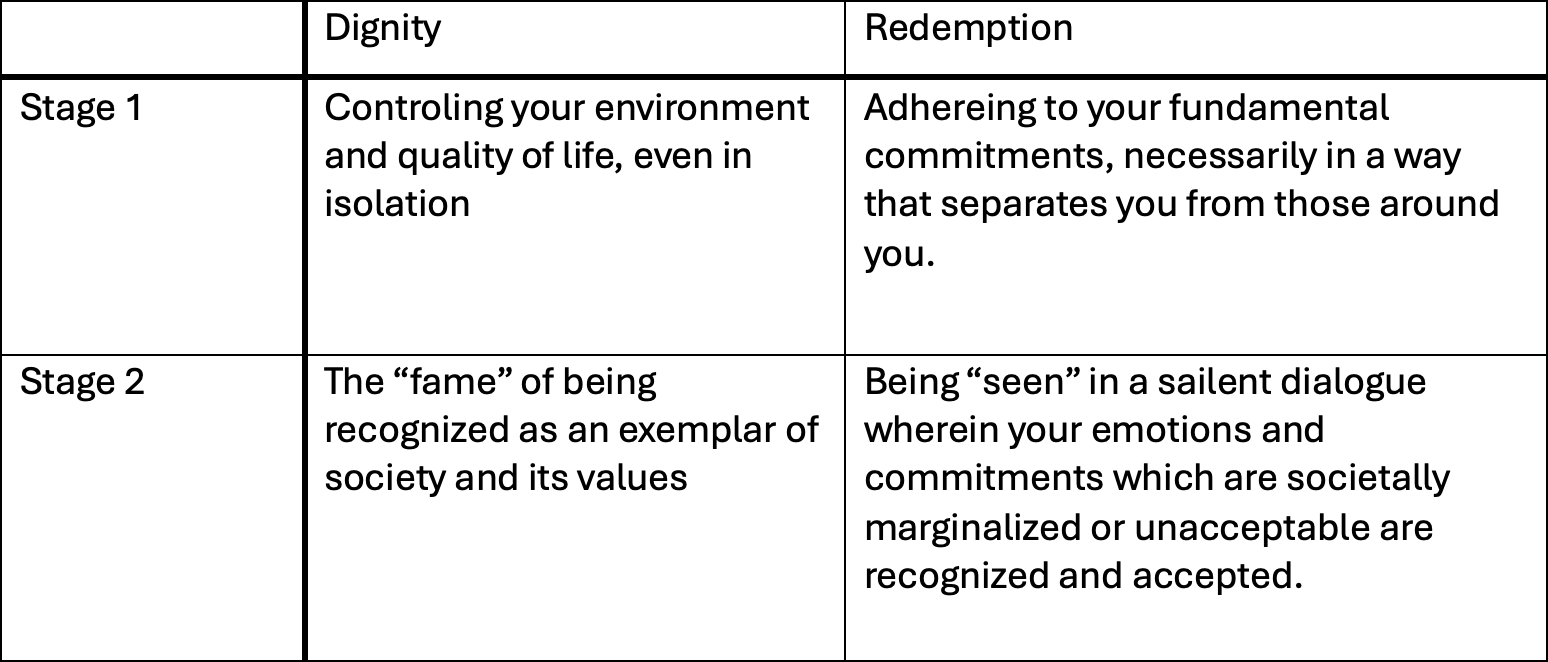
The book is structured around binary ideas, all arranged along the Adam the first/Adam the second binary. In this post, the one that concerns me is “Dignity” vs. “Redemption.” While not stating it directly, Rav Soloveitchik is fairly explicit that redemption is a two-stage process, but I’ve recently come to realizes that not only is dignity also composed of two stages, they parallel the two stages of redemption.
While it comes second in the book, redemption is more explicit, so I’ll start with that.
Redemption
The first stage of redemption, what Rav Soloveitchik calls “cathartic redemptiveness,” is explicitly contrasted with dignity.
There are two basic distinctions between dignity and cathartic redemptiveness:
1. Being redeemed is, unlike being dignified, an ontological awareness. It is not just an extraneous, accidental attribute – among other attributes – of being, but a definitive mode of being itself. A redeemed existence is intrinsically different from an unredeemed. Redemptiveness does not have to be acted out vis-a-vis the outside world. Even a hermit, while not having the opportunity to manifest dignity, can live a redeemed life. Cathartic redemptiveness is experienced in the privacy of one’s in-depth personality, and it cuts below the relationship between the “I” and the “thou” (to use an existentialist term) and reaches into the very hidden strata of the isolated “I” who knows himself as a singular being. When objectified in personal and emotional categories, cathartic redemptiveness expresses itself in the feeling of axiological security. The individual intuits his existence as worthwhile, legitimate, and adequate, anchored in something stable and unchangeable.
2. Cathartic redemptiveness, in contrast to dignity, cannot be attained through man’s acquisition of control of his environment, but through man’s exercise of control over himself. A redeemed life is ipso facto a disciplined life. While a dignified existence is attained by majestic man who courageously surges forward and confronts mute nature – a lower form of being- in a mood of defiance, redemption is achieved when humble man makes a movement of recoil, and lets himself be confronted and defeated by a Higher and Truer Being. God summoned Adam the first to advance steadily, Adam the second to retreat. Adam the first He told to exercise mastery and to “fill the earth and subdue it,” Adam the second, to serve. He was placed in the Garden of Eden “to cultivate it and to keep it.” (LMOF, Maggid 2018, 29–30)
Redemption is, in its first stage, almost antisocial. It undercuts “the relationship between the ‘I’ and the ‘thou’” (and here you can hear Rav Soloveitchik’s engagement with Buber). Cathartic redemptiveness is something a person can attain in isolation, by living a disciplined life guided by faith/their values/etc. The person attaining this level of redemption believes in certain things, they have certain “fundamental commitments” in the language of LMOF, ch. 9, and they choose to live according to them rather than merely based on rational, utilitarian calculus.
The second stage of redemption, in contrast, is specifically attained through a social relationship:
[I]f Adam is to bring his quest for redemption to full realization, he must initiate action leading to the discovery of a companion who, even though as unique and singular as he, will master the art of communicating and, with him, form a community. However, this action, since it is part of the redemptive gesture, must also be sacrificial. The medium of attaining full redemption is, again, defeat. This new companionship is not attained through conquest, but through surrender and retreat. “And the eternal God caused an overpowering sleep to fall upon the man” (Gen. 2:21). Adam was overpowered and defeated—and in defeat he found his companion. (LMOF, 32–33)
If God had not joined the community of Adam and Eve, they would have never been able and would have never cared to make the paradoxical leap over the gap, indeed abyss, separating two individuals whose personal experiential messages are written in a private code undecipherable by anyone else. Without the covenantal experience of the prophetic or prayerful colloquy, Adam absconditus would have persisted in his he-role and Eve abscondita in her she-role, unknown to and distant from each other. Only when God emerged from the transcendent darkness of He-anonymity into the illumined spaces of community knowability and charged man with an ethical and moral mission, did Adam absconditus and Eve abscondita, while revealing themselves to God in prayer and in unqualified commitment, also reveal themselves to each other in sympathy and love on the one hand and in common action on the other. Thus, the final objective of the human quest for redemption was attained; the individual felt relieved from loneliness and isolation. The community of the committed became, ipso facto, a community of friends—not of neighbors or acquaintances. Friendship—not as a social surface-relation but as an existential in-depth-relation between two individuals—is realizable only within the framework of the covenantal community, where in-depth personalities relate themselves to each other ontologically and total commitment to God and fellow man is the order of the day. (LMOF, 57; emphasis added)
The dialogic relationship is the peak of redemption in LMOF. This is not a relationship wherein two people speak to and learn about one another. It is a “sacrificial” act wherein each person opens up to the other without imposing their own understanding upon the other. It is not a rational process, it is essentially about silent listening and acceptance of the other as they present themselves (fully explaining this would require a much longer exploration of dialogue in LMOF; for a key paragraph, see the addendum below). The second stage of redemption is when every person can be “seen” and accepted within a social framework, whether just on the one-to-one level or on level of “the covenantal community.”
Dignity
As we will see, dignity follows the same basic structure. The first stage of dignity is about the capacity to improve one’s life, independent of any social factor.
[M]an is a dignified being and to be human means to live with dignity… Man acquires dignity through glory, through his majestic posture vis-a-vis his environment.
The brute’s existence is an undignified one because it is a helpless existence. Human existence is a dignified one because it is a glorious, majestic, powerful existence. Hence, dignity is unobtainable as long as man has not reclaimed himself from coexistence with nature and has not risen from a non-reflective, degradingly helpless instinctive life to an intelligent, planned, and majestic one. (LMOF, 11–12)
Man of old who could not fight disease and succumbed in multitudes to yellow fever or any other plague with degrading helplessness could not lay claim to dignity. Only the man who builds hospitals, discovers therapeutic techniques, and saves lives is blessed with dignity. Man of the seventeenth and eighteenth centuries who needed several days to travel from Boston to New York was less dignified than modern man who attempts to conquer space, boards a plane at the New York airport at midnight and takes several hours later a leisurely walk along 1he streets of London. (LMOF, 13)
This stage of dignity is simply about quality of life and, more importantly, control over that quality. To be dignified, on this account, is to be able to relieve your own suffering, and to have done so.
However, there is a second stage, because for Rav Soloveitchik, “dignity” is inherently a social term.
Dignity is a social and behavioral category, expressing not an intrinsic existential quality but a technique of living, a way of impressing society, the know-how of commanding respect and attention of the other fellow, a capacity to make one’s presence felt. In Hebrew, the noun kavod, dignity, and the noun koved, weight, gravitas, stem from the same root. The man of dignity is a weighty person. The people who surround him feel his impact. Hence, dignity is measured not by the inner worth of the in-depth personality, but by the accomplishments of the surface personality. No matter how fine, noble, and gifted one may be, he cannot command respect or be appreciated by others if he has not succeeded in realizing his talents and communicating his message to society through the medium of the creative majestic gesture… Dignity is linked with fame. There is no dignity in anonymity. If one succeeds in putting his message across, he may lay claim to dignity. The silent person, whose message remains hidden and suppressed in the in-depth personality, cannot be considered dignified. (LMOF, 20–21)
As in the second stage of redemption, the second stage of dignity is inherently social. To be dignified, at this point, is not simply to relieve your own suffering or improve your quality of life, but to be seen doing so. Such a person is evaluated on the same standard as everyone else, and they emerge as superior (in contrast to the second stage of redemption, wherein the individuals cannot be compared to one another, and to be redeemed is to be seen in your singularity).
To sum up, here it is as a table:
Addendum: Key excerpt on dialogue in The Lonely Man of Faith:
In the natural community which knows no prayer, majestic Adam can offer only his accomplishments, not himself. There is certainly even within the framework of the natural community, as the existentialists are wont to say, a dialogue between the “I” and the “thou.” However, this dialogue may only gratify the necessity for communication which urges Adam the first to relate himself to others, since communication for him means information about the surface activity of practical man. Such a dialogue certainly cannot quench the burning thirst for communication in depth of Adam the second, who always will remain a homo absconditus if the majestic logoi of Adam the first should serve as the only medium of expression. What really can this dialogue reveal of the numinous in-depth personality? Nothing! Yes, words are spoken, but these words reflect not the unique and intimate, but the universal and public in man. As homo absconditus, Adam the second is not capable of telling his personal experiential story in majestic formal terms. His emotional life is inseparable from his unique modus existentiae and therefore, if communicated to the “thou” only as a piece of surface information, unintelligible. This story belongs exclusively to Adam the second, it is his and only his, and it would make no sense if disclosed to others… Distress and bliss, joys and frustrations are incommunicable within the framework of the natural dialogue consisting of common words. By the time homo absconditus manages to deliver the message, the personal and intimate content of the latter is already recast in the lingual matrix, which standardizes the unique and universalizes the individual. (LMOF, 56–57)
The two most popular tellings of Rabbi Akiva’s death (in Bavli Berakhot and Menahot) are mirrors of one another but are also in a sense complementary. Their connection pivots around the relationship between meaning and martyrdom.
Martyrdom, self-sacrifice, is a key theme in the political theological writings of Paul Kahn, whom I have mentioned on here frequently. As he understands it, self-sacrifice is a hermeneutical act—when you sacrifice yourself, you become about something other than yourself. This is what allows him to see a ritual life as a sort of minor act of self-sacrifice—in performing rituals, we dedicate ourselves to a certain ritual, and in doing so become about it and the being who commanded it. In the moment when you perform a ritual, the meaning of your actions derives not from you but from the source of the ritual. Sacrifice radicalizes this dynamic, with the sacrificed person disappearing into the meaning, and not emerging out the other side. In a moment of ritual, the person may still be distracted, and even if performed with total commitment, presence, and focus, the moment will eventually end—with the person remaining. The moment of self-sacrifice is a moment when a person inscribes divine meaning upon their body and self to the degree that their body and self essentially disappear, becoming nothing but vehicles for some greater divine purpose. In this hermeneutical martyrdom, flesh becomes word as the person dies into the signifiers of their social order.
(Kahn loves to invoke the Christological “word become flesh,” but I think the reverse is actually much more apt for what he has in mind, and certainly in a Jewish context makes more sense. I have to recommend here Elliot Wolfson’s article, “The Body in the Text: A Kabbalistic Theory of Embodiment”.)
This hermeneutical martyrdom is first and foremost an individual act: It is the individual who chooses to sacrifice herself for something outside herself, such as God or, as Kahn is tracing out, the state. However, as an interpretive act—an act of meaning—martyrdom has to be witnessed. If a martyr dies alone in a forest, as it were, then they’re not really a martyr. The martyr must “convey” God/the state/their values to someone to whom that is meaningful, the same way words convey meanings to the person who reads or hears them.
There’s a critical political-theological dimension here as well. To cite a passage from Kahn,
“the martyr enters a contest with the state for the privilege of investing a violent act with meaning… The martyrs act of withdrawal from the body is a means of embodying an alternative idea through a competing sacrificial act. That sacrifice denies the state the power to determine the meaning of the martyr s death. Conversely, the state refuses to recognize the martyr’s self-sacrifice, seeing instead only a disloyal criminal whose punished body becomes a visible sign of the state’s conception of itself” (The Reign of Law, 87).
Martyrdom thus asserts that something is worth dying for—that life is not the ultimate value, in terms of the necrotheology I described in my last post. It also specifies what exactly is worth dying for, and what isn’t. Rabbi Akiva is ready to die for the Torah, but we have no reason to believe he would be ready to die for tacos or, for that matter, for the Roman empire.
We can see all of these dynamics at play (or not) in the two deaths of Rabbi Akiva. In the telling in Berakhot, Rabbi Akiva’s martyrdom is first and foremost an act of dedication to the Torah. The Torah is his whole life, as conveyed by the parable of the fish. To die for God/Torah is a good death, in contrast with the death of Pappos. Then Rabbi Akiva says that martyrdom is itself a mitsvah—to die for God/Torah is to fulfill a commandment so total that nothing of you is left afterward. And the story dramatically narrates how his soul leaves his body as he finishes saying the Shema, ending with the word one denoting God’s singularity.
Importantly, at every stage here, Rabbi Akiva has interlocutors to whom the meaning of his death is made clear, either Pappos or his students. It is his students who learn the meaning of the mitsvah of martyrdom just as they watch their teacher willingly die for God and Torah. Even after his death, the Gemara recounts how the angels, outside the social order of the Torah and the mitsvot, still seek the meaning of his death—and receive the answer that is meaningful to them: those who die a good death receive reward in the world to come. This is all in contrast to how the Romans would want his death perceived: as the execution of a criminal.
The opposite dynamics can be seen in the story in Menahot, where the narrator follows not Rabbi Akiva in his dying days but Moshe, as God brings him to witness Rabbi Akiva, first teaching and expounding halakhah and then being tortured to death by the Romans. In both instances, Moshe is too far outside Rabbi Akiva’s social order to find meaning in what he sees. This is true temporally—Moshe comes from too far in the past—but also metaphysically, as his standpoint in the story is essentially that of God, viewing human history from the outside. The maximal degree of meaning he can perceive is alleged continuity (“It is a halakha transmitted to Moses from Sinai”), but no more. When he asks God to make the things he sees make sense (once repeating the angel’s query from the version in Berakhot, “זוֹ תּוֹרָה וְזוֹ שְׂכָרָהּ?”), God simply replies that this is just how things are (“Be silent; this intention arose before Me.”). With no witness to whom Rabbi Akiva can be meaningful, he dies as a victim, not as a martyr. His death receives no explanation, not as a good death, not as a mitsvah, and not even as a source of reward.
The two texts are below. Texts and translations from sefaria.
The Sages taught: One time, after the bar Kokheva rebellion, the evil empire of Rome decreed that Israel may not engage in the study and practice of Torah. Pappos ben Yehuda came and found Rabbi Akiva, who was convening assemblies in public and engaging in Torah study. Pappos said to him: Akiva, are you not afraid of the empire?
Rabbi Akiva answered him: I will relate a parable. To what can this be compared? It is like a fox walking along a riverbank when he sees fish gathering and fleeing from place to place. The fox said to them: From what are you fleeing? They said to him: We are fleeing from the nets that people cast upon us. He said to them: Do you wish to come up onto dry land, and we will reside together just as my ancestors resided with your ancestors? The fish said to him: You are the one of whom they say, he is the cleverest of animals? You are not clever; you are a fool. If we are afraid in the water, our natural habitat which gives us life, then in a habitat that causes our death, all the more so. So too, we Jews, now that we sit and engage in Torah study, about which it is written: “For that is your life, and the length of your days” (Deuteronomy 30:20), we fear the empire to this extent; if we proceed to sit idle from its study, as its abandonment is the habitat that causes our death, all the more so will we fear the empire.
The Sages said: Not a few days passed until they seized Rabbi Akiva and incarcerated him in prison, and seized Pappos ben Yehuda and incarcerated him alongside him. Rabbi Akiva said to him: Pappos, who brought you here? Pappos replied: Happy are you, Rabbi Akiva, for you were arrested on the charge of engaging in Torah study. Woe unto Pappos who was seized on the charge of engaging in idle matters.
When they took Rabbi Akiva out to be executed, it was time for the recitation of Shema. And they were raking his flesh with iron combs, and he was reciting Shema, thereby accepting upon himself the yoke of Heaven. His students said to him: Our teacher, even now, as you suffer, you recite Shema? He said to them: All my days I have been troubled by the verse: With all your soul, meaning: Even if God takes your soul. I said to myself: When will the opportunity be afforded me to fulfill this verse? Now that it has been afforded me, shall I not fulfill it? He prolonged his uttering of the word: One, until his soul left his body as he uttered his final word: One. A voice descended from heaven and said: Happy are you, Rabbi Akiva, that your soul left your body as you uttered: One.
The ministering angels said before the Holy One, Blessed be He: This is Torah and this its reward? As it is stated: “From death, by Your hand, O Lord, from death of the world” (Psalms 17:14); Your hand, God, kills and does not save. God said the end of the verse to the ministering angels: “Whose portion is in this life.” And then a Divine Voice emerged and said: Happy are you, Rabbi Akiva, as you are destined for life in the World-to-Come, as your portion is already in eternal life.
______________________________
Bavli, Menahot 29b
אמר רב יהודה אמר רב בשעה שעלה משה למרום מצאו להקב”ה שיושב וקושר כתרים לאותיות אמר לפניו רבש”ע מי מעכב על ידך אמר לו אדם אחד יש שעתיד להיות בסוף כמה דורות ועקיבא בן יוסף שמו שעתיד לדרוש על כל קוץ וקוץ תילין תילין של הלכות
§ Rav Yehuda says that Rav says: When Moses ascended on High, he found the Holy One, Blessed be He, sitting and tying crowns on the letters of the Torah. Moses said before God: Master of the Universe, who is preventing You from giving the Torah without these additions? God said to him: There is a man who is destined to be born after several generations, and Akiva ben Yosef is his name; he is destined to derive from each and every thorn of these crowns mounds upon mounds of halakhot. It is for his sake that the crowns must be added to the letters of the Torah.
אמר לפניו רבש”ע הראהו לי אמר לו חזור לאחורך הלך וישב בסוף שמונה שורות ולא היה יודע מה הן אומרים תשש כחו כיון שהגיע לדבר אחד אמרו לו תלמידיו רבי מנין לך אמר להן הלכה למשה מסיני נתיישבה דעתו
Moses said before God: Master of the Universe, show him to me. God said to him: Return behind you. Moses went and sat at the end of the eighth row in Rabbi Akiva’s study hall and did not understand what they were saying. Moses’ strength waned, as he thought his Torah knowledge was deficient. When Rabbi Akiva arrived at the discussion of one matter, his students said to him: My teacher, from where do you derive this? Rabbi Akiva said to them: It is a halakha transmitted to Moses from Sinai. When Moses heard this, his mind was put at ease, as this too was part of the Torah that he was to receive.
חזר ובא לפני הקב”ה אמר לפניו רבונו של עולם יש לך אדם כזה ואתה נותן תורה ע”י אמר לו שתוק כך עלה במחשבה לפני אמר לפניו רבונו של עולם הראיתני תורתו הראני שכרו אמר לו חזור [לאחורך] חזר לאחוריו ראה ששוקלין בשרו במקולין אמר לפניו רבש”ע זו תורה וזו שכרה א”ל שתוק כך עלה במחשבה לפני
Moses returned and came before the Holy One, Blessed be He, and said before Him: Master of the Universe, You have a man as great as this and yet You still choose to give the Torah through me. Why? God said to him: Be silent; this intention arose before Me. Moses said before God: Master of the Universe, You have shown me Rabbi Akiva’s Torah, now show me his reward. God said to him: Return to where you were. Moses went back and saw that they were weighing Rabbi Akiva’s flesh in a butcher shop [bemakkulin], as Rabbi Akiva was tortured to death by the Romans. Moses said before Him: Master of the Universe, this is Torah and this is its reward? God said to him: Be silent; this intention arose before Me.
____________________________________
Bonus text: The horrific description of the Romans “raking [Rabbi Akiva’s] flesh with iron combs” immediately brought this passage from Kahn to mind:
“Sacrifice is the inscription on the body of an ideal meaning. The scarred body is a visible symbol of the political meaning for which the individual is willing to give him- or herself. It tells us what that person holds to be of ulti- mate significance—the meanings for which he or she is willing to give up the satisfactions of the private body. The scarred body is always a public text; it proclaims the penetration of political meaning into every point of life’s order.” (The Reign of Law, 85)
This is a post about what I’m calling “Necrotheology,” or theology that balances its concern with life with a concern for death. I’ve adapted the term from critical theories of modern political philosophy, which talks about the state as an entity intended to reserve human life and well-being. Critical theories of politics have pushed back on the idea that well-being is indeed what states are for—what they call “biopolitics”— and argued instead that states are primarily about creating and violently enforcing us/them dynamics, for deciding not just who lives but, more importantly, who dies. This, they refer to as “necropolitics,” a word meant to highlight the subtle, even suppressed, role of death in narratives about the meaning of the state. Adapted from there, “necrotheology” is meant not to celebrate death, but to explore theology (and Jewish theology, specifically) more directly and argue that it does in fact grant a greater role to death than we typically imagine.
In this post, I’m going to lay out the core of classic Jewish life-affirming theology (“biotheology,” if you would) in a pasuk and a midrash thereon, and in one of Rav Soloveitchik’s students. Then, I lay out a different midrash on the same verse, and Rav Soloveitchik’s own opinion, which could certainly be called a “necrotheology.”
“In Them, You Shall Live”
People often talk about how Judaism celebrates life, with it being particularly popular to reference the injunction of pikuaḥ nefesh, saving a life. Based on Vayikra 18:5 (“You shall keep My laws and My rules, you shall do them and in them you shall live; I am God”), the Gemara says that mitsvot were given for people to live, rather than to die (b. Yoma 85b). A Jew should therefore violate commandments in order to save a life, without any hesitation. This is the accepted halakhah throughout all generations, by all commentators, and it is a rule with only a few exceptions. In the modern era, this comes to be seen as an indicator of Judaism’s inherent humanism (and fittingness for modernity). R. Aharon Soloveitchik even cites it to that end (as part of a larger argument) in his monumental article, “‘Mah Enosh’: Reflections on the Relation between Judaism and Humanism.” But this certainly isn’t the only way to think about or interpret this verse, and I’ll return to that below.
“The Primacy of Life”
I’ve been working on a long-form essay reviewing (among other books) Daniel Ross Goodman’s Soloveitchik’s Children (University Alabama Press, 2023). The book is about three rabbis: Jonathan Sacks, David Hartman, and Yitz Greenberg, and their differing relationships with the ideas of R. Joseph Soloveitchik. While working on the review, I’ve spent a lot of time thinking about the authors and theologies involved, and the topic of “life” is one I’ve come back to frequently.
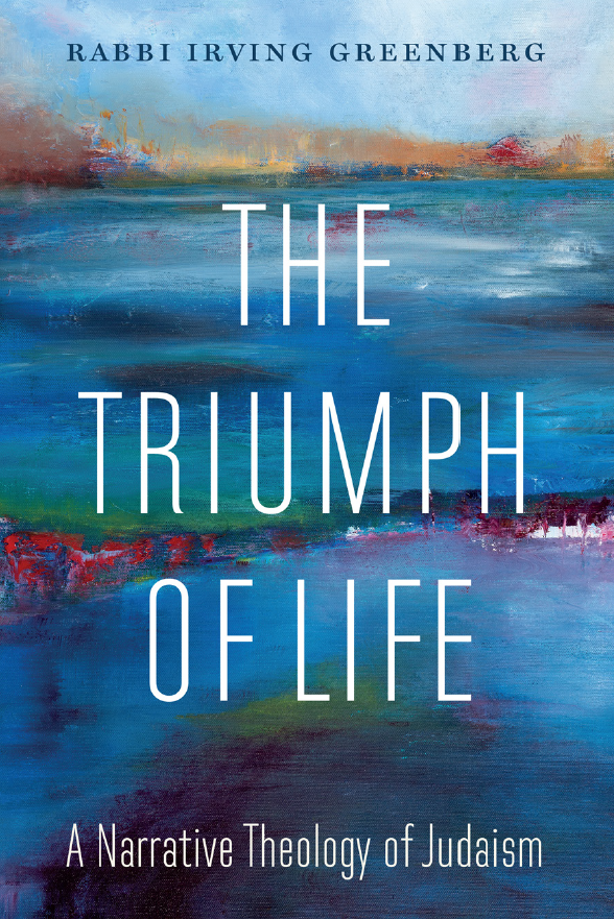
While the book gives a fair amount of space to each, probably the greatest amount of focus is given to Greenberg, and his perspective dominates. “Life” is an incredibly important category for him (his new book is the Triumph of Life; and you can see/listen to him discussing the ideas in the book here and here), and it therefore shows up as a theme throughout Soloveitchik’s Children. A sub-chapter called “The Primacy of Life” explores how this theme shows up in Greenberg, Hartman, and Sacks, and it even has a section on R. Hershel Schacter—generally seen as a student of Soloveitchik’s diametrically opposed to more liberal figures like Hartman and Greenberg—and how he responded to the COVID-19 pandemic.
This sort of vision of Judaism sees it as aimed at promoting human flourishing. Torah, on this model, is a guide for people to thrive, either as individuals, collectives, or both. Greenberg musters an impressive amount of evidence to this effect, presenting texts and laws which present human life—and good human life—as a value. There’s really no question that he’s correct about this. The question is if Greenberg’s (and that of others; I’m just using him as a convenient example) presentation could be too limited or uncomplicated. Perhaps Judaism also values death.
Jewish Necrotheology: “You shall live in them — in the world to come”
“Necrotheology” is a term I’ve made up purely for the purposes of opposing a one-sided emphasis on life as opposed to death. This isn’t to say we should be celebrating death as opposed to life, but rather recognizing that life and death aren’t opposites, that they always come together, and that acting as if they are opposed always obscures their interrelations. Claiming to celebrate life as opposed to death makes it harder to see the way death is always present no matter what.
Turning to specifically Jewish Necrotheology, the ubiquity of death is present in how the Sifra reads Vayikra 18:5:
“And you shall live in them”: in the world to come.
If you would say, in this world, is it not one’s end to die?
How, then, is“and you shall live in them” to be understood?
In the world to come.
“I am the Lord” — Reliable to give reward.
(Translation adapted from Sefaria)
This midrash (cited in Rashi on the pasuk) is diametrically opposed to the standard pikuaḥ nefesh reading. The Gemara reads the “you shall live in them” as a condition for the obligation to keep the mitsvot: you are only obligated to keep mitsvot in situations where doing so does not risk human life. In any other situation, you are exempt. In contrast, the Sifra reads the verse such that keeping the mitsvot is a necessary condition for “life,” and “life” is reread as not as simply being alive but as life after death in the world of reward (hence the last bit of the midrash about the meaning of God’s name). The point of doing mitsvot is not to promote human flourishing in the world but to promote the experience of lifeafter death.
Critically, the Sifra argues that “life” here cannot refer to merely being alive. Why not? Because, as the midrash says, death comes for everyone, even someone who keeps the mitsvot quite fastidiously. Empirically, keeping the mitsvot does not lengthen a person’s life (and see b. Kiddushin 39b, where this problem is discussed in regard to mitsvot where the promise is even more explicit, and it is suggested that the empirical problem is what leads Aher to his famous heresy). Beyond the empirical point, the inevitability of death also suggests that life simply isn’t paramount and perhaps isn’t to be made a basic condition of the mitsvot. In fact, if reward for the mitsvot is imagined to be paid in the afterlife, then dying is a necessity of receiving reward! If doing mitsvot made you live longer, it would be distancing you from receiving the reward for doing those mitsvot, which would be very strange. So while the Sifra is not celebrating or advocating for death, it is saying that we must recognize the place of death in our lives and shift our theologies accordingly.
The Mitsvot as Human Sacrifice: Rav Soloveitchik’s Necrotheology
It is worth noting that Greenberg’s teacher, Rav Soloveitchik, could certainly be said to celebrate self-sacrifice—which is to say, death. Soloveitchik’s Children highlights the life-affirming side of Rav Soloveitchik’s theology (as does Rynhold and Harris’s book on Soloveitchik and Nietzsche) and that’s not wrong, but, again, it presents an incomplete picture. Soloveitchik, in fact, repeatedly and quite explicitly expresses support for human sacrifice, at least on the level of principle. In a lecture on teshuvah, he notes that
Yet, although the Torah forbade human offerings, it did not invalidate the idea behind it that man should sacrifice his own self – “that it is proper that [man] spill his blood and burn his flesh’” (cf. Nahmanides, Leviticus 1:9) – rather than just bring a bull or two pigeons or turtle-doves. God does not seek offerings from man, He seeks man himself. This is the foundation of sacrificial practice, and it is on this idea that the story of the binding of Isaac is based. On unconditional self-sacrifice, body and of soul, the Jewish faith is founded. Judaism does not reject the idea behind human sacrifice. If man is the property of the Holy One, blessed be He, when he hears the voice of God calling to him, “Take now thy son, thine only son … and offer him … for a burnt offering upon one of the mountains which I will tell thee of,” he has no other choice than did Abraham… (“Blotting Out Sin or Elevating Sin,” On Repentance [Maggid, 2017], 161)
The idea of sacrificing the self—of dying for God—is true, he says, and Judaism essentially supports it. It is only as a matter of competing values that Judaism says to avoid it.
Every life is indebted to God, is held by God absolutely and must surrender itself upon demand. And indeed, God demands sacrifices, including the very life of man. The pagan ritual of human sacrifice was prompted by a motif which was basically true. The error of paganism consisted in separating the ethos from the cult. Ritual demands human sacrifice; the ethos, appreciating life as precious, forbids. Judaism was the first religion that combined both and therefore introduced basic changes in the idea of korban, sacrifice, stripping it of its barbarism. We evolved the substitution for the human sacrifice by the physical sacrifice in general, by mental and spiritual surrender to God. (The Emergence of Ethical Man, 43)
In addition to the value of sacrifice, Judaism maintains the value of ethics, and the two contradict. Judaism chooses to resolve this tension in a manner that allows for at least partial resolution—substituting animal sacrifice in place of human sacrifice. The individual still sacrifices something, and perhaps even imagines they were indeed giving up their life, but no human being is harmed.
The ultimate form of this substitution, particularly in post-Temple Judaism, is in ritual observance of the mitsvot.
Nahmanides, at the beginning of Leviticus (1:9), writes that when the Torah uses the word korban, it means human sacrifice and not that of an animal. The Torah, of course, abhors and rejects human sacrifice-but only as far as its physical implementation is concerned. Man belongs to God. All our possessions, all our talents, all our thoughts, all our feelings—everything belongs to God. There is not a single thing in human life which does not belong to Him. There is not a single thing which God does not want man to offer Him, including man himself, including his own existence. An animal is a very inadequate substitute for the real and genuine korban, which is human sacrifice. Yet the Torah says that man can substitute something else for his own being. What the Torah is really out to achieve, of course, is observance of all the mitzvot. God is interested not so much in human sacrifice as in human restraint, human control, human surrender, human submission. If man is ready to sacrifice his life, and spiritually surrenders to God, then he can bring a substitute for himself. God knows man, his frailties, his weaknesses, his indecision, and his self-love; and because of His compassion, His middat harahamim, God substituted animal sacrifice for human sacrifice. (Abraham’s Journey, 69)
Human self-sacrifice, on this model, is elided in favor of doing the mitsvot, and animal sacrifice is a key instance of the category. As Paul Kahn notes in his book, Sacred Violence: Torture, Terror, and Sovereignty, “Ritual is a mediated form of sacrifice. Mediation allows… the displacement of that destruction of the self, which is sacrifice” (120). For Rav Soloveitchik, when a person performs a mitsvah, they perform an act of sacrifice, bringing death and destruction into their lives, even if only in a minor way. They consciously set aside all utilitarian concerns and make their lives about something greater than their lives, at least for a moment.
The contrast with a “Primacy of Life” theology should be clear. Notably, Greenberg says that animal sacrifices “which in fact bring death into the House of God” (The Triumph of Life, 64) represent “a case of utilizing the animal’s life in the service of life” (63), while also being a Maimonidean concession to Israelite culture at the time of the giving of the Torah (64; and cf. 87–88 regarding martyrdom). The mitsvot, for Rav Soloveitchik, are not about human flourishing (except insofar as he thinks sacrifice is an important part of a full human life). In fact, perhaps the ultimate villain of The Lonely Man of Faith is “the religious community,” which refers to people who observe the mitsvot because of how they contribute to human life (what he calls “religious pragmatism”), rather than out of a “fundamental commitment” (characteristic of “the faith community” and individuals of faith). Rav Soloveitchik insists on holding God’s will apart from life and flourishing, and as such God’s will can serve as a basis from which to critique and evaluate “life.”
The Sick Soul: Theology Beyond “Health”
One ramification of this line of thinking may be found in Rav Soloveitchik’s thinking about halakhah’s understanding of “health” in contrast with modern, institutional medical forms of thinking about health. Importantly, he is clear in affirming the importance of medicine for Judaism, rejecting passive, quietist acceptance of sickness and injury as divinely mandated. He even celebrates medicine as a divinely-mandated activity representative of The Lonely Man of Faith’s “Adam the first.” Adam the second must always be kept in mind, however, and this element emerges in an essay in Out of the Whirlwind: Essays on Mourning, Suffering, and the Human Condition (KTAV Publishing, 2003) titled “A Halakhic Approach to Suffering.”
Halakhah wants man to be conqueror and also to be defeated—not defeated by somebody else, not defeated by a friend, not defeated by an outside power, for there is no heroism involved in such a defeat; such a defeat, on the contrary, demonstrates cowardice and weakness. Halakhah wants man to be defeated by himself, to take defeat at his own hands and then reverse the course and start surging forward again and again. This directional movement, like a perennial pendulum, swinging back and forth, gives exhaustive expression to man’s life and to Halakhah.
Is this important for mental health? I believe so. Of course, I cannot spell out here how this doctrine could be developed into a technology of mental health, but I believe this doctrine contains the potential out of which a great discipline of the Judaic philosophy of suffering, an ethic of suffering, and a technology of mental health might emerge… I believe that the trouble with modern man and his problems is what the existentialists keep on emphasizing: anxiety, angst. Man is attuned to success. Modern man is a conqueror, but he does not want to see himself defeated. This is the main trouble. Of course, when he encounters evil and the latter triumphs over him and he is defeated, he cannot “take it”; he does not understand it. (114)
He does not spell out how he imagines this halakhic approach to mental health, but his point is to emphasize that a halakhic approach to mental health would not emphasize the allevation of any and all mental-emotional discomfort. Halakhah cares about mental health above and beyond brute questions of pikuaḥ nefesh, but it may not be fully-accommodating of modern intuitions about relieving discomfort.
Conclusion
This whole topic is deeply jarring to modern sensibilities—celebrating life and human flourishing are just obviously right to us. A word about the importance of what I’m calling “Necrotheology,” of recognizing and making space for death and discomfort within our theologies, is therefore in order. As I see it, its import is two-fold: First, it is simply more accurate to the Jewish tradition, I believe. There have always been elements of Judaism which demand sacrifice, even violence, and pretending they aren’t there chips away at our connection with that tradition.
Secondly, as noted above, celebrating life often just means ignoring the way you are implicated in death. It’s not for nothing that the first Western political philosopher to place life and the promotion of human flourishing at the center of his political theory, Thomas Hobbes, ultimately argued for a violent dictatorship as the ideal form of political regime for serving these goals (for more on this discourse in political theory, google “biopolitics” and “necropolitics”). This is all the more true if the opposition between “life” and “death” gets mapped onto opposing groups. If a group is described as “a death cult,” as “celebrating” or “worshipping” death, then it is hard to imagine building a society with them. We also simply fail to understand them: By locking them into the “death” label, we cannot see other, potentially life-affirming, interpretations of their words and deeds—the vision of life for which they are willing to kill and die.
Celebrating life and encouraging human flourishing are indubitably good! But if we refuse to see sickness and death as inherent parts of our lives, we lose the ability to have important conversations about acceptable risks and about what we ought to sacrifice for the sake of others—when it might be better to die than to kill, as it were.
Postscript
If you’ve made it this far, I should note that the focus on Rav Soloveitchik in this post is not incidental. It’s tangential to my dissertation research but it’s also a much broader exploration. I have a theoretical, book-length project in mind which I may never write, tracing out a critical political theology structured around The Lonely Man of Faith, a work I continue to find to be incredibly rich and fruitful. The first chapter’s working title would be “Faith as Failure, Sickness, and Sacrifice,” and this post is working in a similar vein.
Post-Postscript
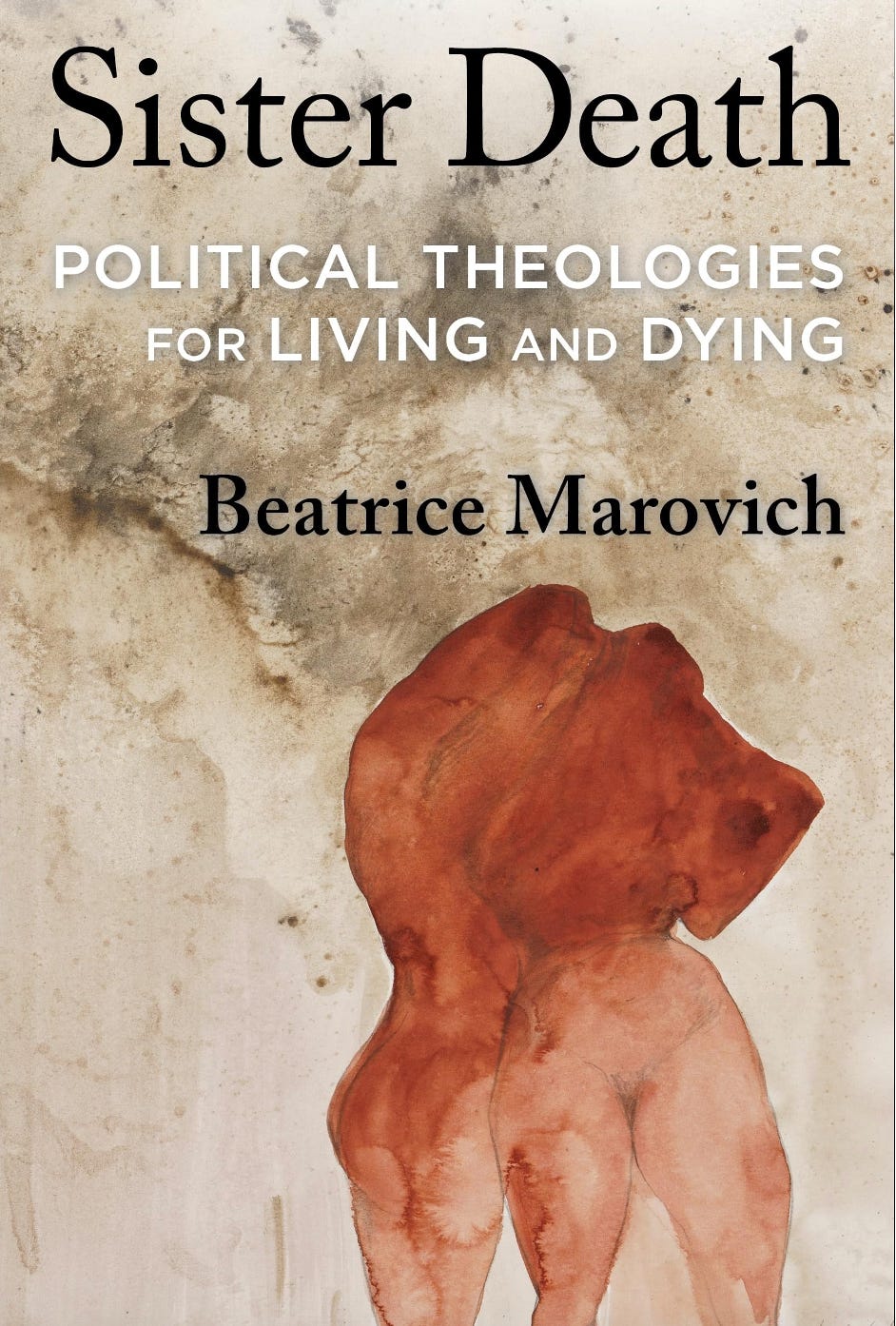
I wrote this blog posts a few months ago, before I had a chance to read Beatrice Marovich’s Sister Death: Political Theologies for Living and Dying.
If you’re interested in thinking through these topics, and particularly in examining how the binary opposition between life and death has manifested throughout much of Christian and Western history, I definitely recommend the book. For anyone interested who doesn’t want to read it, just search for the author’s name on YouTube or in your podcast app and you’ll find a bunch of interviews she did about it.
That said, I should note that the few times she uses the term “necrotheology” in the book, she does so in a critical, wholly negative register, much as the term “necropolitics” mentioned at the beginning of this post is often used. I use the term somewhat more ambivalently and constructively.
This is a short piece I wrote for Tishrei a few years ago, exploring the religious intuition found in a short aphorism from Rav Menachem Froman. Enjoy!
In a fascinating fragment from his small sefer, Hasidim Tsohakim Mizeh, Rav Menachem Froman makes a striking comment on the nature of teshuvah:
“The term for ‘finishing’ (la’avor) a tractate of Talmud derives from the language of ‘transgression’ (averah). I know people who have finished the entirety of the Talmud…
‘Repeating’ (laḥzor) a tractate derives from the language of ‘repentance’ (laḥzor betshuvah).” (Ḥasidim Tsohakim Mizeh §104)
Rav Froman contrasts between two different modes of engaging with learning Torah: finishing vs. repeating—moving on from one masekhta to another to another vs. going over the same masekhta again and again and again. He then—shockingly, if perhaps also playfully—connects these two modes to sin and to repentance, respectively. How are we to understand this connection? Why is learning an increasing number of Torah texts transgressive, while learning the same text numerous times is associated with teshuvah?
One possible explanation might be found in an idea from later in the sefer, where he says, “The evil inclination depends not on what you do but on why you do it. The root of the evil inclination is actions intended just to accumulate achievements” (Ḥasidim Tsohakim Mizeh §132). In this piece, Rav Froman is shifting “the yetser hara” from an idea associated with a specific set of behaviors to an idea associated with a specific motivation: accumulation and consumption—having as a driving force. A few lines later he makes the logical extension of this idea to the area of Torah study: “In this sense, the desire to learn more and more Torah can be an evil inclination. The early leaders of Hasidism strongly opposed Lithuanian Torah study because they saw it as greediness, as the desire to increase the ego, to accumulate Torah achievements, and even spiritual achievements” (ibid.). If the yetser hara is associated with any action performed for the sake of having, then learning Torah in order to have learned yet one more masekhta or one more mishnah is an act motivated by the yetser hara. When we choose to finish one text and move on to the next, rather than returning to the same text and exploring its depths, Rav Froman suggests that we may be engaging in exactly this form of spiritual greed. Teshuvah, in this context, means breaking free from this consumptive impulse and recognizing that the meaning of religious actions—whether Torah study or other mitsvot—lies in doing them, rather than in having done them. It means being truly present in the moment when doing the mitsvah, and perhaps singling out a specific mitsvah which you can learn to do expertly (as suggested by Rambam in his commentary on Mishnah Makkot 3:16).
We can dig deeper into this idea by turning to a text from a Rav Tsadok Hakohen of Lublin. At the beginning of a long passage meditating on the relationship between three interrelated sets of ideas (this world and the next world, non-Jews and Jews, hierarchy and individuality), Rav Tsadok opens by making a surprising identification of power and hierarchy with the Torah: “All hierarchy and authority is a function of words of Torah” (Tsidkat Hatsaddik §231). However, he also argues that Torah contains the power to collapse or flatten out these power structures:
“In truth, the Jewish soul cannot tolerate any hierarchy at all—even when it comes to someone great in wisdom—because each Jew has a portion in Torah… every Jew is connected to a letter of the Torah, and a Torah missing even one letter is invalid. Thus, every Jew needs every other Jew. Even if a Jew has a greater portion in words of Torah, he still doesn’t know anything of the portion of Jew with a smaller portion.” (Ibid.)
Just as Rav Froman spoke about accumulating Torah vs. going over the same Torah, Rav Tsadok speaks of Torah that can be added up and compared—such that some people know more than other people and thus have greater status—vs. Torah that is totally unique to each individual, and which no one else can ever know. Torah knowledge can’t grant any person greater status over any other person, because each person has access to unique Torah which the other person cannot ever learn.
What this means in practice is that you should find and learn the Torah that speaks to you personally, even—especially—if you can’t always explain to other people what about it draws you in. I’ve always loved the Rav Moshe Cordovero’s small mussar sefer, Tomer Devorah, in ways that go beyond the specific passages and ideas I find inside it. I’m just drawn to it.
Taken all together, these great thinkers suggest that part of teshuvah is finding the Torah and the mitsvot which you connect to, without worrying about how manymitsvot you’re doing, and really digging into them, knowing their details, and engaging with them mindfully.
Over Rosh Hashanah I spent some time learning a slim Hebrew volume of Rav Soloveitchik’s shiurim titled, Yemei Zikkaron. It’s full of all kinds of wonderful passages relevant to my ongoing research projects, but one particularly striking bit seemed worth commenting on here.
Rav Soloveitchik’s public image is dominated by the impression made by one of his most famous works, Halakhic Man. Yet scholarly research has often pointed to gaps and differences between this work and other of Rav Soloveitchik’s writings. The most famous is Dov Schwartz’s claim that the work is an esoteric composition, concealing a secret critique of its title figure. Reuven Ziegler and others have also pointed to a more basic point: the figure of the halakhic man could never have written the work Halakhic Man, suggesting that it should not be seen as a perfect reflection of Rav Soloveitchik himself. Making no judgement as to the relationship between the works and their author, I myself have traced out differences between Halakhic Man and Rav Soloveitchik’s other most famous work, The Lonely Man of Faith.
Yemei Zikkaron contains a passage that seems to convey more clearly than any I’ve seen that Halakhic Man is a paean to Rav Soloveitchik’s father, grandfather, and uncle rather than a depiction of his own religious world (though many of the virtues he depicts in it are ones he himself considers ideal as well). This passage also connects to one my current research topics: the place given to emotion in Rav Soloveitchik’s writings. Halakhic Man is, if not emotionless, then current an intellect-first work, while many of Rav Soloveitchik’s other writings center emotion and bewail the emphasis on intellect in Enlightenment modernity. In the following passage, Rav Soloveitchik describes two moments in his youth which bespeak this exact split:
When I was young, I often mentally criticized my father (of blessed memory) and even my grandfather (of blessed memory). Everyone, on at least one occasion, feels like they need to rebel against their parents’ authority. Sometimes the son is hard-hearted and asks challenging questions: “Must a person always live according to halakhah, which seems so dry and emotion-less? Would it be impossible for Judaism to have more kindness and compassion, more gentleness and beauty? Must Shabbat only ever mean “With what do we light” (m. Shabbat 2) or “A general rule” (m. Shabbat 7:1)?
You have to wander a long road through many strange lands and foreign cultures, with the best representatives of the gentiles and with people from the very peak of their cultures to ultimately arrive at a different evaluation. You have to see how exiles of the global culture live in order to understand from the outside the true greatness of the Halakhic Man, the glory of my father’s house. One of R. Hayyim’s former students—who had left Brisk for a very different world and become a famous mathematician—once said: “For years, I was very judgmental toward R. Hayyim, criticizing many of his practices. However, after decades under foreign skies, I have met many people, including some true greats. I met two important scientists who were famous not only for their scientific achievements but also for their ethical behavior. Only now do I understand R. Hayyim’s ethical greatness. What R. Hayyim (of blessed memory) had in his thumb, they did not possess in the whole breadth of their hearts…” (Yemei Zikkaron, 104–105; translation by Levi Morrow)
In the first part of this rich passage, Rav Soloveitchik describes his own criticism of and alienation from his father and grandfather, describing it even as rebellion against their authority. Fleshing out his disagreement with them, he points to the centrality they place on halakhah, and specifically on halakhah as something dry and emotionless. Judaism, on this view, is exhausted by halakhic categories, and those categories speak only to the mind and the will, never to feeling, enthusiasm, or passion.
In the second scene, Rav Soloveitchik describes a conversation with a famous mathematician who had once been a student of R. Hayyim (Rav Soloveitchik’s grandfather). The student attests to having met many great people, accomplished scientists and ethical exemplars. Yet their ethical natures paled in comparison to that of R. Hayyim. Whether he was more ethical in practice, in principle, in thoughtfulness, or in some other manner is not clarified, but it is clear that he far outpaces the ethics of mathematicians and scientists.
The point of comparison between the scientists and mathematicians, on the one hand, and the halakhic man, on the other, is quite fitting. R. Soloveitchik compares the types of figures frequently throughout Halakhic Man—the halakhic man is a sort of scientist who works with halakhah rather than raw data about the world. And despite their similarities, the halakhic man far outstrips them in terms of ethics. This is related to the chapter toward the end of Part I of Halakhic Man, I:15 in the English and I:12 in the Hebrew, where R. Soloveitchik talks about the halakhic man as concerned with ethics and justice, as well as to the discussion earlier in Part I where he differentiates Judaism and Christianity/Mysticism based on the latter abandoning the world and the body, leading to disastrous ethical consequences.
For our purposes, it is significant that the point of alienation and the point of valorization are not identical. Rav Soloveitchik feels alienated from his forebears in terms of emotion and passion, while he valorizes their ethics. This gives him a reason to celebrate them, but it does not erase the differences between them which he first articulated. Halakhic Man can thus very clearly be a book celebrating his father and associated figures without Rav Soloveitchik agreeing with all of it. He was able “to understand from the outside the true greatness of the Halakhic Man, the glory of [his] father’s house”—but from the outside, specifically.
The first derashah in “Living Time,” “The Matter Depends Upon Me Alone,” holds a special place in my heart. It was one of the first essays by Rav Shagar I ever read, and it really grabbed me. After reading it, I knew I had to read more—and I’ve heard similar reports from several other people. The derashah is primarily an extended commentary or meditation on the story of R. Elazar ben Durdayya, depicted as a wild lothario who repents, and “acquires his share [in the World-to-Come] in one moment.” While the essay contains much more than just this, it pivots around two key concepts with broad relevance in Rav Shagar’s writings: decision and illumination.
First, decision. Rav Shagar is fundamentally a theologian of freedom and choice. “Faith Shattered and Restored” contains a whole essay on the topic, “Freedom and Holiness,” and that’s hardly Rav Shagar’s only text about it. His first ever published sefer (other than some smaller booklets) was a book on teshuvah titled “Return, My Soul: Grace or Freedom?” (שובי נפשי: חסד או חירות?), and expounds several approaches to Teshuvah which tie it directly to freedom of choice (with grace corresponding to what I am here calling “illumination”). He sees baselessly choosing to believe as a valid approach to faith and sees choice as means of creating our “selves.” Even when Rav Shagar emphasizes divine involvement in an individual’ life and in history, his emphasis is on the human choice about how to respond to this divine involvement.
In “The Matter Depends Upon Me Alone,” freedom takes the form of critical self-awareness, the ability to act upon the recognition that “You are the one who sinned, and you are the one who repents” (4–5; 7 n.3). R. Elazar ben Durdayya spends much of the narrative appealing to different forces to save him, only to finally realize that he alone can save himself. He must repent, and do so as an act of his own volition: “he needed nothing but himself, not long conversations or musar pep-talks, not people or ideas or books, but only his sincerity, his deep will, his self” (5). We often feel like we are looking for that one thing which will do the job, which will help us change and become someone different, but for Rav Shagar, this is an abdication of responsibility. You need to strip away the false beliefs and hopes which keep you distracted and always looking outside yourself, and finally make the choices you need to make. (This is quite the “musar pep-talk,” as it were.)
This emphasis on personal decision and the way it can shape a life appears in perhaps its most radical form in the Yom Hashoah derashah, “Muteness and Faith,” in a section titled “Decisiveness Beyond the Divine: The Klausenburger Rebbe.” I very nearly considered translating the Hebrew section title, “נחרצות מעבר לאלוקי,” as “Overruling the Divine,” and while I think it’s good that we didn’t go in that direction, that does capture something of what Rav Shagar is getting at. Rav Shagar describes how the Klausenburger Rebbe survived the Holocaust, highlighting his refusal to ever violate halakhah. “During his many sufferings, no matter how bad things were, he took it upon himself to never transgress any law of the Torah or eat any non-kosher food” (199). While he instructed others to follow the normative ruling that survival takes priority over halakhah, “For himself, however, he insisted: ‘Master of the World, I am all alone, I have nothing. You took everything from me…. I am laid bare, exposed, and now you want me to eat treif? I don’t want to eat treif! I will not eat it!’” (200). Rav Shagar depicts this as an act of personal freedom, and as a two-fold rebellion:
The Rebbe’s insistence on refusing to question God and committing to the Torah and the commandments, often to the point of near death, was an expression of his personal rebellion against the Nazis. Despite this, his faith and commitment to his God actually gave him a certain degree of freedom in relation to a God who had ‘betrayed’ him, or, to use religious language, a God who had ‘hidden His face from him.’ In this way, the Rebbe’s rebellion was a rebellion against a God who wanted him to question divine justice. The Rebbe’s personal struggle to maintain his Judaism exceeded his faith in God. God surely had not commanded him to keep Shabbat or only eat kosher in this terrible situation! His decision to live as a Jew and not violate any religious prohibition stemmed from him experiencing his Judaism as the totality of existence, transcending beyond even the divine command itself. (200–201)
As Rav Shagar reads him, the Klausenburger Rebbe was decisively committed to Judaism—to the Torah, mitsvot, and halakhah—well beyond what God or the Torah would ever ask of a person. Neither the Nazis nor even God could ever shake him loose from his observance—“he placed Judaism’s devotion, intimacy, and ultimately holiness itself, beyond God” (201). Invoking the idea that “צדיק גוזר והקב״ה מקיים,” “A righteous person decrees and God fulfills,” Rav Shagar says that the Klausenburger was able to keep halakhah even when he wasn’t supposed to, because “This was a revelation of the very essence of his life, and as a righteous person, he forced God to accept it” (201–202). His creative decision can even overrule God, as it were.
This brings us to the topic of illumination, another key theme for Rav Shagar. “The moment of illumination [is] when all the different threads of existence come together – the moment when the story is born” (69). This is “a sense of self-evidence that ties things together” (66), a sudden awareness or comprehension comes unbidden to a person. It cannot be decided upon, it simply occurs. At most, a person can make themselves open to it. The question is what causes that illumination, and what do you do it strikes? For the Klausenburger, the answer is clear: The illumination was caused by the Holocaust, by the desperate situation in which he was forced to choose between life and Torah. In these circumstances, there was no question for him of what he would do: he chose to continue observing halakhah.
For R. Elazar ben Durdayya, the illumination is a little less clear. Caught by surprise by a prostitute’s flatulence, he is further confounded by her oracular pronouncement: “Just as this passed wind will not return to its place, so too Elazar ben Durdayya will not be accepted in repentance.” For Rav Shagar, this statement is not simply a hopeless condemnation for a life lived in sin—it is the revelation of mortality itself. R. Elazar ben Durdayya doesn’t simply hear that he cannot avoid punishment for his actions—he hears that his actions matter, that because we are finite—because we died—all of our actions are irrevocable. Even if you can go back and undo specific consequences from your actions, you still did them. Time only moves in one direction, and there is no way of restoring past circumstances. Perhaps given infinite time, the world would repeat itself, but that is not the life we live. The live we live is one where you only get to make each decision once, and you have to live with its consequences. It was this illumination that enabled R. Elazar ben Durdayya “to acquire his share [in the World-to-Come] in a single moment.”
Decision and illumination are both opposites and complementary. One is an intentional act, and one must come unbidden. But the real moment of decision always comes after a moment of illumination, and illumination can only come if you choose to be open to it in advance. This dialectical relationship emerges quite clearly in Rav Shagar’s derashot for Shavuot. In “The Folded Torah,” he notes that
Rabbi Nahman teaches us that a person must be open to experiencing revelation, responding to it, as well as accepting the price of this response. The reason people do not experience revelation of truth is not because they seek but do not find it. Rather it is because they are never even open to its presence to begin with. They are not willing to pay the price of revelation. (261)
Being open to revelation can be very destabilizing. It means being open to the possibility of something new, something which may differ radically from the old. As he says in an essay ultimately cut from the book, sometimes people unwilling to ask what God’s will really is “don’t actually have faith that God wants something from them at all” (Luhot U’shivrei Luhot, 140). The most thorough exploration of this topic in “Living Time” is the derashah, “The Name of the Father,” which is wholly dedicated to the tension between creativity and illumination, on the one hand, and loyalty and tradition, on the other. Weaving Lacan and Badiou together with Lurianic Kabbalah and creative readings of Shemot, Rav Shagar tries to get at “The combination of revelation and loyalty to that revelation is, as per Badiou, how truth appears” (172).
Back when I thought Living Time would be released in Fall 2023, I wrote a short essay for 18Forty on Rav Shagar’s thinking around teshuvah which draws on the first essay or two in the book. Now that the book is finally available, I’m reposting the link to the essay here.
The first essay in “Living Time” (an extended reading of the R. Elazar Ben Dordaya story) holds a special place in my heart, and b”h I’ll post about it here in the next few weeks.


 Novel Formulations