The Parker Solar Probe

25 December, 2024

Today, December 24th 2024, the Parker Solar Probe got 7 times closer to the Sun than any spacecraft ever has, going faster than any spacecraft ever has—690,000 kilometers per hour. WHEEEEEE!!!!!!!

But the newspapers are barely talking about the really cool part: what it’s like down there. The Sun doesn’t have a surface like the Earth does, since it’s all just hot ionized gas, called ‘plasma‘. But the Sun has an ‘Alfvén surface’—and the probe has penetrated that.

What’s the Alfvén surface? In simple terms, it’s where the solar wind—the hot ionized gas emitted by the Sun—breaks free of the Sun and shoots out into space. But to understand how cool this is, we need to dig a bit deeper.

After all, how can we say where the solar wind “breaks free of the Sun”?

Hot gas shoots up from the Sun, faster and faster due to its pressure, even though it’s pulled down by gravity. At some point it goes faster than the speed of sound! This is the Alfvén surface. Above this surface, the solar wind becomes supersonic, so no disturbances in its flow can affect the Sun below.

It’s sort of like the reverse of a black hole! Light emitted from within the event horizon of a black hole can’t get out. Sound emitted from outside the Alfvén surface of the Sun can’t get in.

Or, it’s like the edge of a waterfall, where the water starts flowing so fast that waves can’t make it back upstream.

That’s pretty cool. But it’s even cooler than this, because ‘sound’ in the solar wind is very different from sound on Earth. Here we have air. The Sun has ions—atoms of gas so hot that electrons have been ripped off—interacting with powerful magnetic fields. You can visualize these fields as tight rubber bands, with the ions stuck to them. They vibrate back and forth together!

You could call these vibrations ‘sound’, but the technical term is Alfvén waves. Alfvén was the one who figured out how fast these waves move. Parker studied the surface where the solar wind’s speed exceeds the speed of the Alfvén waves.

And now we’ve gone deep below that surface!

This realm is a strange one, and the more we study it, the more complex it seems to get.

You’ve probably heard the joke that ends “consider a spherical cow”. Parker’s original model of the solar wind was spherically symmetric, so he imagined the solar wind shooting straight out of the Sun in all directions. In this model, the Alfvén surface is the sphere where the wind becomes faster the Alfvén waves. There are some nice simple formulas for all this.

But in fact the Sun’s surface is roiling and dynamic, with sunspots making solar flares, and all sorts of bizarre structures made of plasma and magnetic fields, like spicules, ‘coronal streamers’ and ‘pseudostreamers’… aargh, too complicated for me to understand. This is an entire branch of science!

So, the Alfvén surface is not a mere sphere: it’s frothy and randomly changing. The Parker Solar Probe will help us learn how it works—along with many other things.

Finally, here’s something mindblowing. There’s a red dwarf star 41 light years away from us, called TRAPPIST-1, which may have six planets beneath its Alfvén surface! This means these planets can create Alfvén waves in the star’s atmosphere. Truly the music of the spheres!

For more, check out these articles:

• Wikipedia, Alfvén wave.

• Wikipedia, Alfvén surface.

and this open-access article:

• Steven R. Cranmer, Rohit Chhiber, Chris R. Gilly, Iver H. Cairns, Robin C. Colaninno, David J. McComas, Nour E. Raouafi, Arcadi V. Usmanov, Sarah E. Gibson and Craig E. DeForest, The Sun’s Alfvén surface: recent insights and prospects for the Polarimeter to Unify the Corona and Heliosphere (PUNCH), Solar Physics 298 (2023).

A quote:

Combined with recent perihelia of Parker Solar Probe, these studies seem to indicate that the Alfvén surface spends most of its time at heliocentric distances between about 10 and 20 solar radii. It is becoming apparent that this region of the heliosphere is sufficiently turbulent that there often exist multiple (stochastic and time-dependent) crossings of the Alfvén surface along any radial ray.


Epicycles

22 December, 2024

Some people think medieval astronomers kept adding ‘epicycles’ to the orbits of planets, culminating with the Alfonsine Tables created in 1252. The 1968 Encyclopædia Britannica says:

By this time each planet had been provided with from 40 to 60 epicycles to represent after a fashion its complex movement among the stars.

But this is complete nonsense!

Medieval astronomers did not use so many epicycles. The Alfonsine Tables, which the Brittanica is mocking above, actually computed planetary orbits using the method in Ptolemy’s Almagest, developed way back in 150 AD. This method uses at most 31 circles and spheres—nothing like Britannica’s ridiculous claim of between 40 to 60 epicycles per planet.

The key idea in Ptolemy’s model was this:

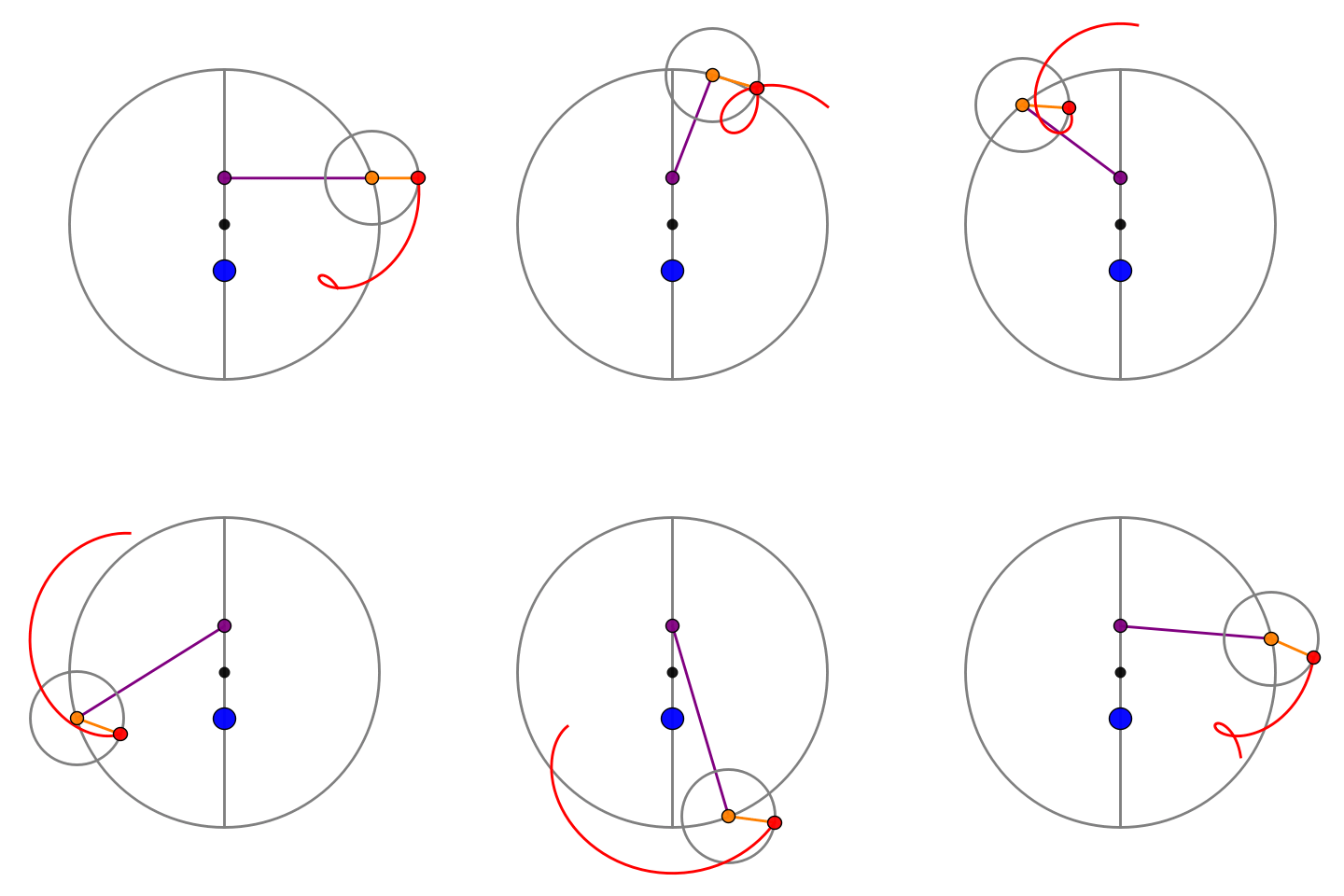
The blue dot here is the Earth. The large black circle, offset from the Earth, is called a ‘deferent’. The smaller black circle is called an ‘epicycle’. The epicycle makes up for how in reality the Earth is not actually stationary, but moving around the Sun.

The center of the epicycle rotates at constant angular velocity around the purple dot, which is called the ‘equant’. The equant and the Earth are at equal distances from the center of the black circle. Meanwhile the planet, in red, moves around the center of the epicycle at constant angular velocity.

In the Almagest, Ptolemy used some additional cycles to account for how the latitudes of planets change over time. In reality this happens because the planets don’t all move in the same plane. Ptolemy also used additional ‘epicyclets’ to account for peculiarities in the orbits of Mercury and the Moon, and a mechanism to account for the precession of equinoxes—which really happens because the Earth’s axis is slowly precessing.

In a later work, the Planetary Hypothesis, Ptolemy eliminated some cycles by having the planets orbit in different planes (as they indeed do). On the other hand, he considered adding other cycles (or actually spheres) for physical purposes. Depending on how you define things, this setup either has more cycles than the Almagest, or a bit fewer.

Anyway, there was never a population explosion of epicycles to the wild degree that the 1968 Brittanica claimed. So, just because something is in an encyclopedia, or even an encyclopædia, doesn’t mean it’s true.

The Encyclopædia Britannica quote comes from their 1968 edition, volume 2, in the article on the Spanish king Alfonso X, which on page 645 discusses the Alfonsine Table commissioned by this king:

By this time each planet had been provided with from 40 to 60 epicycles to represent after a fashion its complex movement among the stars. Amazed at the difficulty of the project, Alfonso is credited with the remark that had he been present at the Creation he might have given excellent advice.

In The Book Nobody Read, Owen Gingerich writes that he challenged Encyclopædia Britannica about the number of epicycles. Their response was that the original author of the entry had died and its source couldn’t be verified. Gingerich has also expressed doubts about the quotation attributed to King Alfonso X.

For the controversy over whether medieval astronomers used lots of epicycles, start here:

• Wikipedia, Deferent and epicycle: history.

and then go here:

• Wikipedia, Deferent and epicycle: the number of epicycles.

Then dig into the sources! For example, Wikipedia says the claim that the Ptolemaic system uses about 80 circles seems to have appeared in 1898. It may have been inspired by the non-Ptolemaic system of Girolamo Fracastoro, who used either 77 or 79 orbs. So some theories used lots of epicycles—but not the most important theories, and nothing like the 240-360 claimed by the 1968 Brittanica.

Owen Gingerich wrote The Book Nobody Read about his quest to look at all 600 extant copies of Copernicus’ De revolutionibus. The following delightful passage was contributed by pglpm on Mastodon:


Martianus Capella

7 December, 2024

In 1543, Nicolaus Copernicus published a book arguing that the Earth revolves around the Sun: De revolutionibus orbium coelestium.

This is sometimes painted as a sudden triumph of rationality over the foolish yet long-standing belief that the Sun and all the planets revolve around the Earth. As usual, this triumphalist narrative is oversimplified. In the history of science, everything is always more complicated than you think.

First, Aristarchus had come up with a heliocentric theory way back around 250 BC. While Copernicus probably didn’t know all the details, he did know that Aristarchus said the Earth moves. Copernicus mentioned this in an early unpublished version of De revolutionibus.

Copernicus also had some precursors in the Middle Ages, though it’s not clear whether he was influenced by them.

In the 1300’s, the philosopher Jean Buridan argued that the Earth might not be at the center of the Universe, and that it might be rotating. He claimed—correctly in the first case, and only a bit incorrectly in the second—that there’s no real way to tell. But he pointed out that it makes more sense to have the Earth rotating than have the Sun, Moon, planets and stars all revolving around it, because

it is easier to move a small thing than a large one.

In 1377 Nicole Oresme continued this line of thought, making the same points in great detail, only to conclude by saying

Yet everyone holds, and I think myself, that the heavens do move and not the Earth, for “God created the orb of the Earth, which will not be moved” [Psalms 104:5], notwithstanding the arguments to the contrary.

Everyone seems to take this last-minute reversal of views at face value, but I have trouble believing he really meant it. Maybe he wanted to play it safe with the Church. I think I detect a wry sense of humor, too.

Martianus Capella

I recently discovered another fascinating precursor of Copernicus’ heliocentric theory: a theory that is neither completely geocentric nor completely heliocentric! And that’s what I want to talk about today.

Sometime between 410 and 420 AD, Martianus Capella came out with a book saying Mercury and Venus orbit the Sun, while the other planets orbit the Earth!


This picture is from a much later book by the German astronomer Valentin Naboth, in 1573. But it illustrates Capella’s theory—and as we’ll see, his theory was rather well-known in western Europe starting in the 800s.

First of all, take a minute to think about how reasonable this theory is. Mercury and Venus are the two planets closer to the Sun than we are. So, unlike the other planets, we can never possibly see them more than 90° away from the Sun. In fact Venus never gets more than 48° from the Sun, and Mercury stays even closer. So it looks like these planets are orbiting the Sun, not the Earth!

But who was this guy, and why did he matter?

Martianus Capella was a jurist and writer who lived in the city of Madauros, which is now in Algeria, but in his day was in Numidia, one of six African provinces of the Roman Empire. He’s famous for a book with the wacky title De nuptiis Philologiae et Mercurii, which means On the Marriage of Philology and Mercury. It was an allegorical story, in prose and verse, describing the courtship and wedding of Mercury (who stood for “intelligent or profitable pursuit”) and the maiden Philologia (who stood for “the love of letters and study”). Among the wedding gifts are seven maids who will be Philology’s servants. They are the seven liberal arts:

The Trivium: Grammar, Dialectic, Rhetoric.
The Quadrivium: Geometry, Arithmetic, Astronomy, Harmony.

In seven chapters, the seven maids explain these subjects. What matters for us is the chapter on astronomy, which explains the structure of the Solar System.

This book De nuptiis Philologiae et Mercurii became very important after the decline and fall of the Roman Empire, mainly as a guide to the liberal arts. In fact, if you went to a college that claimed to offer a liberal arts education, you were indirectly affected by this book!

Here is a painting by Botticelli from about 1485, called A Young Man Being Introduced to the Seven Liberal Arts:


The Carolingian Renaissance

But why did Martianus Capella’s book become so important?

I’m no expert on this, but it seems as the Roman Empire declined there was a gradual dumbing down of scholarship, with original and profound works by folks like Aristotle, Euclid, and Ptolemy eventually being lost in western Europe—though preserved in more civilized parts of the world, like Baghdad and the Byzantine Empire. In the west, eventually all that was left were easy-to-read popularizations by people like Pliny the Elder, Boethius, Macrobius, Cassiodorus… and Martianus Capella!

By the end of the 800s, many copies of Capella’s book De nuptiis Philologiae et Mercurii were available. Let’s see how that happened!


Expansion of the Franks

To set the stage: Charlemagne became King of the Franks in 768 AD. Being a forward-looking fellow, he brought in Alcuin, headmaster of the cathedral school in York and “the most learned man anywhere to be found”, to help organize education in his kingdom.

Alcuin set up schools for boys and girls, systematized the curriculum, raised the standards of scholarship, and encouraged the study of liberal arts. Yes: the liberal arts as described by Martianus Capella! For Alcuin this was all in the service of Christianity. But scholars, being scholars, took advantage of this opportunity to start copying the ancient books that were available, writing commentaries on them, and the like.

In 800, Charlemagne became emperor of what’s now called the Carolingian Empire. When Charlemagne died in 814 a war broke out, but it ended in 847. Though divided into three parts, the empire flourished until about 877, when it began sinking due to internal struggles, attacks from Vikings in the north, etc.

The heyday of culture in the Carolingian Empire, roughly 768–877, is sometimes called the Carolingian Renaissance because of the flourishing of culture and learning brought about by Alcuin and his successors. To get a sense of this: between 550 and 750 AD, only 265 books have been preserved from Western Europe. From the Carolingian Renaissance we have over 7000.

However, there was still a huge deficit of the classical texts we now consider most important. As far as I can tell, the works of Aristotle, Eratosthenes, Euclid, Ptolemy and Archimedes were completely missing in the Carolingian Empire. I seem to recall that from Plato only the Timaeus was available at this time. But Martianus Capella’s De nuptiis Philologiae et Mercurii was very popular. Hundreds of copies were made, and many survive even to this day! Thus, his theory of the Solar System, where Mercury and Venus orbited the Sun but other planets orbited the Earth, must have had an out-sized impact on cosmology at this time.

Here is part of a page from one of the first known copies of De nuptiis Philologiae et Mercurii:


It’s called VLF 48, and it’s now at the university library in Leiden. Most scholars say it dates to 850 AD, though Mariken Teeuwen has a paper claiming it goes back to 830 AD.

You’ll notice that in addition to the main text, there’s a lot of commentary in smaller letters! This may have been added later. Nobody knows who wrote it, or even whether it was a single person. It’s called the Anonymous Commentary. This commentary was copied into many of the later versions of the book, so it’s important.

The Anonymous Commentary

So far my tale has been a happy one: even in the time of Charlemagne, the heliocentric revolt against the geocentric cosmology was brewing, with a fascinating ‘mixed’ cosmology being rather well-known.

Alas, now I need to throw a wet blanket on that, and show how poorly Martianus Capella’s cosmology was understood at this time!

The Anonymous Commentary actually describes three variants of Capella’s theory of the orbits of Mercury and Venus. One of them is good, one seems bad, and one seems very bad. Yet subsequent commentators in the Carolingian Empire didn’t seem to recognize this fact and discard the bad ones.

These three variants were drawn as diagrams in the margin of VLF 48, but Robert Eastwood has nicely put them side by side here:

The one at right, which the commentary attributes to the “Platonists”, shows the orbit of Mercury around the Sun surrounded by the larger orbit of Venus. This is good.

The one in the middle, which the commentary attributes to Martianus Capella himself, shows the orbits of Mercury and Venus crossing each other. This seems bad.

The one at left, which the commentary attributes to Pliny, shows orbits for Mercury and Venus that are cut off when they meet the orbit of the Sun, not complete circles. This seems very bad—so bad that I can’t help but hope there’s some reasonable interpretation that I’m missing. (Maybe just that these planets get hidden when they go behind the Sun?)

Robert Eastwood attributes the two bad models to a purely textual approach to astronomy, where commentators tried to interpret texts and compare them to other texts, without doing observations. I’m still puzzled.

Copernicus

Luckily, we’ve already seen that by 1573, Valentin Naboth had settled on the good version of Capella’s cosmology:


That’s 30 years after Copernicus came out with his book… but the clarification probably happened earlier. And Copernicus did mention Martianus Capella’s work. In fact, he used it to argue for a heliocentric theory! In Chapter 10 of De Revolutionibus he wrote:

In my judgement, therefore, we should not in the least disregard what was familiar to Martianus Capella, the author of an encyclopedia, and to certain other Latin writers. For according to them, Venus and Mercury revolve around the sun as their center. This is the reason, in their opinion, why these planets diverge no farther from the sun than is permitted by the curvature of their revolutions. For they do not encircle the earth, like the other planets, but “have opposite circles”. Then what else do these authors mean but that the center of their spheres is near the sun? Thus Mercury’s sphere will surely be enclosed within Venus’, which by common consent is more than twice as big, and inside that wide region it will occupy a space adequate for itself. If anyone seizes this opportunity to link Saturn, Jupiter, and Mars also to that center, provided he understands their spheres to be so large that together with Venus and Mercury the earth too is enclosed inside and encircled, he will not be mistaken, as is shown by the regular pattern of their motions.

For [these outer planets] are always closest to the earth, as is well known, about the time of their evening rising, that is, when they are in opposition to the sun, with the earth between them and the sun. On the other hand, they are at their farthest from the earth at the time of their evening setting, when they become invisible in the vicinity of the sun, namely, when we have the sun between them and the earth. These facts are enough to show that their center belongs more to then sun, and is identical with the center around which Venus and Mercury likewise execute their revolutions.

Conclusion

What’s the punchline? For me, it’s that there was not a purely binary choice between geocentric and heliocentric cosmologies. Instead, many options were in play around the time of Copernicus:

• In classic geocentrism, the Earth was non-rotating and everything revolved around it.

• Buridan and Oresme strongly considered the possibility that the Earth rotated… but not, apparently, that it revolved around the Sun.

• Capella believed Mercury and Venus revolved around the Sun… but the Sun revolved around the Earth.

• Copernicus believed the Earth rotates, and also revolves around the Sun.

• And to add to the menu, Tycho Brahe, coming after Copernicus, argued that all the planets except Earth revolve around the Sun, but the Sun and Moon revolve around the Earth, which is fixed.

And Capella’s theory actually helped Copernicus!

This diversity of theories is fascinating… even though everyone holds, and I think myself, that the Earth revolves around the Sun.


Above is a picture of the “Hypothesis Tychonica”, from a book written in 1643.

References

We know very little about Aristarchus’ heliocentric theory. Much comes from Archimedes, who wrote in his Sand-Reckoner that

You King Gelon are aware the ‘universe’ is the name given by most astronomers to the sphere the centre of which is the centre of the earth, while its radius is equal to the straight line between the centre of the sun and the centre of the earth. This is the common account as you have heard from astronomers. But Aristarchus has brought out a book consisting of certain hypotheses, wherein it appears, as a consequence of the assumptions made, that the universe is many times greater than the ‘universe’ just mentioned. His hypotheses are that the fixed stars and the sun remain unmoved, that the earth revolves about the sun on the circumference of a circle, the sun lying in the middle of the orbit, and that the sphere of fixed stars, situated about the same centre as the sun, is so great that the circle in which he supposes the earth to revolve bears such a proportion to the distance of the fixed stars as the centre of the sphere bears to its surface.

The last sentence, which Archimedes went on to criticize, seems to be a way of saying that the fixed stars are at an infinite distance from us.

For Aristarchus’ influence on Copernicus, see:

• Owen Gingerich, Did Copernicus owe a debt to Aristarchus?, Journal for the History of Astronomy 16 (1985), 37–42.

An unpublished early version of Copernicus’ De revolutionibus, preserved at the Jagiellonian Library in Kraków, contains this passage:

And if we should admit that the motion of the Sun and Moon could be demonstrated even if the Earth is fixed, then with respect to the other wandering bodies there is less agreement. It is credible that for these and similar causes (and not because of the reasons that Aristotle mentions and rejects), Philolaus believed in the mobility of the Earth and some even say that Aristarchus of Samos was of that opinion. But since such things could not be comprehended except by a keen intellect and continuing diligence, Plato does not conceal the fact that there were very few philosophers in that time who mastered the study of celestial motions.

For Buridan on the location and possible motion of the Earth, see:

• John Buridan, Questions on the Four Books on the Heavens and the World of Aristotle, Book II, Question 22, trans. Michael Claggett, in The Science of Mechanics in the Middle Ages, University of Wisconsin Press, Madison, Wisconsin, 1961, pp. 594–599.

For Oresme on similar issues, see:

• Nicole Oresme, On the Book on the Heavens and the World of Aristotle, Book II, Chapter 25, trans. Michael Claggett, in The Science of Mechanics in the Middle Ages, University of Wisconsin Press, Madison, Wisconsin, 1961, pp. 600–609.

Both believed in a principle of relativity for rotational motion, so they thought there’d be no way to tell whether the Earth was rotating. This of course got revisited in Newton’s rotating bucket argument, and then Mach’s principle, frame-dragging in general relativity, and so on.

You can read Martianus Capella’s book in English translation here:

William Harris Stahl, Evan Laurie Burge and Richard Johnson, eds., Martianus Capella and the Seven Liberal Arts: The Marriage of Philology and Mercury. Vol. 2., Columbia University Press, 1971.

I got my figures on numbers of books available in the early Middle Ages from here:

• Dusan Nikolic, What was the Carolingian Renaissance?, 2023 April 6.

This is the best source I’ve found on Martianus Capella’s impact on cosmology in the Carolingian Renaissance:

• Bruce S. Eastwood, Ordering the Heavens: Roman Astronomy and Cosmology in the Carolingian Renaissance, Brill, 2007.

This also good:

• Mariken Teeuwen and Sínead O’Sullivan, eds., Carolingian Scholarship and Martianus Capella: Ninth-Century Commentary Traditions on De nuptiis in Context, The Medieval Review (2012).

In this book, the essay most relevant to Capella’s cosmology is again by Eastwood:

• Bruce S. Eastwood, The power of diagrams: the place of the anonymous commentary in the development of Carolingian astronomy and cosmology.

However, this seems subsumed by the more detailed information in his book. There’s also an essay with a good discussion about Carolingian manuscripts of De nuptiis, especially the one called VLF 48 that I showed you, which may be the earliest:

• Mariken Teeuwen, Writing between the lines: reflections of a scholarly debate in a Carolingian commentary tradition.

For the full text of Copernicus’ book, translated into English, go here.


ACT 2025

4 December, 2024

The Eighth International Conference on Applied Category Theory (https://easychair.org/cfp/ACT2025) will take place at the University of Florida on June 2-6, 2025. The conference will be preceded by the Adjoint School on May 26-30, 2025.

This conference follows previous events at Oxford (2024, 2019), University of Maryland (2023), Strathclyde (2022), Cambridge (2021), MIT (2020), and Leiden (2019).

Applied category theory is important to a growing community of researchers who study computer science, logic, engineering, physics, biology, chemistry, social science, systems, linguistics and other subjects using category-theoretic tools. The background and experience of our members is as varied as the systems being studied. The goal of the Applied Category Theory conference series is to bring researchers together, strengthen the applied category theory community, disseminate the latest results, and facilitate further development of the field.

Submission

Important dates

All deadlines are AoE (Anywhere on Earth).

• February 26: title and brief abstract submission
• March 3: paper submission
• April 7: notification of authors
• May 19: Pre-proceedings ready versions
• June 2-6: conference

Submissions

The submission URL is: https://easychair.org/conferences/?conf=act2025

We accept submissions in English of original research papers, talks about work accepted/submitted/published elsewhere, and demonstrations of relevant software. Accepted original research papers will be published in a proceedings volume. The conference will include an industry showcase event and community meeting. We particularly encourage people from underrepresented groups to submit their work and the organizers are committed to non-discrimination, equity, and inclusion.

• Conference Papers should present original, high-quality work in the style of a computer science conference paper (up to 12 pages, not counting the bibliography; more detailed parts of proofs may be included in an appendix for the convenience of the reviewers). Such submissions should not be an abridged version of an existing journal article although pre-submission arXiv preprints are permitted. These submissions will be adjudicated for both a talk and publication in the conference proceedings.

• Talk proposals not to be published in the proceedings, e.g. about work accepted/submitted/published elsewhere, should be submitted as abstracts, one or two pages long. Authors are encouraged to include links to any full versions of their papers, preprints or manuscripts. The purpose of the abstract is to provide a basis for determining the topics and quality of the anticipated presentation.

• Software demonstration proposals should also be submitted as abstracts, one or two pages. The purpose of the abstract is to provide the program committee with enough information to assess the content of the demonstration.

The selected conference papers will be published in a volume of Proceedings. Authors are advised to use EPTCS style; files are available at https://style.eptcs.org/

Reviewing will be single-blind, and we are not making public the reviews, reviewer names, the discussions nor the list of under-review submissions. This is the same as previous instances of ACT.

In order to give our reviewers enough time to bid on submissions, we ask for a title and brief abstract of your submission by February 26. The full two-page pdf extended abstract submissions and up to 12 page proceedings submissions are both due by the submissions deadline of March 3 11:59pm AoE (Anywhere on Earth).

Please contact the Programme Committee Chairs for more information: Amar Hadzihasanovic ([email protected]) and JS Lemay ([email protected]).

Programme Committee

See conference website for full list:

https://gataslab.org/act2025/act2025cfp


Black Hole Puzzle

30 November, 2024

101 captains

101 starship captains, bored with life in the Federation, decide to arrange their starships in a line, equally spaced, and let them fall straight into an enormous spherically symmetrical black hole—one right after the other. What does the 51st captain see?

(Suppose there’s no accretion disk or other junk blocking the view.)

Background

A somewhat surprising fact is that the more massive a black hole is, the closer to flat is the spacetime geometry near the event horizon. This means an object freely falling into a larger black hole feels smaller tidal forces near the horizon. For example, we sometimes see stars getting ripped apart by tidal forces before they cross the horizon of large black holes. This happens for black holes lighter than 108 solar masses. But a more massive black hole can swallow a Sun-sized star without ripping it apart before it crosses the horizon! It just falls through the horizon and disappears. The tidal forces increase as the star falls further in, and they must eventually disrupt the star. But because it’s behind the event horizon at that point, light can’t escape, so we never see this.

My puzzle is assuming a large enough black hole that the starships can fall through the horizon without getting stretched and broken.

The view from outside

Suppose you stay far from the black hole and watch the 101 starships fall in. What do you see?

You see these ships approach the black hole but never quite reach it. Instead, they seem to move slower and slower, and the light from them becomes increasingly redshifted. They fade from view as their light gets redshifted into the infrared and becomes weaker and weaker.

The experience of an infalling captain

This may fool you into thinking the ships don’t fall into the black hole. But the experience of the infalling captains is very different!

Each starship passes through the horizon in a finite amount of time as measured by its own clock. While the spacetime curvature is small at the horizon, it quickly increases. Each captain dies as their ship and their body get torn apart by tidal forces. Then each captain hits the singularity, where the curvature becomes infinite.

At least, this is what general relativity predicts. In fact, general relativity probably breaks down before a singularity occurs! But this is not what concerns us here. More relevant is that general relativity predicts that none of the captains ever see the singularity. It is not a thing in space in front of them: it is always in their future, until the instant they meet it—at which point they are gone. (More precisely, general relativity has nothing more to say about them.)

For this it helps to look at a Penrose diagram of the black hole:

Time moves up the page and “away from the black hole” is to the right. Light always moves at 45 degree angles, as shown. The singularity is the black line segment at top. Thus, if you’re in the gray shaded region, you’re doomed to hit the singularity unless you move faster than light! But you’ll never see the singularity until you hit it, because there isn’t any 45 degree line from you going back in time that reaches the singularity.

The red line is the event horizon: this is the boundary of the gray shaded region. Once you cross this, you are doomed unless you can move faster than light.

What the 51st captain sees

As the 51st captain, say Bob, falls into the black hole, he sees 50 starships in front of him and 50 behind him. This is true at all times: before he crosses the horizon, when he crosses it, and after he crosses it.

Captain Bob never sees any starship hit the singularity—not even the 50 starships in front of him. That’s because the singularity is always in his future.

Captain Bob never sees any starship cross the horizon until he crosses the horizon. At the very moment he crosses the horizon, he sees all 50 starships ahead of him also crossing it—but not the 50 behind him.

However, when any of the starships behind him crosses the horizon, the captain of that starship will see Bob in front of them, also crossing the horizon!

The reason is that the event horizon is lightlike: light moves along its surface. You can see this in the diagram, since the horizon is drawn as a 45 degree line. Thus, the light of the 50 previous ships emitted as they cross the horizon moves tangent to the horizon, so the 51st captain sees that light exactly when they too cross the horizon!

It may help to imagine the two starships falling into the black hole:

Captain Alice falls in along the orange line. Captain Bob falls in after her along the green line. This is an approximation: they actually fall in along a curve I’m too lazy to compute. But since ‘everything is linear to first order’, we can approximate this curve by a straight line if we’re only interested in what happens near when they cross the horizon.

Here the black line segments are rays of light emitted by Alice and seen by Bob:

These light rays move along 45 degree lines. In particular, you can see that when Alice crosses the horizon, she emits light that will be seen by Bob precisely when he crosses the horizon!

The redshift

Thus, as Captain Bob falls into the black hole, he will see Alice in front him for the rest of his short life. But she will be redshifted. How much?

Greg Egan calculated it, and here is his result:

Egan assumed Alice and Bob start from rest at r = 11 and r = 12, respectively, measured in units of the black hole’s Schwarzschild radius. (This sentence only makes sense if I tell you what coordinate system Egan was using: he was using Schwarzchild coordinates, a commonly used coordinate system for nonrotating black holes.)

Then Egan graphed the frequency of light Bob sees divided by the frequency of light Alice emitted, as a function of time as ticked off by Bob’s watch. Thus, in the vertical axis, “1” means no redshift at all, and smaller numbers means Alice looks more redshifted to Bob!

Alice as seen by Bob becomes more and more redshifted as time goes by. She becomes infinitely redshifted at the instant Bob hits the singularity. In this graph nothing very special happens when Bob crosses the horizon, though the light he sees then is from Alice crossing the horizon.

We could make a more fancy graph like this showing the redshift of all 50 ships in front of Captain Bob and all 50 ships after him, as seen by him. That might be worth actually doing with, say, 2 ships in front and 2 behind. But I will stop here for now, and let my more ambitious readers give it a try!

If you’re ambitious, you might also compute the angular radii of the ships as seen by Bob: how big or small they look.

(Edit: Greg Egan has now done this in the comments below—though with 9 ships instead of 101, which is very reasonable.)


Compact Multi-Planet Systems

29 November, 2024

Happy Thanksgiving! I’m thankful to be living in the age when humanity got to know planets outside our Solar System. I remember being awed when we detected the first one in 1992. I never expected that we’d soon be seeing thousands of them and starting to learn what planets are typically like. That’s actually much more interesting.

We can only detect planets that are large enough and/or close enough to their star, so what we’re seeing is biased. But taking that into account, we still see some real trends—and they’re amazing. There are plenty of solar systems that aren’t at all like ours.


Each row shows a solar system with planets bigger than Earth, and closer to their star than we are to the Sun! Plenty are as big as Neptune: 4 times the radius of the Earth. Some are as big as Saturn: 9 times the radius of Earth. There are even bigger ones, not shown here.

But the really interesting thing is that the planets often act like peas in a pod! They’re often regularly spaced and of uniform size—roughly.

This is something we need to understand. We can try to figure it out by simulating the formation of solar systems.

Why do we need to understand it? Because we live in this universe, and that means some of us can’t resist trying to it! Our realm of concern is spreading beyond the surface of our little planet—though sadly, some still haven’t even learned to care about the whole Earth, and the life on it.

If we look at all planets whose year is less than 1000 of our days, we see more:


There are a bunch of ‘hot Jupiters’ whose year is about 3 days long: that’s the cloud at top here. But there are even more ‘peas in a pod’ solar systems, which have several planets of roughly equal radius, often between the size of Earth and Neptune. A few are shown in different colors here.

These two kinds of solar systems probably require different explanations! For a great talk on this stuff, and especially how hot Jupiters get formed, see Sarah Millholland’s talk “Tidal sculpting of short-period exoplanets”:

After an overview, she focuses on how hot Jupiters form. They’re probably born far from their sun, outside the ‘frost line’:


So what makes some Jupiter-sized planets move in closer to their stars? Maybe interactions with other planets or another star push them into a highly eccentric orbit. Then tides can make them lose energy and spiral closer to their star!

But these tides can work in several different ways—and Millholland goes into a lot of detail about that.

This paper of hers should be good to read for more about the ‘peas in a pod’ phenomenon:

• L. M. Weiss, S. C. Millholland et al, Architectures of compact multi-planet systems: diversity and uniformity, in Protostars and Planets VII, Astronomical Society of the Pacific, 2023.

This is from a conference proceedings, and many of the talks from that conference seem interesting: you can see videos of them here.


Threats to Climate-Related US Agencies

28 November, 2024

Trump’s cronies are already going after US government employees involved in the response to climate change. You can read about it here:

• Hadas Gold and Rene Marsh, Elon Musk publicized the names of government employees he wants to cut. It’s terrifying federal workers, CNN, 27 November 2024.

When President-elect Donald Trump said Elon Musk and Vivek Ramaswamy would recommend major cuts to the federal government in his administration, many public employees knew that their jobs could be on the line.

Now they have a new fear: becoming the personal targets of the world’s richest man—and his legions of followers.

Last week, in the midst of the flurry of his daily missives, Musk reposted two X posts that revealed the names and titles of people holding four relatively obscure climate-related government positions. Each post has been viewed tens of millions of times, and the individuals named have been subjected to a barrage of negative attention. At least one of the four women named has deleted her social media accounts.

Although the information he posted on those government positions is available through public online databases, these posts target otherwise unknown government employees in roles that do not deal directly with the public.

[…]

It appears [one] woman Musk targeted has since gone dark on social media, shutting down her accounts. The agency, the US International Development Finance Corporation, says it supports investment in climate mitigation, resilience and adaptation in low-income countries experiencing the most devastating effects of climate change. A DFC official said the agency does not comment on individual personnel positions or matters.

Musk also called out the Department of Energy’s chief climate officer in its loan programs office. The office funds fledgling energy technologies in need of early investment and awarded $465 million to Tesla Motors in 2010, helping to position Musk’s electric vehicle company as an EV industry leader. The chief climate officer works across agencies to “reduce barriers and enable clean energy deployment” according to her online bio.

Another woman, who serves as senior advisor on environmental justice and climate change at the Department of Health and Human Services, was another Musk target. HHS focuses on protecting the public health from pollution and other environmental hazards, especially in low-income communities and communities of color that are experiencing a higher share of exposures and impacts. The office first launched at Health and Human Services under the Biden administration in 2022.

A senior adviser to climate at the Department of Housing and Urban Development was also singled out. The original X post said the woman “should not be paid $181,648.00 by the US taxpayer to be the ‘Climate advisor’ at HUD.” Musk reposted with the comment: “But maybe her advice is amazing.” Followed by two laughing emojis.

This revives fears that US climate change policies will be rolled back. Reporters are interviewing me again about the Azimuth Climate Data Backup Project—because we’re again facing the possibility that a Trump administration could get rid of the US government’s climate data.

From 2016 to 2018, our team backed up up 30 terabytes of US government databases on climate change and the environment, saving it from the threat of a government run by climate change deniers. 627 people contributed a total of $20,427 to our project on Kickstarter to pay for storage space and a server.

That project is done now, with the data stored in a secret permanent location. But that data is old, and there’s plenty more by now.

I don’t have the energy to repeat the process now. As before, I’m hoping that the people at NOAA, NASA, etc. have quietly taken their own precautions. They’re in a much better position to do it! But I don’t know what they’ve done.

First I got interviewed for this New York Times article about the current situation:

• Austyn Gaffney, How Trump’s return could affect climate and weather data, New York Times, 14 November 2024.

Then I got interviewed for a second article, which says a bit more about what the Azimuth Project actually did:

• Chelsea Harvey, Scientists scramble to save climate data from Trump—again, Scientific American, 22 November 2024.

Eight years ago, as the Trump administration was getting ready to take office for the first time, mathematician John Baez was making his own preparations.

Together with a small group of friends and colleagues, he was arranging to download large quantities of public climate data from federal websites in order to safely store them away. Then-President-elect Donald Trump had repeatedly denied the basic science of climate change and had begun nominating climate skeptics for cabinet posts. Baez, a professor at the University of California, Riverside, was worried the information — everything from satellite data on global temperatures to ocean measurements of sea-level rise — might soon be destroyed.

His effort, known as the Azimuth Climate Data Backup Project, archived at least 30 terabytes of federal climate data by the end of 2017.

In the end, it was an overprecaution.

The first Trump administration altered or deleted numerous federal web pages containing public-facing climate information, according to monitoring efforts by the nonprofit Environmental Data and Governance Initiative (EDGI), which tracks changes on federal websites. But federal databases, containing vast stores of globally valuable climate information, remained largely intact through the end of Trump’s first term.

Yet as Trump prepares to take office again, scientists are growing more worried.

Federal datasets may be in bigger trouble this time than they were under the first Trump administration, they say. And they’re preparing to begin their archiving efforts anew.

“This time around we expect them to be much more strategic,” said Gretchen Gehrke, EDGI’s website monitoring program lead. “My guess is that they’ve learned their lessons.”

[….]

Much of the renewed concern about federal data stems from Project 2025, a 900-page conservative policy blueprint spearheaded by the Heritage Foundation that outlines recommendations for the next administration.

Project 2025 calls for major overhauls of some federal science agencies. It suggests that Trump should dismantle NOAA and calls for the next administration to “reshape” the U.S. Global Change Research Program, which coordinates federal research on climate and the environment.

The plan also suggests that the “Biden Administration’s climate fanaticism will need a whole-of-government unwinding.”

A leaked video from the Project 2025 presidential transition project suggested that political appointees “will have to eradicate climate change references from absolutely everywhere.”

Trump has previously distanced himself from Project 2025. In July, he wrote on the social media platform Truth Social that he knew “nothing about Project 2025,” did not know who was behind it and did not have anything to do with the plan.

But since winning the 2024 presidential election, Trump has picked several nominees for his new administration that are credited by name in the conservative policy plan, reviving fears that Project 2025 could influence his priorities.

Trump has also recently named Elon Musk and Vivek Ramaswamy to lead his new so-called Department of Government Efficiency, an external commission tasked with shrinking the federal government, restructuring federal agencies and cutting costs. The announcement has also ignited concerns about job security for federal scientists, including the researchers tasked with maintaining government datasets.

“There are lots and lots of signs that the Trump team is attempting to decapitate the government in the sense of firing lots of people,” said Baez, who co-founded the Azimuth Climate Data Backup Project in 2016 and is currently a professor of the graduate division in the math department at University of California Riverside. “If they manage to do something like that, then these databases could be in more jeopardy.”

Though federal datasets remained largely untouched under the first Trump administration, other climate-related information on federal websites did change or disappear, Gehrke pointed out. EDGI documented about a 40 percent decline in the use of the term “climate change” across 13 federal agencies it monitored during the first term.

A better organized effort could result in more censoring under a second administration, she said.

While groups like EDGI are gearing up for their next efforts, Baez says he has no immediate plans to revamp the Azimuth Climate Data Backup Project — although he hopes other groups will step up instead. One lesson he learned the first time is just how much data exists in the federal ecosystem and how much effort it takes to archive it, even with a dedicated group of volunteers.

“We got sort of a little bit burnt out by that process,” Baez said. “I’m hoping some younger generation of people picks up where we left off.”

If you’re interested in doing this, and want to see what data we backed up, you can see a list here.


The Great Conjunction

21 November, 2024


Near the end of December 2020, I saw Jupiter and Saturn very close in the sky just after sunset. I didn’t know this was called a great conjunction. The next one will happen in November 2040. And it will happen in a very different part of the sky: close to 120° away.

This is how it always works. People have known this for millennia. They just forgot to teach me about it in school. The time between great conjunctions is always roughly 20 years, and if you keep track of them, each one is roughly 120° to the east of the last. Thus, they trace out enormous equilateral triangles in the sky.

Almost equilateral. These triangles drift slightly over time! This picture, drawn by Johannes Kepler in 1606, shows how it works:

After three great conjunctions, 60 years later, we get back to a great conjunction in almost the same place in the sky, but it’s shifted east by roughly 7¼ degrees.

Kepler was not just an astronomer: he earned money working as an astrologer. Astrologers divide the sky into 12 zones called houses of the zodiac. These 12 houses are divided into 4 groups of 3 called triplicities. Successive great conjunctions usually loop around between 3 corners of a triplicity—but due to the gradual drifting they eventually move on to the next triplicity.

Astrologers connected these triplicities to the 4 classical elements:

• Fire — Aries, Leo, Sagittarius — hot, dry
• Earth — Taurus, Virgo, Capricorn — cold, dry
• Air — Gemini, Libra, Aquarius — hot, wet
• Water — Cancer, Scorpio, Pisces — cold, wet

Yeah, now things are getting weird. They were taking solid facts and running too far with them, kinda like string theorists.

Anyway: the great conjunctions stay within one triplicity for about 260 years… but then they drift to the next triplicity. This event is called a greater conjunction, and naturally astrologers thought it’s a big deal.

(They still do.)

Here’s a nice picture of the triplicities. The 12 houses of the zodiac are arbitrary human conventions, as is their connection to the 4 classical elements (earth, fire, water and air). But the triangles have some basis in reality, since the great conjunctions of Saturn and Jupiter approximately trace out equilateral triangles.

The actual triangles formed by great conjunctions drift away from this idealized pattern, as I noted. But if you’re a mathematician, you can probably feel the charm of this setup, and see why people liked it!

People look for patterns, and we tend to hope that simple patterns are ‘the truth’. If we make a single assumption not adequately grounded by observation, like that the motions of the planets affect human affairs, or that every elementary particle has a superpartner we haven’t seen yet, we can build a beautiful framework based which may have little to do with reality.

Since ancient times, ancient astrologers actually knew about the gradual drift of the triangles formed by great conjunctions. And they realized these triangles would eventually come back to same place in the sky!

In fact, based on section 39d of Plato’s Timaeus, some thought that after some long period of time all the planets would come back to the exact same positions. This was called the Great Year.

A late 4th-century Neoplatonist named Nemesius got quite excited by this idea. In his De natura hominis, he wrote:

The Stoics say that the planets, returning to the same point of longitude and latitude which each occupied when first the universe arose, at fixed periods of time bring about a conflagration and destruction of things; and they say the universe reverts anew to the same condition, and that as the stars again move in the same way everything that took place in the former period is exactly reproduced. Socrates, they say, and Plato, will again exist, and every single man, with the same friends and countrymen; the same things will happen to them, they will meet with the same fortune, and deal with the same things.

My hero the mathematician Nicole Oresme argued against this ‘eternal recurrence of the same’ by pointing out it could only happen if all the planet’s orbital periods were rational multiples of each other, which is very unlikely. I would like to learn the details of his argument. He almost seems to have intuited that rational numbers are a set of measure zero!

But as the historian J. D. North wrote, the subtle mathematical arguments of Oresme had about as much effect on astrologers as Zeno’s arguments had on archers. Only slightly more impactful was Étienne Tempier, the Bishop of Paris, who in his famous Condemnation of 1277 rejected 219 propositions, the sixth being

That when all the celestial bodies return to the same point, which happens every 36,000 years, the same effects will recur as now.

For him, an eternal recurrence of endless Jesus Christs would have been repugnant.

The figure of 36,000 years was just one of many proposed as the length of the Great Year. Some astrologers thought the triangle formed by three successive great conjunctions rotates a full turn every 2400 years. If so, this would happen 15 times every Great Year.

But we’ll see that figure of 2400 years is a bit off. I get something closer to 2650 years.

The math

Why does the triangle formed by great conjunctions rotate a full turn in the sky every 2650 years? For that matter, why is there one great conjunction roughly every 20 years? Let’s see if we can work this stuff out. It turns out we only need two numbers to do it:

• how long it takes for Jupiter to orbit the Sun (about 12 years),

and

• how long it takes for Saturn to orbit the Sun (about 29 years).

But we need to know these numbers much more precisely! In fact the orbital period of Jupiter is 4332.59 days, while that of Saturn is 10759.22 days. So, Jupiter is moving around the Sun at a rate of

1/4332.59 orbits per day

while Saturn is moving more slowly, at

1/10759.22 orbits per day

Thus, relative to Saturn, Jupiter is moving around at

(1/4332.59 – 1/10759.22) orbits per day

Thus, Jupiter makes a full orbit relative to Saturn, coming back to the same location relative to Saturn, every

1/(1/4332.59 – 1/10759.22) days

This idea works for any pair of planets, and it’s called the synodic period formula. So now we just calculate! It takes

1/(1/4332.59 – 1/10759.22) days ≈ 7253.46 days
                                                  ≈ 19 years, 313 days and 17 hours

for Jupiter to make a complete orbit relative to Saturn, coming back to the same place relative to Saturn. So this is the time between great conjunctions: somewhat less than 20 years.

How many orbits around the Sun does Jupiter make during this time? About

7253.46/4332.59 ≈ 1.67416

This is close to 1⅔. Nobody knows why. It means there’s a near-resonance between the orbits of Jupiter and Saturn—but their orbits don’t seem to be locked into this resonance by some physical effect, so most astronomers think it’s a coincidence.

Since ⅔ of 360° is 240°, and the planets are moving east, meaning counterclockwise when viewed looking down from far above the Earth’s north pole, each great conjunction is displaced roughly 240° counterclockwise from the previous one—or in other words, 120° clockwise. If you’re confused, look at Kepler’s picture!

But 1.67416 is not exactly 1⅔. The difference is

1.67416 – 1⅔ ≈ 0.00750

of an orbit. In terms of degrees, this is

0.00750 × 360° ≈ 2.7°

After three great conjunctions we get another one in almost the same place, but it’s shifted by

3 × 2.7° ≈ 8.1°

Hmm, this doesn’t match the figure of 7¼ that I quoted earlier. I got that, and a lot of this fascinating material, from a wonderful essay called ‘Astrology and the fortunes of churches’ in this book:

• J. D. North, Stars, Minds and Fate: Essays in Ancient and Medieval Cosmology, The Hambledon Press, London, 1989.

I don’t know why the figures don’t match.

Anyway, I am trying to figure out how many great conjunctions are required for the near-equilateral triangle in Kepler’s picture to turn all the way around. If it really makes 0.00750 of a full turn every 7253.46 days, as I’ve calculated, then it makes a full turn after

(7253.46 / 0.00750) days ≈ 96700 days ≈ 2650 years

This actually matches pretty well the estimate of 2600 years given by the great Persian astrologer Abū Ma‘shar al-Balkhi, who worked in the Abbasid court in Baghdad starting around 830 AD. It was his works, under the Latinized name of Albumasar, that brought detailed knowledge of the great conjunction to Europe.

So, I think I did okay. I have ignored various subtleties. Most importantly, the timing of great conjunctions as seen from Earth, rather than from the Sun, are complicated by the motion of the Earth around the Sun, which significantly affects what we see. Instead of happening at equally spaced intervals of 19 years, 313 days and 17 hours, the duration between great conjunctions as seen here ranges from roughly 18 years 10 months to 20 years 8 months.

You can see a listing of all great conjunctions from 1200 AD to 2400 AD here. Kepler witnessed one in December of 1603. He theorized that the Star of Bethlehem was a great conjunction, and computed that one occurred in 7 BC.

For more, see:

• D. V. Etz, Conjunctions of Jupiter and Saturn, Journal of the Royal Astronomical Society of Canada 94 (2000), 174–178.

Here is a movie of the December 21, 2020 great conjunction taken by ProtoSlav:

Click on this picture and others to see where I got them.


ASKAP J1935+2148

17 November, 2024

MeerKAT is an amazing array of 64 radio telescopes in South Africa. Astronomers want to expand this to the Square Kilometer Array, which will actually consist of thousands of telescopes in South Africa and Australia. But it’s already seeing great stuff. For example, this June they found a weird thing that flashes like a pulsar, but extremely slowly: roughly once an hour, instead of many times a second like an ordinary pulsar!

That’s insane! What is this thing? We don’t know, and that’s exactly why it’s cool.

Imagine an enormous star flinging off its outer layers after it runs out of fuel and its core collapses under its own gravity. If the core doesn’t collapse to form a black hole or completely explode, it can shrink down to a ball of neutronium just 20 kilometers across. Just as a ballerina spins faster as she pulls in her arms, this ball spins really fast—like 1000 rotations a second. And since neutronium conducts electricity, it can blast out radio waves as it spins, creating a blinking radio signal, called a pulsar.

Pulsars are so precisely periodic that when Jocelyn Bell first spotted one, she considered the possibility that it was a signal from space aliens!

We did not really believe that we had picked up signals from another civilization, but obviously the idea had crossed our minds and we had no proof that it was an entirely natural radio emission. It is an interesting problem—if one thinks one may have detected life elsewhere in the universe, how does one announce the results responsibly?

Like the rest of us, pulsars slow down as they age. But this also means their signal weakens, and eventually quits. So we usually don’t see pulsars in the gray region of the following chart—to the right of the line called the ‘pulsar death line’.

Pulsars are the gray dots to the left of this line. The pink squares are called ‘magnetars’. These are the squalling infants in the world of pulsars: young and highly magnetized neutron stars that do crazy stuff like put out big bursts of X-rays now and then.

But then there are weirder things. In Australia there’s an array called Australian Square Kilometer Array Pathfinder or ASKAP, which was built to test technologies for the forthcoming Square Kilometer Array. It was searching for radio waves connected to a gamma ray burst in 2022 when it stumbled on something that blasts out radio waves about once an hour. It lost track of this object, so folks brought in the more powerful MeerKAT array and found it again.

Now this mysterious radio source is called ASKAP J1935+2148. It’s well to the right of the pulsar death line. What could it be?

It blasts out radio waves once every 54 minutes, which is incredibly slow for a pulsar. Pulsars usually pulse somewhere between 1000 times a second and once every few seconds.

ASKAP J1935+2148 puts out three kinds of pulses in a seemingly random way:

• bright pulses of radio waves that are strongly circularly polarized,
• weak pulses that are somewhat less polarized, and
&ull; no pulse at all.

But if you fill in the missing pulses, you’ll see the pulses keep the same period with an accuracy of 1/10 of a second! So I imagine it must be something quite heavy slowly spinning around, which has a patch that switches between three modes of radio emission.

It could be a really weird pulsar, but nobody knows how a pulsar spinning so slowly could put out radio waves. It could be a pulsar-like white dwarf. Three of these are known, people argue about how they work, and they pulse more slowly than ordinary pulsars—but not as slowly as this.

In short, it’s a mystery! And that means we’ll learn something cool.

For a nice account of this, try Astrobites:

• Magnus L’Argent, This ultra-long period radio signal can’t make up its mind, Astrobites, 2 July 2024.

For even more details, try the original paper:

• M. Caleb, E. Lenc, D. L. Kaplan, T. Murphy, Y. P. Men, R. M. Shannon, L. Ferrario, K. M. Rajwade, T. E. Clarke, S. Giacintucci, N. Hurley-Walker, S. D. Hyman, M. E. Lower, Sam McSweeney, V. Ravi, E. D. Barr, S. Buchner, C. M. L. Flynn, J. W. T. Hessels, M. Kramer, J. Pritchard and B. W. Stappers, An emission-state-switching radio transient with a 54-minute period, Nature Astronomy 8 (2024), 1159–1168.

That’s where the nice figure of the ‘pulsar death line’ came from.


Polarities (Part 5)

14 November, 2024

Today I’d like to dig a little deeper into some ideas from Part 2. I’ve been talking about causal loop diagrams. Very roughly speaking, a causal loop diagram is a graph with labeled edges. I showed how to ‘pull back’ and ‘push forward’ these labels along maps of graphs. But it turns out that to make pulling back and pushing forward functorial, we need to take two very different approaches to graphs with labeled edges:

  1. We can ignore the meaning of the edge labels—treat them as elements of an arbitrary set—and declare that a map between labeled graphs is any map of graphs that preserves these labels. That makes pulling back easy.
  2. Or we can think of the labels as something we can add, and declare that when a bunch of edges map to a single edge, we add their labels. This makes pushing forward easy. But for this, we had better use graphs with edges labeled by elements of a commutative monoid, so we can add the labels—and for the sums to be well-defined, we should work with finite graphs.

While approach 2 is more complicated, I believe it’s more useful for the applications I’ve been talking about. I explained in Part 2 that for these applications we want graphs with edges labeled by elements of a rig. The commutative monoid I’m talking about in approach 2 is the one coming from addition in this rig. Multiplication in this rig gives another monoid, which is important for other purposes, as explained in Part 1.

I might as well explain both approaches, 1 and 2, because they’re worth comparing. We’ll see they’re ‘dual’ in a certain way!

I’m afraid this post may not make much sense unless you’re reasonably comfortable with category theory. You see, today I feel the need to strip away the veils and talk in a way that more closely resembles how I’m thinking about this stuff. For example, I’ll show that approach 1 gives a ‘discrete fibration’, while approach 2 gives a ‘discrete opfibration’. These are concepts that warm the hearts of category theorists. I’ll explain them. But if they don’t warm your heart, don’t give up: future posts in this thread are unlikely to rely on the technical details of this one!

Graphs with edges labeled by elements of a set

For any set L there is a category of L-labeled graphs where:

• an object is a graph s, t \colon E \to V together with an L-labeling \ell \colon E \to L.

• a morphism is a map of graphs that preserves the L-labeling: each edge is mapped to an edge with the same label.

We can also think about L-labelings in a fancier way. There is a graph G_L with one vertex and with one edge for each element of L. An L-labeling of a graph G the same as a map of graphs

G \to G_L

Using this, we can see that the category of L-labeled graphs is the slice category \mathsf{Gph}/G_L: that is, the category of graphs equipped with a map to G_L.

There is a functor

q \colon \mathsf{Gph}/G_L \to \mathsf{Gph}

that sends each L-labeled graph to its underlying graph. It just forgets the labeling of edges.

In fact this functor q is a ‘discrete fibration’, and this is why we can pull back L-labelings along maps of graphs.

Let me explain this. For each G \in \mathsf{Gph} the fiber of q over G is the set of L-labelings of that graph. It’s called a fiber because the formula for it resembles the formula for other things called ‘fibers’:

q^{-1}(G) = \{ X \in \mathsf{Gph}/G_L \; \vert \; q(X) = G \}

In general the fibers of a functor are categories, but for a so-called ‘faithful’ functor they are categories where the only morphisms are identity functors, so we can treat them as sets. The functor q is indeed faithful: a map of L-labeled graphs is uniquely determined by its underlying map of graphs. Thus, I’m treating the fiber q^{-1}(G) as a set.

In fact we have an isomorphism

q^{-1}(G) \cong \text{hom}(G, G_L)

Why? Here’s why: elements of q^{-1}(G) correspond to L-labelings of G, which in turn correspond to maps from G to G_L.

Thus, we can treat the fiber q^{-1}(G) as the result of applying the functor

\text{hom}(-, G_L) \colon \mathsf{Gph}^{\text{op}} \to \mathsf{Set}

to the graph G. This makes the fiber contravariantly functorial. That is, any map of graphs

f \colon G \to H

gives rise to a map

\text{hom}(f, G_L) \colon \text{hom}(H, G_L) \to \text{hom}(G, G_L)

which in turn gives a map we could call

q^{-1}(f) \colon q^{-1}(H) \to q^{-1}(G)

We say this map lets us pull back any L-labeling of H along any map of graphs f \colon G \to H to get an L-labeling of G.

Thus, we’ve defined the fiber not just on graphs, but on maps between graphs—and it’s a contravariant functor! This functor deserves the name

q^{-1} \colon \mathsf{Gph}^{\text{op}} \to \mathsf{Set}

Category theorists would summarize the whole situation by saying three things:

1) The functor assigning to each graph G its fiber q^{-1}(G) is representable by G_L.

This means

q^{-1} \cong \text{hom}(-, G_L)

as functors from \mathsf{Gph}^{\text{op}} to \mathsf{Set}.

2) The category of L-labeled graphs is the category of elements of the contravariant functor q^{-1}.

This means:

• an L-labeled graph amounts to the same thing as a graph G together with an element \ell \in q^{-1}(G).

• a map of L-labeled graphs from (G,\ell) to (H, m) is the same as a map of graphs f \colon G \to H such that

q^{-1}(f)(m) = \ell

3) By general theory, it follows that the functor q is a discrete fibration. This means that for each L-labeled graph Y and each map of graphs f \colon G \to q(Y) there exists a unique map of L-labeled graphs g \colon X \to Y such that q(g) = f.

This implies q(X) = G. As a further consequence, X is the result of pulling back Y along f.

These three facts, 1)–3), mean the whole situation is peachy-keen and we have a vast arsenal of tools available to work with it! By the way, I should thank Damiano Mazza for helping me understand this situation. In a sense this whole section is a laborious explanation of two sentence he wrote.

Graphs with edges labeled by elements of a commutative monoid

Things work quite differently if we try to push forward L-labeled graphs along maps of graphs. We can’t do it when our map sends two or more edges with different labels to a single edge: there’s no way to decide which label to use!

Luckily we can take a different approach when our set L of labels is a commutative monoid. We just add the labels. And as I explained in Part 2, this is exactly what we want in applications. If infinitely many edges get mapped to the same edge it may not make sense to add their labels, but we can avoid that simply by restricting attention to finite graphs (i.e. graphs with finitely many vertices and edges).

So, let’s see what happens in this approach. We need to switch from our previous category of L-labeled graphs to a new category, which I’ll call the category of L-graphs. But then everything works nicely.

For any commutative monoid L there is a category L\mathsf{Gph} where:

• an object is an L-graph: a finite graph s, t \colon E \to V together with an L-labeling \ell \colon E \to L.

• a morphism is a map of L-graphs: that is, a map between their underlying graphs such that the L-labeling of each edge in the target graph is the sum of the L-labelings of the edges that map to it.

There is a functor

p \colon L\mathsf{Gph} \to \mathsf{Gph}

that sends each L-graph to its underlying graph.

As we’ll see, this functor p is a ‘discrete opfibration’, and this lets us ‘push forward’ L-labelings along maps of graphs.

Let me explain what that means. The whole story is parallel to the previous one, but different in various ways.

Like the functor q, the functor p is faithful: a map between L-graphs is uniquely determined by its underlying map between graphs. This is easy to see from the definitions.

Thus we can think of the fibers of p as sets, and the fiber of p over a graph G is

p^{-1}(G) = \{ X \in L\mathsf{Gph} \; \vert \; p(X) = G \}

This is simply the set of L-labelings of G.

Further, p is a discrete opfibration. This means that for each L-graph X and each map of finite graphs f \colon p(X) \to H there exists a unique map of L-graphs g \colon X \to Y such that p(g) = f. Again, this is easy to see from the definitions.

As a further spinoff, because p(g) = f, we must have

p(Y) = H

Thus, any map between finite graphs

f \colon G \to H

gives rise to a map between fibers

p^{-1}(f) \colon p^{-1}(G) \to p^{-1}(H)

that sends X \in p^{-1}(G) to Y \in p^{-1}(H) defined as above. We say this map lets us push forward any L-labeling of G along f to get an L-labeling of H.

Thus, we’ve now defined the fiber not just on finite graphs but on maps between them—and it’s a covariant functor! This functor deserves the name

p^{-1} \colon \mathsf{FinGraph} \to \mathsf{Set}

Category theorists would summarize the whole situation by saying two things:

1) The category of L-graphs is the category of elements of the covariant functor p^{-1}.

This means:

• an L-graph amounts to the same thing as a finite graph G together with an element \ell \in p^{-1}(G).

• a map of L-labeled graphs from (G,\ell) to (H,m) is the same as a map of graphs f \colon G \to H such that

p^{-1}(f)(\ell) = m

2) By general theory, it follows that the functor p is a discrete opfibration.

Note: we just have two facts this time, not three. That’s because the covariant functor p^{-1} is not representable, while the contravariant functor q^{-1} was. The reason is that the procedures this time use the fact that our set of labels is a commutative monoid. It’s possible I’m missing a trick or two.

Still, pulling back and pushing forward labelings are remarkably parallel!