 September 4, 2026
 Categories: Headline / Columns
This Elul in Jerusalem


One of the most fascinating things about spending a year in Israel is discovering the wide-ranging and diverse religious cultures that exist. From the many nuances between different chassidic courts, versions of litvish-yeshivish Judaism, and degrees of their integration into Israeli culture, to the many manifestations of Jewish religious observance among so-called “Chiloni” (secular) and “Mesorati” (traditional) Israelis, there is a near-endless wealth of religious diversity to explore.
But my primary interest is closest to home: the Dati Leumi world. There are, of course, variations of Dati Leumi that overlap significantly with American Modern Orthodoxy, particularly in neighborhoods such as Katamon and Baka. But there are also many versions of Dati Leumi that are distinct from standard Modern Orthodoxy in more than a few ways. I hoped to use this year in Israel to experience some of these alternative religious expressions within the Dati Leumi world, and perhaps also to share those experiences with you.
So when I was walking down the street and saw a sign for a Kinnus Tefillah Va'Avodah, a gathering devoted to prayer and the service of G-d, I was intrigued. The event was organized by the Beit Midrash le-Hitchadshut, a branch of Mekor Chaim High School led by its rosh yeshiva, Rav Dov Singer. The beit midrash's broader project is to inspire the Dati Leumi community (and ultimately the entire Jewish people) to deeper tefillah and spirituality. The idea of the program was to set aside an afternoon and evening to sing together, to think about teshuvah together, and to daven together in advance of the Yamim Noraim.
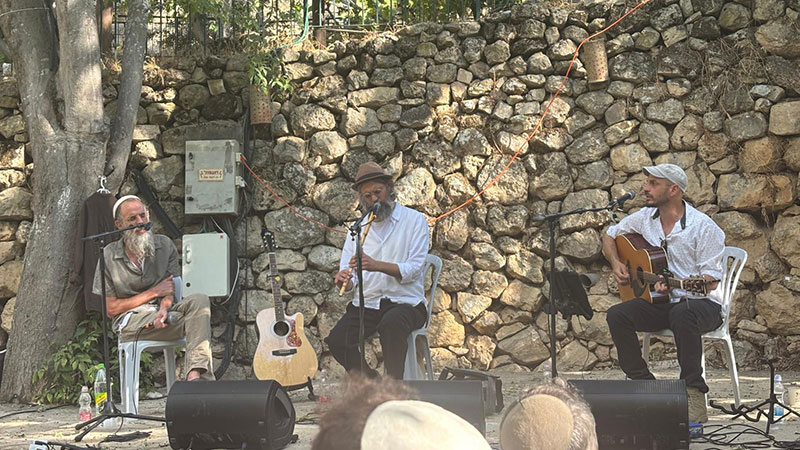
I headed to the event, held at the scenic Ein Yael, right next to the Jerusalem Biblical Zoo. Luckily, it was a mild day, with a mere high of 85 degrees after more than a week of consistent 95-degree weather, and by the late afternoon it was very comfortable. The opening event featured music from Yagel Harush and Torah from Rav Yosi Fruman. Yagel Harush is an Israeli musician who specializes in Mizrahi/Eastern Jewish music and has come to prominence on account of his Shirat Be'eri, a hauntingly beautiful kinah that he wrote and performed in memory of the Be'eri community, which was devastated on October 7. Rav Fruman is a rosh yeshiva at Yeshivat Machanayim and an educator who runs tefillah seminars. The opening session emphasized that its goal was to wake people up from their slumber – not by shouting “Elul!” as in a classical mussar schmooze, but by speaking to the heart, through stories and moving song.
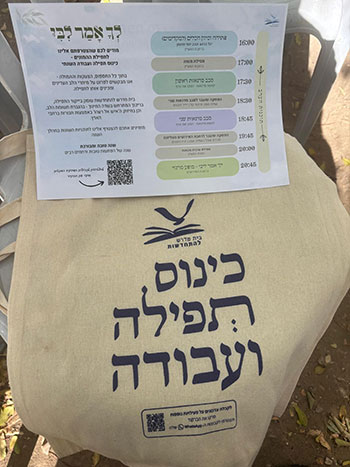
Following the opening session, there were two slots with a number of breakout sessions, with topics including “Imagination as a Pathway to Redemption of the Self,” “Prayer in Movement, Movement in Prayer,” “The Prayers of the Holidays as a Path Between States of Consciousness,” and “Prayer after Years of Detachment.” There were also two sessions relating to miluim – one for miluim families and one for soldiers – as the event did not hide from the great challenges facing the Dati Leumi community over the past three years.
After these sessions came the main event: Maariv, introduced by speeches and accompanied by many musical instruments. Unfortunately, I had to miss the main event to help put my kids to bed. But if videos of previous years are any guide, it was a momentous and powerful experience.
The idea of hundreds, if not thousands, of people gathering together in preparation for the Yamim Noraim – not as a shul program, but as a much larger convocation – reminded me of Yishay Ribo's huge performances at Madison Square Garden in 2023 and 2024. There were, of course, some differences. While Ribo's performances managed to bring together Charedi, Modern Orthodox, and non-Orthodox Jews, this gathering was almost entirely Dati Leumi (and also quite a bit smaller). While those performances took place in an indoor arena (The World’s Most Famous Arena, in fact!), this took place outdoors, surrounded by nature. And while Ribo's concerts took the form of high-production-value performances, with loud music and flashy lights, this was a quieter affair, also featuring lovely music but with a little more focus on the heart and less emphasis on the show.
The most striking difference, though, was the religious atmosphere at this Kinnus.
The sources quoted in both the opening presentation and the breakout sessions I attended were almost entirely Kabbalistic and chassidic – Zohar and especially Rabbi Nahman among them – but the sources themselves were only a small part of the presentation. There was music, and also many stories and parables, particularly comparisons between love of G-d and love of one's spouse or child. A number of participatory exercises were employed, as well: “Everyone, close your eyes for a minute and think about where you stand in your process of teshuvah,” or “Everyone, pick a perek of Tehillim at random and share a key word in it that moves you.”
For an American Modern Orthodox Jew accustomed to Elul programs built around a shiur with classical mekoros, or a mussar schmooze, this was a different religious vocabulary. It was also much more expressive and self-reflective than a Tisch. To the extent that practices like these have begun to be employed in American Modern Orthodoxy, they can generally be traced back to the direct influence of Rav Singer and Mekor Chaim, including through their Lifnai V’Lifnim program for educators.
But while these methods felt in some ways foreign to me, for the crowd attending the Kinnus they seemed completely normal. This is far from the first such program that the Beit Midrash le-Hitchadshut has run; the organization has offered Elul seminars like these for years, among other programs. I recall attending, a number of years ago, a “Happy Minyan” on Sukkot, with a packed crowd at the Great Synagogue in Jerusalem, that Rav Singer organized and ran
Programs like this seem to point to a broader development: neo-chassidut has become not simply a marginal alternative within the Dati Leumi world, but a mature and increasingly influential religious approach. This movement has been at work for decades now. Mekor Chaim, for example, was established in the mid-1980s. Similar trends in the American scene are a couple of decades younger and have not yet succeeded in creating the same kind of broad-based culture and institutional infrastructure.
I heard very little English at the Kinnus. It was a fundamentally Israeli event, and did not draw from the many Anglo neo-chassidic communities that exist in Jerusalem, in Nachlaot and elsewhere. This was a distinctly Israeli religious culture, with its own institutions, idioms, and assumptions.
In many ways, this approach has succeeded in doing precisely what its proponents had hoped to do: to recreate what the original chassidut accomplished, drawing people into religious life through popular and experiential rather than primarily intellectual means, through stories, music, emotional experience, and inspiring teachings. The approach draws upon chassidic teachings, but also on stories from one's own life, or from Leonard Cohen (whose music was riffed upon by Harush), if these ideas and songs have the potential to inspire people and impact them for the better.
I left the Kinnus having been spiritually moved, even awakened. This event had a real spiritual vitality to it, even if it is not the natural choice for the Litvak at heart. It is part of a vibrant, diverse, and growing Dati Leumi community that is increasingly neo-chassidic.