 September 4, 2026
 Categories: Arts / Collecting
The Rebbe and the Baal Shem Tov Bicentenary
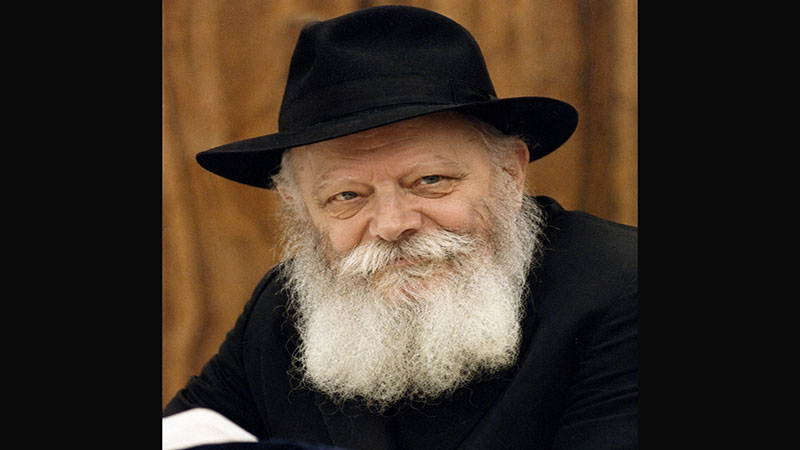


Any serious effort to understand the Rebbe, Rav Menachem Mendel Schneerson, must begin with his understanding of Israel ben Eliezer, aka, the Baal Shem Tov (“Master of the Good Name”) because the latter stood at the very center of the Rebbe’s theological, intellectual, and practical worldview. The Baal Shem Tov, founder of the Chassidic movement in the 18th century, was not, in the Rebbe’s conception, merely a historical figure or even simply a great spiritual teacher; rather, he was the originator of a transformative current in Jewish life whose implications, the Rebbe believed, were not only enduring but still unfolding. Indeed, the Rebbe consistently framed the teachings of the Baal Shem Tov as a dynamic force, one whose ultimate purpose had not yet been fully realized and whose theological dissemination remained an urgent, ongoing task.
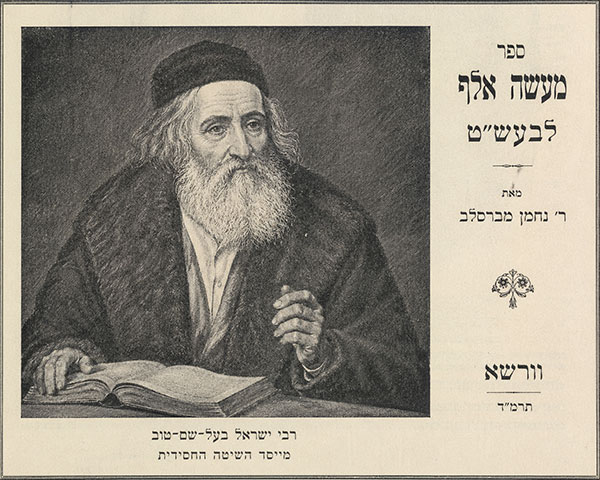
At the heart of this understanding lies a teaching that has become foundational within Chabad thought, attributed to a mystical experience of the Baal Shem Tov himself: that the coming of the Messiah is contingent upon the widespread dissemination of his “wellsprings” (i.e., his teachings) to the furthest reaches. The Rebbe returned to this idea repeatedly across decades of public talks, private correspondence, and institutional initiatives, and he interpreted it not as a mere poetic metaphor but as a directive with earth-shattering concrete implications. The teachings of the Baal Shem Tov were to be studied, certainly, but more importantly, they were to be shared, translated into accessible language, transmitted through every available medium, and brought to every Jew, regardless of background or level of observance.
This expansive vision was not conceived in isolation. The Rebbe consistently rooted it in the intellectual and spiritual legacy of Shneur Zalman of Liadi (the “Alter Rebbe”), who systematized Chassidic thought into a structured philosophy that emphasized comprehension as well as devotion. Equally significant was the role of Rav Yosef Yitzchak Schneersohn, the Rebbe’s father-in-law and predecessor, who carried Chabad through the upheavals of the Soviet period and into the modern Western world. From both these seminal figures, the Rebbe inherited not only teachings, but also a sense of mission: that Chassidism, though once confined to relatively small circles, was destined to become the shared spiritual inheritance of the entire Jewish people.
Born in the region of Podolia, then part of the Polish–Lithuanian Commonwealth, today in Ukraine, the Baal Shem Tov emerged from relative obscurity to become the founding personality of the Chasidic movement. Early accounts describe a childhood marked by poverty and, after being orphaned at a young age, a period of quiet spiritual development in rural settings. While some details of these formative years are filtered through later hagiographic tradition, there is broad scholarly agreement that by the 1730s and 1740s he had begun to attract a circle of followers. He eventually settled in the town of Medzhybizh, where he functioned as a healer, teacher, and charismatic religious guide, and his message, transmitted primarily through disciples rather than through his own writings, placed unusual emphasis on devekut (“cleaving to G-d”), the spiritual value of sincere prayer, and the accessibility of divine service to ordinary Jews. In contrast to more elite, text-centered modes of religious leadership, he stressed joy, inward devotion, and the sanctification of everyday life; these teachings, preserved and elaborated by figures such as R. Dov Ber of Mezeritch, became the foundation upon which later Chasidic thought, including Chabad, would be constructed.
By the time of his death in 1760, the Baal Shem Tov had not founded an organized movement in the institutional sense; rather, he left behind a network of disciples who would broadly disseminate and systematize his ideas across Eastern Europe. Over the ensuing decades, his reputation grew dramatically; his life was increasingly interpreted as the decisive turning point in the emergence of Chasidism; and it was precisely this transformation, from a relatively localized spiritual master into a figure of enduring historical and religious significance, that set the stage for the later marking of the bicentennial of his passing, an event that would reflect not only the memory of the man himself but the vast movement that traced its origins to his influence.
The bicentennial of the Baal Shem Tov, marked in 1960, two hundred years after his death, was not merely a commemorative milestone but a revealing moment in modern Jewish religious history, one that exposed how deeply the founder of Chassidism had moved from the margins of eighteenth-century controversy into the center of twentieth-century Jewish consciousness. What makes that bicentennial especially striking is not simply that it was widely observed, but that it drew broad participation across ideological, geographic, and even political lines that had historically been sharply divided.
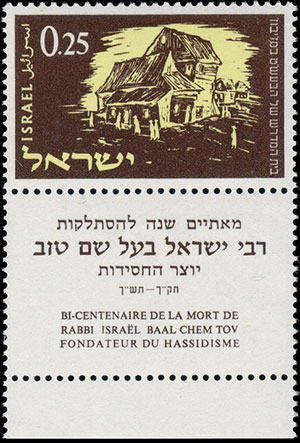
This 1961 stamp issued by the Israel Postal Service in honor of the bicentennial of the Baal Shem Tov depicts the traditional site of his synagogue in Mezhibozh.
The most prominent and best-documented commemorations and exhibits took place in Israel, where the event was elevated to the level of national significance. One of the central gatherings occurred in Jerusalem under the auspices of the Rav Kook Institute, bringing together an extraordinary constellation of figures: the President of Israel, Yitzhak Ben-Zvi; the Prime Minister, David Ben Gurion; the Chief Rabbinate; and leaders from both religious and secular sectors of Israeli society. This convergence alone is remarkable; the Baal Shem Tov, during his lifetime and for decades afterward, was a figure who provoked fierce opposition from the rabbinic establishment, particularly among the mitnagdim; yet by 1960, his legacy had become sufficiently normalized – and, more than that, deeply admired – that the highest political authorities of the Jewish state could publicly honor him alongside leading rabbinic figures.
The symbolism of such a gathering should not be underestimated. The Israel of 1960 was still a young state, only twelve years removed from its founding and still deeply engaged in the work of shaping a shared cultural identity among diverse Jewish populations. The Baal Shem Tov, whose teachings emphasized the spiritual dignity of every Jew and the accessibility of divine service beyond elite scholarship, offered a figure uniquely suited to this moment because his legacy could be invoked not only by Chassidic communities but also by broader segments of Israeli society seeking a unifying spiritual heritage.
The Jerusalem exhibition was organized as five conceptual zones: Origins of Chasidism (Besht-centered framing); Early Disciples and Teachings; Dynastic Spread Across Eastern Europe; Material Culture of the Chasidic Courts; and Modern Israeli-National Framing of Chasidism. Items attributed to the Baal Shem Tov himself included a pair of his tefillin; a kiddush cup; a siddur; and a Chanukah menorah.
In the United States, the bicentennial was marked less by centralized state ceremonies and more by a constellation of communal and institutional events, reflecting the decentralized nature of American Jewish life. Various Chassidic groups organized farbrengens, lectures, and publications dedicated to the teachings of the Baal Shem Tov, and the Lubavitch movement in particular emphasized dissemination of his teachings, framing the bicentennial not merely as a historical commemoration but as a call to action, an approach that was consistent with the broader Chabad interpretation of the Baal Shem Tov’s mission as ongoing.
Anecdotal evidence from American communities suggests that the bicentennial often served as an entry point for Jews who had little prior exposure to Chassidic thought. Public lectures in synagogues and community centers frequently emphasized not technical mystical doctrines but the Baal Shem Tov’s accessible teachings about joy, prayer, and the value of every individual.
The bicentennial also generated a noticeable increase in publication activity. New editions of Chassidic texts, collections of stories, and explanatory works were printed and circulated, making teachings that had once been confined to specific communities more broadly available. This publishing effort reflects a broader mid-century trend in which traditional Jewish texts were increasingly translated, annotated, and disseminated to wider audiences.
In retrospect, the bicentennial of 1960 can be seen as a moment of consolidation. It did not introduce the Baal Shem Tov to the Jewish world; that work had been accomplished over the preceding two centuries, particularly through the efforts of Chabad and its Rebbes. Rather, it marked the point at which his legacy was publicly and widely affirmed across diverse sectors of Jewish life.
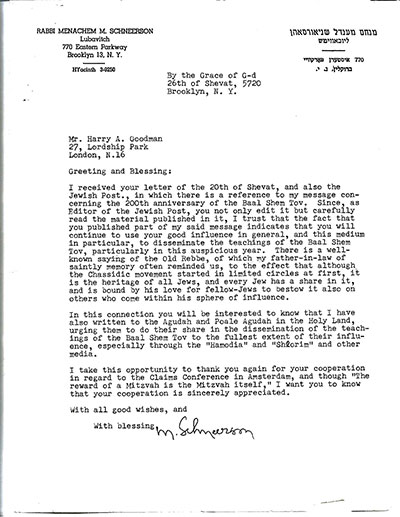
It is against this background that I present this most amazing and historic 26 Shevat 5720 (February 23, 1960) correspondence written to Mr. Harry Goldstein and originally signed by the Rebbe:
I received your letter of the 20th of Shevat [February 17, 1960], and also The Jewish Post, in which there is a reference to my message concerning the 200th anniversary of the Baal Shem Tov. Since, as editor of The Jewish Post, you not only edit it but carefully read the material published in it, I trust that the fact that you published part of my said message indicates that you will continue to use your good influence in general, and this medium in particular, to disseminate the teachings of the Baal Shem Tov, especially in this auspicious year. There is a well-known saying of the Old Rebbe, of which my father-in-law of saintly memory often reminded us: to the effect that although the Chassidic movement started in limited circles at first, it is the heritage of all Jews, and every Jew has a share in it and is bound by his love for fellow-Jews, to bestow it also on others who come within his sphere of influence.
In this connection, you will be interested to know that I have also written to the Agudah and Poalei Agudat in the Holy Land, urging them to do their share in dissemination of the teachings of the Baal Shem Tov to the fullest extent of their influence, especially through the ”HaModia,” and ”She’arim,” and other media.
I take this opportunity to thank you again for your cooperation in regards to the Claims Conference in Amsterdam. And though “The reward of a mitzvah is the mitzvah itself,” I want you to know that your cooperation is sincerely appreciated.
With all good wishes, and with blessing
The recipient of our correspondence, Harry A. Goodman, was a prominent figure in British Orthodox Jewish communal life whose career combined organizational leadership with journalistic activity. He served as chairman of the European executive of Agudas Israel and as a vice-president of the world organization, placing him within the upper ranks of that movement’s international leadership while, at the same time, he was active within the broader representative structure of Anglo-Jewry as a member of the Board of Deputies of British Jews. These roles situate him firmly within the institutional world of mid-twentieth-century Orthodoxy, particularly within circles committed to preserving traditional forms of Jewish religious authority and communal organization in the face of modern ideological currents.
In addition to his communal leadership, Goodman was the editor of a publication of the Jewish Post, a newspaper that functioned not as a general or ideologically neutral periodical, but as an organ closely associated with Agudas Israel and the Orthodox community it represented. As such, it served as a vehicle for articulating and disseminating the perspectives of that movement, reflecting its priorities and positions rather than presenting a broad spectrum of Jewish opinion. The paper’s orientation would therefore have been shaped by the core commitments of Agudas Israel: a strong emphasis on halachic observance, deference to rabbinic authority, and a concern for maintaining the integrity of traditional Jewish life within rapidly changing social and political contexts.
Goodman’s own outlook can be understood in light of these affiliations. As a leading figure in Agudas Israel, he belonged to a camp that viewed the preservation of Torah-centered life as the central task of Jewish continuity, and his work as an editor suggests an additional role as a public advocate for these values, helping to frame and communicate Orthodox perspectives to a wider audience. [The Rebbe clearly alludes to this at the end of his letter].
In his message marking the Baal Shem Tov bicentennial to which he refers in our letter, the Rebbe emphasized that the Baal Shem Tov’s enduring contribution lay not in institutional innovation, but in a transformative reorientation of Jewish spiritual life. Central to this legacy was the insistence that hashgacha pratit (“Divine Providence”) extends to every detail of existence, a teaching that invests even the most ordinary aspects of life with religious significance. The Rebbe stressed that this idea was not merely theological but practical: it demands a mode of living in which every action is undertaken with awareness of its divine purpose.
At the same time, the Rebbe highlighted the Baal Shem Tov’s elevation of the “simple Jew,” underscoring that sincere faith, joy, and heartfelt prayer possess intrinsic spiritual value independent of scholarly attainment and that this democratization of religious experience as a defining feature of the Baal Shem Tov’s path and one that remains urgently relevant. In an age marked by spiritual dislocation, the Baal Shem Tov’s teachings offer a framework through which all individuals can engage meaningfully in divine service.
Anniversaries such as these were treated within Chassidic tradition as spiritually charged moments. As such, the Rebbe’s description of the period as “this auspicious year” reflects a deeply embedded concept: that time is not homogeneous, and that certain moments carry heightened potential for spiritual achievement. The implication is clear: Commemoration is not an end in itself; it is a call to action.
Accordingly, the central directive of the letter is unmistakable: the dissemination of the teachings of the Baal Shem Tov must be intensified. Characteristic of the Rebbe’s approach is that rather than imposing an external obligation, he identifies the recipient’s existing role – in this case, editorial influence – and reframes it as a vehicle for spiritual purpose. He thereby elevates that act of editing and publishing from a professional function to a form of religious service.
The letter’s citation of a “well-known saying of the Old Rebbe” deepens this imperative. The teaching in question, that although the Chassidic movement began in limited circles, it is “the heritage of all Jews,” captures a critical shift in the self-understanding of Chassidism. What originated as a movement with elements of exclusivity had, over time, come to be seen as universal in scope so that the Rebbe’s inclusion of this teaching is not incidental; it serves to ground his call for dissemination in authoritative tradition, while simultaneously reinforcing the idea that every Jew has both a share in these teachings and a responsibility to pass them on.
The “Alter Rebbe,” was the founder and first leader of Chabad (Lubavitch) Chasidism and one of the most influential figures in the intellectual development of the Chasidic movement. Born in the region of White Russia, he later became a leading disciple of Dov Ber of Mezeritch, the principal successor of Israel ben Eliezer, under whom he absorbed and began to systematize the emerging teachings of Chasidism.
The Alter Rebbe’s distinctive contribution lay in his effort to articulate a more structured, intellectually grounded form of Chasidic thought as he founded Chabad, signaling his emphasis on contemplative understanding as a path to religious devotion. This approach did not reject the emotional fervor associated with early Chasidism, but sought to discipline and deepen it through sustained intellectual engagement; in doing so, he created a framework that appealed to more scholarly audiences and helped stabilize Chasidism as a durable religious movement.
His most important work is the Tanya, first published in 1797, which presents a systematic exposition of his theology and spiritual psychology and in which he addresses the inner struggles of the individual, outlining a path by which one can achieve constant awareness of G-d despite the tensions between spiritual aspiration and worldly inclination. In addition to his contributions to Chasidic thought, the Alter Rebbe was also a major halachic authority, authoring the Shulchan Aruch HaRav, an authoritative code of Jewish law that remains influential in Chabad and beyond.
The Alter Rebbe’s life was also shaped by the broader political and social upheavals of his time. He was twice imprisoned by Russian authorities, in part due to suspicions surrounding his support for Jewish communities in Ottoman-controlled Eretz Yisrael, and his release, particularly in 1798, came to be seen within Chabad tradition as a moment of vindication for his teachings. By the time of his death in 1812 during the turmoil of Napoleon’s invasion of Russia, he had established a distinct intellectual and spiritual legacy that would be carried forward by successive generations of Chabad leadership.
The attribution of the Rebbe’s reference to his father-in-law, Yosef Yitzchak Schneersohn (1880 – 1950), the sixth Rebbe of Chabad-Lubavitch (often referred to as “the Frierdiker Rebbe,” Yiddish for “the Previous Rebbe”), is equally revealing, as it powerfully situates our letter within a continuum of leadership, underscoring continuity rather than innovation. The Frierdiker was a pivotal figure in modern Jewish history whose leadership bridged the decline of Jewish religious life in Soviet Russia and the rebirth of Chabad in the United States.
During his tenure in Soviet Russia, Rav Yosef Yitzchak became renowned for his courageous resistance to Communist efforts to eradicate Jewish religious life, as he established clandestine networks to maintain Jewish education, ritual practice, and communal continuity under severe persecution. His activities led to his arrest by the Soviet secret police in 1927, and he was initially sentenced to death, a sentence later commuted to exile following international pressure and intervention. This episode became a defining moment in Chabad collective memory, symbolizing steadfast commitment to religious observance under extreme duress.
After his release, he left the Soviet Union and eventually settled in Riga, Latvia, and later in Poland, before immigrating to the United States in 1940, fleeing the advancing Nazi threat in Europe. In New York, he reestablished Chabad headquarters at 770 Eastern Parkway in Brooklyn, transforming the movement into a global presence, and he focused on rebuilding Jewish religious life in the aftermath of European destruction, emphasizing education, outreach, and the preservation of traditional observance in the American environment.
Rabbi Yosef Yitzchak’s leadership combined institutional rebuilding with spiritual resilience. He established educational institutions, encouraged the training of emissaries, and laid the groundwork for the expansive outreach activities that would later characterize Chabad under his son-in-law and successor, the Rebbe. His legacy is thus understood both in terms of survival during one of the most repressive periods in Jewish history and as the architect of Chabad’s transition into a global movement in the modern era.
One of the most striking aspects of the letter is its outward reach. The Rebbe notes that he has written to Agudath Israel and to Poalei Agudat Yisrael in Eretz Yisrael, urging them to participate in the same effort of dissemination, particularly through their respective publications, including HaModia and She’arim. This detail is of considerable importance, as it demonstrates that the Rebbe’s vision was not confined to his own movement; notwithstanding significant ideological differences between Chabad and these organizations, he sought their cooperation in a joint endeavor. The teachings of the Baal Shem Tov, in this conception, transcend factional boundaries, and such outreach reflects a broader characteristic of the Rebbe’s leadership: a willingness to engage with diverse segments of the Jewish world, provided that such engagement served a constructive purpose. His efforts were not limited to internal consolidation; they extended to coalition-building, even among groups with differing priorities and perspectives. The letter thus provides a glimpse into a strategy that combined theological conviction with pragmatic inclusivity.
Equally revealing is the reference to the Conference on Jewish Material Claims Against Germany and its activities in Amsterdam. This seemingly tangential remark opens a window into another dimension of the Rebbe’s concerns: the material and political welfare of the Jewish people in the aftermath of the Holocaust. The Claims Conference, established in 1951, played a central role in negotiating restitution from Germany for survivors and Jewish institutions. By thanking the recipient for cooperation in this context, the Rebbe acknowledges participation in a matter of profound historical and ethical significance.
Yet even here, the Rebbe frames his gratitude within the classical religious teaching of Ben Azzai: “The reward of a mitzvah is the mitzvah itself” (Pirkei Avot 4:2). This statement emphasizes the intrinsic value of good deeds. It reflects a worldview in which external recognition or reward is secondary to the act itself. At the same time, the Rebbe adds a personal note of appreciation, ensuring that the recipient’s efforts are both spiritually validated and humanly acknowledged.
The letter’s engagement with media is another point of interest. By addressing an editor and referencing specific publications, the Rebbe demonstrates a keen awareness of the power of the press. Long before the digital age, he recognized that ideas could be amplified through print, reaching audiences far beyond the confines of any single community, and his encouragement to use this medium for the dissemination of Chassidic teachings anticipates the extensive use of media that would later become a hallmark of Chabad’s global activities.
Scholars and observers have often remarked on the Rebbe’s ability to operate simultaneously on multiple levels. He was at once a theologian, a strategist, and a pastoral leader, and our letter, which exemplifies that multidimensional approach, engages with ideas, institutions, and individuals in a manner that is both coherent and compelling. Each element reinforces the others, creating a unified gestalt-type message that is greater than the sum of its parts.
In assessing the uniqueness of the letter, it is therefore insufficient to consider only its rarity or provenance because its true distinction lies in its capacity to encapsulate a worldview. Within a relatively brief text, one encounters the Rebbe’s understanding of history, his interpretation of Chassidic teachings, his approach to leadership, his engagement with contemporary issues, and his method of communication. Few documents ever achieve such density without sacrificing clarity.
Moreover, the letter offers insight into a particular moment in Jewish history, a period marked by reconstruction, redefinition, and renewed aspiration. The aftermath of the Holocaust, the establishment of the State of Israel, and the shifting dynamics of Jewish life in the diaspora all form part of the background against which this correspondence must be read. The Rebbe’s emphasis on dissemination, unity, and purposeful action can be seen as responses to these broader challenges.
Ultimately, the letter stands as a testament to an enduring vision. The teachings of the Baal Shem Tov, as understood and articulated by the Rebbe, are not confined to the past; they are presented as living forces, capable of shaping the present and influencing the future. The responsibility to disseminate them is framed not as a burden but as an expression of love for fellow Jews, for tradition, and for the possibilities inherent in both.
Author's note subsequent to the publication of this article in the newspaper:
There is no securely authenticated contemporary portrait of the Baal Shem Tov. The purported image of him in my article, "The Rebbe and the Baal Shem Tov Centenary," was AI-generated, which I unfortunately failed to note in the caption.
Mea culpa to my readers, who may have been misled. I very rarely use AI — I don’t trust it — and, in this case, the punishment (my embarrassment about my error) fits the crime.
~Saul Jay Singer