Futures market
Gold Looks Ready For Another Major Breakdown ! Weekly analysis.Gold is no longer showing the same bullish strength it had during the previous rally phase. The market is slowly shifting into a clear bearish structure where every recovery is getting sold aggressively. Buyers are failing to sustain momentum, and the overall price action is starting to look more li
XAGUSD Pullback Into Major Demand ZoneSilver faced a sharp rejection after failing to sustain above the ascending channel resistance, leading to strong bearish momentum across the market. Price has now entered a key support and demand zone near 77.00, where buyers may attempt to regain control.
The current area is acting as an importan
GOLD WILL NOT MOVE… UNTIL THIS CONDITION IS MET**4500 IS A TRAP ZONE 🚨 GOLD IS HUNTING BOTH SIDES BEFORE A MASSIVE MOVE 💀📈**
Whenever gold trades around a major key area where both buyers and sellers are highly active, the market usually becomes choppy and highly volatile.
In such zones, the real move doesn’t happen immediately. Instead, the m
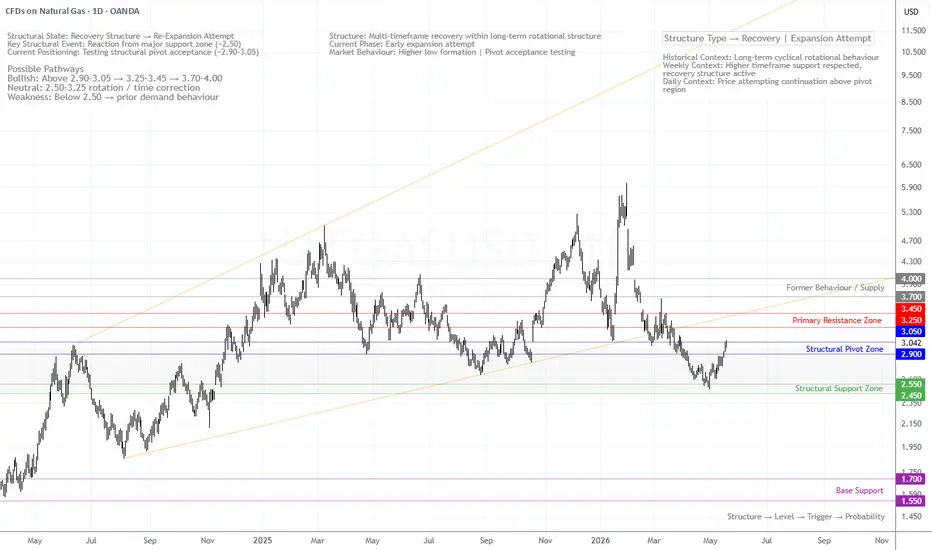
Natural Gas: Recovery Structure Testing Pivot AcceptanceNatural Gas continues showing recovery behaviour from higher timeframe support and is currently testing a key pivot region.
Structural Observation
• Recovery Structure → Re-Expansion Attempt
• Reaction from major support (~2.50)
• Testing structural pivot acceptance (~2.90–3.05)
Behaviour Obser
XAUUSD: Intraday Buy Setup at 4521| Target 4526 ResistanceThe current market structure on the lower timeframes (M15/H1) reveals an institutional footprint characterized by a recent Liquidity Sweep of sell-side stops just below the 4,500–4,510 structural demand zone. Following this trap, aggressive buying volume stepped in, printing a sharp CHoCH (Change of
Gold Bounce Looks Weak Below Key EMAsGold is attempting a technical rebound near 4,560 USD after last weekend’s sharp selloff, but current price action still looks more like a dead cat bounce than a true reversal.
On the H1 chart, XAUUSD remains below both EMA34 and EMA89, while EMA34 continues sloping sharply downward — confirming th
XAUUSD: Key Fibonacci Zone to WatchThe price has dropped sharply, with sellers in control, forming a series of lower lows and lower highs, confirming the downtrend. However, after this steep decline, the bearish momentum is beginning to slow: candles show long wicks and small bodies, indicating weakening selling pressure.
If the pri
Gold Bearish Continuation: H1 Order Block Rejection Ahead?Technical Breakdown
Structure Shift: The market initially formed a clear RANGE at higher levels before breaking aggressively to the downside, confirming a valid bearish BOS.
Bearish Momentum: Following a minor retest (labeled BREAKOUT), price encountered another smaller consolidation phase (RANGE)
XAU/USD Range Accumulation Breakout SetupMarket Structure
The chart shows XAU/USD (Gold) trading inside a clear sideways consolidation range after a strong bearish move from the top left.
The purple rectangle highlights the range-bound accumulation zone.
Price repeatedly respects:
Range resistance near 4,570–4,575
Range support near 4,53
See all popular ideas
Quotes
Futures collections
Frequently asked questions
A futures contract is a legal agreement to buy or sell an asset (such as a commodity or security) at a set price on a specific future date. The buyer agrees to purchase and receive the asset when the contract expires, while the seller agrees to deliver it at that time.
Most futures contracts are traded through centralized exchanges like the Chicago Board of Trade and the Chicago Mercantile Exchange (CME). But there's no need to leave TradingView to trade futures — you can do it right from your charts. Just check out the list of our integrated brokers and find the best one for your needs and strategy.
Before you start, it's crucial to do you research: perform technical analysis on the chart, evaluate risks, and test your strategy.
Energy futures are contracts tied to energy commodities — they're aimed at facilitating the trading of specific quantities of crude oil, natural gas, gasoline, etc. Energy futures allow producers, consumers, and traders to manage price volatility in energy markets or capitalize on future price movements.
Explore a wide range of energy futures with detailed stats directly on TradingView.
Agricultural futures are derivative contracts with agricultural commodities (wheat, corn, soybeans, etc.) as the underlying. They're widely used to trade standardized quantities of commodities, allowing farmers, food producers, and traders to hedge against price fluctuations or to profit from expected price changes in the agricultural market.
Browse a full list of agricultural futures with detailed stats directly on TradingView.
Futures market is a bustling place with many interested parties. Here are some key participants to keep in mind:
- Hedgers (traders using futures to protect their existing positions or trades from risk caused by market volatility or direction)
- Speculators (traders executing trades based on their price predictions)
- Arbitrageurs (traders trying to win from market inefficiency and price difference by buying and selling the underlying in different markets)
- Institutional investors
- Retail investors
Futures markets are platforms where traders gather to buy and sell futures contracts. In the past, trading was performed physically: traders would come to a 'pit' in the trading floor and conduct trading by shouting and actively gesturing. But today, this is all done electronically.
In a futures market, buyers and sellers post margin to secure their positions, and profits or losses are settled daily through mark-to-market. At expiration, contracts are settled in cash or through physical delivery, though most traders close positions beforehand. Since futures offer flexibility and leverage, futures markets attract diverse participants: hedgers, speculators, arbitrageurs, institutional and retail investors.
Some of the largest futures markets today are the New York Mercantile Exchange (NYMEX), the Chicago Mercantile Exchange (CME), the Chicago Board of Trade (CBoT), and the Cboe Options Exchange (Cboe). They're registered with the Commodity Futures Trading Commission (CFTC), the main body in charge of futures markets regulation in the US. In other countries, futures markets are regulated by a corresponding national body.
Open interest is the total number of active futures contracts that haven’t been closed or expired. It reflects how much interest or participation exists in a market.
Traders use open interest to gauge market strength. For example, declining open interest often signals that traders are closing positions — a possible sign of a weakening trend.
Futures prices are mainly driven by supply and demand, economic indicators, and central bank policies. Disruptions like droughts or geopolitical tensions can affect supply, while inflation or interest rate changes shape investor expectations. These shifts influence how traders value future prices relative to current conditions.
Market sentiment and speculation also play a big role, with traders often reacting to news or forecasts before fundamentals change. Factors like storage costs, inventory levels, and contract expiration impact pricing too, especially in commodities. Seasonal trends, government policies, and even new technologies can further sway futures markets.
It's always best to test you skills in futures trading before going to the real markets. You can do it right on TradingView thanks to our Paper Trading functionality — just find the Paper trading icon on the trading panel and put your ideas to the test. You can also check out our Bar Replay feature — it simulates past price movements for strategy testing.