The Bionic Woman 1.1 – Welcome Home, Jaime (part one)

I enjoyed springing the surprise that Jaime Sommers got her own show. I told our favorite six year-old critic that we’d be watching some bionic action tonight, and then I told him we would not be watching The Six Million Dollar Man. He watched the pre-credits sequence with a raised eyebrow wondering what was going on.

In the fall of 1975, The Bionic Woman started production and it debuted on ABC the following January. 1976-77 were the golden age of bionics. Now in her own show (it aired Wednesdays while Six remained on Sundays), Jaime moves to Ojai – happily, that blasted doctor stayed behind in Colorado Springs – and takes an apartment above Steve Austin’s parents’ barn at their new ranch. She gets a job teaching a gang of unruly kids – “The Dirty Dozen” – at Ventura AFB, and this first story sees her putting her life and memories together. Meanwhile, Carlton Harris, the villain from that mission she and Steve botched a few months earlier, is getting ready to attack her and get revenge, which seems a bit silly considering how little trouble the bionic agents actually caused him.

This actually kind of reminded me of the original Six pilot movie, because it’s really more of a slow-paced character drama with occasional punctuations of bionic stunts to keep the kids watching. I was pleased that the writer and producer, Kenneth Johnson, decided to give Jaime her memories back, but not her feelings. It is a little heartbreaking when she tells Steve that she knows they were engaged now, but she doesn’t have any love for him yet.

I was less pleased by the surprising reminder of how incredibly touchy everybody was with women in the seventies. Everybody in this show is either embracing or kissing Jaime or putting their hands on their shoulder, even her brand new boss at the military base school. I had a little talk with our son about how that’s not acceptable behavior any longer!

Leave a comment

Filed under bionic woman, six million dollar man

Doctor Who: The Mind of Evil (part three)

I may not much like the character of the Master as much as I enjoy Roger Delgado’s portrayal of him, but there’s one cute little bit about the Doctor’s and the Master’s relationship that I really love. The Doctor is just about clueless when it comes to modern popular culture. He doesn’t know the Beatles catalog, he doesn’t know anything about Spider-Man, he thinks that Batman flies a space rocket, and when he tries to sing the Ghostbusters theme, he might as well be saying “Correctamundo!” to a classroom full of kids, he looks so stupid.

But the Master is fully versed in classic children’s television and popular music. He enjoys the Scissor Sisters and King Crimson. And yes, Crimson was a popular band, once. He’s listening to In the Wake of Poseidon in the back of his limo, and that album actually went to # 4 in the UK charts, a real-world fact that might be even harder to believe from the cold light of the 21st Century than anything in the Master’s latest scheme.

We’ll leave this story here for a couple of days to give our son a break from it. He thinks this serial is super-scary and could use some bionic down time.

Leave a comment

Filed under doctor who

Doctor Who: The Mind of Evil (part two)

I wasn’t planning on using an image of the strange Chinese dragon that appears onscreen for all of maybe eleven seconds in episodes two and three of “The Mind of Evil” – the director sensibly decided it’s an enormously disappointing costume and lingered instead on reaction shots from people – but the illusory beast just scared the pants off our son. You can never tell with kids! He was far more stoic and brave about the notoriously child-frightening “Terror of the Autons” than this infamously poor dragon.

His mom suggested that this story is doing a good job getting under his skin because we tell him that monsters and aliens aren’t real and can’t hurt him. And suddenly here’s a story about things that are not real killing people. It helps sell the fantasy when the dude who plays Senator Alcott, Tommy Duggan, does a really great job of freaking completely out when Captain Chin Lee turns off the lights and turns into a monster. The direction and Dudley Simpson’s loud-as-thunder music and the freaky noise of the Keller machine helps. Grown-ups may roll their eyes at that dragon, but it certainly was a very effective cliffhanger for our son.

Incidentally, who the blazes said “Okay, Alcott’s got a phobia of dragons, specifically Chinese dragons, so he’s probably got some subconscious issues with the People’s Republic, so he’s just the right guy to go to London and negotiate with them!”

In the cast, John Levene is back in action as Sgt. Benton in this episode, and, tying all the plot threads together, Roger Delgado is back as the Master. He’s got a limousine and a driver and a big cigar this time, he’s got Captain Chin Lee under his hypnotic control to cause havoc at the conference, he’s eavesdropping while Captain Yates discusses plans to dispose of the nuclear missile, and he’s able to transmit the Keller Machine’s power from the prison through Chin Lee to attack the delegates. He’s just being deliciously evil in this story so far.

Leave a comment

Filed under doctor who

Doctor Who: The Mind of Evil (part one)

It’s a great pleasure to finally see “The Mind of Evil” in color. I’ve had this DVD for a while and, like “The Ambassadors of Death,” I’ve been waiting patiently to watch it with my son. All of the other lost-in-color Jon Pertwee episodes of Doctor Who had some kind of color version available in the tape trading days, usually a low-quality multiple-generation copy that came from an American broadcast of the series in the mid-seventies. Nobody is known to have recorded this story and kept it. A gentleman called Tom Lundy recorded the other four (I think he was in Buffalo NY) and kept them, but he recorded over “The Mind of Evil” with a football game. All that remained was a few minutes at the beginning of part six before he taped something else.

A few years ago, the BBC’s technicians and magicians reassembled this story as close to the way it was originally shown as can be managed, and it looks very good. Every fifth (or so) frame of part one is hand-colored, with computers estimating the rest, and parts two through six were restored through chroma-dot recovery, extracting a color signal from the data within a black-and-white copy. I think this is all so fascinating. The only critique I can make about part one is that the insides of actors’ mouths seem unnaturally black. Otherwise this looks incredibly good.

“The Mind of Evil,” written by Don Houghton, is a little bit of a throwback to the previous season of Doctor Who. It’s a harder-edged story than the increasingly fanciful and lighter eighth season, tackling prison reform and the threat of global war without an army of candy-colored monsters. The special effects are not as garish as in the previous story, or anywhere as close to how they’d be in the next one, and the Doctor is still yelling at bureaucrats who get in his way, only this time the target of the Doctor’s loud mouth snaps back, and it is pretty hilarious seeing the Doctor get a little comeuppance for his constant rudeness.

Our heroes are faced with two issues that keep them separated in part one. The Doctor and Jo are observing an experimental procedure that is said to be the work of the famous Dr. Emil Keller. It is supposed to remove the “evil” impulses from the minds of criminals. It seems to work on a cruel fellow called Barnham, played by Neil McCarthy, who was the farmhand from the first season of Catweazle a year before this was shown. Also in the cast is perennial guest-starred-in-everything actor Michael Sheard as the prison doctor.

Meanwhile, UNIT is trying to balance providing security to a World Peace Conference while simultaneously planning to dispose of a missile – you don’t think these plot threads are going to join up, do you? – and their jobs get complicated when a Chinese military captain first reports some stolen documents and then waits half an hour after finding her country’s delegate murdered body and lies about it. Joining UNIT for this story and the next is Fernanda Marlowe as Corporal Bell, whose uniform indicates that she enlisted in the RAF, not the Army, before being assigned to UNIT. Corporal Bell has very little to do in her two stories, but it’s nice that the TV people made the effort to continue giving UNIT some recurring characters before forgetting about the character!

I kind of predicted this would start out a little complicated and over the head of our favorite six year-old critic. He wasn’t really taken with it, but he did let us know that the strange Keller Machine, and the bizarre deaths that happen in the prison’s processing room, are “creepy.” Hopefully he’ll enjoy the next episodes a little more!

Leave a comment

Filed under doctor who

Starcrash (1979)

There are exactly two reasons anybody ever needs to watch Starcrash. Either they’re under ten and want to see laser swords and Vader villains and exploding spaceships, or they’re over ten and want to ogle Caroline Munro while she’s wearing several ridiculous, skimpy costumes.

Well, alternately, a person could be stuck trapped on a sofa between these audiences. Poor Mommy.

Starcrash is arguably one of those projects that began its long development before Star Wars, but nobody outside the producers’ immediate families is going to defend its originality. It even opens with a shot that’s been stripped right from Wars, only while the ships in that movie looked like actual spaceships, these look like toys. All of the miniatures here look like toys with the little leftover bits from model kits glued on them and given solid white or gold spray jobs.

No, what money there was in this movie, after securing the services of Christopher Plummer, Caroline Munro, David Hasselhoff, and a bunch of other people who look like they were on a two-week furlough from the steel mill, went into the location filming. Munro plays Stella Star, a pilot and smuggler who’s been pardoned by the Emperor of the Universe and commissioned to find his missing son. The search takes her and her crew to a beach planet, an ice planet, and a volcano planet, where they get into battles with space amazons and space cavemen, before confronting the evil Count Zarth Arn, which might be the best and silliest name for any of the screen’s Vader clones.

Speaking of best and silliest actually, and you won’t believe me, but my favorite part of this movie wasn’t actually Caroline Munro in her leather space bikini and boots, but the laser guns used by Zarth Arn’s troops. They have these absurd and delightful little red crosshairs printed on the barrels of their rifles and I chuckled every time I saw them.

For our six year-old, this was serious business and he adored this film. He liked it just fine until the climactic space shootout, and told us that his favorite part was “the end, when everything went boom boom boom. I liked everything else, but I really liked it when everything went boom boom boom!” There are lots of explosions as all the extras and stuntmen shoot at each other in a set that looks about the size of our apartment, but which nevertheless somehow holds about a dozen of these little torpedo ships which crash through the living room windows of the Death Sta– I mean whatever Zarth Arn calls his space station — but that wasn’t the really big explosion.

Our son also really enjoyed this movie’s obligatory robot. This sort of movie just wouldn’t be complete without one. It’s a police robot called Elle, voiced by Hamilton Camp in a possibly Texan accent. Like C-3PO, he worries and complains about everything from water to flying a floating city, but he also guns down amazons and cavemen.

With the battle almost lost, Emperor Christopher Plummer realizes that there’s no alternative but to execute the dangerous plan of Starcrash. The other really great thing about this movie is the wonderful way that David Hasselhoff replies “Fourth dimensional attack!” You’d think that something called a fourth dimensional attack would be a little more impressive than two model kits bumping into each other, though.

Starcrash was released in America by Roger Corman’s New World Pictures after the original producers, AIP, judged it too poor a movie to bother. It’s been a cult classic for almost forty years of mocking – some friends have been shouting “Fourth dimensional attack!” at inappropriate moments since the early nineties – and it finally made its way to Mystery Science Theater 3000 three months ago. I very much doubt my wife will ever sit through this film ever again, even with Jonah, Tom Servo, and Crow to help us through it.

Incidentally, the unmistakable miniature work and silly Christmas light star systems in this film would, you’d think, be unique enough that nobody would think about using them anywhere else, but two years later, the visual effects all turned up again in a really dopey movie called Escape From Galaxy 3. It was apparently marketed in some countries as a sequel to Starcrash, but it certainly isn’t!

1 Comment

Filed under movies, star wars cash-ins

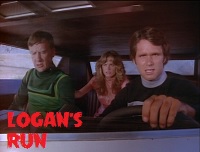
Logan’s Run 1.7 – Crypt

The grown-ups in the room sat up straight when we saw Harlan Ellison’s name in the credits. He wrote the original story of “Crypt,” with Al Hayes finishing the teleplay, and Ellison can typically be relied upon for something very interesting. He contributed a story with six scientists, frozen in cryogenic sleep for two hundred years and all suffering from an ancient plague, awakened today with only enough anti-toxin for three of them. Complications ensue when one of the six might be an impostor. One of the six is definitely a murderer, and then there were five.

I think the grown-ups might have been more entertained than our six year-old critic. The moral dilemma surrounding who will live was a bit over his head, and he also immediately identified the impostor. I’m not sure how he was able to nail his guess so accurately, but whodunits often lose their luster once you figure ’em out.

Of minor note: one of the six scientists is an engineer played by Christopher Stone, who was apparently contractually bound to appear as a guest star on every single prime-time drama made for American TV in the seventies. You know that guy with a mustache who was always being aggressive and rude? That guy. I believe we’ll see him again once or twice down the line.

Leave a comment

Filed under logan's run

The Six Million Dollar Man 3.9 – The Bionic Criminal

Monte Markham returned for a second outing as the other bionic man, now renamed Barney Hiller without in-story comment, in this pretty entertaining story by Peter Allan Fields and Richard Carr. This was the fourth of seven episodes of The Six Million Dollar Man that Carr wrote or co-wrote; he’d been writing for westerns and other dramas since the early 1950s. Among his credits is a first season Batman story for the Riddler.

Our son enjoyed this one more than Barney’s original appearance, which surprised me. It is a good story: Barney agrees to be reactivated for 48 hours in an experiment to see whether bionic powers can be turned off and on again in case of national emergencies, but is blackmailed by a former OSI scientist, played by Donald Moffat, into robbing banks. We know Moffat as Rem in Logan’s Run already, and I am pleasantly amused that we got to see one of his bionic appearances alongside our screenings of Run.

But while this episode does have another slow-motion bionic fistfight, which pleased our son, it’s nowhere as destructive and entertaining as the one in Barney’s first appearance. The deciding factor, it turns out, is a long scene where Barney tries to resume his career as a race car driver. A fast car put this one over the top. Six year-olds!

Two other thoughts strike me: there’s an incredibly long flashback with several clips to Barney’s initial outing. It seems really strange to devote almost four minutes to an in-story memory. This episode is one of the few we’ve seen that does not have a pre-title sequence at all, where a “Previously on…” recap might normally go. I wonder why they decided to build a nearly four minute flashback into the narrative instead of just cutting something shorter together before the opening credits.

But the really unusual surprise is that Alan Openheimer returns in this story as Dr. Wells. By chance, this morning’s viewing comes just as a couple of Doctor Who fans – there will always be a couple of Doctor Who fans to make you roll your eyes and sadly say “there are these couple of Doctor Who fans…” – are outraged and upset that the powers that be have recast the role of the First Doctor for a team-up episode. Apparently, every other recasting in all of television and film is acceptable, but because each Doctor is special and magical and sacred, and the show invented the concept of regeneration, then if any Doctor now or in the future were to meet an old version in a team-up, then they should only use one of the last few Doctors, and honorably retire the ones played by actors who have died.

So in The Six Million Dollar Man, we’ve got a character who’s been played by Martin Balsam, then Alan Oppenheimer, then Martin E. Brooks, then Oppenheimer again, and Brooks will take back over the next time Dr. Wells is seen. The world kept turning. But David Bradley playing the First Doctor is some kind of sacrilege despite William Hartnell being dead since 1975. It’s a fictional character in a popular drama, not a blessed holy relic, you know.

Leave a comment

Filed under six million dollar man

Doctor Who: Terror of the Autons (part four)

Like many middle-aged American Doctor Who fans, I first found the series via the edited-into-a-movie omnibus versions that Lionheart syndicated in the mid-eighties. By that time, the BBC had wiped several of their color copies of Jon Pertwee episodes, and so five of the stories, including this one, were offered as black-and-white movies. I taped my copy off WGTV one Saturday night in 1986 and watched it so often I can still recite whacking great chunks of dialogue.

Color copies in various levels of condition – often poor – circulated for most of the episodes as well. A decade previously, Time-Life had successfully sold most of the Jon Pertwee stories, in their proper episode-by-episode form, to several PBS stations around the country. At least one person copied a 1977 broadcast of “Terror” on Chicago’s WTTW, and I landed a copy around 1991 or so. My eyes just about fell out of my skull when I saw it, not because the quality was so poor – it was probably fifth or sixth generation – but because it proved that the BBC’s black-and-white master copy had been cut by five or six seconds.

The black-and-white “Terror” that I’d seen a hundred times was one where the UNIT forces defeat the Autons pretty decisively. The shootout at the radio telescope at the show’s climax was kind of disappointing, but UNIT had the upper hand, for once. That’s because somebody decided to carefully snip out every shot in which a human gets blasted or knocked off the tower. It’s so nice to have a complete color copy of this fun story at last.

Our son also thought this was very fun in the end, giving this his thumbs-up “pretty cool” seal of approval. He thought the Autons’ daffodil was “crazy.” I remember reading about the daffodil around a year or so before I saw this story and thinking that was exceptionally grim when I was a teen: a weapon that kills you by gluing four square inches of clingfilm around your nose and mouth. Best not to linger on it. It’s no less grim in the cold light of middle age.

Leave a comment

Filed under doctor who