Opinion
How one NGO cries wolf at the expense of Palestinians
-
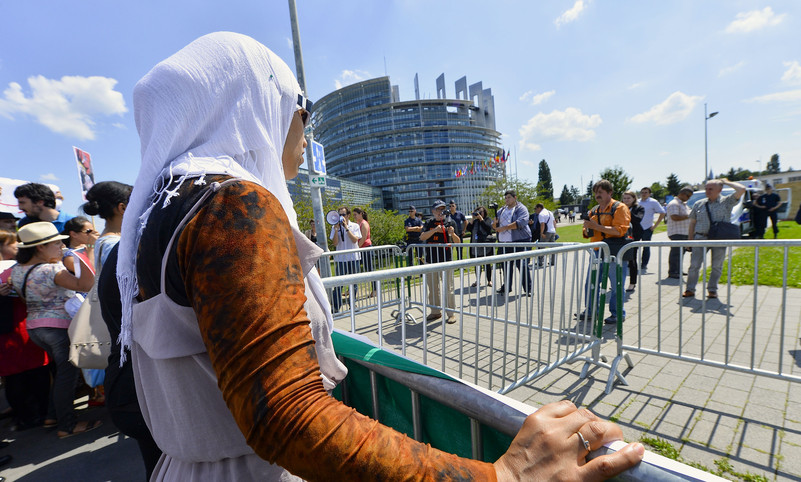
A pro-Palestinian protest outside the European Parliament in Strasbourg (Photo: europarl.europa.eu)

By Olga Deutsch
I was bemused to read a strident opinion piece published last week in EUobserver by Issam Aruri, chair of the Palestinian NGO Network (PNGO). Mostly because it was a response to something I had written months ago for a totally different publication.
In my capacity as Europe desk director at NGO Monitor, I published a piece last February in EP Today making the case that Aruri's organization, PNGO, which represents 134 Palestinian NGOs, functions as a "ring leader" that coerces its members to toe the line with an extreme agenda, thus shrinking the space for Palestinian civil society.
Join EUobserver today
Support quality EU news
Get instant access to all articles — and 18 year's of archives. 30 days free trial.
Choose your plan
... our join as a group
Don't miss out on
Did you know that 65 percent of EU institution staff find EUobserver influential in terms of EU news? We provide the deep context to make informed decisions. Try us.

Why join?
Watch our reporter Eszter Zalan explain the reasons in this 30 seconds video.
For EUobserver readers who are not familiar with NGO Monitor, we are a Jerusalem-based research institute that provides information and analysis on the reports and activities of human rights and humanitarian NGOs active in the Arab-Israeli conflict.
Apparently PNGO submitted a rebuttal at the time, which was never published by EP Today. Contrary to Aruri's accusation, we are not privy to the editorial decisions of any newspaper, nor have we ever participated in any sort of "campaign" to get a publication not to run another group's article.
Aruri's insults and conspiracy theories aside, I am happy to continue the exchange on a new platform. From NGO Monitor's perspective, we welcome substantive discussions.
At the risk of restating the obvious, I will present some of NGO Monitor's main findings regarding PNGO and explain why they remain valid. Both Aruri's article and another rebuttal posted on the PNGO website fail to directly address any of them.
Aruri begins accurately, noting that "for decades, the EU has invested into civil society organisations in Israel and Palestine that promote its core values 'on the ground'."
What Aruri fails to mention is that PNGO categorically rejects the very notion that funds ought to be conditioned on the promotion of donor governments' values, and considers "the withholding of foreign aid from legitimate Palestinian resistance to be a form of support of the illegal Israeli occupation."
Leaving aside the fact that Palestinian "resistance" often takes a violent form, Aruri has erased any mention of PNGO's long history of condemning funding provisions that do not quite fit with its political agenda.
In 2000, it called on "all Palestinian NGOs to stop all joint programs and activities with Israeli organisations, especially projects conducted in the framework of the 'People to People' program, the Peres Institute for Peace, and the 'Joint Projects Program' funded by the American Agency for International Development (USAID), as well as any other project aiming at normalisation with Israel."
The announcement added that PNGO would "compile a list of Palestinian and Arab organisations that violate this position and will publicise it regularly among all Arab and Palestinian communities."
So much for the pluralistic inclusivity and open debate that is ostensibly the staple of civil society.
Seven years later, PNGO spearheaded a boycott of USAID funding following the introduction of anti-terrorism clauses to funding agreements.
In 2013, PNGO went as far as to denounce the EU's Partnership for Peace program for encouraging "normalisation between Palestinian and Israeli civil society organisations."
Norway case
By far the most disturbing, however, is PNGO's statement from June 2017 condemning Norway – one of its funders – for pulling funds from a youth centre named after a terrorist. The centre, inaugurated by one of PNGO's member organisations, Women's Affairs Technical Committee (WATC), was named after no other than Dalal Mughrabi, the terrorist involved in the 1978 coastal road massacre that saw 38 civilians, including 13 children, murdered.
In its statement, PNGO reiterated "their total refusal of changing the Martyr Dalal Mughrabi Centre that was established in Burqa Village. PNGO believes this is another form of foreign domination and oppression calling Palestinian resistance a terrorist resistance against Israeli occupation."
It added, for good measure, that "No one in Burqa or in the Palestinian society glorifies terrorism and or terrorist attacks; there is a difference between freedom fighters and terrorists."
To the shock of nobody at all, PNGO did not address its unequivocal glorification of a terrorist in any of its responses. Instead, following my op-ed mentioning this uncomfortable fact's publication, PNGO scrubbed the statement from its website without a word of explanation.
It was archived, however, and can be found in the Internet Wayback Machine. Perhaps this is what Aruri means when he says, "We face draconic digital surveillance and interference by Israel, which violates our fundamental privacy and obstructs our work."
This is hardly a viable defence when hateful, self-damaging statements are exposed.
Astoundingly, the EU has long been a funder of PNGO, and the group is currently the co-beneficiary of two EU grants. The EU has also, however, pledged in its 2017 Annual Action Programme in favour of Palestine to put an end to the situation where "EU-supported civil society organisations also engaged in activities inciting to hatred and/or violence." Perhaps this caught the attention of Mr Aruri.
So, no, NGO Monitor is clearly not in the business of shrinking the space in which NGOs operate.
At the same time, we unapologetically reject PNGO's attempts to undermine the most precious, fundamental values of global civil society. As noted by the EU, there is no contradiction between promoting a constructive civil society and the values that this process is designed to promote.
Olga Deutsch is the director of Europe Desk at NGO Monitor, an independent research institute which provides information and promotes accountability on the reports and activities of NGOs claiming to advance human rights and humanitarian agendas.