
Gulen did not order Turkey coup, EU spies say
-
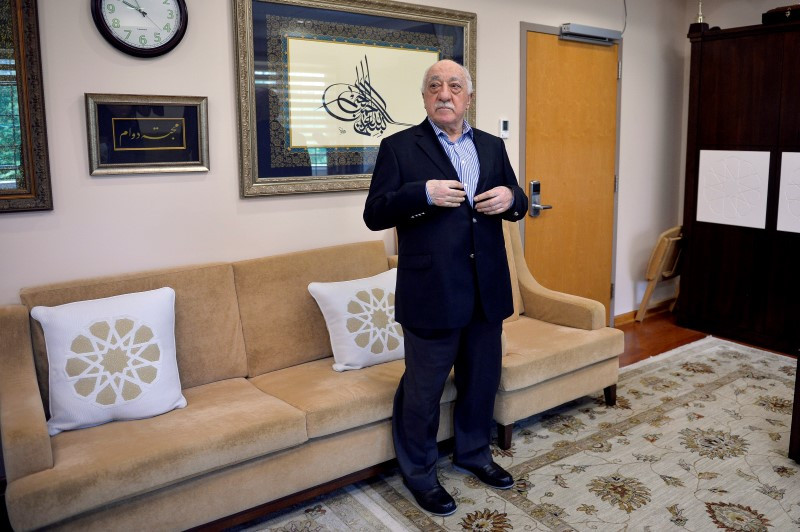
Fethullah Gulen fled Turkey in 1999 (Photo: Reuters)

Exiled cleric Fethullah Gulen did not order the coup in Turkey, a leaked document from EU intelligence services says.
The document, written by the EU’s intelligence-sharing unit Intcen, also says a post-coup purge of supposed Gulen supporters led by president Recep Tayyip Erdogan was designed to deepen his grip on power.
Dear EUobserver reader
Subscribe now for unrestricted access to EUobserver.
Sign up for 30 days' free trial, no obligation. Full subscription only 15 € / month or 150 € / year.
- Unlimited access on desktop and mobile
- All premium articles, analysis, commentary and investigations
- EUobserver archives
EUobserver is the only independent news media covering EU affairs in Brussels and all 28 member states.
♡ We value your support.
If you already have an account click here to login.
-

Erdogan had prepared the post-coup crackdown well in advace (Photo: Reuters)

The revelations shed light on the EU’s reaction to the failed coup, and show how Europe's intelligence agencies regard Gulen as the “master” of an “anti-Semitic and anti-Christian” movement.
They also put an unwelcome spotlight on Intcen.
“It is likely that a group of officers comprising Gulenists, Kemalists, opponents of the AKP, and opportunists was behind the coup. It is unlikely that Gulen himself played a role,” the document said.
“It is unlikely that Gulen really had the capabilities and capacities to take such steps.”
Kemalists are secularist Turks who oppose the Islamist views of Erdogan’s AKP political party.
The EU intelligence report said individual Gulenist military officers, who did not rank above lieutenant or captain, might have felt “under pressure” to join the coup attempt in July because they knew that Erdogan planned to go after them in August.
The report said his “upcoming purge” would have seen them being prosecuted for terrorist offences.
The EU report said Erdogan was trying to dismantle Gulen’s movement in Turkey because it was his “one and only real rival” in his bid to rule the country via “a full presidential system”.
It also said he “exploited” the coup to launch a wider “repressive campaign against the opponents of the AKP” for the sake of “personal ambitions”.
It said that the MIT, Turkey’s intelligence service, began compiling lists of “troublesome individuals” years ago.
It said the lists also contained the names of “civil activists” who took part in anti-Erdogan protests in Gezi Park, Istanbul, in 2013.
“The huge wave of arrests in the days following the coup attempt was already previously prepared. The coup was just a catalyst for the crackdown prepared in advance,” the intelligence report said.
Lukewarm EU
Intcen is a branch of the EU foreign service in which intelligence officers from EU states share information.
It filed the six-page report, entitled Turkey - The Impact of the Gulenist Movement, on 24 August last year to senior EU officials and to member states’ ambassadors in Brussels.
The classified paper was first uncovered by The Times, a British newspaper, on Tuesday (17 January).
The views in the leaked document, also seen by EUobserver, were aired almost word for word by Johannes Hahn, the EU commissioner dealing with Turkey, in his reaction to the coup.
He said at the time that it looked “like something that had been prepared. That the lists [of alleged Gulenists] are available [so soon] after the events indicates that this was prepared and that at a certain moment it should be used”.
Subsequent EU statements were also lukewarm toward Erdogan.
The bloc urged restraint, especially when his purge spread to opposition MPs and the media, prompting furious responses from the Turkish president.
The master
The EU leak comes at a time when Turkey is asking the US to extradite Gulen.
Although the intelligence report exonerated him over the coup, it did not paint him in a favourable light.
The report said teachings published in his name “on the surface … propagate tolerance”, but “at the same time, Islamic scholars expert in usage of language and symbols recognise that they are expressly anti-Semitic and anti-Christian”.
It said Gulen was the “master” of a “worldwide” structure that had branches in some 100 countries in Europe, north and South America, Asia, and Africa.
It said his “orders” were “enforced” by “special imams” and by “convinced” followers who “infiltrated” state institutions.
It said Gulenists had 160 elite schools around the world where they groomed students.
It said the best students were offered special teaching sessions, called Houses of Light, “in the evening … in apartments, to small groups without state control”.
Leak fallout
The leak is an embarrassment for the EU foreign service at a time when it is trying to galvanise EU security cooperation.
The Intcen report was marked “confidential”, meaning, in the EU’s own literature, that it could prompt "formal protest or other sanctions" by non-EU countries and "damage" EU "security or intelligence operations" if it got out.
It was marked “not releasable and not to be disclosed to third states and international organisations”.
It was meant to be sent via encrypted channels or kept in paper form in “secure conditions”.
Its disclosure could harm EU-Turkey and US-Turkey relations at a time when Erdogan is building closer ties with Russia.
It could also harm Intcen, if member states no longer trust the EU office to keep their secrets.

