Don't forget Russia in EU talks, Ukraine says
-
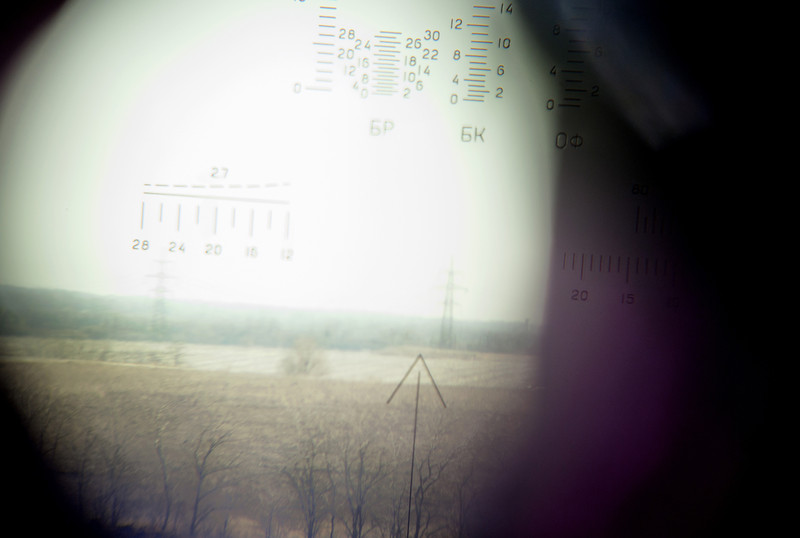
View through Ukrainian artillery sight on Russian positions in east Ukraine (Photo: Christopher Bobyn)

As leaders meet in Bratislava to try to stop EU fragmentation, Ukraine has highlighted Russia’s role in trying to “shatter” the bloc.
“I strongly believe that every threat you will discuss - ongoing migration waves, large-scale propaganda and misinformation, rising populism and right-wing extremism, undermining of values and instigation of N-exits - are all servants of Russia’s hybrid warfare”, Ukrainian president Petro Poroshenko said in a letter, seen by EUobserver, to EU institutions and capitals on Thursday (15 September).
Dear EUobserver reader
Subscribe now for unrestricted access to EUobserver.
Sign up for 30 days' free trial, no obligation. Full subscription only 15 € / month or 150 € / year.
- Unlimited access on desktop and mobile
- All premium articles, analysis, commentary and investigations
- EUobserver archives
EUobserver is the only independent news media covering EU affairs in Brussels and all 28 member states.
♡ We value your support.
If you already have an account click here to login.
-

Poroshenko depicted the war in Ukraine as the front line in defending Europe's post-Cold War order (Photo: president.gov.ua)

“The Kremlin scenario is to shatter the EU’s unity and the trans-Atlantic alliance and to impose an ‘alternative Europe’, based on integration fatigue, national egoism, [and] hatred”, he said.
Russia relations are not on Friday’s agenda, with EU leaders to discuss them at a summit in October instead.
But the Kremlin’s efforts to “weaponise” refugees, in the words of one Nato general, and its financing of far-right, anti-EU parties have shown that Europe’s problems are not just internal.
Russia’s media campaign, on TV and on the internet in almost every EU language, has also fed anti-EU populism.
In Germany, earlier this year, fake Russian news that migrants had raped a girl prompted street protests. In France, last year, journalists exposed Russian loans, worth millions, to the far-right National Front party.
Sanctions
The EU imposed economic sanctions on Russia two years ago due to its invasion of Ukraine.
But in the run-up to the October summit, some EU leaders have said that sanctions did not deter Russia or that they impeded diplomatic solutions.
For Poroshenko, Moscow would take EU concessions as a green light to commit more “crimes”.
“Any debates on easing the restrictive measures … are counterproductive and instigate the Kremlin to further violations”, he said in his letter.
He said the sanctions were “a powerful tool” and that they “keep the Kremlin at the negotiating table both in the Minsk process and in the Normandy format”.
The Minsk ceasefire accord says “foreign” troops must leave east Ukraine and that Kiev must devolve power to war-torn regions via local elections.
The Normandy format - meetings in which France and Germany speak for the EU in talks with Ukraine and Russia - authored the Minsk deal.
Minsk sequence
The EU’s position is that Russia must fully comply with Minsk before it relaxes sanctions.
But EU diplomats told EUobserver that the October talks could “decouple” the sanctions from Minsk, freeing the Europe to undertake “selective engagement” with Russia in return for smaller, positive steps.
French foreign minister Jean-Marc Ayrault, in Kiev on Wednesday, also said Ukraine should move forward on devolution because Russia-controlled fighters had called a truce.
A Ukrainian official, who asked not to be named, told EUobserver there is a risk that the EU could blame Ukraine for Minsk non-compliance, even though it cannot hold elections in Russia-occupied regions until Russian forces leave.
If elections went ahead, it could, “paradoxically”, see the EU reward Russia on Minsk progress due to concessions made by Ukraine.
“Only sequencing of the Minsk commitments can provide us with transparent benchmarks and sound guarantees for implementation”, Poroshenko’s letter noted.
The president, who is to attend the EU’s October summit, warned that Russia used “controlled escalation” to undermine the peace process when it does not go its way.
Escalation
With Russia surging troops toward Ukraine’s borders in summer, that risk of escalation was highlighted in a UN report on Thursday.
“The situation along the contact line remains deeply unstable … there is a real risk that a new outbreak of violence could happen at any time”, the UN’s human rights envoy, Zeid Ra’ad Al Hussein, said.
The Ukrainian official said it was a good thing that Ayrault, and his German counterpart Frank-Walter Steinmeier, visited the conflict zone on Thursday because they “would understand the reality of Russia’s hybrid war”.
He said the Ukrainian army is better equipped today than it was last year to resist Russian aggression.
Speaking to EUobserver in Brussels last week, Nadiya Savchenko, a Ukrainian MP and former soldier, who visits the front line, said that if Russia invaded Ukraine “It would be very bloody. There would be a brutal reaction by every Ukrainian man and woman. We would fight to the last man”.
“It would be the most pessimistic and drastic situation for Russia’s own existence”, she said.