

Schizophrenia is defined by the World Health Organisation as:
“a severe mental disorder, characterized by profound disruptions in thinking, affecting language, perception, and the sense of self. It often includes psychotic experiences, such as hearing voices or delusions. It can impair functioning through the loss of an acquired capability to earn a livelihood, or the disruption of studies.”

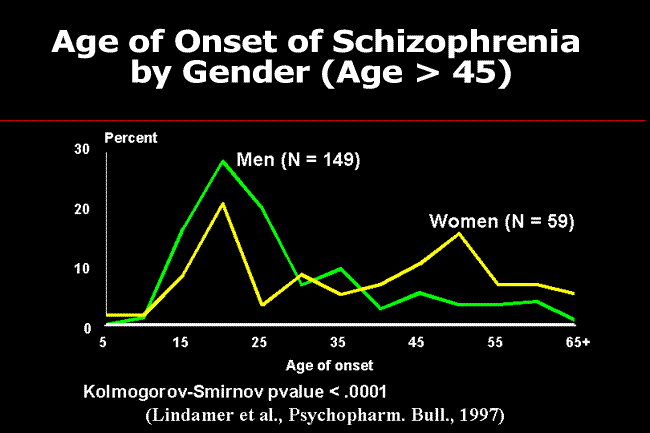
Schizophrenia is typically diagnosed between the ages of 15 and 35. It is one of the most common serious mental health conditions. There is now strong evidence that males have an increased risk of developing schizophrenia. Heritability of schizophrenia is estimated at 83% according to a population-based twin study.
The incidence of schizophrenia in Europe can range from 7 per 100,000 [Aarhus, Denmark], up to 14 per 100,000 [Nottingham, UK]. [World Health Organisation 10 country study, Jablensky et al 1992. See here].
Although it is treatable, schizophrenia imposes a huge cost on society. It is estimated that in the US, schizophrenia consumes a total of $63 billion a year for direct treatment, family and societal costs. According to National Institutes of Mental Health, almost one third of that figure is for direct treatment and the remainder comprises other factors such as lost time from work for patients and caregivers, social services and criminal justice resources. Schizophrenia accounts for a quarter of all mental health costs. As most schizophrenia patients are never able to work, they also must be supported long term by public assistance and Medicaid. In the UK, 80 million working days are lost each year and according to a report by the London School of Economics and Political Science, schizophrenia costs UK society around £11.8 billion [$18.8 billion] a year [http://www.lse.ac.uk/LSEHealthAndSocialCare/pdf/LSE-economic-report-FINAL-12-Nov.pdf]. In addition, people with schizophrenia have around a 50 times greater risk of committing suicide than the general population.
So what actually causes schizophrenia, and who most is at risk? The exact cause remains unknown, however many experts support what is known as the stress vulnerability model theory of schizophrenia. This theory states that everyone has a particular vulnerability to schizophrenia which is determined by a combination of biological, psychological and environmental factors. In this model, a traumatic or stressful event can trigger schizophrenia, with relatively minor events triggering it in people with higher vulnerability, and more significant events triggering it in people with lower vulnerability.
Several risk factors and/or causes are believed to responsible for risk of susceptibility to schizophrenia. [Note that we can’t always be sure if the association is correlational or causational].
These could include: genetic heritability; infections such as toxoplasmosis and herpes; sensitivity to the neurotransmitter dopamine; mutations in the gene for serotonin receptor 2a; parasitic infection interfering with the development of the foetal brain during maternal pregnancy; gut inflammation or dysbiosis [which has numerous causes]; being born in winter; reactions to gluten and casein (food proteins found in wheat and dairy); hormonal changes (eg during puberty); pregnancy or birth complications; children born of consanguineous marriages; climate; latitude; Vitamin D status; fish consumption; advanced paternal age (and/or possibly maternal age); regular use of narcotics, eg cannabis, and especially strong herbal cannabis [‘skunk’], particularly at a younger age; being raised in an urban environment; being an immigrant; having experienced traumatic or stressful life events; being of African/Caribbean [or African-American] heritage; and being male.
Regarding genetics, in terms of the relationship between the Major Histocompatibility Complex (MHC) and schizophrenia, Human Leukocyte Antigen (HLA) loci were among the earliest to be studied. Initial results had proved promising. However, a meta-analysis a few years later with larger volumes of data proved to be somewhat less promising. More studies were carried out since then however. Recently the subject has been looked at once more, with a number of genome wide association studies (GWAS) and a combined analysis by the Psychiatric Genomics Consortium which demonstrated a link between schizophrenia and single-nucleotide polymorphisms (SNPs) in the MHC region.
Previously HLA alleles have been associated with various immunological disorders. However there has been no conclusive proof that schizophrenia had an auto-immune related cause. The only non-immune related disorder with a clear HLA association was hemochromatosis. Also, a problem with HLA is that associations with certain conditions are hard to pin down as alleles can be tightly linked with each other in blocks as part of haplotypes (‘linkage disequilibrium’ or LD) and don’t recombine quickly. So that an association between an immune disorder and HLA can be easily identified, but pinpointing the actual causal variants is not quite so easy. Also, the situation is compounded by other issues, including the fact that humans tend to mate with MHC-dissimilar partners which leads to greater HLA heterogeneity in their offspring. Also, due to the MHC’s role in protecting against pathogens the region is under intense selective pressure which increases diversity [the HLA loci being the most polymorphic]. And finally, in many western countries with ethnically diverse populations and many highly admixed individuals, false-positive disease associations may also arise, so it is important to carefully match case and control subjects ethnically.
Despite these issues, however, it now definitely looks as though HLA’s association with schizophrenia is genuine. As the numbers of studies carried out and sample sizes have greatly increased, results have increasingly been replicated and p-values [for explanation of p-values, see here] have dramatically reduced. Moreover, research increasingly suggests that the MHC region plays a significant role in neuronal function, brain development (prenatal and postnatal), plasticity, etc.
So which HLA alleles have been found to confer susceptibility to or protection from schizophrenia? And what are the frequencies of these alleles in worldwide populations?
The Irish Schizophrenia Genomics Consortium and the Wellcome Trust Case Control Consortium 2 genome-wide association study (GWAS) [see here] identified HLA Class I allele C*01:02 as conferring susceptibility to schizophrenia:-

| 1 | C*01:02 |  |
China Southwest Dai | 0.2940 |  |
||||||
| 2 | C*01:02 | |
China Guizhou Province Shui | 0.2840 | |
||||||
| 3 | C*01:02 |  |
Australia Yuendumu Aborigine | 0.2470 |  |
||||||
| 4 | C*01:02 | |
China Yunnan Province Han | 0.2180 | |
||||||
| 5 | C*01:02 |  |
Taiwan pop 2 | 0.2150 | |
||||||
| 6 | C*01:02 | |
Taiwan Han Chinese | 0.2120 | |
||||||
| 7 | C*01:02 | |
China Guizhou Province Bouyei | 0.2100 | |
||||||
| 8 | C*01:02 |  |
USA Hawaii Okinawa | 0.2050 | |
||||||
| 9 | C*01:02 | |
China South Han pop 2 | 0.2017 | |
||||||
| 10 | C*01:02 | |
Taiwan Minnan pop 1 | 0.2010 | |
So we can see from this study that peak world frequencies for this allele are to be found in certain regions of China, plus Taiwanese aboriginals and Australian aboriginals.
But what about alleles which have been found to confer protection from schizophrenia? The same study replicated a previous study, and also found that HLA Class I alleles B*08:01 and DRB1*03:01 were both protective:-

| 1 | B*08:01 |  |
Ireland South | 0.1820 | |
||||||
| 2 | B*08:01 | |
Australia New South Wales Caucasian | 0.1730 | |
||||||
| 3 | B*08:01 |  |
Ireland Northern | 0.1620 | |
||||||
| 4 | B*08:01 |  |
England North West | 0.1540 | |
||||||
| 5 | B*08:01 |  |
Germany DKMS – United Kingdom minority | 0.1342 | |
||||||
| 6 | B*08:01 |  |
Germany DKMS – Netherlands minority | 0.1125 | |
||||||
| 7 | B*08:01 | |
USA Caucasian Bethesda | 0.1120 | |
||||||
| 8 | B*08:01 |  |
Oman | 0.1100 | |
||||||
| 9 | B*08:01 |  |
Austria | 0.1100 | |
||||||
| 10 | B*08:01 | |
USA Caucasian pop 2 | 0.1090 | |

| 1 | DRB1*03:01 |  |
Italy Sardinia pop2 | 0.5570 | |
||||||
| 2 | DRB1*03:01 |  |
United Arab Emirates pop 2 | 0.1810 |  |
||||||
| 3 | DRB1*03:01 | |
Ireland South | 0.1700 | |
||||||
| 4 | DRB1*03:01 |  |
India Northeast Shia | 0.1530 | |
||||||
| 5 | DRB1*03:01 |  |
France Rennes | 0.1520 | |
||||||
| 6 | DRB1*03:01 | |
India Andhra Pradesh Golla | 0.1510 | |
||||||
| 7 | DRB1*03:01 |  |
Tunisia pop 3 | 0.1510 | |
||||||
| 8 | DRB1*03:01 | |
France Rennes pop 3 | 0.1500 | |
||||||
| 9 | DRB1*03:01 | |
Tunisia pop 2 | 0.1500 | |
||||||
| 10 | DRB1*03:01 |  |
Norway | 0.1400 | |
You will recall from earlier where I mentioned the results of the World Health Organisation ten country study, where the incidence of schizophrenia in European cities ranged from a low of 7 per 100,000 in Aarhus, Denmark, up to a high of 14 per 100,000 in Nottingham, England.
Now both of these cities are broadly similar in size, population, and wealth. Aarhus is at a more northerly latitude than Nottingham. The population of Aarhus is more than 85% of white Danish ethnic background, while the population of Nottingham is approximately 65% of white British ethnic background. Numerous studies have indicated that British and Danish people are genetically very close to one another. So unless there is a major lifestyle difference between the populations of the two cities which is somehow causing the incidence of schizophrenia in Nottingham to be double that of Aarhus, clearly there is another factor at play. In addition, it is probably unlikely that British health professionals would be far more zealous in terms of diagnosing schizophrenia than their Danish counterparts are.
Could there be a significant difference in rates of cannabis use? According to the United Nations Office on Drugs and Crime (UNODC) World Drug Report 2011, the annual prevalence of cannabis use as a percentage of the population aged 15-64 was 5.5% in Denmark (2008); and 6.6% in England and Wales (2010). I haven’t looked at historical trends or regional trends in either country, but this is probably a reasonable proxy for estimating cannabis use rates in Nottingham and Aarhus. If cannabis use was the primary or major cause of schizophrenia, we would likely see far higher rates of cannabis use in England and Wales in order to account for such a disparity in schizophrenia rates between the two cities.
In any case, it is not at all clear that cannabis use really is a cause anyway. The first study on schizophrenia and cannabis took place in Jamaica in the 1960s. Doctors had observed that Rastafarians who regularly smoked cannabis were at greater risk of psychosis. Further studies in the UK and Sweden in the 1980s showed that schizophrenia patients were several times more likely to be cannabis smokers. However these studies merely demonstrated correlation rather than causation. In fact some schizophrenia patients reported that smoking cannabis made them feel better, so it was theorised that people who are more predisposed to schizophrenia may choose to “self-medicate” with cannabis. Some more recent studies, however, suggest that cannabis use may be a partial cause of schizophrenia, when used by teenagers or young adults whose brains are still developing. Nevertheless further research is required.
Alcohol use is unlikely to be a major factor. According to the World Health Organisation, total pure alcohol consumption among adults aged 15+ in litres per capita per year is the same figure for both UK and Denmark [13.37 litres]. [See here].
One major difference between the two cities that we haven’t looked at yet is the ethnic composition.
According to Wikipedia, in 2008 12% of Aarhus’ population were immigrants. If we assume that, including those born in Denmark to non-Danish parents, the total population of non-Danish origin was 15%, that means Aarhus’ population is 85% of White Danish origin. According to Wikipedia, the largest immigrant groups (2008 data) are Palestinians (1.4%),Turks (1.4%), Somalis (1.2%), Iraqis (1.0%), Vietnamese (0.8%), and Iranians (0.7%).
We have recent ethnic data available for Nottingham, UK, following the publication of the 2011 Census by the Office for National Statistics (ONS) – [see here].
The ethnicities of Nottingham’s minority populations are as follows: South Asian 9.0%; Black 7.3%; White Other [mainly East European, especially Polish] 6.1%; Black/White Mixed 4.7%; Asian Other 2.1%; Chinese 2.0%; Other Ethnic Group 1.5%; Asian/White Mixed 1.1%; Other Mixed 0.9%.
So from comparing this data we can conclude that the current population of Nottingham in the UK is far more ethnically diverse than that of Arhus in Denmark.
But how different was the ethnic profile of the two cities back in 1992 when the WHO published their 10 country study?
In the case of Nottingham we can refer back to extracts from the 1991 census.
In 1991, Nottingham’s population was lower, being 235000 [as compared with 289301 in 2011].
Nottingham’s population at that time was considerably less diverse than today. Although there was a small Irish community, in 1991 it was still many years before large-scale migration of East Europeans to the UK following the expansion of the European Union in 2004. So the majority of white people in Nottingham were White British. Also the UK government had yet to begin its programme of dispersing refugees and asylum seekers out to provincial cities (the majority were settled in London). It was also many years before the expansion of numbers of international students enrolled in British universities, and the National Health Service (NHS) had yet to begin a new phase of large-scale recruitment of doctors and nurses abroad.
Therefore most ethnic minorities residing in Nottingham in 1991 were first and second generation migrants of South Asian origin (approximately 4.4%) and African-Caribbean origin (approximately 3.2%), derived from migration in the 1950s and ’60s.
I haven’t been able to locate data on Aarhus’ population in the early 1990s, but it is probably fair to assume that the proportion of immigrants was likely considerably lower in 1991/2 than it was in 2008.
It seems fair to conclude that the fact that the rate of schizophrenia diagnosed in Nottingham in the UK was double the figure for Aarhus in Denmark [according to the World Health Organisation’s 1992 10 country study] is likely due to Nottingham’s very different ethnic composition compared with Aarhus.
In their paper “Migration and schizophrenia: an examination of five hypotheses” [Social Psychiatry 1987, Volume 22, Issue 4] Raymond Cochrane and Sukhwant Singh Bal looked at rates of admission for schizophrenia for the native born and the four largest foreign born populations living in England in 1981 (Irish, Indian, Pakistani, and Caribbean born). These groups were also the main ones represented in Nottingham in the 1991 census.
Interestingly, schizophrenia rates for the Irish living in England were comparable with Irish people living in Ireland, but this figure was still actually higher than that of the English themselves. The Irish do not greatly differ from the English genetically, so perhaps other factors may account for the difference [recent history of consanguineous marriages within Irish families? poorer nutrition?] Despite popular stereotypes, high alcohol consumption is unlikely to be the issue as consumption is only marginally higher among the Irish as compared with the British, according to World Health Organisation data.
Very high rates of schizophrenia were found among both Caribbean-born men and women; high rates were found among Indian-born men and women; and high rates among Pakistani-born men only [this is believed to be due to cultural reasons, with mentally ill Pakistani women opting out of the formal mental health system &/or returning to their country of origin].
My conclusion is that economic migrants to cities in western countries in northern latitudes who originate from non-western, tropical countries are genetically predisposed to a risk of schizophrenia, but also placed at greater risk of certain trigger factors for schizophrenia risk in terms of their new lifestyle.
In the case of South Asian and African/Caribbean migrants to the UK, it may be the case that there could be several such trigger factors. These could include, for example, increased psychological stress [for many different reasons]; lack of exposure to bright sunlight/reduced vitamin D levels; poorer nutrition; reduced immune system function brought on by several of the above factors plus colder air temperature in UK resulting in parasitic infection [impacting either the adult migrant themselves or their unborn foetus], etc.
From the point of view of genetics, in particular looking at the Major Histocompatibility Complex (MHC) again, what can be determined from the available HLA data with regard to South Asian and African/Caribbean populations and schizophrenia risk, relative to British?
I decided to use HLA data from the Allele Net Frequency Database (ANFD) to find out [see here].
I decided to look at the following populations: Representing ‘White British’, a sample of Brits [n=1043] living in Germany; representing ‘South Asian’, two populations living in Delhi, India [n=112 & n=90, respectively]; representing ‘Black’ [including West African and West African-derived populations] are several groups including African Americans, African Brazilians, African Caribbeans, various West African groups, and Congolese This data ought to be representative of the main three ethnic groups residing in Nottingham at the time of the World Health Organisation’s ten country study on schizophrenia in the early 1990s.
I will look at frequencies of the three main HLA alleles which I previously mentioned in regards to schizophrenia: C*01:02 [confers susceptibility]; B*08:01 [protective]; and DRB1*03:01 [protective].
C*01:02 [Confers susceptibility to schizophrenia]:
| C*01:02 | |
Germany DKMS – United Kingdom minority | 0.0319 | |
| C*01:02 | |
India Delhi pop 2 | 0.0310 | |
| C*01:02 |  |
Senegal Niokholo Mandenka | 0.0310 | |
| C*01:02 | |
USA African American Bethesda | 0.0160 | |
|||||||
| C*01:02 | |
USA African American pop 4 | 0.0085 | |
|||||||
| C*01:02 |  |
Mali Bandiagara | 0.0080 | |
B*08:01 [Confers protection from schizophrenia]:
| B*08:01 | |
Germany DKMS – United Kingdom minority | 0.1342 | |
| B*08:01 | |
India Delhi pop 2 | 0.0160 | |
| B*08 | |
Senegal Dakar | 0.1110 | |
| B*08:01 |  |
Guinea Bissau | 0.0770 | |
| B*08 |  |
Brazil Parana Afro Brazilian | 0.0650 | |
|||||||
| B*08 | |
USA African American Bethesda | 0.0640 | |
| B*08:01 |  |
Cameroon Yaounde | 0.0540 | |
| B*08:01 | |
Senegal Niokholo Mandenka | 0.0480 | |
| B*08:01 | |
USA African American | 0.0460 | |
| B*08 | |
USA OPTN African American | 0.0430 | |
| B*08:01 | |
USA African American pop 3 | 0.0400 | |
|||||||
| B*08:01 | |
USA African American pop 4 | 0.0384 | |
|||||||
| B*08:01 | |
USA African American pop 8 | 0.0380 | |
| B*08 |  |
Martinique | 0.0300 | |
|||||||
| B*08 |  |
Burkina Faso Mossi | 0.0190 | |
| B*08:01 | |
Cameroon Beti | 0.0110 | |
|||||||
| B*08:01 | |
Mali Bandiagara | 0.0070 | |
| B*08 |  |
Trinidad African | 0.0000 | |
DRB1*03:01 [Confers protection from schizophrenia]:
| DRB1*03:01 | |
Germany DKMS – United Kingdom minority | 0.1395 | |
| DRB1*03:01 | |
India Delhi | 0.1220 | |
| DRB1*03:01 | |
USA Colorado Univ Cord Blood Bank African American | 0.0780 | |
| DRB1*03:01 | |
USA African American pop 4 | 0.0707 | |
|||||||
| DRB1*03:01 | |
USA African American Bethesda | 12.6 | 0.0700 | |
| DRB1*03:01 |  |
Congo Kinshasa Bantu | 0.0670 | |
|||||||
| DRB1*03:01 | |
USA African American pop 7 | 0.0670 | |
|||||||
| DRB1*03:01 | |
Martinique | 0.0600 | |
| DRB1*03:01 | |
Congo Kinshasa expatriates living in Belgium | 0.0460 | |
|||||||
| DRB1*03:01 |  |
Jamaica | 0.0230 | |
|||||||
| DRB1*03:01 | |
Senegal Dakar | 4.4 | 0.0220 | |
||||||
Discussion
In looking at this HLA data, one can observe that the White British and South Asian populations both have similar frequencies of HLA C*01:02 which confers susceptibility to schizophrenia, while in the absence of suitable data on Jamaicans one can guess using the data from other populations of similar origin that their frequency of the allele would be either equal to or lower than the White British and South Asian samples [definitely not likely to be much higher].
Regarding the B*08:01 allele which confers protection from schizophrenia, this allele is at a very high frequency in the White British sample, very low frequency in the South Asian sample, and found at verious frequencies in the West African-derived populations [but still usually far lower than the British].
Regarding our final allele, DRB*03:01, which is also protective from schizophrenia. This allele is often found within the same high frequency haplotype as B*08:01 in northern European-derived populations [A*01:01-B*08:01-C*07:01-DRB1*03:01-DQB1*02:01], so it is no surprise that it would also be found at high frequency in the British population. This allele is also found at high frequency in our South Asian group [12.2%]. However, the frequency is much lower in general for the African-derived populations, ranging from as low as 2.0% to as high as 7.0%. We are fortunate for this allele to actually have data from Jamaicans, which falls at the low end of the scale (just 2.3%).
So to recap: it appears that the White British, South Asian, and Black [West African-derived] populations all possess similar, rather low frequencies of the schizophrenia susceptibility-conferring C*01:02 allele.
The protective allele B*08:01, found at very high frequencies in the British, is at a low frequency in the South Asian sample, and with the exception of certain outliers is found at much lower frequencies in Black [West African-derived] populations as compared with the British.
Finally, the protective allele DRB1*03:01 is again found at a very high frequency in the British sample, but is also found at a high frequency in the South Asian sample this time. Whereas the Black [West African-derived] populations again have much lower frequencies, and in the case of the Jamaican sample in particular, the figure is particularly low.
Conclusion
We could benefit from many more populations being typed for HLA, and more studies or datasets being published, and in particular more studies into HLA disease associations.
However using the HLA data to compare three different ethnic groups [White British, South Asian, and Black] which resided in Nottingham at the time of the World Health Organisation schizophrenia study in 1992, it is possible to conclude that Nottingham’s schizophrenia rate was double that of Aarhus in Denmark not so much for environmental or lifestyle factors, but more likely due to its ethnic profile.
The British have similar levels of the allele that confers susceptibility to schizophrenia as the South Asian and Black groups do, but very high levels of the two alleles which confer protection from schizophrenia.
Whereas the South Asian sample only shows a high frequency of just one of the two protective alleles, the Black [West African-derived] groups generally have high frequencies of neither, and in a number of cases [eg Jamaicans and DRB1*03:01] actually have very low frequencies.
Clearly there are both environmental and genetic reasons behind the higher rates of schizophrenia among Black and South Asian migrants to the UK relative to the native British population.
As more studies are carried out in the coming years the picture will become much clearer.
To take a free, online schizophrenia test, click here.
