Elvis Costello and the Roots – “Wise Up Ghost” (2013)
Another review of EC’s excellent new album with The Roots. This review comes from Alex Wisgard, Sept. 12th, from The Line of Best Fit website…

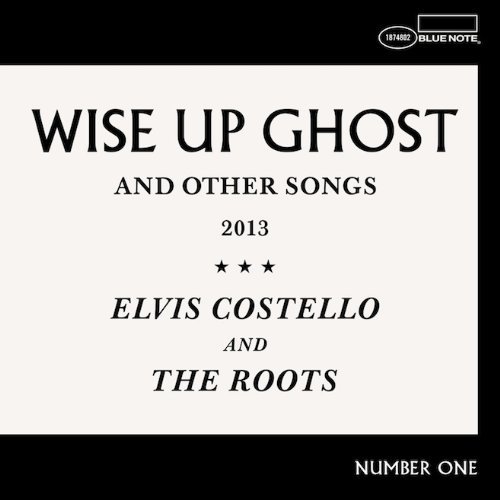
While the announcement of a collaboration between The Roots and Elvis Costello was certainly a surprise, it would be boneheaded to say that there’s no precedent to Wise Up Ghost in either band’s vast careers. Neither act are strangers to collaborations outside of their comfort zone, and it’s fair to say that Ghost doesn’t actually step too far out from certain corners of either band’s ouevre – the lurching loops and swampy textures of Costello’s 2002 effort When I Was Cruel are actually pretty obvious forerunners to the tracks here. In fact, what on paper sounds like a potentially clumsy stab at relevance for Costello and timelessness for The Roots actually turns out, on wax, to be a pretty potent meeting of minds.
So, two facts before I take this any further:
1) The Roots are not trying to be the Attractions.
2) Elvis Costello is Very Much Not trying to rap.
Rather, Wise Up Ghost – released on the seminal Blue Note jazz label and wrapped in a stark, City Lights poetry-style sleeve – is a sinewy collection of some of The Roots’ best grooves, and Costello’s signature blend of observatory bile and jaded travelogues. Sometimes, especially towards the end, the parts don’t quite mesh – the smoky Latino-jazz detour ‘Cinco Minutos con Vos’ is an indulgence too far, while the nursery-rhyming ‘Viceroy’s Row’ sees Costello stretching his vowels over what sounds like a completely different beat from the one ?uestlove is playing.
But these are trifles when compared with the monumental sounds of Ghost‘s highlights; Costello sounds positively breathless trying to keep up with The Roots’ rolling, dubwise beat for ‘Walk Us Uptown’, while the close-miked music-box waltz of ‘Tripwire’ is the album’s best ballad, whose gently swaying delicacy belies some of the albums most ominous lyrics (“Don’t open the door ’cause they’re coming, don’t open the door ’cause they’re here”). Much has been made of ‘Stick Out Your Tongue”s recycling the lyrics of 1983′s ‘Pills and Soap’, but less a case of self-sampling than a wry, timely update (“In time, you can turn these obsessions into careers”) of one of Costello’s most obliquely ferocious songs, over the darkest groove here. You can all but hear the grin on Costello-superfan ?uestlove’s face as Elvis unravels the words.
And then there is the title track, a fucking totemic thing rooted in Morricone strings and a doomed Gershwin piano motif. A kaleidoscopic slow-builder, its six and a half minutes of psychedelic soul mop up the threads of the entire album, from snatches of recycled refrains (copping a chorus from three tracks earlier, a chorus of Costellos shrieks ”She’s pulling out the pin!”, like nervy horror fans at a cinema trying to warn the heroine not to open that door), skitterish drums and the kind of relaxed, lazy vocal delivery that can only come from a man who’s seen it all, and doesn’t care where it all goes from there. If anyone had any doubts about the potential of this album, they’ll all be silenced by the time this track rolls to its conclusion.
Even at its worst, Wise Up Ghost is impossible to hear as anything other than the sum of its parts. Neither band is adapting their playing to the other, yet somehow you can’t imagine the Roots tackling these songs with any other vocalist, nor Costello with any other band. This isn’t mere dilettantism, and while it’s likely to net both acts new fans from the other side of the great genre divide, it holds up more than capably on its own terms. Sure, The Roots have another album due within the next six months, but if Costello does decide to deliver on his oft-made promise to never make another record, this is a pretty fine way for him to bow out.
Alex Wisgard
http://thelineofbestfit.com/reviews/albums/elvis-costello-and-the-roots-wise-up-ghost-136030
The Clash – “Sound System” (2013)
A review of the new Clash box set (which I hope to get one of these days), by Patrick Sawer of The Telegraph, dated July 21, 2013…

Joe Strummer and Co. sound as fresh as ever in Sound System, a box set of songs remastered by the band’s guitarist Mick Jones and Tim Young, says Patrick Sawer.
The Clash’s Sound System, the latest offering from what has become the retro recording industry, will only add to a debate that has continued since that spiky cultural movement called punk first exploded on to the British music scene in 1976.
This box set brings together all the band’s albums and singles – at least those recorded by their classic line-up – with previously unreleased tracks and early demo tapes, along with archive film, promotional videos and unseen concert footage.
There are also reproductions of original badges and stickers, a hidden poster, and facsimile editions of two fanzines produced by the band, alongside a collection of essays by those closely associated with the Clash camp, such as film maker and DJ Don Letts, seamstress Alex Michon and the ‘Baker’, band roadie turned blogger.
The content is lovingly packaged in a box neatly dressed-up as one of those giant beat boxes hipsters used to lug around before the advent of the Sony Walkman and the digital revolution that followed.
In 1976, in what can be taken as their founding statement of intent, and yardstick by which the band were subsequently measured, the Clash’s then 24- year-old singer, Joe Strummer, exclaimed: “I think people ought to know that we’re anti-fascist, we’re anti-violence, we’re anti racist and we’re pro-creative. We’re against ignorance.”
On that measure alone the Clash do more than stand the test of time. To listen to “Complete Control,” “(White Man) in Hammersmith Palais” and “London’s Burning” afresh – particularly in an era of global turmoil – is to be reminded that pop music should still speak to the anger and concerns of the marginalised, dispossessed and disillusioned.
“White Man” is Strummer’s personal account of a night at a pop reggae concert which mutates into a state-of-the-nation broadcast. “Career Opportunities” and “48 Hours” are the staccato refrains of youngsters in dead end, exploitative jobs – a punk rendition of Marx’s theory of alienation if ever there was (“Monday’s coming like a jail on wheels”).
While rock n roll cannot change the world per se, these songs restake the claim that it can at least shape the minds and steel the spirits of those who listen to it.
The tracks, remastered by the band’s guitarist Mick Jones and Tim Young (who won a Grammy for his work on the Beatles 2006 Love album), sound fresh as ever, crisper even. Jones, the official muso of the band, said that during the remastering process he discovered guitar lines he couldn’t remember and previously buried instrumental details certainly stand out – along with Strummer’s biting ad-libs.
Given their preoccupation with keeping the price of records and concert tickets within the reach of young fans, its legitimate to ask whether a box set retailing online at £81.50 betrays the promise of a band who famously declared: “There will be no six quid Clash LP ever.”
After all, the double album London Calling sold for £5 on its 1979 release, and the sprawling six sided of Sandinista! – part groundbreaking genius, part folly – for £5.99, in detriment to band’s royalties.
Sound System’s release will undoubtedly see accusations that the surviving members of the Clash – Strummer died in 2002 – are doing what they once so eloquently denounced, “turning rebellion into money”.
But while this collection may be out of reach of a jobless teenager or student discovering the band for the first time, its 11 CDs, plus one DVD of concert and studio footage, work out at a more than reasonable £6.79 each, even before the added memorabilia is included.
That still begs the question of who the intended buyers are, since most fans will already own most of this material. Archivists? Obsessive collectors? Inquisitive teens wondering what their parents made such a fuss about will need a generous benefactor.
UK punk’s art school and dole queue origins, and the ideological mindset it adopted, created a year zero mentality among both its disciples and critics.
But in reality there was never a year zero – where all punk music was born with no reference to the ‘decadent’ past.
How could there be, especially with a band like The Clash? Jones, was a teenage fan of Mott the Hoople and had sneaked into the Stones’ legendary 1969 Hyde Park concert; Strummer worshipped at the altars of Eddie Cochran and Bo Diddley; bassist Paul Simonon grew up on a south London soundtrack of ska and reggae; and drummer Topper Headon could play jazz and soul licks in his sleep.
As the box set amply demonstrates, the canon of modern popular music finds echoes throughout the band’s work, from musical nods and lyrical references to cover-versions of pioneering reggae and R&B cuts. That was how me and thousands of other teens received our musical education.
I arrived at Willie Williams through the Clash’s apocalyptic version of “Armagideon Time,” I sought out Diddley because they had invited him to support them on the 1979 US tour, I dug into Prince Far I and Big Youth because their ‘heavy manners’ slogans about the Jamaican state of emergency were stenciled on the band’s clothes.
If it hadn’t been for the Clash’s cover version of “Brand New Cadillac” would I have ever heard of Vince Taylor, Britain’s forgotten rock and roll legend? And “The Magnificent Seven,” from Sandinista! (1980) led many a suburban British white boy to seek out the new hip-hop sounds from New York.
Montgomery Clift? I first met him on the London Calling track “The Right Profile,” written by Strummer after the album’s maverick producer, Guy Stevens, leant him a biography of the actor.
Far from narrowing my cultural horizons punk widened them, heightening my curiosity and that of other fans.
And what of the rule that punk had to be played badly, on two chords? Another myth.
The first people to put paid to that were the founding fathers of British punk themselves, without whom Strummer said there would have been “nothing.” In Steve Jones and Paul Cook the Sex Pistols surely had one of the tightest and most powerful drum and guitar pairings in rock’s rich history.
Compare the first demo tapes the Clash recorded in mid ‘76, at Beaconsfield Film Studios – where their friend Julian Temple, later a renowned director, was a student – to the later incarnation of those songs on the eponymous first album, recorded some 10 months later. There’s a hesitancy and ponderousness, betraying the band’s first time studio nerves and contrasting to their adrenalin rush on stage.
By the time of the first album’s release, however, they had added to their repertoire the reggae vibe that filled the air around their Notting Hill stamping ground, giving even the fastest numbers, such as “White Riot” and “Cheat,” an added dimension, thanks to the echo and dropout techniques pioneered by dub DJs and producers.
This sort of cultural sampling is now the stock in trade of British bands, and their US indie counterparts, but the Clash were early exponents, particularly on London Calling and Sandinista! Whether trying their hand at soul – “The Card Cheat” – throwing in some jazz – “If Music Could Talk” or “Broadway” – or ripping it up rockabilly style, there remains the sense of urgency and anarchic inventiveness that is both punk’s calling card and rooted their sound in the great musical currents of the late 20th century.
Perhaps the most enduring key punk principle was Do It Yourself. You too could form a band, make your own clothes, start your own fanzine – and not just wait for the latest record release or concert appearance from your idols.
When Strummer barked “No Elvis, Beatles or the Rolling Stones in 1977”, hundreds of kids up and down the country took that at face value and formed their own garage bands.
For all its high end production values and high end price tag, Sound System is at root an example of the band’s DIY principle.
This is manifest not only in the reproduction of the two issues of the fanzine-style programme sold at gigs, or the stenciled typography of the artwork. The real measure of the band’s continuing adherence to self-creativity is the fact the box set has been designed by Simonon.
It was Simonon, an art-school dropout, who designed the Clash’s trademark look – from their early Jackson Pollock paint-splattered mod blazers and ties, to ‘40s-gangster-meets-western-outlaw threads – and their stage backdrops.
Tucked into one of the box set’s mini pink flight cases is a facsimile of a Penguin classic. It’s a Clash joke; humorous in execution, serious in content.
The paperback’s title is one of Strummer’s multifarious epigrams: The Future Is Unwritten. But it’s contents is blank page after blank page.
What’s this, but an echo of that exhortation proffered by Strummer, Jones, Simonon and Headon to their fans more than 35 years ago? You can write your own music, your own story, your own myth. You can still do it yourself.
Whatever the arguments about the price of Sound System, or whether the world needs another Clash collection – however beautifully packaged – that will surely be the enduring legacy of punk and of one of the movement’s most creative bands.
Patrick Sawer
Elvis Costello and the Roots – “Wise Up Ghost” (2013)
Colin McGuire’s Sept. 16th review of EC’s new album with The Roots. Taken from the PopMatters website (link below)…

All you really need to know about Wise Up Ghost, the genius collaborative effort from iconic songwriter-singer Elvis Costello and iconic live hip-hop act the Roots, can be found on “Viceroy’s Row”. At about five minutes, the song is the single most indicative example of precisely how oddly nuanced the entire project ultimately is. The track runs on ?uestlove’s misleading, inventively provocative dark groove that doesn’t even prove itself not a mistake until the third or fourth listen. Is it rhythm and soul? Is it a shuffle? Is it the blues? Is it rap music come alive?
Ultimately, it’s all of those things doing their best impressions of the others, an amalgam of an idiom as trite as influence that reaches unprecedented heights here because of impeccable fearlessness and rarified talent. There aren’t a lot of people who could pull this type of collection off, anyway, and there certainly will be some who can’t even muster the guts to accept it as mere listeners. But regardless of intention, reaction, comprehension or confusion, there is still no denying this undeniable fact: Holy cow. The Roots and Elvis Costello actually got together and made an album.
And at the risk of sounding overly smug or obnoxiously glib … these 12 songs sound exactly like the Roots and Elvis Costello got together and made an album. Each artist is prevalent within the fabric of each note of each track, and each artist gives only as much as they take, allowing for the others to shine in ways only they know how. It’s as unique as anything you’ll hear in pop music today and it demands repeated spins before settling on any rational opinion. It’s not, not accessible, of course, but it’s also not “Alison” sung over a “Rising Down” back beat, either.
What it is, however, is a display of shit-hot funk feels underneath a surprisingly inspired and subliminally aged Costello. “Refuse to Be Saved”, anthemic in nature, is irresistible fun, the singer inching closer and closer to Black Thought (who is disappointingly absent from the set) territory with his rapid-fire delivery and stuttering verses. Even more enticing is the Steve Naive-esque keys that meet up with the Roots’ horns for an interplay alone worthy of whatever they want you to pay. By the time the “I refuse to be saved” cadence shines through the track’s climax, you can’t tell if you’re in Memphis for the protests or the music.
Actually, it’s that very Southern soul that makes Wise Up Ghost so intoxicating. “Wake Me Up”, a retread of the singer’s “Bedlam” and “The River in Reverse”, might be the grooviest Mr. MacManus has ever sounded on a record, his solemn, low-key vocals playing perfectly with the Philadelphia crew’s expertly crafted and authentically presented version of contemporary R&B. Joining Costello’s familiar faces is the decidedly hip-hop “Stick Out Your Tongue”, a Punch the Clock favorite repurposed for a collection that was initially borne out of the idea that ?uestlove and his boys wanted to revisit some of the singer’s catalogue. In hindsight, thank God they didn’t. Because for as intriguing and insightful as that record may have turned out, it would have been criminal to leave this original material unrealized.
Maybe the most notable example of that would-be depravity is the tender “Tripwire”, a throwback ballad that accentuates the best qualities of both parties. Costello, for all his signature angst and punk-rock attitude, has long allowed his secret weapon to be his vulnerability (have you seen the stripped down version of “Everyday I Write the Book” from his short-lived Spectacle series?). The Roots, meanwhile, are accustomed to backing modern-day soul sisters, mastering the art of playing it pretty while also playing it smart. In this instance, the song is a bona fide 1960s R&B radio hit, echoing Smokey and his Miracles along with a settled down Little Stevie Wonder. Adding to the AM Gold is the singer’s delicacy, uttering the title word with the strength of a feather. It’s so welcoming, you would prefer to fall asleep in it rather than to it.
Still, and all gentility aside, you can’t have these guys get together and not expect some dirty fun. “Come the Meantimes” and “Walk Us Uptown” stand out for the dance party they want to help formulate in some sweaty warehouse the other side of Chelsea. The former is classic Roots with its slinky movements and unique instrumentation (not to mention an unavoidable Breaking Bad connection: With all the tiny, spastic ringing bells, it’s easy to envision Hector Salamanca sitting in somewhere on this performance). “Uptown”, the collection’s first single, sets the tone correctly for a release so stubbornly collaborative. The funk guitars and organs, coupled with ?uestlove’s straight-ahead pitter-patter, create the soulful legs on which the rest of the songs stand, a clear indication of exactly what is to be expected throughout the next 11 songs.
And what’s to be expected through those next 11 songs is a surprisingly exciting record. For all the collaborations both Elvis Costello and the Roots have found themselves in, Wise Up Ghost has got to be among the most substantial, among the most revered. Everybody knew that it might get a little weird to hear what these guys could do together, but nobody figured it would be this … invigorating. Costello sounds no more reborn than he does retooled while ?uest and his crew have never before appeared this skin-tight on wax (turns out that Fallon gig has worked wonders for their capabilities, no?). Right place, right people, right time; those things aren’t even the half of it.
Some people turn their obsessions into careers, the singer argues at one point during “Stick Out Your Tongue”. Elvis Costello and the Roots? Well, they already have the careers. With Wise Up Ghost, though, they now also have a great album.
Colin McGuire
http://www.popmatters.com/review/elvis-costello-and-the-roots-wise-up-ghost/

Leonard Cohen – “I’ve Got a Little Secret” (Live – 2013)
Live at the 02 Arena in Dublin, taken from Sept. 12th, a brand new song from LC…
 The Beat Patrol