Wire weaving experiment

I ordered new wire-wrapping wire recently, and with this wire and an 18 gauge one I already have with me, I attempted my first wire weaving.Wire weaving pendant

The weaving was fun while I was coiling it near the pearl, but got pretty difficult as I neared the top. I’ll probably need to go a gauge or two thinner in the future, but I’ll reserve that judgment until I finish another weaving test run. Maybe I just need practice, and this will not be an issue.

With this weave, it was also difficult to keep the coils pinched together — they just kept loosening up, just a little though. Another indicator to practice more. πŸ™‚

I was in a different headspace while cutting the wire, and ended up cutting a really small length of wire, hehe… Since I was just practicing and didn’t know how the piece would turn out, I decided to go ahead with that length. When it ran out, I continued with new wire added in. You can see that ugliness near the weave beside the pearl. I’ll need to snip it and adjust it so it won’t be visible much, but I’ll leave it for another day. (Laziness wins today! πŸ˜› )

I had hammered the ends of the thicker wire before I started, and after finishing the weaving, I hammered the top a bit too. I like the texture it creates.

Overall, for my first attempt at wrapping wire, I consider this a success! πŸ™‚ I’ll try out a different weave next time to see how I fare.

Bright Summer Jewelry

My next project from PCA 2017. The tutorial itself involves creating a pendant with canes and gradients. The pendant looks awesome, but if I do make one, I’m doubtful if I (or my sis) would wear it, because it is a tad large for our liking. I really liked the shapes and colors in the piece, though, so I thought I’d make tinier versions from parts of the project. And here’s the result.

Bright Summer Jewelry

Bright Summer Jewelry

Love these tiny things!

Trying to use a gradient for the spheres in these little pieces would not even show the gradient colors much, so instead, I just used glass beads for them.

Shaping the crescents was a bit tricky, but the results are not too shabby. After my last project, I’d thought of trying out sanding for my next project, but the curves in the tiny crescents made it kinda difficult, and I ended up not sanding. I did buff the pieces for quite a while, although I admit it doesn’t make much difference without the sanding preceding it. πŸ™‚ Next project, hopefully…

Crocheted Polymer Clay Jewelry

My first project in the PCA art retreat. And my first batch of improvisations to compensate for lack of supplies where I live. πŸ˜‰

Crocheted Polymer Clay Jewelry

Crocheted Polymer Clay Jewelry

This project uses the invisible spool knitting technique of wire crochet to embellish organic polymer clay beads with a delicate wire mesh, creating teardrop-shaped earrings and pendant. The wire crochet technique is used to create a fine necklace as well.

I could make the beads without much hassle. (Thanks to my sis for lending me her supplies to add the shine on them.) However, I can’t find the fine wire needed for the project here. So I used what I could lay my hands on — a thicker gauge wire.

Now, this wire does not really hold its shape while I work on it, so I couldn’t use the invisible spool knitting technique. I did regular crochet instead, which makes for a thicker mesh.

The wire mesh is also not the least bit delicate — if anything, it’s strong and yet springy πŸ™‚ — but I wanted to work with it instead of trying to force it to be something it wasn’t, so I made the pieces look more traditional Indian instead of modern, by adding more wire-crocheted accompaniments for the earrings. Instead of making a fine necklace, I made a tube that a cord (or a seed-bead necklace) can be strung into.

And I also made a tiny piece that I added as a charm to an old scrunchy bracelet that I’d made. πŸ™‚

So many improvisations! Love the results! ❀ ❀

Dragon Pendant

Another challenge that inspired me to try out something new!

The team at Art Elements launches a themed challenge every month. I’d thoroughly enjoyed working on a sugar skull keychain inspired by their October theme. This month, it’s a winter themed challenge, and Niky from Art Elements came up with a dragon-inspired theme! And who can resist dragons? πŸ™‚ So I tried my hand at a dragon pendant, and then decided to officially participate in the challenge as well. I’ve been inspired indeed! πŸ˜€

Polymer Clay Dragon Pendant

Polymer Clay Dragon Pendant

Thanks to Niky for coming up with this theme. I wouldn’t have tried something like this otherwise. I loved making the pendant — from inspiration to design to execution! Someday, when my claying skills improve, I’ll make some different dragon jewelry that does justice to the sheer awesomeness of this magnificent creature. Until then, this will do. πŸ™‚

I originally had a design in mind for a dragon curled around a large bead, but sculpting a dragon was not something that I was looking forward to, especially so soon after sculpting the sugar skull. I have a mold with some paisley vine-like shapes, and I thought one of them could work as the dragon’s body. I changed my design to suit this dragon shape, molded the clay, and made the tail pointier.

Though I’d thought of adding scales similar to the appliquΓ© flower petals I made for my sugar skull, I didn’t think I’d be able to work much on the dragon’s curly body. So I poked dots on its back instead, and made some ridges on its belly.

I set the dragon on a big flat wooden bead, with a large white glass bead behind the dragon. The setup still looked a bit empty, and I cut off thin strips from a gold-and-brown sheet I’d made, and arranged them behind the dragon.

I covered the back with a layer of dark polymer clay, and bent two wires to form loops that I attached to the back. I then wrapped a strip of brown clay along the circumference, marked ridges on it, and added more of the gold-and-brown strips over it at the top.

I kept the piece aside for a few days — just in case I finished more projects, I could bake them all together. I took it out this week to fiddle a tiny bit with it, the behind-the-dragon strips broke off partially! 😦 I didn’t have the patience to remove all of that area, and risk damaging the dragon as well, so I added a few more strips to the broken area. The new strips didn’t work well with the old ones, and no gentle prods could make them do so. I finally poked dots in them to force them to stay. To keep things consistent, I carefully poked dots in the other similar areas too. It’s not as good as the original, but it’s not bad either… Liquid Polymer Clay would probably have helped here, and it’s now gone up a slot in my to-buy list.

Finally, I made two tiny horns and a tiny eye, and attached them both to the dragon’s head. I wondered if I should try to add anything else (wings), but I couldn’t risk the dragon’s body crumbling like the background did, so I went ahead and baked the piece before anything else could break off. It came out of the oven well. Phew! πŸ™‚


Here’s all the beautiful dragon-inspired jewelry that everyone has made —

Guests

Kathy Lindemer
Kelly Rodgers
Shai Williams
Tammy Adams
… And of course, there’s me! πŸ™‚

AJE Team

Caroline
Cathy
Claire
Diana
Jen
Jenny
Laney
Niky
Susan

Polymer Clay Adventure

PCA — an amazing collection of polymer clay courses, with 24 projects to work on, over the next year… And I’m joining!

I came across the PCA online art retreat a couple of months ago, and was impressed with the variety of techniques covered in the curriculum — there are some mixed media projects as well. And at an incredibly low price tag, it’s a steal! My only concern was the availability of project supplies where I live. I decided that if some supplies are not available, I’ll find alternatives. After all, that’s a kind of challenge too! πŸ™‚ My generous sis is willing to loan me some of her card-making supplies if we think they’d work out (love you, sis ❀ πŸ˜„ ) so I’m hoping it’ll be fun.

So I finally enrolled in the course this week. Claying-wise, 2017 is going to be epic!

Premo!

Ever since I discovered that Sculpey III is brittle and not really suited for most of the polymer clay work I’m interested in, I’d thought of buying sampler packs of other clays. I finally ordered some of Premo!, Premo! Accents and SoufflΓ©.

The package arrived, and I eagerly sat down to play with the clay.Β To my disappointment, I found that it was ancient stock, and I just couldn’t condition the clay at all. When my hands finally started aching from all the pressing and rolling (I haven’t bought a conditioning machine yet), I began looking for what other people do to make old clay ‘like new.’ Apparently, most people throw away the clay if it’s this bad. Well, I spent a lot of money on mine, and throwing it away isn’t an option. What else you got, The Internet? Some suggestions popped up about adding mineral oil or baby oil to the clay. Okay, I could do that.

It worked! Really well, in fact. I still don’t know how the oil-conditioned clay will behave over months (or years), but for now, it’s made me happy I decided to try out these new clays. I was apprehensive about the post-bake quality, but the finished products are sooo sturdy. I made two earrings and a buckle.

The earrings

To start with, I twirled two snakes of silver and black around each other, folded the new rope to and fro into a roughly rectangular shape and rolled it flat. I wanted to test making two sets of earrings, one thinner than the other.

Premo! experiment - Thick earrings

Premo! experiment – Thick earrings

For the thicker earrings, I used a rectangular cutter and cut out two pieces. I continued to roll the remaining clay into a thinner sheet, and then cut out a circle using another cutter. (I haven’t used this circle yet.) I used a larger circular cutter on the remaining clay, and then cut the resulting shape into two equal earring pieces.

Premo! experiment - Thin, curved earrings

Premo! experiment – Thin, curved earrings

There was still some clay left, and I rolled it up into a snake, and used it for lining the edges of all four pieces. I then poked holes in the pieces for inserting jump rings later.

While baking, I kept the thinner piece bent over some folded card, so its surface is curved.

Results: The thicker one is sturdy, and the thinner one is slightly rubbery when I try to bend it, but pretty sturdy too. It didn’t chip or break when I tested it. (Reminded me of the time my experimental Sculpey III piece snapped.) Of course, I didn’t try my hardest to break it — after all, what earring goes through such hardships? πŸ˜›

The buckle

Premo! experiment - Buckle

Premo! experiment – Buckle

I used a mold for the torus base. Then, I decided to mix things up, and cut out uneven strips from an old Sculpey III sheet of brown (from the dragonfly project.) I first laid out thicker strips on the base, and then I rolled thinner strips around it. Finally, I firmly attached a decent-sized solid cylinder, made from the same clay as the base, for the buckle’s support.

Result: This piece is born to be a buckle — look at how it’s holding a belt in place! ❀

So overall, I like Premo!, as long as I find newer stock. (Because conditioning old clay is not fun.)

Kumihimo bracelet

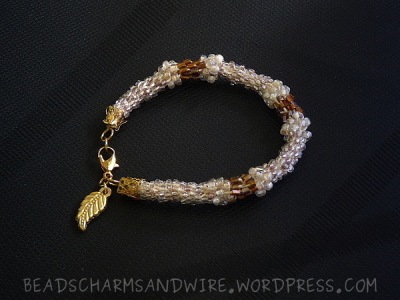
I tried out Kumihimo again, though I know the beads I have are not really suitable — the more even ones are too small, show the thread, and don’t settle down well; and the larger ones are too uneven. :)Kumihimo bracelet

This is a 12-strand Kumihimo bracelet. After braiding only with the threads for about 0.5cm, I threaded an equal number of beads into all strands, and incorporated them into the braid. I added 1+2+1 cream+brown+cream beads for the next section. At this point, I became involved in another project and forgot all about this one. When I came back to this, I realized that I’d forgotten how many beads I’d added in the first section! πŸ˜€

I tried counting, but lost track. Then deciding that I didn’t want to undo the braid just to count the beads, I just winged it, and added 6 beads in each of the strands. It looked fine then (though it doesn’t now…) Anyway, I continued with the two sections until the rope was about 16cm long. I braided some 0.5cm more with just the threads, applied glue on the braid and snipped the threads off. Then, forming two pieces of wire eyelets at both ends, I secured bead caps at both ends.

To finish the bracelet, I attached jump rings and a lobster claw clasp. I also added a little leaf charm to one of the jump rings. So cute! ❀

In other news, I decided to take the plunge into international orders, and placed one for beads (not seed beads) with Fire Mountain Gems and Beads during a sale recently (not a Thanksgiving one). I’m delighted with the purchase! The downside is that the shipping costs end up being more than 50% of the order, and customs duty is about 30% on order+shipping, which means my pocket will be lighter by almost double the actual price of the items. Worth it? Only if most of my purchases happen during a sale and are 50% (or more) off! πŸ˜€