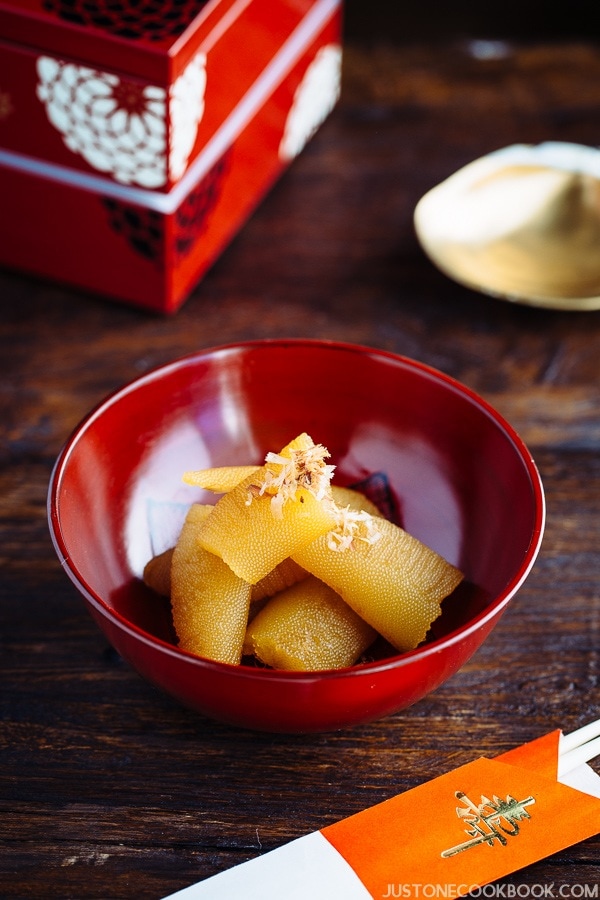
Kazunoko, herring roe marinated in dashi soy seasoning, is one of the popular Japanese New Year feast. This prized delicacy symbolizes prosperous family and wish for many children and grandchildren.

Kazunoko (数の子) is one of the popular dishes in Osechi Ryori (おせち料理), the Japanese New Year food. What is Kazunoko? It’s herring roe that’s marinated in dashi soy sauce seasoning. As Kazunoko symbolizes many children and prosperous family, this rare and expensive delicacy is considered an important part of Osechi.

Kazunoko – Herring Roe
As a child, I wasn’t particularly fond of this dish and I wondered why my parents enjoy this salty weird-texture food. As I got older and gained more experience in eating different textures and flavors of foods, I started to enjoy this delicacy more.
Each roe is a collection of tiny eggs and it has a beautiful golden color. As you bite into it, it gives crunchy texture (the texture is explained as korikori コリコリin Japanese). The tiny eggs break apart from each other and disintegrate inside your month. The individual eggs have a caviar/tobiko-like texture.
In terms of its flavor, kazunoko has an acquired taste. There’s saltiness, and you can also taste umami from dashi and soy sauce base seasoning after its marinated.

3 Things You Need To Know Before Cooking Kazunoko
1. Need to desalinate in salt water.
This might sound strange. Why do you desalinate (remove salt) salted herring roe with salt water? There are also some recipes ask you to soak in plain water to desalinate. So which is correct? Well, the correct way can be explained by chemistry…
When you soak in plain water, there is too much difference with the salt concentration and you will lose salt content too quickly as well as the umami of the eggs. The salinity contains sodium chloride and magnesium chloride and they have different dissolving rates (sodium chloride dissolves faster and magnesium chloride dissolves slowly).
If you soak it in plain plater, it means that sodium chloride will dissolve first and magnesium chloride will remain in the roe and gives the roe an unwanted bitter taste. In order to remove magnesium chloride, it must be further soaked in water and it will make the kazunoko lose all the umami flavor and become watery.
If you use salt water, the difference in concentration decreases and the salt slowly escapes. Only excess salt will be removed while moderate salt content and umami remain in the herring roe.
2. Gently remove membrane
The only drawback of preparing kazunoko is tedious peeling process of herring roe membrane. If you don’t remove this membrane, the dashi and seasonings won’t be absorbed well. Once the membrane is removed, kazunoko looks much prettier in color too. So be ready for this time-consuming process, especially if you have to make a lot of kazunoko…
My quick tip is to use your thumbs to press the membrane upwards against the center of the roe. Once the membranes are collected in the center, you can pull up from the edge and detach from the roe easier.
3. Use Usukuchi Soy Sauce
If possible, I recommend using Usukuchi Soy Sauce (薄口醤油). It’s a light-colored Japanese soy sauce, commonly used in the western and southern Japan as the main soy sauce. Even though it’s called light-colored soy sauce, it is actually saltier than dark-colored Koikuchi Soy Sauce (濃口醤油).
As I grew up in Tokyo area, my “regular” soy sauce is Koikuchi and I don’t keep Usukuchi soy sauce in my kitchen. I used to keep both, but since I rarely finish up usukuchi soy sauce before the expiration date I stopped purchasing them.
The good reason why you should use usukuchi soy sauce for this recipe is to keep the ingredient’s beautiful golden color. The dish also won’t look as dark if you use usukuchi soy sauce. Other dishes I recommend using usukuchi soy sauce are nimono (simmered dishes) like Chikuzenni and Chawanmushi (savory steamed custard).
Where To Find Kazunoko
Your local Japanese grocery stores may start to sell kazunoko (salted herring roe) shortly after Christmas. During this time, the grocery store will focus on Osechi Ryori ingredients and New Year celebration produces and products.
At my local Japanese grocery store, kazunoko usually costs about $25 to 30 per pound. I’m not familiar if other Asian cuisines use salted herring roe. If you have purchased and used this in your cuisine, let me know in the comment below where you purchase it from.
Kazunoko is usually prepared and enjoyed once a year for the New Year’s feast. Ingredients used only for a special holiday like this can be difficult for us living outside of Japan to acquire. I apologize if you can only read and learn about this dish, and can’t make it for yourself due the availability of the ingredients.

I hope you enjoyed my Kazunoko recipe! If you make this recipe, snap a picture and hashtag it #JustOneCookbook. I love to see your creations on Instagram, Facebook, & Twitter! Thank you so much for reading and trying the recipes!
Don’t want to miss a recipe? Sign up for the FREE Just One Cookbook newsletter delivered to your inbox! And stay in touch with me on Facebook, Google+, Pinterest, and Instagram for all the latest updates.
- 5 (140-200 g) salted herring roes
- 6 cups (1440 ml) water, used as 2 cups 3 separate times
- 3 tsp. kosher salt (1½ tsp. regular table salt), 1 tsp. 3 separate times
- 2 Tbsp. sake
- 1 Tbsp. mirin
- 1 cup (240 ml) dashi
- 2 Tbsp. soy sauce (if possible, light-colored “usukuchi” soy sauce)
- 1 Tbsp. (1.5 g) katsuobushi (dried bonito flakes)
- Katsuobushi (dried bonito flakes)
- Prepare all the ingredients on 12/29 or 12/30 (See Notes).

- Combine 2 cups water and 1 tsp. salt in a measuring cup and mix well until salt is completely dissolved.

- Place the salted herring roes in a dish with rim (1 pound cake pan is perfect). Then pour 2 cups of salt water and let it soak for 2 hours.

- Discard the salt water and make another batch of 2 cups salt water. Soak the roe again for another 2 hours. Repeat one more time. Once you finish soaking 3 rounds of salt water (6 hours total), taste a bit of salted herring roe to see how salty it is. It should be slightly salty but taste good as is. If it’s still too salty, continue one more round of desalinating.

- Meanwhile, heat up 2 Tbsp. sake and 1 Tbsp. mirin in a small saucepan and let the alcohol evaporate (until the smell of alcohol is gone).

- Then add 1 cup (240 ml) dashi and 2 Tbsp. soy sauce and bring to boil.

- Once boiling, add 1 Tbsp. (1.5 g) katsuobushi. Turn off the heat and let stand for 1 minute.

- Strain the marinade and discard the katsuobushi. Set aside to cool.

- Remove the salted herring roe from salt water. Using your thumb and pointing finger, rub and press to collect membrane to the center of the roe. Once membranes are collected around the center and you have enough to pinch and pull, detach the membrane from the roe. Make sure to remove all the membranes on both sides.

- Wash the kazunoko thoroughly and pat dry with paper towel.

- Transfer the herring roes into a container and soak in the marinade for overnight (up to 2 days).

- Tear into bite size pieces and put inside osechi box or serving plate/bowl. You can sprinkle some katsuobushi (dried bonito flakes) on top before serving.

- Store it in airtight container and keep in the refrigerator for up to 3-4 days.
Recipe by Namiko Chen of Just One Cookbook. All images and content on this site are copyright protected. Please do not use my images without my permission. If you’d like to share this recipe on your site, please re-write the recipe in your own words and link to this post as the original source. Thank you.

Chloe
Ah, Kazunoko! In the midst of my massive osechi shopping trip the other day, it’s the one thing I forgot, meaning I’m pretty sure I no longer have time to prepare it (I’m cooking everything on the 30th).
I do have a question, if you know the answer. I’m not entirely familiar with the ingredient (I only made it once last New Year’s), but my local Nijiya offers three kinds: Jumbo Ajitsuke Kazunoko, Unbleached Shio Kazunoko, and Kazunoko Konbu (which looks much different, with konbu in the middle). I think I bought the shio last year, but are either if the other two kinds ready to eat? If so, I might be able to have some with our osechi after all, cause I’ll be going back on the 31st to get some ikura and other more-perishable items.
Nami
Hi Chloe! Yes, you’re correct. Ajitsuke (seasoned) Kazunoko and Kazunoko Konbu are ready to eat. Shio Kazunoko is required to be desalinated. 🙂 Happy New Year to you and your family! Good luck cooking on the 31st!
Chloe Mitchell
Oh thank you! I of course prefer to prepare everything myself, but this way I can have a complete box. Happy new year to you and your family too! And happy cooking!
-^ o ^-
Nami
Happy New Year, Chloe! 🙂
Yuko
Thank you so much for the recipe! I made it and it turned out great. I didn’t have usukuchi shoyu so I used regular and it turned out dark but otherwise it was great.!
Nami
Hi Yuko! I’m so happy to hear that! Me too, I mentioned that I used koikuchi soy sauce for my recipe too. It’s darker in color for sure, but it doesn’t mean it’s saltier (as I mentioned, usukuchi has higher salt content). My family loved this recipe way more than premade one that I got from the store. 🙂
Grace Uyemura
Is there a recipe for konbu kazunoko?
Nami
Hi Grace! Are you talking about Komochi Kombu (http://item.rakuten.co.jp/youseikatsu/16492/)? We don’t make it and usually buy it. 🙂
Raymund
Wow I never tried this, but I will definitely give it a chance once I grab hold of one. Anyways guess what! I made it to Japan, such a nice place want to go back there and watch out for my posts 🙂
Nami
Hi Raymund! YOU DID!!!!! I’m SUPER excited and happy that you enjoyed your trip to Japan! Yes, I’ll keep an eye on your new post about your trip. Sorry I haven’t left the comment, but I’ve been pinning your recipes instead. 🙂