
By John Gruber

Q1 2025 openings for ads on Daring Fireball just like this one. Email for info.
- Google and Microsoft Each Donate $1 Million to Trump’s Inauguration Racket ★
-
CNBC:
Google donated $1 million to President-elect Donald Trump’s inauguration fund, becoming the latest major tech company to try and curry some goodwill with the incoming administration.
“Google is pleased to support the 2025 inauguration, with a livestream on YouTube and a direct link on our homepage. We’re also donating to the inaugural committee,” Karan Bhatia, Google’s global head of government affairs and public policy, told CNBC in a statement.
So Google joins Amazon and Meta with $1 million company donations. Tim Cook and Sam Altman are in with $1 million personal donations. I originally posted this piece wrongly thinking Microsoft hadn’t joined the party, but they just did too. That leaves, among the big six, just one company which as yet has not been reported to have donated, either from the company or its CEO: Nvidia.
By the way, a reader pointed my way to Biden’s Presidential Inaugural Committee FEC filing from four years ago:
- Microsoft gave $500,000.
- Google gave $337,500.
- Amazon gave $326,509.85.
- Apple gave $43,200; Tim Cook gave nothing.
- Neither Facebook (pre-name-change) nor Zuckerberg gave a cent.
- ‘Inside Mark Zuckerberg’s Sprint to Remake Meta for the Trump Era’ ★
-
Mike Isaac, Sheera Frenkel, and Kate Conger, reporting for the NYT in the best-sourced piece I’ve seen on Meta’s big policy changes this week (gift link):
The entire process was highly unusual. Meta typically alters policies that govern its apps — which include Facebook, Instagram, WhatsApp and Threads — by inviting employees, civic leaders and others to weigh in. Any shifts generally take months. But Mr. Zuckerberg turned this latest effort into a closely held six-week sprint, blindsiding even employees on his policy and integrity teams.
Months-long processes with a large number of stakeholders from inside and outside the company are the way you make policy changes intended to be as uncontroversial as possible. A six-week sprint with a tight team is how you make policy changes that you know will be controversial. The process was unusual because the nature of the changes was unusual.
In interviews, more than a dozen current and former Meta employees, executives and advisers to Mr. Zuckerberg described his shift as serving a dual purpose. It positions Meta for the political landscape of the moment, with conservative power ascendant in Washington as Mr. Trump takes office on Jan. 20. More than that, the changes reflect Mr. Zuckerberg’s personal views of how his $1.5 trillion company should be run — and he no longer wants to keep those views quiet.
This rings true to my ears, and my take on Zuckerberg. But they run counter to the Times’s headline for the story, which paints alignment with Trump as the primary motivation. I think it’s pretty clear that aligning with Trump is just the cover for Zuckerberg putting Meta’s content moderation policies back where he feels they should always have been. Zuck’s not rightwing but he’s not anti-right-wing. But for a large swath of the left today, anyone who’s not anti-right-wing is right-wing. Zuck is done trying to placate those of that mindset.
At Meta, Mr. Zuckerberg began preparing to change speech policies. Knowing that any moves would be contentious, he assembled a team of no more than a dozen close advisers and lieutenants, including Joel Kaplan, a longtime policy executive with strong ties to the Republican Party; Kevin Martin, the head of U.S. policy; and David Ginsberg, the head of communications. Mr. Zuckerberg insisted on no leaks, the people with knowledge of the effort said.
And give them credit — not a whisper regarding these changes leaked in advance of Zuckerberg dropping them in his Instagram video. Meta announced these changes on their own terms, in their own way.
Some employees were livid at what they saw as efforts by executives to hide changes to the “Hateful Conduct” policy before it was announced, two people said. While people across the policy division typically view and comment on significant revisions, most did not have the opportunity this time.
Some employees were surprised, after years of working for a company run by a face-eating founder who owns a controlling share of the company’s stock and thus answers to no one but himself, to find their own faces eaten off.
- ‘We’re All Trying to Find the Guy Who Did This’ ★
-
Good piece and great headline by Charlie Warzel at The Atlantic:
The social-media hall monitors have been so restrictive on “topics of immigration and gender that they’re out of touch with mainstream discourse,” Zuckerberg said with the zeal of an activist. He spoke about “a cultural tipping point towards once again prioritizing speech” following “nonstop” concerns about misinformation from the “legacy media” and four years of the United States government “pushing for censorship.” It is clear from Zuckerberg’s announcement that he views establishment powers as having tried and failed to solve political problems by suppressing his users. That message is sure to delight Donald Trump and the incoming administration. But there’s one tiny hitch. Zuckerberg is talking about himself and his own policies. The establishment? That’s him.
The changes to Meta’s properties, including Facebook, Instagram, and Threads, are being framed by the CEO as a return “to our roots around free expression.” This bit of framing is key, painting him as having been right all along. It also conveniently elides nearly a decade of decisions made by Zuckerberg, who not only is Meta’s founder but also holds a majority of voting power in the company, meaning the board cannot vote him out. He is Meta’s unimpeachable king. [...]
Zuckerberg’s personal politics have always been inextricably linked to his company’s political and financial interests. Above all else, the Facebook founder seems compelled by any ideology that allows the company to grow rapidly and make money without having to take too much responsibility for what happens on its platforms. Zuckerberg knows which way the political wind is blowing and appears to be trying to ride it while, simultaneously, being at least a little bit afraid of it.
Exactly what I meant by Zuckerberg’s zigging and zagging and now back to zigging in my piece earlier this week on Meta’s policy about-face.
Nvidia, the New King of Keynotes
Saturday, 11 January 2025
There were several interesting announcements made at Nvidia CEO Jensen Huang’s Keynote at CES 2025, including a new RTX 50 generation of gaming GPUs and an upcoming $3,000 Mac-Mini-sized “personal AI supercomputer” called Project Digits. But most interesting to me was the scale of the keynote itself: over 6,000 attendees in an arena at Mandalay Bay in Las Vegas. Just look at it: it resembled a rock concert more than a tech keynote.1
We — yours truly very much (and self-evidently) included — in the Cupertino punditocracy often bloviate about the pros and cons of Apple’s post-Covid pre-filmed keynotes versus the company’s pre-Covid live-audience keynotes. The argument in favor of the new pre-filmed format is that, no matter how big the live audience ever was (and for Apple that capped out around 5,000 for WWDC keynotes at Moscone West and the San Jose Convention Center), several orders of magnitude more people watch on video, so the format ought to be optimized for video, not a live audience.2 The pre-filmed format also lets Apple move through more topics, and bring in more presenters, more quickly. Of course everything just looks better and more polished. And because everything is pre-filmed, demos not only never fail, they never even hiccup. But you can also argue that demos in particular are a con, not a pro, of the new format — as I wrote a few months ago about a few AI demo fails at a Google event, live demos carry real drama, and as I noted in a footnote in September, I miss the drama of live Apple demos in particular.
But what struck me about the venue size and audience enthusiasm of Nvidia’s CES keynote is something much more general about live events than just the drama of live demos. There’s magic in a live audience. It just matters. Taylor Swift’s record-setting stadium-filling Eras tour was a worldwide sensation because it was a shared experience between enthusiastic fans. She’d still be insanely popular if she hadn’t done that tour, but she’s more popular because she did. Attending a live sporting event is profoundly different than watching on TV. And as sports fans learned in 2020, watching sports on TV feels weird and flat and low-stakes if there is not a live audience present at the event.
Apple owned that in the world of tech. Even when Apple was, by market cap and market share, a smaller company, they commanded an outsized share of the world’s attention for live keynotes. That’s partly because Apple has always had fans of its products in ways that no other company in tech does, partly because Apple worked (and works) so much harder at its keynotes than any other company, and partly because Steve Jobs personally was just so spectacularly gifted and charismatic as a stage presence. Until Apple walked away from IDG’s Macworld Expo starting in 2010, Apple singlehandedly made Macworld keynotes a rival, attention-wise, to the entirety of CES. The most famous keynote in history, introducing the original iPhone, was delivered at Macworld Expo in San Francisco on 9 January 2007. Nobody remembers anything at all from the CES 2007 keynote, which Bill Gates delivered the next day in Las Vegas. I’ll bet Bill Gates himself doesn’t remember anything from that keynote.
Until Apple stopped holding live WWDC keynotes, those WWDC keynotes were events. The enthusiasm didn’t wane an iota without Steve Jobs. The answer to the question of which company held the keynotes which attracted the most enthusiastic large live audiences was always Apple. And they just walked away from that. Inviting a few thousand developers to watch the new pre-filmed WWDC keynotes on the lawn at Apple Park is nice, but it’s a different vibe. A live movie-watching event is not a live performance.
There’s clearly a new answer to the question of which company holds the keynotes which attract the most enthusiastic large live audiences: Nvidia. ★
-
I won’t lie and say I watched the whole Nvidia keynote, but I watched enough of it to get a feel for it. It’s good — primarily because Nvidia is killing it. They’re delivering exciting new products, across several categories, that are the best in the world. And those are categories that enthusiasts, of both gaming and AI, really care about. Project Digits is a genuinely innovative idea. And Jensen Huang is a charismatic presenter. He’s good. But one thing that’s very clear to my eyes is that they didn’t rehearse enough. Or more specifically, they didn’t rehearse nearly as much as Apple did when Apple performed live keynotes. Part of Steve Jobs’s on-stage appeal was that he came across as largely winging it, speaking off the cuff from an outline of prepared Keynote slides. But that was an illusion. Jobs rehearsed, rehearsed, rehearsed, and then rehearsed some more. Jobs might have been better than anyone else even if he had just winged it, but he still put in the work of rehearsing long hours to be as good as he could be.
Both halves of Penn and Teller have espoused the same sentiment as the only real “secret” of magic. Teller, in a wonderful 2012 profile by Chris Jones for Esquire: “Sometimes magic is just someone spending more time on something than anyone else might reasonably expect.” Penn Jillette, in a 2011 video interview for Unmasked: “I will tell you the absolute secret of magic, at the most honest level. The secret of magic is you would not be willing to work as hard as we are, and that’s the whole secret.” That’s basically the secret to Apple’s keynotes, both old and new. They don’t just work a little bit harder on them than most companies. They work way harder than any other company, or CEO, would reasonably expect.
Jensen Huang is good and Nvidia’s keynote was good, but they didn’t work as hard or rehearse as much as Apple does, and I don’t think Huang would consider doing so reasonable or a good use of his time and attention. ↩︎
-
And, as I reported — also in a footnote — back in September, I am very reliably informed that Apple’s keynote streams in recent years have higher viewership numbers than ever, and today dwarf the viewership of Jobs-era keynotes. Which of course is not to say that viewership of Apple keynotes is higher than ever because of the format change from live events to pre-filmed videos. But it might be true that more people enjoy this format, and the change hasn’t hurt. ↩︎︎
Friday, 10 January 2025
- Zuckerberg Disses Apple With Joe Rogan: ‘They Haven’t Invented Anything Great in a While’ ★
-
Chance Miller listened so we don’t have to:
Zuckerberg also took issue with AirPods and the fact that Apple wouldn’t give Meta the same access to the iPhone for its Meta Ray-Ban glasses:
They build stuff like AirPods, which are cool, but they’ve just thoroughly hamstrung the ability for anyone else to build something that can connect to the iPhone in the same way.
There were a lot of other companies in the world that would be able to build like a very good earbud, but Apple has a specific protocol that they’ve built into the iPhone that allows AirPods to basically connect to it.
It’s just much more seamless because they’ve enabled that, but they don’t let anyone else use the protocol. If they did, there would probably be much better competitors to AirPods out there.
If only there existed other phone platforms than the iPhone, we could see how cool these other earbuds would be. And Meta Ray-Bans could integrate with those phones in super cool ways that would make iPhone users realize what dopes they’ve been.
What’s really rich about Meta and Zuckerberg’s incessant complaining about being restricted by Apple’s rules for third party software on Apple’s platforms is that Meta doesn’t allow third parties any sort of access to their successful platforms. There are no third-party clients for Facebook, Instagram, Threads, or WhatsApp. It is very hard to get any information out of them let alone integrate with them bi-directionally.
Miller concludes:
Let us also not forget that Meta has never “invented anything great.” Oculus was an acquisition, WhatsApp was an acquisition, Instagram was an acquisition, and intermixed with those acquisitions are features copied and pasted from other platforms.
Yeah but other than that they invented a lot.
- James Thomson on the Origins of the MacOS Dock ★
-
James Thomson:
So, we are coming up on a little anniversary for me this weekend. On the 5th of January 2000, Steve Jobs unveiled the new Aqua user interface of Mac OS X to the world at Macworld Expo.
Towards the end of the presentation, he showed off the Dock. You all know the Dock, it’s been at the bottom of your Mac screen for what feels like forever (if you keep it in the correct location, anyway).
I would not accept this Dock placement blasphemy from anyone else, but from Thomson, well, OK. (The correct location is on the right. Left, we’ll let you argue for. But definitely not on the bottom.)
I didn’t design the dock — that was Bas Ording, a talented young UI designer that Steve had personally recruited. But it was my job to take his prototypes built in Macromind Director and turn them into working code, as part of the Finder team.
I had already written another dock — DragThing — before I worked for Apple, and that had helped me get a job there. I moved over from Scotland to Ireland in late 1996 with my future wife, with both of us joining the small software team there. It was primarily a manufacturing plant, but there was a little bit of software and hardware testing and engineering that went on around the edges.
In the middle of all that, when I was out in Cupertino, I was asked if I wanted to work on a secret project with the code name “Überbar”. I was shown some prototypes and basically told that six people had seen it, and if it leaked they would know it was me that had talked. I figured if anybody was finally going to kill off DragThing, it might as well be me.
I’ve heard most of this story over the years — from James — but never all in one narrative like this. There are a lot of 25-year-old stories about how Mac OS X came together that I hope the participants start sharing. Even Apple folks should be free to talk about quarter-century-old work — and both the work and the stories are so good.
- Los Angeles Fires: The Damage in Maps, Video, and Images ★
-
Just heartbreaking, and a scale of destruction that’s hard to comprehend.
Thursday, 9 January 2025
- Understanding the Various Inscrutable Beeps, Bops, and Bloops AirPods Make ★
-
Juli Clover, MacRumors:
In a support guide, Apple says that the AirPods Pro may play a sound every so often while in the case to ensure the microphones and speakers are working as intended. From Apple:
To help ensure that your AirPods microphones and speakers are operating at their best (for example, to help provide high-quality hearing test results), your AirPods may periodically play a quiet chime when they’re in their charging case.
Information on the mysterious chime was highlighted on Mastodon after Apple’s unclear AirPods sounds were discussed on today’s ATP podcast. As noted on the podcast, Apple does not have an established guide that provides insight into the different sounds that the AirPods make, so it can be confusing.
Years ago, Apple was a successful company and documented how their products work. These days, Apple is struggling financially, and alas can no longer afford to produce something even as simple as an interactive web page with examples of the sounds that AirPods make and explanations of what those sounds mean.
- Breathable, Garrett Murray’s AQI Widget for iOS and MacOS, Is Now Free of Charge ★
-
I first linked to Breathable back in 2021 when Murray released the first version, writing then:
The entire point of Breathable is to offer widgets — the app itself just lets you configure how the widgets look. Brilliantly simple, and in a way, fun, with its clever “emoji scale”. I started using it last week after Murray pinged me about it, but only because I was interested in the idea of a widget-only weather app — Philadelphia generally doesn’t have air quality issues. I should have known better. Turns out, the whole world now has air quality issues.
Breathable costs just $2, and Murray is donating a portion of the proceeds to foundations focused on climate change initiatives.
Breathable is now up to version 3.0, and is better than ever. Today, Murray announced he’s making it free of charge:
In light of the awful fires and air quality in Los Angeles, I’ve made Breathable free and app will remain free permanently. I charged for the app prior only so I could donate the proceeds to climate change charities, but paying Apple 15% for that privilege is silly.
If you paid for the app in the past, thank you so much — your money was not wasted! It was donated to the Union of Concerned Scientists, the Clean Air Task Force and the Climate Change Emergency Fund. I took great pride in donating to these terrific causes in Breathable’s name.
Good thoughts and best wishes to everyone in southern California facing this catastrophe.
- Microsoft’s Recent History of Dirty Tricks With Edge ★
-
Following up on yesterday’s item regarding Bing masquerading as Google to trick Edge users into searching with it, this Mastodon post from Timo Tijhof lists a few other such subterfuge tactics they’ve pulled recently. My favorite was this one from last year: when users opened a tab for “bard.google.com”, Edge inserted an ad in the tab bar encouraging the user to “Compare answers with the AI-powered new Bing”. Ads in the tab bar, jeebus.
There’s also a longstanding practice where if you search for “Chrome” or “Chrome download”, Edge shows a special pop-up encouraging you to stick with it rather than switch. Google pulls a similar thing, using popups across its web properties to encourage users of other browsers — perhaps especially Safari, unsurprisingly, considering how much money they pay Apple each year — to switch to Chrome, often with the implication that Google recommends switching for security reasons, not financial ones.
As a comparison, the best search engine in the world, Kagi, is so scrupulous that they don’t screw with the order of the results for the search term “Orion”, even though that’s the name of their own web browser. (If you missed it over the holidays, I had a great interview with Kagi founder Vlad Prelovac on The Talk Show last month.)
Wednesday, 8 January 2025
- When You Search for ‘Google’ on Bing, Bing Attempts to Trick You Into Thinking the Results Page Is Google ★
-
Tom Warren, The Verge:
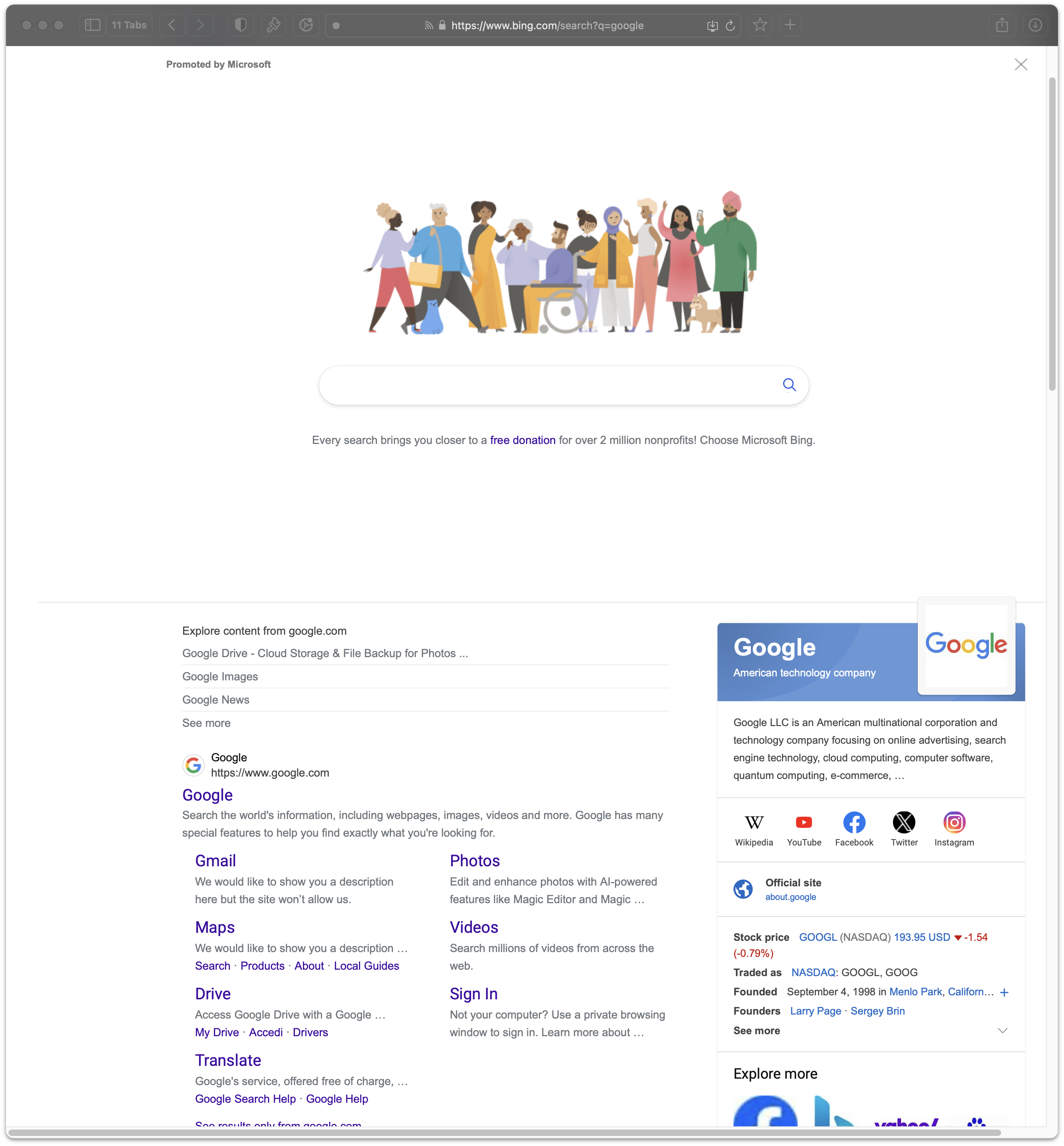
Microsoft is pulling yet another trick to get people to use its Bing search engine. If you use Bing right now without signing into a Microsoft account and search for Google, you’ll get a page that looks an awful lot like... Google.
It’s a clear attempt from Microsoft to make Bing look like Google for this specific search query, and other searches just list the usual Bing search results without this special interface. The Google result includes a search bar, an image that looks a lot like a Google Doodle, and even some small text under the search bar just like Google does. Microsoft even automatically scrolls down the page slightly to mask its own Bing search bar that appears at the top of search results.
The idea here is that Edge is the default browser on Windows, and Edge remains the only browser that sets Bing as its default search engine. And so a lot of technically un-savvy Windows users open their browser (Edge) and type “Google”. This trick is meant to make them think they’re now on Google, and I have to say, it’s really well done. The lack of Google’s main logo above the search box is explained by the Google-Doodle-style illustration. It’s common for Google itself to do that. The autoscrolling moves the page down just far enough to move Bing’s own page header out of the viewable page content. But because they just autoscroll down from the Bing page header, as opposed to hiding it completely (say, using
display: nonein CSS) you can see it by just scrolling back up. But who thinks to scroll up immediately after typing a search term and hitting Return? (No one.) They even actually have the word “Google” and Google’s actual logo on the results page, in an “info box” for Google, the “American tech company”. See for yourself.It’s an exquisite dirty trick, and I’ll bet it actually works remarkably well. Google itself has long claimed that “google” is the most-searched-for term on Bing. I’ll bet that presenting the results for that search this way greatly increases the number of users who, thinking they’re actually now on Google, perform the search they intended to do on Google right there on Bing. And then do it again, and again, until some helpful friend or colleague shows them how to install a better browser or just switch Edge’s default search to Google.
This is the most classic old-school Microsoft rat fuck they’ve pulled in a long while. They used to scheme up these type of devious moves all the time back in the ’80s and ’90s. Deceptive enough to work, but with plausible deniability, however thin, for every aspect of it. Glad to see they’ve still got it in them.
Tuesday, 7 January 2025
- Also From the Archive: ‘“Beta” Is Not an Excuse’ ★
-
2006 post from yours truly that applies perfectly to Apple Intelligence today:
The sentiment here is that it’s somehow unfair to developers to treat software labeled “beta” with the same critical eye as non-beta software. That’s true, in the case of actual beta software, where by “actual beta” I mean “not yet released, but close”.
Released vs. not-released is the distinction that warrants critical restraint. Film critics don’t write reviews of rough cuts. Book critics don’t review non-final manuscripts of novels.
Released software that is labeled “beta” is still released software, and is fair game for the same level of criticism as any released software. You can’t “semi-release” your 1.0 just because you want it out there but aren’t yet finished. Being semi-released is like being semi-pregnant. [...]
What exactly is meant by software that is released, but labeled “beta”? That there are missing features? All software has missing features. I’ve never met a single developer working on a significant software project who has completely zeroed out the features-to-do list. Knowing how to draw that line between features that make it for this release and features postponed for later is a big part of the art of shipping.
No, what “beta” means in this context is “buggy”.
Read through to the end, and I even have a badge (courtesy my friend Bryan Bell) that Apple could use to more clearly label Apple Intelligence notification summaries.
- From the DF Archive: ‘Life as a Facebook Moderator’ ★
-
I mentioned earlier today Casey Newton’s remarkable 2019 piece for The Verge, “Bodies in Seats”, an eye-opening look at the lives of content moderators at a large Facebook contractor in Tampa. When I linked to it, I wrote:
If this is what it takes to moderate Facebook, it’s an indictment of the basic concept of Facebook itself. In theory it sounds like a noble idea to let everyone in the world post whatever they want and have it be connected and amplified to like-minded individuals.
In practice, it’s a disaster.
The problem isn’t the “everyone can post whatever they want” — that’s the nature of the internet, and I truly believe it has democratized communication in a good way. The disastrous part is the “be connected and amplified to like-minded individuals”. That’s the difference between Facebook (and to some degree, YouTube and Twitter) and things like plain old web forums. Facebook is full of shit about most of what they actually do, but one part of their self description that is true is that they really do connect people. The problem is that some people shouldn’t be connected, and some messages should not be amplified.
There is something fundamentally wrong with a platform that — while operating exactly as designed — requires thousands of employees to crush their own souls.
Holds up.
- Dude, You’re Getting a Dell Pro Max Premium Plus ★
-
Antonio G. Di Benedetto, reporting for The Verge:
The tech industry’s relentless march toward labeling everything “plus,” “pro,” and “max” soldiers on, with Dell now taking the naming scheme to baffling new levels of confusion. The PC maker announced at CES 2025 that it’s cutting names like XPS, Inspiron, Latitude, Precision, and OptiPlex from its new laptops, desktops, and monitors and replacing them with three main product lines: Dell (yes, just Dell), Dell Pro, and Dell Pro Max.
If you think that sounds a bit Apple-y and bland, you’re right. But Dell is taking it further by also adding a bit of auto industry parlance with three sub-tiers: Base, Plus, and Premium.
It’s simple, really. You can choose a Dell Pro Premium, which is not as good as a Dell Pro Max Plus, but both are better than a Dell Premium, which actually isn’t premium at all. Easy.
It is never not funny when a company is willing to shamelessly copy Apple but their institutional marketing bureaucracy completely fucks it up. If Dell was willing to wipe its existing branding slate completely clean, they could have easily devised a taxonomy of adjectives that created a hierarchy that’s more obvious and intuitive than Apple’s (where, for example, “Max” is sometimes but not always not the max).
After Years of Moderation-Heavy Zagging, Zuckerberg Announces That Meta Is Going Back to Moderation-Light Zigging Across Its Platforms
Tuesday, 7 January 2025
Mark Zuckerberg today announced major changes to the way Meta is going to apply content moderation across Facebook, Instagram, and (I presume) Threads. His main announcement is a video, for which there’s an unofficial transcript here. Zuckerberg himself summarized his own points in a thread on Threads, which I’ll annotate below:
1/ Replace fact-checkers with Community Notes, starting in the US.
This sounds ... fine? Just about everything at Twitter/X has taken a turn for the worse under Musk, but community notes seem to be a model that actually works pretty well. My favorite two social platforms right now, by far, are Bluesky and Mastodon. Neither has fact checkers. And I’ve never seen any evidence that Meta’s fact checkers have ever checked a single fact. (Maybe that’s what the team is doing in Macrodata Refinement at Lumon?)
2/ Simplify our content policies and remove restrictions on topics like immigration and gender that are out of touch with mainstream discourse.
This too seems fine. Let people spout what they want to spout. The problem has never been about whether users should be allowed to express opinion A about topic Z. The problem has always been about which opinions algorithmic platforms choose to promote. I can frame this specifically about Twitter/X. Under Elon Musk’s ownership, you can express pretty much whatever political opinions you want. That’s great. But, also, in my experience during the Musk era — and I’m not sure anyone would disagree with this — the political opinions that tend to get algorithmically boosted are those that align with the Musk/Trump agenda.
I don’t want to make a hypothetical example. I went to X.com just now, and searched for “Hillary Clinton medal of freedom”. In reverse order, the third tweet in my search results (screenshot) was a congratulatory tweet from the Clinton Foundation account. The second was a tweet from Hillary Clinton’s own account, thanking President Biden, accompanied by a photo of Biden fastening the medal around her neck at the White House. But the first tweet in my results was from “Dr. Clown, PhD”, presenting an AI-generated video of Clinton transmogrifying into a fire-spewing horned demon.
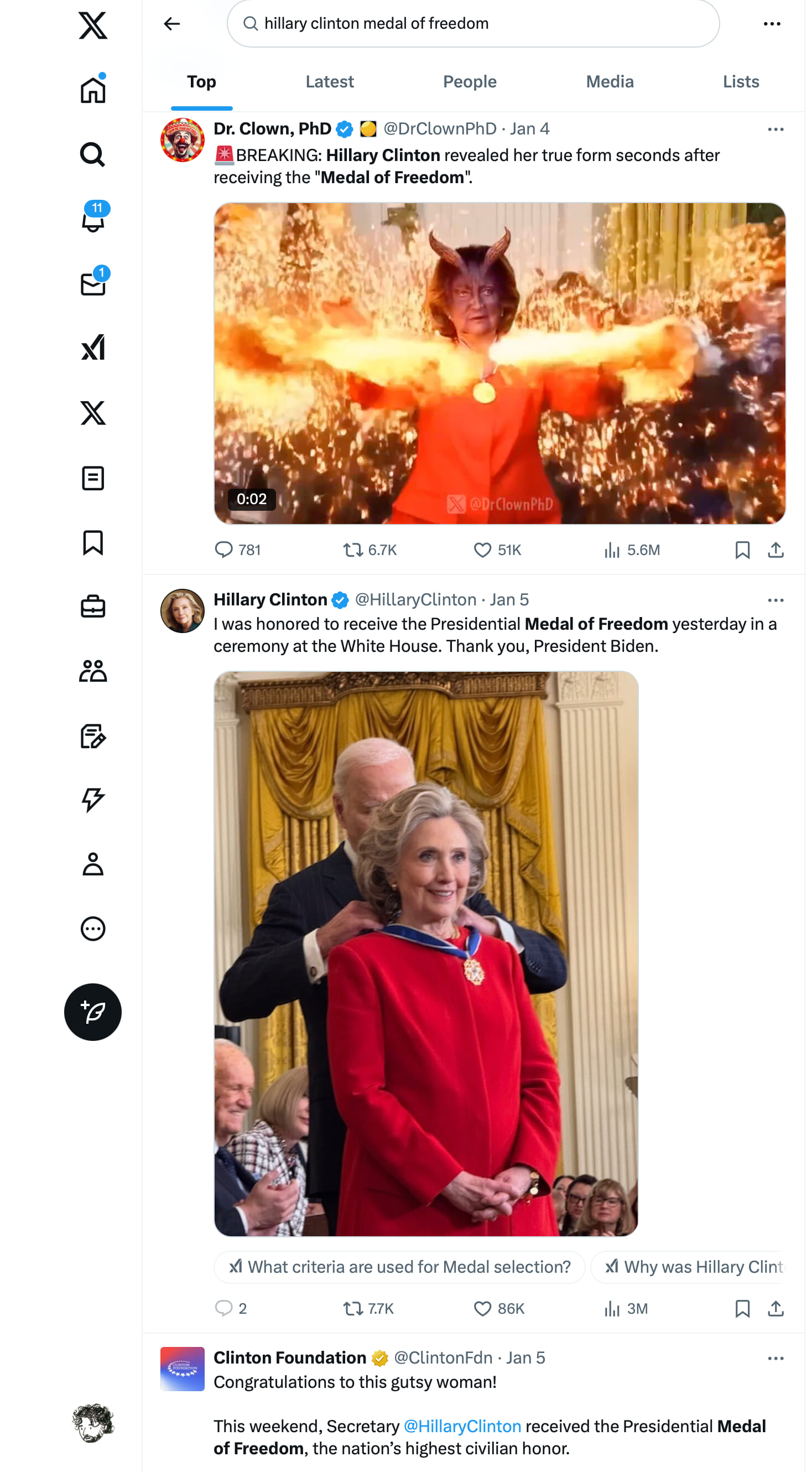
I legit think it’s fine that the esteemed Dr. Clown is permitted to post such a video to X. It doesn’t need to be fact-checked. (Although someone should let Tucker Carlson know it’s not real.) It certainly shouldn’t be forbidden. But I also have zero interest in searching for political news on a platform that would promote such un-clever AI-generated slop when searching for “Hillary Clinton medal of freedom”, let alone promote it to the very top spot in the results, literally above Hillary Clinton’s own tweet about the award.1
The question isn’t what sort of posts Meta is now going to allow, but rather, what sort of posts are their algorithms going to promote, and to whom. I’m not trying to be a Pollyanna here — I’m fully aware that the sort of people who think that Twitter/X has improved, not declined, under Elon Musk’s ownership are the sort of people who not only think their posts should be permitted, but that they should be promoted to a wide audience, and that anything less than wide algorithmic promotion is the result of nefarious “shadow-banning”. If Meta intends to start showing me content from the likes of the esteemed Dr. Clown, well, I’m out. If they simply want to show more Hillary-Clinton-is-a-demon AI slop to those who think that’s clever, that’s fine.
So, let’s see what Meta means here. In a weird way I sort of hope this means Meta’s platforms go full virulent Nazi. I’d love to pay as little attention to another social media platform as I now do to X.
3/ Change how we enforce our policies to remove the vast majority of censorship mistakes by focusing our filters on tackling illegal and high-severity violations and requiring higher confidence for our filters to take action.
Meta would do well to illustrate this policy change by citing specific examples of content that they have censored, but no longer will. Without specific examples this is meaningless, and could result in anything from Meta’s platforms changing dramatically to not changing at all. Admitting you’ve made mistakes without citing what those mistakes were isn’t really admitting to anything other than a change in vibes. (This largely applies to the entirety of Zuckerberg’s announcements today.)
In an accompanying post on the Meta company blog (still hosted, oddly, at the about.fb.com domain), newly-promoted chief global affairs officer Joel Kaplan — a career Republican who served as an administration official for all 8 years of George W. Bush’s two terms — writes:
Over time, we have developed complex systems to manage content on our platforms, which are increasingly complicated for us to enforce. As a result, we have been over-enforcing our rules, limiting legitimate political debate and censoring too much trivial content and subjecting too many people to frustrating enforcement actions.
For example, in December 2024, we removed millions of pieces of content every day. While these actions account for less than 1% of content produced every day, we think one to two out of every 10 of these actions may have been mistakes (i.e., the content may not have actually violated our policies).
With millions of examples and, supposedly, a 20 percent false positive rate, there should be plenty of examples they could cite. But Kaplan cites not a one. It could be empty posturing. It could be a lurch to promote outright right-wing viewpoints. Only their actual actions will reveal the answer.
Back to Zuckerberg:
4/ Bring back civic content. We’re getting feedback that people want to see this content again, so we’ll phase it back into Facebook, Instagram and Threads while working to keep the communities friendly and positive.
On the surface this seems to translate as, roughly, “We’ve downplayed political content in recent years, most conspicuously in 2024, an election year, and now that the election is over and Trump is coming back into office, sure, let’s bring political content back.” Which seems like the wrong timing, to me, but whatever. I don’t see this timing as Zuckerberg putting his thumb on the scale in favor of Trump. Meta has been de-prioritizing all political content, and if they’re really going to re-prioritize it now, that would apply as much to Trump’s critics as his supporters.
Consider if the timing had been reversed, and Meta’s platforms had been a political free-for-all throughout 2024, with political takes promoted to the top of everyone’s feeds, and today, two weeks before Trump takes office again, Zuckerberg announced that Meta was going to reduce the heat in the proverbial kitchen by de-emphasizing “civic content” across all its platforms. Those determined to view any decision he makes as being in the bag for Trump — which may or may not be correct — would be jumping up and down today arguing that Zuckerberg is shamelessly attempting to silence Trump’s critics on the cusp of his second inauguration.
What to me seems obvious is that in recent years, Meta made a decision to eschew controversial content even at the cost of engagement. How they think they can re-prioritize political (or in Zuck’s euphemistic phrasing, civic) content while “keeping the communities friendly and positive”, I don’t see. Nothing is going to be “friendly and positive” in our political discourse so long as Trump remains a national figure, and he hasn’t even re-taken office yet. What the whole thing primarily highlights is that Zuckerberg has no guiding principles — zero, zilch, nada — behind any of Meta’s platforms other than “success” in and of itself. Is it about you and your closest friends and family? Or about following celebrity influencers? Politics yes, or politics no? The answers were all different a few years ago, and they’re likely to be different again a few years from now.
5/ Move our trust and safety and content moderation teams out of California, and our US content review to Texas. This will help remove the concern that biased employees are overly censoring content.
First, California and Texas are roughly counterbalanced political opposites, but Texas is slightly less red than California is blue. Consider the recent election.
- Kamala Harris: 9,276,179 votes (59%)
- Donald Trump: 6,081,697 votes (38%)
- Donald Trump: 6,393,597 votes (56%)
- Kamala Harris: 4,835,250 votes (42%)
Texas is a big state, though. If Meta is moving its content moderation team to Austin, they’re moving to a county that voted for Kamala Harris 69–29, significantly more “blue” than California as a whole.
But this is all performative. Zuckerberg’s geographic explanation makes no sense so long as Meta itself is headquartered in Menlo Park, California. Are we to believe that any biases in Meta’s content moderation are determined by the moderators themselves — who are largely, if not entirely, contractors who work for third party companies? In 2019, Casey Newton wrote a spectacular piece at The Verge profiling several of the “800 or so” employees working as Facebook content moderators for a vendor named Cognizant at a site in Tampa, Florida. (Florida’s 2024 election results were nearly identical to Texas’s, 56–43 for Trump.)
It’s the algorithms that drive discourse on Meta’s platforms, and the engineers who steer them work in California. But really, whether the entire staff of the company works in Wyoming or Vermont doesn’t matter. Ultimately, everyone at Meta answers to Zuckerberg.
6/ Work with President Trump to push back against foreign governments going after American companies to censor more. The US has the strongest constitutional protections for free expression in the world and the best way to defend against the trend of government overreach on censorship is with the support of the US government.
Mark Cuban’s theory on how this could work, in a reply to Zuckerberg on Threads:
Translation: Americans are going to see Tariffs on products from countries you believe censor Meta services as a means of pressuring them into removing any restrictions that impact your profitability in those countries.
Also: You’ll have carte blanche to take posts that no longer have restrictions, making them a more explicit representation, and train your AI Models
Also: Bluesky is now the only moderated social media platform with tools that allows the user to control their own experience
To me, this just seems like Zuckerberg donning a MAGA cap and saying “Fuck yeah, Trump!” to please the boss. I don’t see the Trump administration altering its tariff plans for the EU based on the EU’s content moderation and data privacy policies for U.S. social media companies. And I certainly don’t see the EU changing its content and privacy regulations based on Trump-imposed tariffs on unrelated physical goods. But who knows? Nobody. Trying to predict what Trump might actually do is like trying to predict the shuffle of a fair deck of cards.
And ultimately, that’s where Zuckerberg and Meta seem most aligned with Trump. My take on Trump post-election has been to stop paying attention, as best I can, to anything he says. I’m only paying attention to what he does. With any other national leader, there’s a correlation between their words and their eventual actions that makes paying attention to what they say worthwhile. With Trump, there’s almost no correlation, and his endless stream of outrageous proclamations amounts to nothing but a distraction.
The same goes for Meta. Remember their “Oversight Board”? It’s still there, supposedly. They even piped up today, with a pathetic “Hey Mark, remember us? We’re still here” statement. Turns out they’re a complete joke with no actual influence, let alone authority, over the company’s platforms. Shocker. But much of the news media fell for the idea that the Oversight Board was in any way a serious endeavor hook, line, and sinker over the years of its pantomime existence.
Today’s Meta announcements sound significant, but so too does the notion that the U.S. military might invade Greenland to claim its territory. Don’t get distracted by blather. Let’s see what happens. ★
-
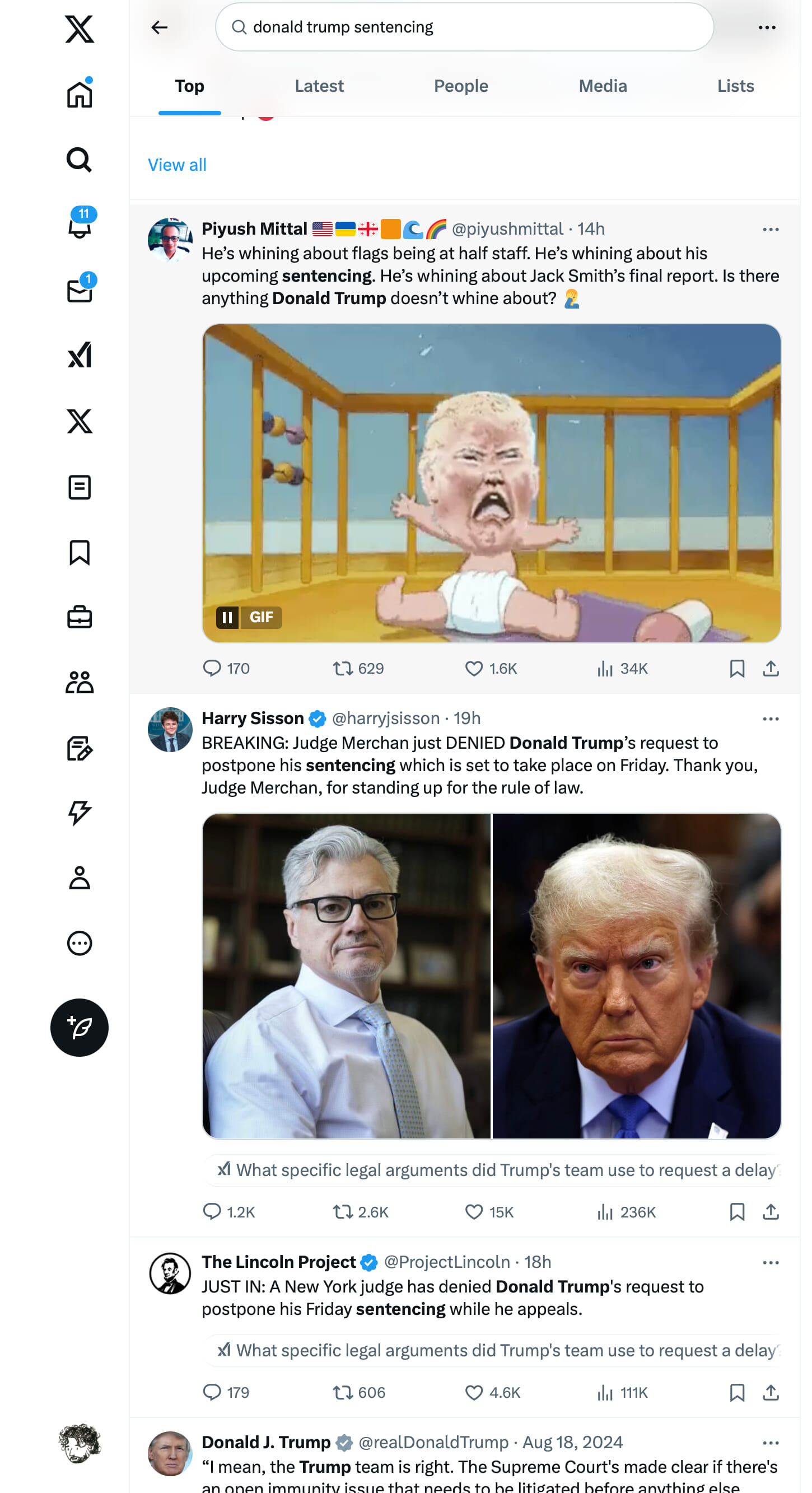
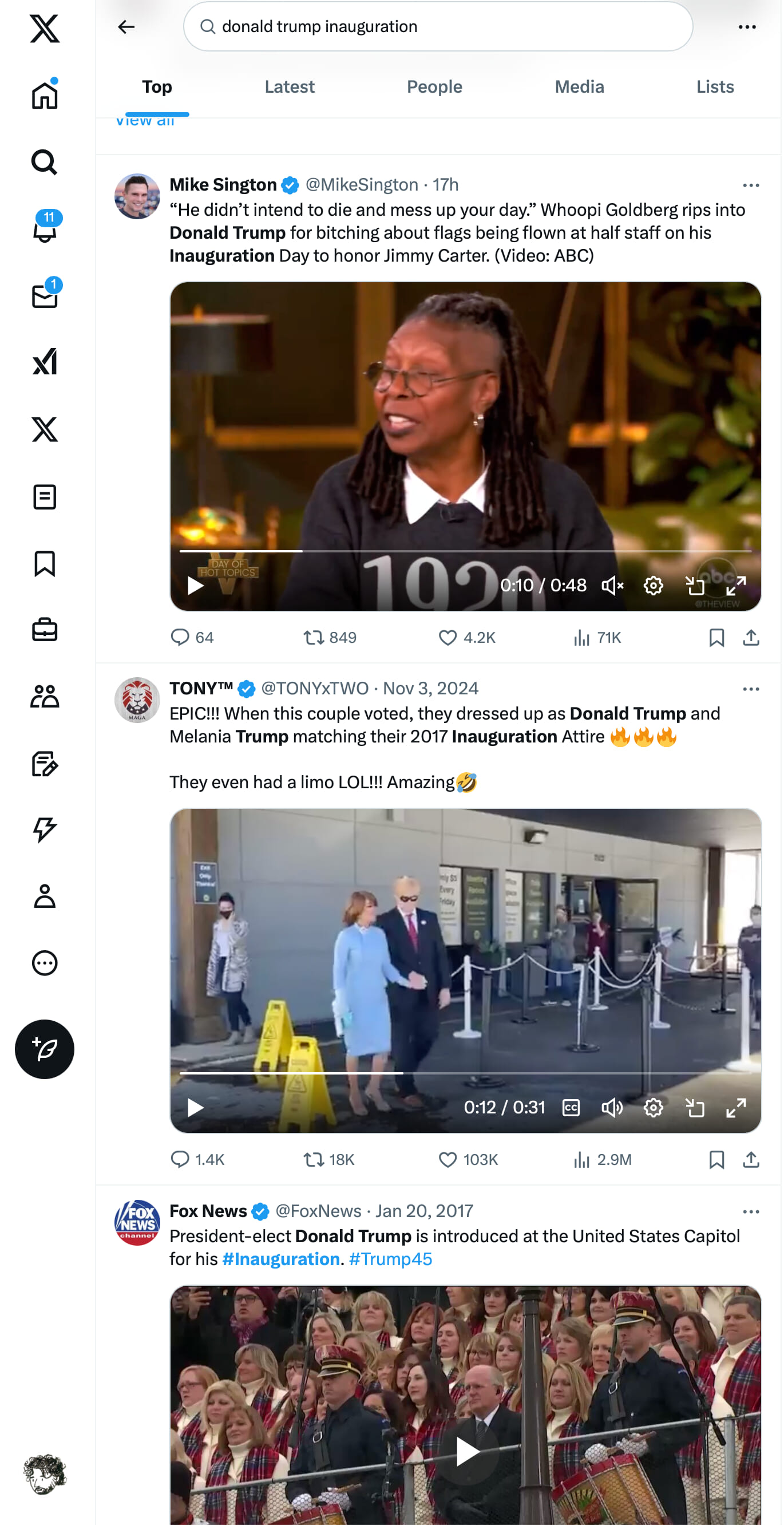
That said, my top result on X for a search for “Donald Trump sentencing” is this tweet with an animated GIF rendering Trump as a whiny crying baby, so perhaps X’s algorithmic bias is more toward Elon Musk’s insipid sophomoric sense of humor, not his political agenda. And a search for “Donald Trump inauguration” shows top three results of (1) a Whoopi Goldberg clip from yesterday’s episode of The View; (2) a November 3 tweet about a random couple who, when they voted, dressed up as Donald and Melania Trump; and (3) a 2017 @FoxNews tweet about Trump’s first inauguration. So maybe X just sucks at search. ↩︎
Monday, 6 January 2025
- Jason Snell: ‘Apple Intelligence Summaries Might Get Warning Labels. That’s Not Enough.’ ★
-
Jason Snell, writing at Six Colors:
So what can Apple do now? A non-apology and the promise of a warning label isn’t enough. The company should either give all apps the option of opting out of AI summaries, or offer an opt-out to the developers of specific classes of apps (like news apps). Next, it should probably build separate pathways for notifications of related content (a bunch of emails or chat messages in a thread) versus unrelated content (BBC headlines, podcast episode descriptions) and change how the unrelated content is summarized. Perhaps a little further down the road, news notifications should be summarized based on the full text of the news article, rather than generating a secondhand machine summary of a story already summarized by a human headline writer.
In all the years Snell and I have been doing what we do, I don’t think we’ve ever come so close to writing the exact same take at the same time. The only subtle differences are that (a) I side with Apple in not giving developers the option to opt out of notification summaries, and (b) that I’m a bit more of the mind that Apple can address this by somehow making it more clear which notifications are AI-generated summaries. Like, perhaps instead of their “↪︎” glyph, they could use the 🤪 emoji.
Update: Guy English:
Use the Apple logo. If you’re going to usurp the hard won decades of trusted reporting the BBC has with your own automated hot take you should put your reputational wood behind the arrow. Put your logo on what you generate from other people’s work.
My wacky emoji idea is obviously a joke, but this isn’t. Sign your work. Take responsibility for it.
Apple Claims It Will Soon ‘Further Clarify’ Which Notifications Are AI-Generated Summaries, Following Embarrassing BBC News Summarization Mistakes
Monday, 6 January 2025
Liv McMahon and Natalie Sherman, reporting for BBC News:
The company, in its first acknowledgement of the concerns, on Monday said it was working on a software change to “further clarify” when the notifications are summaries that have been generated by the Apple Intelligence system. The tech giant is facing calls to pull the technology after its flawed performance.
The BBC complained last month after an AI-generated summary of its headline falsely told some readers that Luigi Mangione, the man accused of killing UnitedHealthcare CEO Brian Thompson, had shot himself.
On Friday, Apple’s AI inaccurately summarised BBC app notifications to claim that Luke Littler had won the PDC World Darts Championship hours before it began — and that the Spanish tennis star Rafael Nadal had come out as gay.
This marks the first time Apple has formally responded to the concerns voiced by the BBC about the errors, which appear as if they are coming from within the organisation’s app.
All of the following things are true:
- All of Apple Intelligence is labelled “beta”.
- People generally know what “beta” means.
- Apple is promoting the hell out of Apple Intelligence to consumers, and its advertisements hide, rather than emphasize, its “beta” quality.
- The promotion of a feature is an implicit encouragement to, you know, actually use it.
- Apple Intelligence has to be opted into, and once enabled, can be turned off.
- Apple Intelligence notification summaries are marked with an icon/glyph, sort of like the “↪︎” Unicode glyph with a few horizontal lines to suggest text encapsulated by the arrow — a clever icon to convey an abstract concept, to be sure.
- The meaning of that icon/glyph is not at all obvious unless you know to look for it, and most users — even those who opted in to Apple Intelligence understanding that it was “beta” and might produce erroneous results — don’t know to look for that particular glyph.
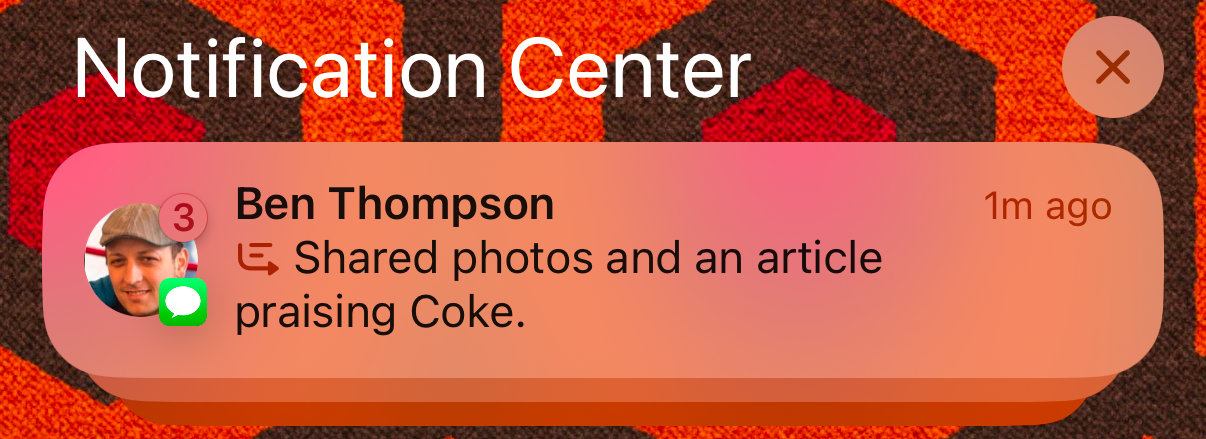
Thus, even to a user well aware of what they opted into, when they get a notification summary from “BBC News” that claims, say, that Luigi Mangione shot himself, it is perfectly reasonable for that user to presume it was BBC News reporting that Luigi Mangione shot himself.
Apple’s statement to BBC News said:
“A software update in the coming weeks will further clarify when the text being displayed is summarization provided by Apple Intelligence. We encourage users to report a concern if they view an unexpected notification summary.”
No word from Apple on what this clarification will look like, but if it’s clear enough, that sounds like a reasonable path forward. These notification summaries are very useful overall, in my experience. The mistake rate is very low and the utility is very high. But it really ought to be crystal clear what is an Apple-Intelligence-generated summary and what is not.
Calls for Apple to entirely remove the feature are hysterical nonsense. But what’s conspicuously missing from Apple Intelligence is a way for individual app developers to opt out of it. For a developer to say, effectively, “Never offer summaries of this app’s notifications.” That would alleviate some of this problem, but not all — because some news notifications come from apps that don’t belong to the publisher whose headlines are being summarized, like an email app or a news aggregation app like Apple News.
But I can also see why Apple doesn’t want to offer such an option to developers. To whom do notifications belong — the developer of the app that generates them, or the user who is receiving them? My oft-cited rule of thumb is that Apple’s priorities are in a clear order:
- Apple itself.
- Users.
- Developers.
From that perspective, it’s clear why Apple doesn’t offer developers the option to opt out of having their notifications summarized by Apple Intelligence. First, Apple doesn’t want them to opt out. Second, these notifications belong to the users receiving them, not the developers sending them. Thus, it’s up to the users whether the feature is enabled at all, and to control which apps might be exempt from it (Settings → Notifications → Summarize Notifications). If you think about it, it’s not much different from email. The sender of an email doesn’t get to opt out of inbox filtering. If a developer does not want their notifications summarized by Apple Intelligence under any circumstances, then they should stop sending notifications.
I think it’s correct for Apple to leave this in the control of users, not developers. But Apple really does need to make it more clear what is an AI-generated summary and what is a verbatim original notification. And, of course, it really needs to reduce the number of these errors. If a human editor had made this number of egregious mistakes in a single month, they’d have lost their job. ★
Monday, 6 January 2025
- Listen Later ★
-
My thanks to Listen Later for sponsoring last week at DF. Listen Later is a super simple, super useful service that turns articles into podcast episodes. When you sign up, you get a custom email address to send articles to; every article you forward to your Listen Later address is transformed into very human-like narration, and gets delivered to your private podcast feed. You can subscribe to your private Listen Later podcast feed in any podcast app.
In addition to the email gateway, there’s a Shortcut for sending articles from Safari (on Mac or iOS), a web extension for Chrome, and a simple web interface for submitting new articles. It’s very simple and the narrated versions sound great.
Sign up for free and start listening today. New users get $2 in credits to try it out — no commitment. And if you like it, you simply prepay for credits as you go. There’s no subscription — you simply pay for what you use. I wish more services had a pay-as-you-go model like Listen Later’s.
Sunday, 5 January 2025
- Jamison Foser on the Obsequiousness of The Washington Post Spiking Ann Telnaes’s Cartoon ★
-
Jamison Foser:
Washington Post opinion editor David Shipley offered the kind of obviously-false explanation you only utter when you know admitting the truth will make you look even worse:
David Shipley, The Post’s opinions editor, said in a statement that he respected Ms. Telnaes and all she had given to The Post “but must disagree with her interpretation of events.”
“Not every editorial judgment is a reflection of a malign force,” Mr. Shipley said in the statement. “My decision was guided by the fact that we had just published a column on the same topic as the cartoon and had already scheduled another column — this one a satire — for publication. The only bias was against repetition.”
Look, this is bullshit. It is risible to suggest that the world’s most powerful billionaires — men who control Facebook, Amazon, The Washington Post, The Los Angeles Times, Disney, ABC News, and OpenAI — aligning themselves with an aspiring autocrat is unworthy of two columns (one satirical) and a drawing.
And Shipley’s claim that the Post opinion section has a “bias … against repetition”? As I write this, at 8:50 pm on January 4 the main page of the opinion section at WashingtonPost.com currently features the following:
- “The 10 worst things Biden did in 2024” by Marc Thiessen
- “The 10 best things Biden did in 2024” by Marc Thiessen
- “Dave Barry’s 2024 year in review” by Dave Barry
- “24 good things that happened in 2024” by the Editorial Board
- “2025 promises to be tumultuous. Here’s our New Year’s resolution” by the Editorial Board
- “How poker players keep New Year’s resolutions” by Annie Duke
- “Classifying New Year’s resolutions,” a cartoon by Edith Pritchett
- “Bringing in the New Year,” a cartoon by by Ann Telnaes
Clearly this is not an opinion section that has a “bias … against repetition.” Just as clearly, the Post’s explanation for spiking Telnaes’ cartoon is bullshit. It is a defense so preposterous it serves as unwitting acknowledgment of the most obvious — and damning — interpretation of the Post’s actions: The Post spiked Telnaes’ cartoon because of its portrayal of Post owner Jeff Bezos.
Foser further makes the point that the Post’s obsequiousness here is not toward Trump, but rather toward Bezos. In fact, if Trump has seen Telnaes’s cartoon, he surely loves it. He might have it framed.
- Charlie Sykes on the Stupidity of The Washington Post Spiking Ann Telnaes’s Cartoon ★
-
Charlie Sykes:
To fully absorb the profound stupidity of the Wapo’s decision, consider the alternative timeline in which the paper published Telnaes’s sketch. If the Wapo had published it, both the paper and Bezos would have looked… better. The paper would have reasserted a modicum of independence and integrity; and even Bezos would have benefited.
Instead of looking like a thin-skinned, craven autocrat, he would have looked like someone big enough to tolerate criticism.
And as Sykes’s post points out right at the start, the Streisand Effect is fully in play here. Telnaes’s draft of the cartoon is now the most celebrated and re-posted political cartoon in recent memory.
Saturday, 4 January 2025
- Pulitzer-Prize-Winner Ann Telnaes Quits the Washington Post After Editors Nix Cartoon Mocking Bezos (and His Tech/Media Mogul Cohorts) for Paying Fealty to Trump ★
-
Ann Telnaes, from her personal site on Substack (alas):
I’ve worked for the Washington Post since 2008 as an editorial cartoonist. I have had editorial feedback and productive conversations — and some differences — about cartoons I have submitted for publication, but in all that time I’ve never had a cartoon killed because of who or what I chose to aim my pen at. Until now.
The cartoon that was killed criticizes the billionaire tech and media chief executives who have been doing their best to curry favor with incoming President-elect Trump. There have been multiple articles recently about these men with lucrative government contracts and an interest in eliminating regulations making their way to Mar-a-lago. The group in the cartoon included Mark Zuckerberg/Facebook & Meta founder and CEO, Sam Altman/OpenAI CEO, Patrick Soon-Shiong/LA Times publisher, the Walt Disney Company/ABC News, and Jeff Bezos/Washington Post owner. [...]
As an editorial cartoonist, my job is to hold powerful people and institutions accountable. For the first time, my editor prevented me from doing that critical job. So I have decided to leave the Post. I doubt my decision will cause much of a stir and that it will be dismissed because I’m just a cartoonist. But I will not stop holding truth to power through my cartooning, because as they say, “Democracy dies in darkness”.
The only thing wrong with the cartoon is that she drew it too soon to include Tim Cook. The cartoon isn’t even particularly scathing. I’d describe it as tame even. It shows these moguls as offering money to Trump — which they are! What a bizarre decision by Telnaes’s editors. It’d be like me getting offended if someone drew a cartoon that showed me wasting money betting on the Dallas Cowboys. If the shoe fits you have to wear it.
This isn’t a sign that the Washington Post has taken another turn for the worse. It’s simply proof of what many of us wrote before the election, when Bezos kiboshed the Post editorial board’s endorsement of Kamala Harris. In one fell swoop that decision collapsed the entirety of The Washington Post’s editorial integrity. This Telnaes fiasco is just more proof. More will follow until Bezos sells.
Friday, 3 January 2025
- The Great American Tradition ★
-
Kelly Hooper, reporting for Politico on 9 January 2021:
The Biden Inaugural Committee on Saturday released its list of donors, which included Google, Microsoft, Boeing and several other major corporations. The list contains all contributors who donated more than $200 to President-elect Joe Biden’s Jan. 20 inauguration ceremony and related activities.
That website is now defunct, and the “bideninaugural.org” domain redirects (for the next 17 days) to “www.whitehouse.gov”, but Internet Archive has a capture from Inauguration Day, 20 January 2021.
Apple is not listed, and while there is a “Tim Cook” on the list, he’s listed as residing in Michigan. [Update 11 January 2025: The Biden Inaugural Committee’s eventual filing with the FEC did list Apple Inc. as a donor, for a grand total of $43,200. Times were tight for Apple in 2020, perhaps.]
All “great American traditions” have to start somewhere, and perhaps Tim Cook — the one from California, by way of Alabama — believes the great American tradition of donating money to presidential inaugural committees is only beginning now. Or, giving him the benefit of the doubt, perhaps he only saw fit to contribute $199 to Biden’s inauguration and thus wasn’t listed, and bumped his donation by $999,801 this time. You know, for “unity”.
(Thanks to reader Daniel Streicher for the link.)
- ‘Don’t You Think We Should Maybe Ask for More Than a Million Dollars? A Million Dollars Isn’t Exactly a Lot of Money These Days.’ ★
-
Hard not to think of this clip today, re: an egomaniacal villain, whose worldview is frozen several decades in the past, setting the terms for an extortion racket.
- Axios: Tim Cook Donates $1 Million to Trump Inauguration ★
-
Axios co-founder Mike Allen:
Apple CEO Tim Cook will personally donate $1 million to President-elect Trump’s inaugural committee, sources with knowledge of the donation tell Axios. [...]
Cook, a proud Alabama native, believes the inauguration is a great American tradition, and is donating to the inauguration in the spirit of unity, the sources said. The company is not expected to give.
Donald Trump tried to overthrow the legitimate results of the 2020 election to remain in office, and as part of his efforts, inspired a violent mob of insurrectionists to invade the U.S. Capitol and disrupt the peaceful transfer of power.
For that reason alone — there are, of course, many others, but to me, Trump’s betrayal of U.S. democracy itself remains paramount — this donation is gross and perverse. But I’m not sure it was feasible not to play ball here. In times like this, realpolitik is the only politics. I wouldn’t have the stomach to make this donation, and those of you disgusted by this likely don’t either. Few people are cut out to be the CEO of a large multinational company like Apple. Sometimes you have to eat the shit sandwich.
It seems pretty obvious that it was Apple/Cook that leaked this to Axios, not Trump’s side, given the eye-roll-inducing “proud American tradition” spin, but more especially the nugget that only Cook personally, not Apple as a company, is contributing. That’s Cook asking for any and all ire to be directed at him, personally, not Apple. Good luck with that.
- The Intricacy of ASML’s Extreme Ultraviolet Lithography Machines ★
-
Fascinating piece by Ben Cohen for The Wall Street Journal (News+ link):
And there are two things I learned about the EUV tool I saw that I can’t get out of my head:
ASML teamed up with a German optical company to develop mirrors so flat that if they were scaled up to the size of Germany itself, their largest imperfection would be less than a millimeter.
The precision of EUV machines is comparable to directing a laser beam from your house and hitting a ping-pong ball on the moon.
It took decades for these absurdly sophisticated machines to make their way from labs to fabs. And until recently, it wasn’t clear if the company’s audacious bet on EUV lithography would ever pay off. In 2012, ASML was strapped for cash and sold a 23% equity stake to Intel, Samsung Electronics and Taiwan Semiconductor Manufacturing, which meant its biggest customers were literally invested in the company’s success.
ASML soon ramped up production — very, very slowly. The company delivered the first EUV system in 2010. Not until 2020 did it deliver the 100th. And last year was a busy one: ASML shipped a total of 42 EUV machines.
The piece is also a profile of one ASML engineer, Brienna Hall, who is one of a small cadre of frontline support engineers who keep these machines operating perfectly. The article’s headline, though, is bizarrely framed to suggest that she’s the only such support engineer in the world. The weird headline distracts from an otherwise fascinating story.
Thursday, 2 January 2025
- Simon Willisons’s Approach to Running a Link Blog ★
-
Speaking of Simon Willison, I greatly enjoyed this post from last week, with some of the self-imposed principles he follows writing his excellent eponymous blog. Amongst them:
- I always include the names of the people who created the content I am linking to, if I can figure that out. Credit is really important, and it’s also useful for myself because I can later search for someone’s name and find other interesting things they have created that I linked to in the past. If I’ve linked to someone’s work three or more times I also try to notice and upgrade them to a dedicated tag. [...]
- If the original author reads my post, I want them to feel good about it. I know from my own experience that often when you publish something online the silence can be deafening. Knowing that someone else read, appreciated, understood and then shared your work can be very pleasant.
- A slightly self-involved concern I have is that I like to prove that I’ve read it. This is more for me than for anyone else: I don’t like to recommend something if I’ve not read that thing myself, and sticking in a detail that shows I read past the first paragraph helps keep me honest about that.
Every step of the way, I found myself nodding my head, thinking to myself, I do that too! — right down to creating tags for people after I’ve mentioned their work or simply credited their bylines a few times. (The difference is that Willison seemingly isn’t a procrastinator, and I am, so my decades of tagging aren’t yet exposed to anyone but me.)
Then I got to this:
There are a lot of great link blogs out there, but the one that has influenced me the most in how I approach my own is John Gruber’s Daring Fireball. I really like the way he mixes commentary, quotations and value-added relevant information.
And now it doesn’t seem quite as amazing that I was nodding my head in agreement with each of his guidelines. But, call me biased, it’s still a hell of a good start to a blogging rulebook.
- ‘Things We Learned About LLMs in 2024’ ★
-
Simon Willison:
A lot has happened in the world of Large Language Models over the course of 2024. Here’s a review of things we figured out about the field in the past twelve months, plus my attempt at identifying key themes and pivotal moments. [...]
I think telling people that this whole field is environmentally catastrophic plagiarism machines that constantly make things up is doing those people a disservice, no matter how much truth that represents. There is genuine value to be had here, but getting to that value is unintuitive and needs guidance.
Those of us who understand this stuff have a duty to help everyone else figure it out.
Nobody is doing a better job of that than Willison. I learned so much from reading this piece — I bet you will too.
Update: Anil Dash:
I think everyone who has an opinion, positive or negative, about LLMs, should read how @simonwillison has summed up what’s happened in the space this year. He’s the most credible, most independent, most honest, and most technically fluent person watching the space.
Couldn’t say it better myself.
Wednesday, 1 January 2025
- Tesla Cybertruck Explodes and Burns Outside Entrance of Trump International Hotel and No-Casino in Las Vegas ★
-
There are metaphors, and then there are metaphors.
Happy New Year. Buckle up.
Tuesday, 31 December 2024
- Apple TV+ Is Free This Weekend, January 3–5 ★
-
Hartley Charlton, MacRumors:
Apple TV+ is set to be available to stream for free from Saturday, January 4 to Sunday, January 5, providing its full catalog with no subscription fee. Following a series of teasers, Apple today confirmed the free weekend on social media, building anticipation for new releases early in 2025 such as the second season of Severance. Simply open the Apple TV app to watch for free.
Bizarrely, the only places Apple announced this seems to be on X and Instagram. Not a word on Apple Newsroom, for example. Update: OK, it’s also posted on Apple’s dedicated press release site for TV+, which I heretofore didn’t know existed.
Apple TV+ has an abundance of great shows (but a relative dearth of good original movies, with Scorsese’s Killers of the Flower Moon being the standout exception). I wouldn’t hesitate to argue that the average quality of an Apple TV+ original show is higher than that for any other streaming platform. It really is the new HBO. But for one weekend of free viewing I can easily name my two favorites, both of which I think will stand the test of time and long be remembered: Severance and Slow Horses.
Monday, 30 December 2024
- DF Sponsorships ★
-
Speaking of sponsorships, the Q1 schedule is filling up, but I’ve still got this week and next open. If you’ve got a product or service you think would be of interest to DF’s audience of people obsessed with high quality and good design, get in touch.
- James Fallows: ‘Jimmy Carter Was a Lucky Man’ ★
-
James Fallows, in a 2023 piece for The Atlantic, written when Carter entered hospice care:
Jimmy Carter survived to see many of his ambitions realized, including near eradication of the dreaded Guinea worm, which, unglamorous as it sounds, represents an increase in human well-being greater than most leaders have achieved. He survived to see his character, vision, and sincerity recognized, and to know that other ex-presidents will be judged by the standard he has set.
He was an unlucky president, and a lucky man.
We are lucky to have had him. Blessed.
- Mark Gurman Says Voice Control for Next Magic Mouse ‘Makes Sense’ ★
-
Juli Clover, MacRumors:
An upcoming version of the Magic Mouse with voice control for AI would “make sense,” Bloomberg’s Mark Gurman said today, though he claimed that he has heard no rumors about the feature so far.
Alongside the voice-input mouse, it’d make just as much sense to bring back some of that see-through 1998 iMac aesthetic by switching MacBooks to transparent aluminum.
- 52 Things Kent Hendricks Learned in 2024 ★
-
Fun and interesting list overall (via Kottke), but #7 caught my attention:
Walking speed on the streets of New York, Boston, and Philadelphia has increased 15% since 1979. (“Shifting Patterns of Social Interaction: Exploring the Social Life of Urban Spaces Through A.I.”)
Not sure what made the researchers pick those three cities, but in my experience they’re the only three cities in America where people walk at a reasonable clip.
(Sidenote: #1 on Hendricks’s list was an item claiming that Firefox and Chrome users tend to be happier and more satisfied employees than Internet Explorer or Safari users, because they’re the sort of non-conformist thinkers who install third-party web browsers rather than use the system default. As if the inclusion of “Internet Explorer” weren’t hint enough that one should be skeptical of this claim, the cited source is an article from 2016, and the study only applied to people with jobs as customer service agents. Chrome has 66 percent market share for desktop browsers today — pretty sure using it doesn’t make one a non-conformist.)
Sunday, 29 December 2024
- Due ★
-
My thanks to Junjie for sponsoring last week at DF to promote Due, their excellent reminder app for the Mac, iPhone, and iPad. I first linked to Due back in 2010, writing this short post:
I’ve been trying this $3 app for a few days and digging it — a convenient, low-friction way to set short-term reminders and timers. Sort of like Pester but for iPhone. Focused and thoughtful design.
A lot of apps have come and gone since then. But Due has thrived. I never would have expected it when I penned the short blurb above, but here we are at the very end of 2024 and I’ve been relying upon Due for 14 years and counting. I started using it then and haven’t stopped. Due has long held a permanent position on my iPhone’s first home screen. And for several years now, Due has been available, with seamless iCloud syncing, on the Mac.
You might ask why use Due instead of Apple Reminders. For me the answer is simple. Due’s conception and presentation of “reminders” works for me and my way of thinking in a way that Apple Reminders does not. I have tons of to-do items in Reminders. But for a certain type of recurring and one-off tasks that I want to be reminded about at a certain time, they go in Due.
For example, our trash gets picked up on Monday and Thursday mornings. So I have recurring Due reminders to take out the trash every Sunday and Wednesday night. I don’t want these in my calendar. I just want them in Due, and Due makes sure I see notifications at 9:00pm every trash night. Due’s intuitive snoozing options make it easy to postpone one of these by a day during weeks when trash pickup is delayed by a holiday. I also keep my reminders related to Daring Fireball’s weekly sponsors in Due — posting the new sponsor’s ad at the start of the week, and writing my thank-you post at the end of the week — which reminders were quite meta this week.
It turns out, that brief blurb I wrote about Due 14 years ago was meaningful to the success of Due. Reading Junjie’s remembrance about that post made me sit up a bit straighter, I’ll admit. I’ll accept some small measure of credit for discovering Due back then, but Due is so good, so distinctively original and useful, that I firmly believe its success was inevitable. Go check it out.
- Jimmy Carter Dies at 100 ★
-
The New York Times:
While his presidency was remembered more for its failures than for its successes, his post-presidency was seen by many as a model for future chief executives. Rather than vanish from view or focus on moneymaking, he established the Carter Center to promote peace, fight disease and combat social inequality. He transformed himself into a freelance diplomat traveling the globe, sometimes irritating his successors but earning the Nobel Peace Prize in 2002.
OpenAI’s Board, Paraphrased: ‘To Succeed, All We Need Is Unimaginable Sums of Money’
Sunday, 29 December 2024
From an un-bylined post from OpenAI’s board of directors on Friday:
The hundreds of billions of dollars that major companies are now investing into AI development show what it will really take for OpenAI to continue pursuing the mission. We once again need to raise more capital than we’d imagined. Investors want to back us but, at this scale of capital, need conventional equity and less structural bespokeness.
My take on OpenAI is that both of the following are true:
- OpenAI currently offers, by far, the best product experience of any AI chatbot assistant.
- There is no technical moat in this field, and so OpenAI is the epicenter of an investment bubble.
Thus, effectively, OpenAI is to this decade’s generative-AI revolution what Netscape was to the 1990s’ internet revolution. The revolution is real, but it’s ultimately going to be a commodity technology layer, not the foundation of a defensible proprietary moat. In 1995, investors mistakenly thought investing in Netscape was a good way to bet on the future of the open internet and the World Wide Web in particular. Investing in OpenAI today is a bit like that — generative AI technology has a bright future and is transforming the world, but it’s wishful thinking that the breakthrough client implementation is going to form the basis of a lasting industry titan.
There’s even a loosely similar origin story. Netscape started life as Mosaic, a free-of-charge browser that debuted in January 1993 and instantly revolutionized the nascent-but-still-obscure World Wide Web by adding support for images. Mosaic was developed and released by a team led by Marc Andreessen at the National Center for Supercomputing Applications (NCSA). A year later Andreessen and his team left NCSA and, with Silicon Graphics founder James Clark, founded Netscape Communications Corporation, using the Mosaic browser as the foundation for Netscape Navigator. OpenAI’s whole “forget about this being a public-benefit thing, let’s make it a for-profit thing” transition is very reminiscent of the Mosaic-to-Netscape transition.
The biggest difference is that Netscape went public quickly, and that’s when the investment money poured in. NCSA Mosaic debuted in January 1993 and Netscape’s IPO was just 2.5 years later, in August 1995. OpenAI has raised tens of billions of dollars already — $13 billion from Microsoft alone — while still in this uncertain transition from an ostensibly not-for-profit foundation to a totally-for-profit company.
OpenAI’s board now stating “We once again need to raise more capital than we’d imagined” less than three months after raising another $6.6 billion at a valuation of $157 billion sounds alarmingly like a Ponzi scheme — an argument akin to “Trust us, we can maintain our lead, and all it will take is a never-ending stream of infinite investment.” ★
Tuesday, 24 December 2024
- The Talk Show: ‘A Professional Internet User’, With Kagi Founder and CEO Vlad Prelovac ★
-
Kagi founder and CEO Vlad Prelovac joins the show to talk about the business of web search, the thinking behind Kagi’s own amazing search engine, and their upstart WebKit-based browser Orion.
Sponsored by:
- Squarespace: Make your next move. Use code talkshow for 10% off your first order.
- Memberful: Monetize your passion with membership. Start your free trial today.
- Coding Font Selection ‘Tournament’ ★
-
Via Jason Snell (back in October), who points first to this thread on Mastodon where a few of us posted about our preferences for the fonts we use for writing, and then describes this fun “tournament” from Typogram that lets you pick your favorite monospaced coding font from 32 choices. One limitation is that the only options are free fonts — some of my favorite monospaced fonts aren’t free and thus aren’t included (e.g. Consolas, Berkeley Mono, or Apple’s SF Mono). Another limitation is that some of the fonts in the tournament just plain suck. But it’s really pretty fun.
It’s also a good thing I procrastinated on linking to this for two months — it’s improved greatly in the weeks since Snell linked to it. The example code is now JavaScript, not CSS, which is a much better baseline for choosing a programming font. And there are some better font choices now.
I highly recommend you disable showing the font names while you play, to avoid any bias toward fonts you already think you have an opinion about. But no matter how many times I play, I always get the same winner: Adobe’s Source Code Pro. My second favorite in this tournament is IBM Plex Mono. The most conspicuous omission: Intel One Mono.
Sunday, 22 December 2024
- Jiiiii ★
-
My thanks to Mochi Development for sponsoring last week at DF to promote Jiiiii, their exquisitely well-crafted app for tracking anime. (Jiiiii — with five i’s — is the onomatopoeia for staring at something, commonly used in Japanese media.) With over 75 shows that aired this past season alone, keeping up with and discovering new anime can be hard, especially across several streaming services. Jiiiii makes that simple by giving you a single schedule to check as you await your favorite’s show’s next episode.
Unlike any other anime aggregation site, Jiiiii has a collection of beautiful native apps for iPhone, iPad, Mac, Apple TV, and Vision Pro, making it the best way to keep up with anime on Apple devices. They even have a progressive web app in beta, that you can download on almost any other platform to get a similar experience.
The best part? No ads, no tracking, and complete privacy — all the benefits you’d expect from the indie husband-and-wife developers Dimitri and Linh Bouniol. (Dimitri streamed the entire development of Jiiiii to YouTube, and continues to do so every night.)
Catch up on anything you missed from the fall season, and get ready for the winter season’s new anime with Jiiiii, and never miss out on a show again.
- ‘Well, Hang Tight. Rickey’s Gonna Give You That Chance.’ ★
-
Another great Rickey Henderson remembrance, this one from Joe Posnanski:
I’d argue that no player in baseball history was ever more alive than Rickey Henderson, which is why his shocking death just days before his 66th Christmas hits so hard. Rickey played a cautious sport with abandon. Rickey played a timid sport with flash. Rickey irritated and thrilled and frustrated and dominated and left us all wanting more.
“When we were kids,” his teammate Mike Gallego said, “we played in the backyard emulating Pete Rose’s stance or Joe Morgan’s. I believe Rickey emulated Rickey.”
Yes, Rickey was his own thing, entirely, completely, from the way he crouched at the plate (“he has a strike zone the size of Hitler’s heart,” Jim Murray famously wrote), to the way he slid headfirst on the bases (he modeled his slide after an airplane landing) to the way he held out virtually every spring (“You have to say Rickey’s consistent,” Don Mattingly said during one of those holdouts, “and that’s what you want from a ballplayer: consistency”) to the way he referred to himself in the third person (“People are always saying, ‘Rickey says Rickey,’” Rickey said, “but it’s been blown way out of proportion”) to the joyful confidence he exuded every time he stepped out on the diamond from age 20 to age 44.
“You wanna throw me out today?” he would ask catchers the first time he stepped to the plate. “Well, hang tight. Rickey’s gonna give you that chance.”
I don’t want to spoil a single word of the story Posnanski closes his piece with. Just be sure to read through to the very end.
See also:
From ESPN’s obit, by Howard Bryant and Jeff Passan:
He played his last game at 44 years, 268 days old Sept. 19, 2003, for the Dodgers, and his stolen base total remains more than 1,000 ahead of the current active leader.
Here’s the list of career steals leaders among active players, led by Starling Marte with 354 and Jose Altuve with 315. There are only four other active players with more than 200. Rickey had 1,406. Lou Brock is second place on the all-time list with 938 steals. So even if Marte (who is already 36 years old) or Altuve (34 years old) were to steal as many additional bases as Lou Brock did in his entire 19-year career — the guy who is second-place all-time — they’d still be well short of Rickey’s record. In the entire history of Major League Baseball there are only nine players who stole half of Rickey’s career number. But as FanGraphs’s Dan Szymborski observes, “The funny thing with Rickey is that you take away the stolen bases, he’s still easily in the top 10 for LF WAR all time.”
Also from ESPN:
Stories about Henderson were as legendary as his play, such as the true story of him once framing a million-dollar bonus check and hanging it on his wall — without first cashing it.
Last but not least, give a listen to this quick story from Giants great Will Clark, about a preseason game against Rickey’s Oakland A’s when the A’s coaches tried to give him the “don’t steal” sign. You know what Rickey did.
Saturday, 21 December 2024
- Yankees Legend Rickey Henderson Dies at 65 ★
-
Craig Calcaterra, writing at Cup of Coffee:
To say this is a massive loss is about as big an understatement as is possible. Henderson was the biggest and brightest star of his generation. There may not have been any player in history who was better at more things than Rickey Henderson was.
Henderson was, without question, the greatest leadoff hitter of all time and the greatest base-stealer of all time. He, arguably, possessed the greatest combination of power and speed of any player in the history of the game as well. Perhaps the best characterization of Henderson’s career came from Bill James who once wrote that, “if you could split Rickey Henderson in two, you’d have two Hall of Famers.” [...]
In 1980, his first full major league season, Henderson broke Ty Cobb’s 65-year-old American League record for stolen bases by swiping 100 bags to Cobb’s 96. In 1982 he stole 130 bases, breaking Hall of Famer Lou Brock’s all-time single-season record of 118. Henderson’s 130 steals that year stands as the record to this day. He would lead the American League in stolen bases in each of his first seven full seasons and nine of his first ten. He’d lead his league in steals in 12 seasons in all, the last of which came in 1998 when he was 39 years-old.
On May 1, 1991, Henderson broke Brock’s all-time stolen base record with his 939th steal and would go on to steal an astounding 1,406 bases before he retired. No player has come anywhere close to Henderson’s mark in the three decades since he set it and many doubt anyone ever will.
You have to be really good even to have had been on base that many times, to have had the opportunity to steal 1,400+ bases, let alone to have actually swiped them. He was amazing. He’s best known for his career base-stealing record, but Henderson — thanks to his speed, talent, competitiveness, and remarkable longevity — is also the career leader in runs scored. Scoring runs is how you win — you can make the case that no stat is more important in baseball, and Rickey (as everyone called him, including himself) scored more runs than anyone who ever played. Look at the names on the top 10 for career runs scored:
- Rickey Henderson 2,295
- Ty Cobb 2,245
- Barry Bonds 2,227
- Hank Aaron 2,174
- Babe Ruth 2,174
- Pete Rose 2,165
- Willie Mays 2,068
- Alex Rodriguez 2,021
- Stan Musial 1,949
- Derek Jeter 1,923
What a player, and character, he was. Rickey was the most exciting player I ever saw.
Thursday, 19 December 2024
- Woody Johnson’s New York Jets ★
-
Zack Rosenblatt, Dianna Russini, and Michael Silver have written a devastating profile of the most dysfunctional franchise in all of U.S. pro sports, the New York Jets, whose dysfunction has a clear and obvious root cause: meddling idiot owner Woody Johnson (heir to the Johnson & Johnson pharmaceutical fortune). One example:
A few weeks later, Douglas and his Broncos counterpart, George Paton, were deep in negotiations for a trade that would have sent Jeudy to the Jets and given future Hall of Fame quarterback Aaron Rodgers another potential playmaker. The Broncos felt a deal was near. Then, abruptly, it all fell apart. In Denver’s executive offices, they couldn’t believe the reason why.
Douglas told the Broncos that Johnson didn’t want to make the trade because the owner felt Jeudy’s player rating in “Madden NFL,” the popular video game, wasn’t high enough, according to multiple league sources. The Broncos ultimately traded the receiver to the Cleveland Browns. Last Sunday, Jeudy crossed the 1,000-yard receiving mark for the first time in his career.
Coming into this season, the Jets had hopes of ending the franchise’s 13-year playoff drought — the longest in the four major men’s North American sports — and quieting years of talk about the franchise’s dysfunction. Instead, this season has only cemented the Jets’ reputation.
The fans of every other team in the NFL that is having a disappointing season — like yours truly — are all texting this story to each other today, with the same message: “At least we’re not the Jets.”
Wednesday, 18 December 2024
- ‘Silo’ Renewed for Two Additional Seasons ★
-
Joe Otterson, reporting for Variety:
“Silo” has been renewed for both Seasons 3 and 4 at Apple TV+, with the fourth season set to be the show’s last.
The renewal news comes as the post-apocalyptic drama is currently airing its second season. The sixth episode of Season 2 is due out on Dec. 20. The season finale is scheduled to debut on Jan. 17.
I feel bad complaining about a good show not only getting renewed, but renewed through to a planned conclusion. I fucking hate when good shows get cancelled after one season.
But. While I really liked season 1 of Silo, season 2 has been a bore. We’re halfway through — five episodes — and everything interesting could have been put in one episode. Maybe one and half. I hope the remaining five episodes of season 2 pick up, but so far, it really feels like this entire season has just been padding, spinning its wheels, waiting to get to what’s next. Hugely disappointing, really.
- Acorn 8’s Documentation ★
-
One last item on Acorn 8. Whether you are a longtime Acorn user (like me), or a would-be new user, you should set aside some time to actually read Acorn’s documentation. It’s a full user manual, and it not only describes, in detail, what every feature in the app does and how to use them, but also a vast array of “how-to” tutorials, many of them videos.
In broad strokes, there are two approaches to documenting a serious, professional-level app or software system. One way is a comprehensive functional reference resource. That’s a way that you, the user, can teach yourself how to use a feature, refresh your memory about a feature you haven’t used in a while, or even just check to see if a certain feature even exists. The other is a narrative, storytelling, tutorial approach. That’s not teaching yourself — that’s letting an expert teach you, and today that’s often a visual approach through video.
Acorn’s documentation is so thorough that it encompasses both approaches. Either one would qualify Acorn as a well-documented application. But by including both, Gus Mueller should be given some sort of medal or award. Different people learn in different ways, and Acorn’s documentation is there for everyone.
It should go without saying, but no serious tool — hardware or software — is complete without thorough, polished documentation. Acorn goes above and beyond. It’s amazing enough that a company as small as Flying Meat — it’s really just Gus and his wife Kirstin — has produced a full-fledged professional-strength image editing application that has remained modern and cutting-edge for 17 years and counting. But it’s also accompanied by first-class comprehensive documentation.