Episode 549: James Wines SITE Architect
May 24, 2016 · Print This Article

Audio clip: Adobe Flash Player (version 9 or above) is required to play this audio clip. Download the latest version here. You also need to have JavaScript enabled in your browser.
download
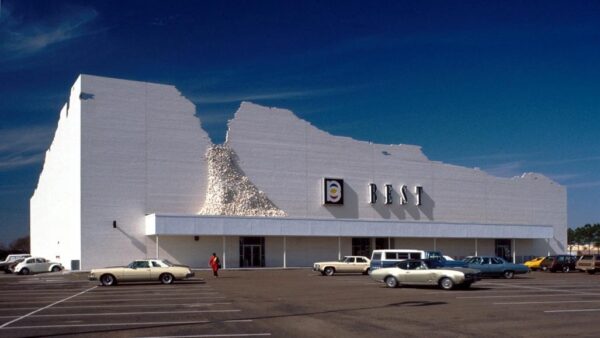
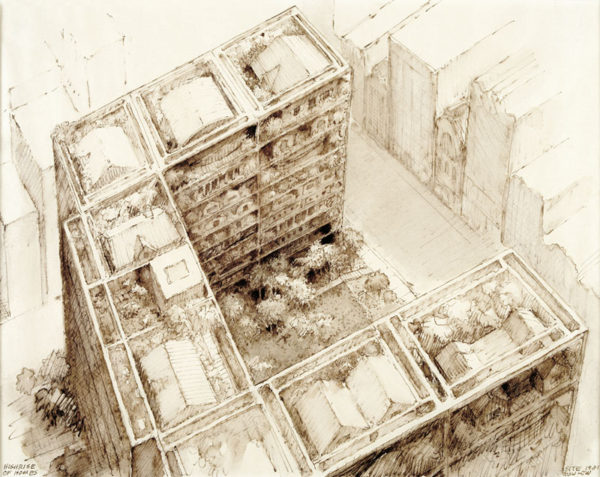
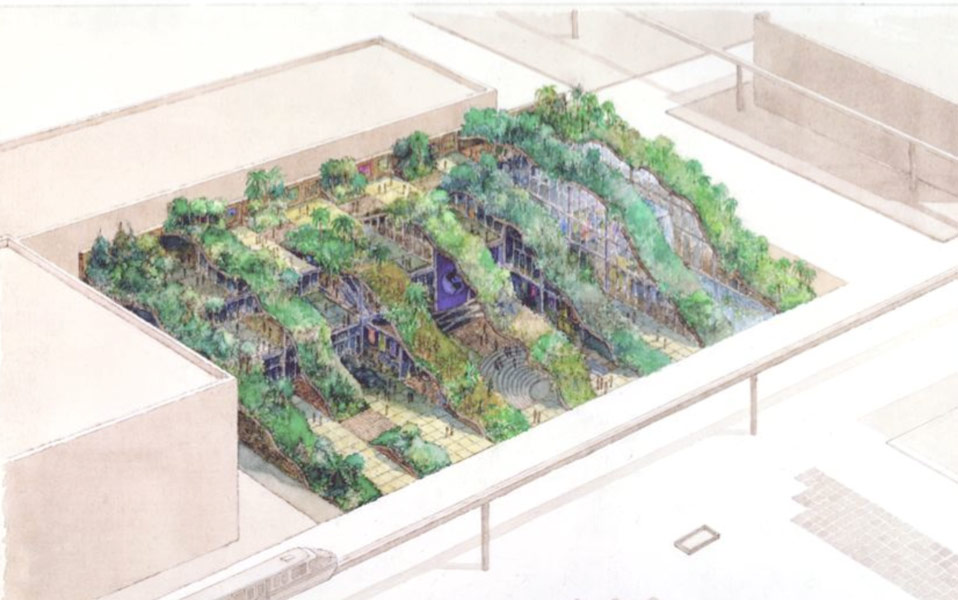
Low and behold, in conjunction with Rhona Hoffman and on the eve of the 2015 Chicago Architectural Biennial we had a once in a life time opportunity to sit down and speak with James Wines of SITE. An architect so radical his buildings have a power quite unlike most contemporary architects, they don’t bend us with spectacle, physicality, or industry, they delight us with wit and whimsy. They open our eyes to a magic in the everyday or in the second glance you have to give to a building telling you the story of its demise.
Some days this is the best job.
Review: “Mastry” Kerry James Marshall
May 16, 2016 · Print This Article

Guest post by Noah Hanna
Kerry James Marshall: Mastry; the first major museum retrospective of the artist’s work opened on April 23rd at the Museum of Contemporary Art. Organized collaboratively between the MCA, The Met, and LAMOCA, the exhibition gathered national allure prior to its opening; and it seems only appropriate that B@S join in the discussion.
The MCA website proclaimed Marshall “one of the greatest living artists, and he responded with perspective, telling the Chicago Tribune “I’d take a James Brown introduction, ‘hardest working man in show business.’ ” At 60, Marshall is regularly seen meeting and greeting avid fans at the museum, always with his infectious smile, warm eyes, and kind demeanor. It is easy to admire Kerry James Marshall simply as a person; and then there’s the work he creates.
One could only assume the considerable pressure felt by Marshall upon opening this exhibition. To start, the title, “Mastry” is a formidable expression that no self-respecting artist would dare assign to their own body of work. The concept of the retrospective itself is foggy in contemporary art. The term connotes a fixed span of time with an inevitable conclusion; an indication that the artist whose work is on display has reached his creative climax. Frankly, retrospective usually denotes the work of an artist who is no longer creating. So what does this mean in contemporary art which defines itself by its association with the living? Does this mean that the artist who is given a retrospective within his lifetime is considered finished? Much to the contrary; Kerry James Marshall and Mastry have important work to do.
Kerry James Marshall is a painter, and a figurative painter at that. It feels appropriate that a mode constantly questioned for its validity in the twenty-first century should be the one Marshall employs to push the medium forward. His use of Renaissance and Baroque compositions, scale, and themes are apparent and necessary. Motifs of spirituality, strength, domesticity and the human condition come to serve as the foundation for his work, much as they did for Titian or Carracci.

Kerry James Marshall, Beauty Examined, 1993. Courtesy of Charles and Nancy Adams-Sims. Photo: Matthew Fried, © MCA Chicago.
Since the late 1980s, Marshall has been identified as a painter focused on the representation of people of color; but ample care is given to the history of painting itself. Marshall’s Beauty Examined (1993) draws close comparison to Rembrandt’s Anatomy Lesson of Dr. Nicolaes Tulp (1632) in its depiction of a black woman laid out as an anatomical exhibit. Reference points across her body indicate areas of beauty in the subject; and the words “Beauty is only skin deep” rest in the curvature of her frame.
Though Marshall has a deep admiration for the work of Renaissance masters and his own paintings draw heavily from their conventions, the depiction of the black figure is his passion. In the large-scale School of Beauty, School of Culture (2012), Marshall paints the interior of a beauty salon that can be seen from the outside in a 2003 painting from his studio window, 7 am Sunday Morning (also on display in the exhibition). While the scene is brimming with references to Black Nationalism and power, including posters of Lauryn Hill and Chris Ofili, I found myself most captivated by the skewed and elongated image of Disney’s Sleeping Beauty affixed to the floor. In this imagery, Marshall invokes a 1533 painting entitled The Ambassadors by Hans Holbein the Younger. In the classic painting, as two men proudly pose for their portrait, a skull rests below them in the same elongated form, perhaps as a memento mori. As the young ambassadors face the inevitable but obscured prospect of death and decay, the exuberant clientele of the salon face the unspoken expectations of white female beauty that lies just below them; a very young boy cocks his head to observe the face on the floor in the correct perspective.

Kerry James Marshall, School of Beauty, School of Culture, 2012. Collection of the Birmingham Museum of Art; Museum purchase with funds provided by Elizabeth (Bibby) Smith, the Collectors Circle for Contemporary Art, Jane Comer, the Sankofa Society, and general acquisition funds. Photo: Sean Pathasema.
Much of Marshall’s work addresses domesticity and celebrates the mundane nature of everyday life. There is a keen awareness that images of black lives simply do not exist in art, and that those of color who do appear within the historical canon are portrayed as servants, concubines, or villains; I am reminded vividly of Manet’s Olympia when I say this. Marshall masterfully captures reality in his paintings; images of gardening and camping are paired with expressions of intimate, unencumbered love. There is a palpable urge to smile when looking upon Marshall’s smitten lovers.
However with reality comes an acute awareness of history. It’s in this dichotomy that Mastry excels above and beyond. There are several cathartic points within this exhibition, images that speak volumes to American history, both past and present. At times I found myself astonished at Marshall’s apparent prophetic imagery. Lost Boys (1993) commemorates two young boys whose childhoods were abruptly cut short. One boy glances at the viewer, a brightly colored pink toy pistol in his hand, referencing a report Marshall had heard of a child killed by police for brandishing the toy. A frame from Marshall’s ongoing comic series Rythm Mastr sees a black man confronting a television reporter following a shooting. “I saw the whole thing and it wasn’t nothing like they said!” he exclaims. While we see these today as painfully indicative of a recent incident that occurred in Cleveland, and others throughout the country, I find myself forcing to remember that Marshall does not possess the sage wisdom of prescience and that rather he depicts life as it is.

Kerry James Marshall, The Lost Boys, 1993. Collection of Rick Hunting and Jolanda Hunting. Photo: Dominique Provost, © MCA Chicago.
I cannot deny that myself and many of my peers have been blessed with the privilege to be detached bystanders to these realities: holding onto trivial facts concerning isolated incidents of unrest in Los Angeles in the early 1990s; a basic curriculum knowledge of the racial movements of the late 1960s; and a junior high school reading of Christopher Paul Curtis’ 1963 book The Watsons Go to Birmingham. This is why the Kerry James Marshall retrospective matters now and why his works are such an accomplishment. Marshall’s ability to create figures who possess intricate personalities gives them their poignancy, the stoic civil disobedience and ardent steadfastness of Martin Luther King, Jr. and the unrepentant power of Malcolm X, a combination that seems both at odds and as imperative as the two leaders were. The violence of Marshall’s images of Nat Turner and The Stono Rebellion are subtle, and Marshall adamantly makes sure it is not the focus of the work; the figure and its identity are foremost.
Nothing within art exists within a vacuum or free from what has come before it. Even an action in condemnation of the past is a response to it nonetheless. Art is a beautiful and equally bitter amalgamation of human history. Very few artists capture this better than Marshall. We cannot change the art historical canon any more than we can change the past, but we can build on it. Painting an ever more crystalline and inclusive image of our shared history. I can only hope that Kerry James Marshall, the faces he so magnificently paints and the stories he tells, enter into the scope of art history so that they may be looked on in the future with the admiration and eminence that they so rightfully deserve.
Episode 548: Amanda Williams
May 10, 2016 · Print This Article

Audio clip: Adobe Flash Player (version 9 or above) is required to play this audio clip. Download the latest version here. You also need to have JavaScript enabled in your browser.
download
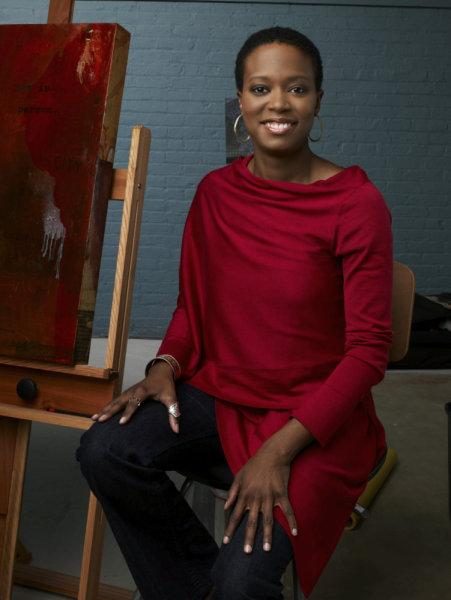
This week Duncan, thanks to Columbia College Chicago and a class called the Late Late Afternoon Show, rocks the mic with Amanda Williams whose work blew our collective minds with the “Color(ed) Theory” series of public works on the south side of Chicago. She pulled in the lion’s share of the press at the 2015 Chicago Architectural Biennial and seems to have been going nonstop since!
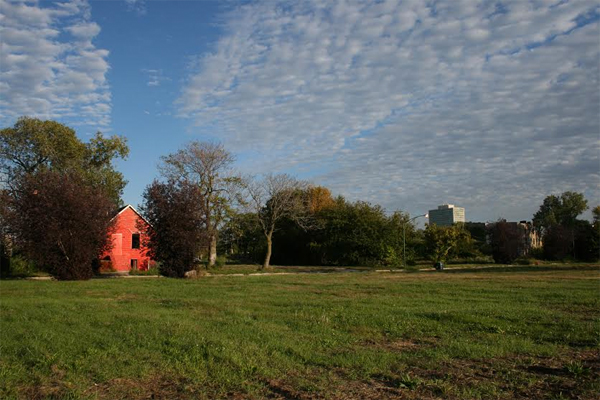
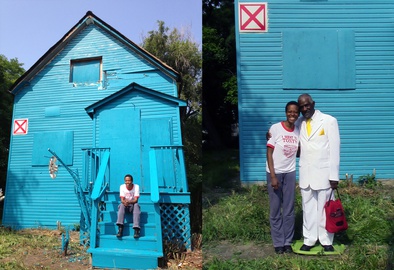

Photo by the author for Bad at Sports.
Guest post by Brent Fogt.
Glass geodesic domes play a leading role in Christine Tarkowski’s “Chthonic Void” at Devening Projects. The domes symbolize utopian ideals and their failure to take root. The exhibition, by contrast, is an unqualified success.
The main gallery features four of Tarkowski’s glass sculptures, two of which rest on pedestals in the center of the room. Unlike the monumental scale of some of Tarkowski’s past work, the scale of these sculptures is closer to architectural models. Made of stacked, softball-sized glass domes, the sculptures are covered with shiny black liquid that brings to mind chocolate syrup. The stacks seem simultaneously precarious and grounded, unstable and solid, animated and static.
This tension between movement and stasis is repeated in two enormous paintings that surround the sculptures on opposite walls. Composed of overlapping diagonal stripes that form moiré patterns, these paintings vibrate, ripple and bulge the longer you look at them. When the eyes feel fatigue, rest is available at the edges, where raw canvas is left unpainted.
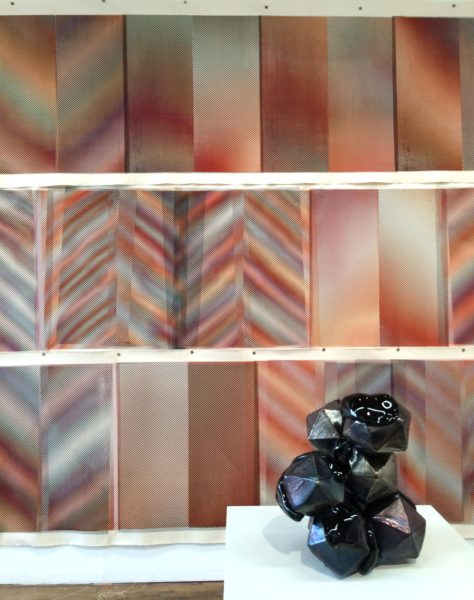
Photo by the author for Bad at Sports.
On the wall next to the paintings are two small, embossed works on paper. These pieces, which also contain overlapping patterns, create a subtler moiré effect. This quieter approach is an ideal counterpoint to the larger, more intensely hued works on canvas.
Down the hall from the main gallery is a room completely devoted to Tarkowski’s glass works. The space is stunning. Eleven black sculptures, all a combination of glass on glass or glass and steel, lie on all-white pedestals that span the center of the white room, creating vivid contrasts not only between light and dark but also between glossy and matte.
The sculptures resemble unearthed architectural ruins that have been exposed to extreme heat and are melting, dripping and decaying before our eyes. Some of the drips form pools over sunken areas of the geodesic domes. Others are as thin as string or spaghetti and drape themselves over tenuous, broken grids of steel.
“Chthonic,” in fact, means subterranean—in, under, or beneath the earth. In classical mythology, “chthonic” refers to spirits that dwell under the earth. The show title “Chthonic Void” is especially fitting, because Tarkowski’s glass sculptures seem both worldly and otherworldly—both part of, and separate from, the earth itself.
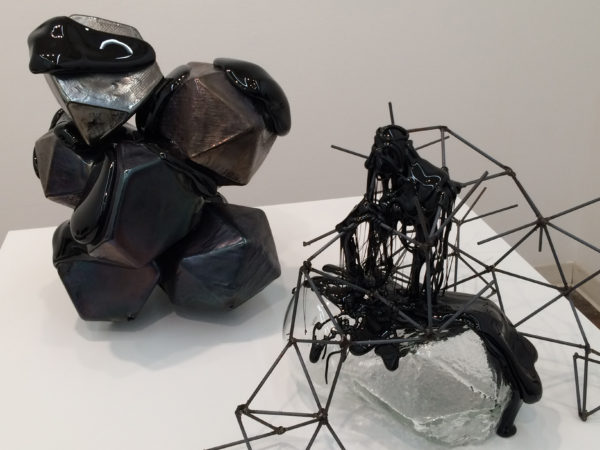
Photo by the author for Bad at Sports.
Exhibition on view at Dan Devening Projects, 3039 W Carroll Ave.
April 3 –May 14, 2016