by Lisa Wainwright.

Artist and educator, Barbara DeGenevieve, passed away on August 9 and now the world is a little less interesting without her.
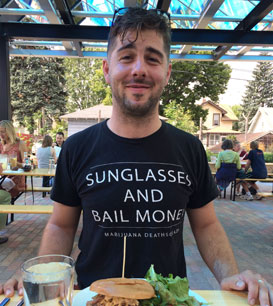
Barbara was irrepressible. I first learned of this willful spirit while a graduate student at the University of Illinois in Urbana-Champaign, where she was on the art and design faculty. There was a great hubbaballo as she had called for the melt down of a 19th sculpture whose sexist bravado [gorilla with naked maiden] had been prominently placed in the entrance of the new Krannert Museum. Barbara’s was a conceptual call to arms with text and photos, aided by her longtime colleague and friend, Alan Labb, and the intent was to incite conversation. This was her steadfast M.O. Years later, when I was her Dean at the School of the Art Institute of Chicago—where she taught since 1994, I was obliged to rein her in with some of the riskier projects. At one point I even placed a letter in her personnel file about not touching students’ genitals, but that’s a longer essay. She and I would laugh about it later, about the infamous penis and its sober critique panel. Then there was her porn class. She was one of the early pioneers to offer studio courses in this arena, and it also got her into some trouble–of course. Semester after semester, I tried to counsel her, temper her a bit. She won mostly. And bully on her. It was about artistic integrity and Barbara had this in spades. Barbara was irresistible. She could charm the pants off you –literally.
She was strikingly good looking. Thin, statuesque, with a mane of wild grey hair—she was that Medusa she had coined as her penname on one of her naughtier websites. Barbara had amazing hands with elegantly manicured nails in lurid green and decadent black, and a sexy barbed wire tattoo that wrapped around her wrist. Her voice was deep and seductive. She dressed well—somewhere between Stevie Nicks and Chrissy Hines [She’s cringing at the Stevie Nicks reference]. Barbara always looked great as she was essentially always on the prowl–for sex, for ideas, for engagement, for life.
Barbara was irreplaceable. She was an amazing teacher with an enormous following. For she gave her students permission to act and think and make with uncompromised abandon. And at the same time, she insisted on their being deeply immersed in art history and theory, particularly around the leitmotifs of power, class, and race. The rigor of theory undergirded her promiscuous practice and she taught this matrix to her students. And they followed. Social media sites have been buzzing for weeks since her death. Across the country and around the world, legions of students are honoring Barbara with their thoughts and condolences. She impacted so many. More recently, Barbara became enchanted with the pedagogy of professional practice. Ironic I thought for someone who liked to break the rules and push the edge. But she was as fierce in her commitment to teaching artists how to manage their careers as she was in helping them find their voice.
Barbara was subversive and kind, radical and caring, unconventional and humane. She was a complex creature with a heart of gold–trimmed in leather. We miss her madly.

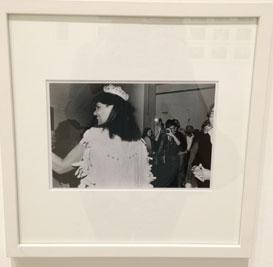
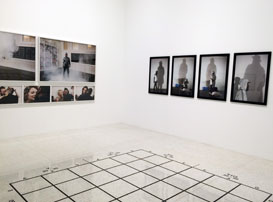
images thanks to Hyperallergic
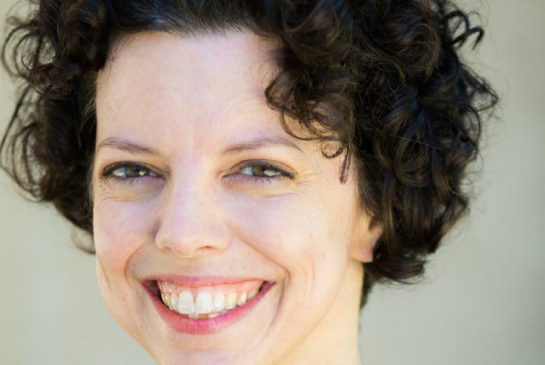
Stephanie Smith, former Chief Curator and Deputy Director of the University of Chicago’s Smart Museum of Art / newly appointed Chief Curator at the Art Gallery of Ontario
This summer it was announced that Stephanie Smith, a longtime Chicago cultural work, best known as deputy director and chief curator at the Smart Museum of Art at the University of Chicago, has left her Chicago post to become chief curator at the Art Gallery of Ontario in Toronto. Smith, whose interests lay in contemporary art with social and political bents, developed highly-acclaimed exhibitions and programs for the Smart, most notably Feast: Radical Hospitality in Contemporary Art, Heartland (with the Van Abbemuseum) and the site-specific Threshold series, co-curated an international biennial exhibition in Athens, and, until recently, edited Afterall journal, a scholarly contemporary art quarterly. Bad at Sports’ managing editor Jamilee Polson Lacy touched based with Smith upon her departure for this “Exit Interview”:
Jamilee Polson Lacy: To gain a bit of insight, what first drew you to Chicago?
Stephanie Smith: I felt Chicago’s gravitational pull as a kid growing up in St. Louis, but landing in Chicago wasn’t inevitable. I actually arrived via Houston. That’s where I went to college and cut my teeth as a curator. Houston is also where I first got interested in socially engaged public practice by watching the early evolution of Project Row Houses (PRH), and during the mid/late 90s while researching PRH, I started to learn about related activities in Chicago like the Culture in Action exhibition and various projects at Randolph Street Gallery. So, long before I lived in Chicago, I had ideas about it as an exciting city for art—high and low, in museums and out in the streets.
The thing that finally pulled me to Chicago was the PhD program in art history at Northwestern. I left after just a year because I realized that I’m happiest and more effective in museums, where I can work directly with art and artists and in dialogue with the public. I almost immediately landed at the Smart Museum as associate curator and continued to grow into new roles up to my most recent position as deputy director and chief curator. The Smart turned out to be a perfect place for me. The choice to leave the PhD program at that particular moment turned out to be one of the best decisions of my life.
JPL: You have had notable success at the Smart Museum of Art and in the greater Midwest as a curator, an arts administrator and as a general cultural force. In many ways, you’ve brought the international art world to Chicago and helped to propel the successful careers of many local and regional artists. With so many projects under your belt, can you name a few things that you think have been your most important contributions to the Smart? To Chicago?
SS: Thanks for the very kind words! [But] I tip the hat back to everyone who has done this work with me—all the artists, colleagues, sparring partners, friends. Anything I’ve achieved has been through collaboration with all of you.
I’m proud that at the Smart I helped to build a culture in which it became a habit across the institution to think critically, transparently and collaboratively about what’s at stake in our work. Within museums there’s often a pressure to produce—to feed an exhibition-making machine. When feeding that machine we can get into a mode in which we’re simply ticking things off our lists without pausing enough to reflect about what we’re doing, and why, and how, and for whom. It’s a challenge faced by every self-aware cultural worker or institution. At the Smart, we worked hard to make that kind of reflection a part of the DNA across the whole institution, and we often did it in collaboration with artists, scholars, students and others who helped us ask better questions and do better work. All of this hooks into larger trends in the field as [institutions and cultural workers] continue to think through what it means to be a twenty-first century museum. We have to keep asking the big questions about our values and choices. We have to keep seeking more sustainable ways to work. We need to remember that we do it all in the service of art and ideas and the public—as well as for our own pleasure as creative people.
Now that I’ve let my museum-administrator-geek-flag fly, back to the art: I hope that I’ve helped to shape a wider critical awareness of Chicago as a dynamic and particular context for contemporary art and ideas. One driver of my work has been curiosity about what’s distinctive about Chicago and the Midwest versus any other place in the world. What does it mean to be based here, rather than another place? Sometimes the answer is “nothing,” but it’s worth posing the question, and I’ve tried to develop a kind of critical regionalism that assesses questions of place without falling into traps of ghettoization or booster-ism. Often I’ve featured Chicago-based artists in shows along with their international peers without calling out their Chicago-ness. I’ve also done a few projects that deal with the issue directly, particularly in relation to the region’s strength in socially and politically engaged art. (Critical Mass, on activist practice in Chicago, and Heartland which the Smart co-organized with Van Abbmuseum to cross-pollinate European and Midwestern contexts). And like any good curator I’ve introduced the city’s art and artists into new international contexts—by bringing great outsiders to Chicago, by making connections, by showing the work (for instance last year as one of the curators of AGORA, the 4th Athens Biennial). I’m also proud of the work I’ve done to build the Smart’s collection, especially its holdings of both Chicago-based artists and of socially engaged work. The latter hasn’t been happening enough yet across the field because this work can be difficult for institutions to manage, but such stewardship is crucial. We need to think about what view of art and the world we’re shaping for future generations of museum-goers.
JPL: You have also kept busy as an arts writer and editor working on various projects and publications beyond the museum. Are you currently working on any writing projects? Will you continue this kind of work from Toronto?
SS: Writing will remain a big part of my practice, but it needs to slow down for a while so I can focus on the AGO and Toronto. For now, I’m simply wrapping up prior commitments.
I’m in the final stages of editing a book called Institutions and Imaginaries. It’s part of the Chicago Social Practice History Series that Mary Jane Jacob and Kate Zeller are putting together in tandem with SAIC’s fall exhibition on art and social action. My book explores the roles of institutions as spurs, proponents, and contexts for socially engaged art practice. It’s a good topic to be thinking about right now as I pivot between cities and jobs.
I’m also writing an essay on Fernando Garcia-Dory’s para-institutions for Afterall journal for 2015.
And I’m in the very early stages of developing a book via New Projects—my ongoing collaboration with architect and urban designer Marshall Brown—but we’ve paused the project until I get settled in Toronto.
JPL: What will you miss the most about our fair city—art and/or otherwise?
SS: My family. The friendships, long-standing collaborations, ongoing conversations, and lazy afternoons with my closest crew—I know I’m going to love Toronto, but it takes a while to build up that sense of community.
I’ll miss the particular gritty energy of this city, with all its beauty and all its flaws. I’ll also miss specific things about Chicago as a built place. Certain walks, certain parks, certain neglected corners. The lakefront. Those sublime vistas that you get while riding the El through the Loop. The Point. The perfect diamond grid of the city seen at night from a plane, or from the bar at the Hancock Tower with an out-of-town guest who would invariably get caught up in the giddy-making magic of the view, as would I, every time.
Art-wise, Chicago’s an exciting place right now. There’s such great work here, so many brilliant minds, such big hearts, and of course big shoulders. It’s been a privilege to work in the city for so many years. And you’re not rid of me yet, Chicago—Toronto’s a short flight away.
JPL: Now, be brave: What won’t you miss?
The occasional flare of second-city provincial anxiety and its flip side of defensive booster-ism—please get over that, Chicago. The flatness (except when viewed from on high—see qabove). The traffic and the scale and the psychological distance both can create between people. Crazy inequities and persistent racism. And as a born-and-raised St. Louis Cardinals kid: Cubs fans.
JPL: Let’s wrap up with a look ahead: Art Gallery of Ontario. What excites you most about your new institution and this new position?
SS: I’m arriving at the Art Gallery of Ontario at a great time. Toronto is a fast-growing, vibrant, and incredibly international city, and the AGO is poised to make the most of that civic energy. There’s so much to build on: the creative vitality of Toronto as well as the AGO’s own strengths as one of North America’s great civic art museums. The AGO has a rich history of exhibitions and scholarship, a terrific collection, a great building, a talented staff and an engaged board, a bone-deep commitment to audience engagement and civic service. It also faces the usual institutional challenges. I’m really looking forward to digging into all of this and to working with colleagues across the AGO and within the community to tackle those big questions about what it means to be a truly great twenty-first century civic art museum. It’s a much bigger institution than the Smart, but the two museums share a spirit of adventurous inquiry and a commitment to hospitality. This feels like a natural next step, and I’m looking forward to diving into the work here.
JPL: And though it may be a bit premature to ask, what are some of your plans/upcoming projects for AGO?
SS: My first priority is to get to know the AGO and the city. I need to learn about what’s already happening on the ground. I’m looking forward to thinking with the team about how to do our best work together, how to build the strongest possible relationships with artists and other core collaborators, how to connect in the most meaningful ways with the museum’s wide civic audience, and how to extend the AGO’s international reach. I’ll be working on strategic planning, including collections-building strategies, long-term exhibition planning, and building curatorial capacity at the AGO. So, much of my job will be about bigger-picture curatorial leadership for the museum overall, but I’ll be doing my own exhibitions and research as well. [I] can’t say anything yet about exactly what that will look like, except that it will grow naturally out of my work in Chicago.