News from the Clark: Time to Be
July 30, 2014 · Print This Article

Guest post by Jackie Terrassa
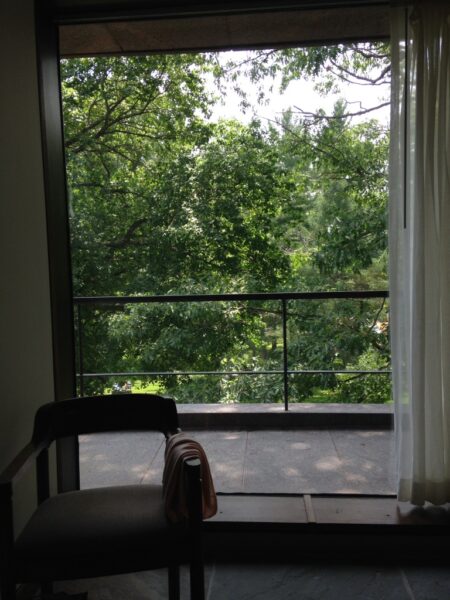
Office view from the Clark
Three more weeks at the Clark Institute of Art in Williamstown.
Since 2010, the Samuel H. Kress Foundation has funded an annual museum education summer fellowship at the Clark. Five other scholars in art history—all curators or professors—are also here this summer as part of the Clark’s fellowship program. We get a private office with a view of trees, a few hours a week of support from a research assistant, access to the Clark’s fabulous library, plus an apartment that is larger than my own in New York City.
But what we really get are hills, ponds, green—lots of green. Time for pause and concentration. This is quite rare, especially in museum education. We have all become masters of the art of mixing life and work, 24/7, or rather crowding life with work. It’s an endurance test.

In-gallery education at the Metropolitan Museum of Art, NYC; Photo credit: Don Pollard
My focus here? To kick-start the formal planning year of what will hopefully become a major, national research study. This collaborative project has been taking shape since 2010 as an initiative of the Museum Education Division of the National Art Education Association (NAEA), which I direct until my term ends in 2015; the Association of Art Museum Directors (AAMD) recently joined us as partners. Four years ago, a group of museum educators decided to do something about a startling fact: that in spite of all of those field trips that happen every day at art museums nationwide, in spite of evaluation studies of specific programs at different institutions, we as a field don’t have any rigorous, broadly generalizable information about how people benefit from art museum experiences. And yet we in this community of the art world and museum education believe that young people should have the chance to physically go to art museums, spend time with great art as part of their school day, create or make sense of these works of art on their own terms, and also enjoy these experiences with their friends and families, outside of school. We also believe that while these experiences might be beneficial because they somehow improve test scores or help school retention, they are actually valuable because of deeper, more complex, more important, and more human reasons. But we have little to prove this. This disconnect between what we believe, what we do, and what we actually know makes us weak in the eyes of funders, school administrators, and government officials, especially in today’s evidence-based educational environment. It also means that, without a strong research basis, our own practice as educators suffers.

In-gallery education at the Metropolitan Museum of Art, NYC; Photo credit: Filip Wolak
This led us to develop a research framework and conduct some initial focus groups with educators. Now, with funds from the Samuel H. Kress Foundation, we are staring to work with a research firm to design a study that will address this question: What are the benefits to K-12 students of object-based experiences in art museums with original works of art as part of their regular school day?
Answering the question is quite difficult. We have to first devise criteria for a type of field trip that happens often enough at big and small art museums across the country, in rural and urban communities, and that is based on some understanding in the field about what constitutes good practice. We also have to define the grade range (elementary? high school?) and clarify our hypothesis about how students may benefit from these experiences, including social, affective, cognitive and creative dimensions. Finally, we have to establish criteria for selecting the museum sites and school districts where the study will take place and begin to develop the methodology of the study. And we have to fundraise for the study. To inform our thinking and contextualize the project, we are conducting a literature review that includes studies on field trips in general, impact studies about visual arts experiences, and texts on interpretive theory and museum education. And that is all before the study can begin.

High School interns, The Metropolitan Museum of Art. Photo Credit: Elvia Flores-Galdamez.
Over the last few weeks, I have spent a good part of my time wrapping up the process of selecting our research partners as well as shaping the literature review–establishing a framework for what to include, identifying key texts and other relevant documents, and also reading and building an annotated bibliography. This work will continue over the next three week as I also begin planning in earnest with our research team.
This fellowship experience is far from a vacation. The truth is I am working just as hard, balancing Met upkeep hours and NAEA-AAMD research, plus a handful hours toggled between reviewing grant proposals for a foundation and securing contractors or talking to a real estate agent about property still owned, soon to be sold, in Chicago.
What is radically different is the outlook, the change of pace and place. Sometimes quiet, green, and alone is what one needs.
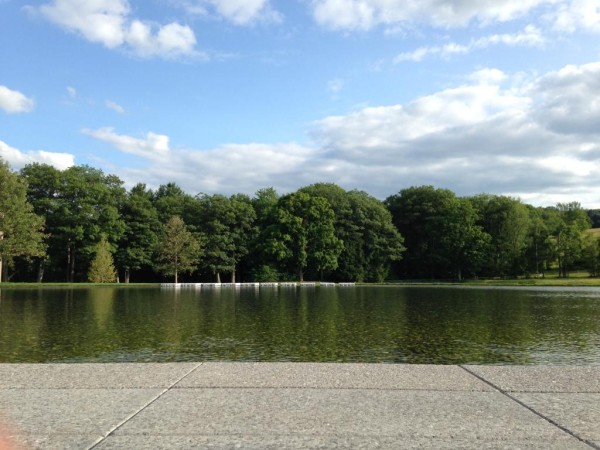
Clark ponds; Photo Credit: Jackie Terrassa
—-
 Jackie Terrassa is the Managing Museum Educator for Gallery and Studio Programs at The Metropolitan Museum of Art and, until 2015, directs the Museum Education Division of the National Art Education Association. This summer she is the Kress Summer Fellow in Museum Education at the Clark Institute of Art. At the Met she leads a range of public programs that engage people of all ages and backgrounds with original works of art and that may also involve artists and art-making. She cut her teeth in art administration and programming at the Hyde Park Art center; after which she worked in various roles at the David and Alfred Smart Museum of Art, University of Chicago; served as Head of Planning at the Freer Gallery of Art and Arthur M. Sackler Gallery, Smithsonian Institution; and led public programs at the Museum of Contemporary Art, Chicago. She has written and presented on art and art education, taught museum education, and served on advisory groups and panels, including those of the National Endowment for the Arts, the Illinois Arts Council, the Terra Foundation for the Arts, and the Joyce Foundation.
Episode 465: Nonsense with Jeff Stark
July 28, 2014 · Print This Article

Audio clip: Adobe Flash Player (version 9 or above) is required to play this audio clip. Download the latest version here. You also need to have JavaScript enabled in your browser.
download

This week: Duncan, Richard and Amanda talk Nonsense with Jeff Stark!
What is Nonsense NYC?
Nonsense NYC is a discriminating resource for independent art, weird events, strange happenings, unique parties, and senseless culture in New York City.
What does that mean?
We send out an email every Friday about unique events occurring the following week.
What kind of stuff?
Street events, loft parties, puppet shows, bike rallys, costume balls, interactive art shows, movies in unusual places, parades, outlaw dancing, guerilla theater, burlesque and variety shows, loser open mikes, cirkuses, and absurdist pranks. Nonsense covers the stuff that has no name, or a name that you feel really awkward and self-conscious saying out loud, like “underground.”
Sounds great, how do I sign up?
Um, I’d rather not give you my email address. Can I just read it online?
No. The only place you can read Nonsense NYC is your inbox. We like the intimacy of email, thank you, and this Web stuff is too much work. We promise not to sell your email address or give it away. We’re not going to spam you with useless information either.
OK, I’ve signed up, and I want to know more about Nonsense. Will you print my event?
We’d love to hear about all of your events. The important thing to remember is that Nonsense NYC happens because of you. That means we rely on you to let us know what events you’re organizing and what events you’re attending. Please keep us up to date and don’t assume that we’ll find out about it from someone else. Our job is to gather, edit, organize, and filter; your job is to make interesting things happen and let us know about them. Remember to include all the important information, like the address and stuff, and a brief description. When you put it all together, send it to [email protected]. Please send a text-only email; flash graphics, links to online fliers, and facebook announcements make our life more difficult. You can find a guide to better email communication here.
Also, Nonsense does not list events that cost more than $25 at the door, without door code, RSVPs, or special arrangement. We make some exceptions for obvious extra expenses, like boat rentals. To those of you promoting events: We’re sorry. We know it’s hard. We know it’s risky. We know it’s expensive. But nonsense has always skewed toward cheaper events; our readers expect it.
But one time I sent you something about my band/my movie/my party/my opening and you didn’t print it. What gives? How do you decide what events will be on Nonsense NYC?
To start with, almost all the stuff we list is independent. Also, we like rock bands and experimental musicians and arty films and galleries and museums and big street festivals, but we can find information about all of those things in other places. We generally will not list them.
We use something called the rule of three. That means that we will generally list your event if there are three different things going on: DJs, bands, dancers, costumes, fire performance, theater, film, art, projections, fashion, an unusual space, or several other intangibles. Your event doesn’t have to include all of these in order to be listed, and it certainly doesn’t need all this at once. If you’re in doubt, send it to us anyway — we’re decent editors.
The list is huge sometimes. Where do you find all this stuff? Do you write all of it yourself?
We don’t really write so much as edit announcements from other people. The bulk of each weekly list is culled from other lists and Web calendars. We monitor a couple dozen of them. You can find a partial listing on the Links page.
So, do you go to all of the events that you list on Nonsense?
Not even. We can’t afford it. We go out a couple of times a week, and we generally write a small editorial note if we have an opinion to share. You can find those comments in each post. They’re all marked like this: NOTE.
How can I tell the good events from the bad ones? Will I have fun at all the events?
No, you won’t always have fun. And please don’t assume that merely listing this stuff is some sort of implicit endorsement. A lot of these events are strictly amateur hour. We love amateur hour. But the problem with some amateurs is that they’re just amateurs. It’s hard to distinguish the good stuff from the bad. Some of it, no doubt, will make you wish you’d sat on the couch eating microwave nachos. If you want a safe bet, go to the movies.
That said, if you start going to a lot of the events listed here you’ll start to recognize some of the names of performers, promoters, venues, and so forth.
Let us know if you have a great time at an event. Hell, let us know if you feel like you got scammed out of $5. Send us a sentence or two about the events you’ve attended — especially if you went to something that is ongoing — and we’ll run them in the future. You don’t have to be a professional writer or do anything fancy. Just tell us what you would tell your friends over a late breakfast. Your fellow subscribers will appreciate it.
Why does the new Nonsense come out so late? Can’t you get it out earlier?
No, we can’t. It takes a long time to put this thing together. We have real jobs, and real lives. Both prohibit us from compiling the list earlier in the week. We try to run events for the following Thursday so you can have a heads up, but a lot of the people who do the kind of events that we list don’t always have their shit together.
We print stuff that’s happening on the day we post because sometime the show will happen a few more times throughout the weekend. Sometimes there will be a contact listed and you can use it to reach people and make sure that you don’t miss their events in the future. If you check your email before you go out you’ll still have time to make a snap decision.
What’s with the “we?”
We don’t know. We got used to writing like this several years ago and we kind of like it. It has a lot of antecedents, including the unsigned Talk of the Town section in the old New Yorker. We’d like to think that it alludes to that sort of liveliness and sparkling wit. You may disagree. We will cherish our delusions.
Conceptually, we thought that Nonsense NYC would be sort of a group effort, with its subscribers kicking down a lot of the weekly copy. It didn’t really turn out that way, but we still like to hold on to the thought that Nonsense is put together by its community. In a way, it is: It would be a mighty boring list if there were no events to compile, and the people who make these events happen are the kind of people who receive it.
So who exactly is “we,” and why are you doing this?
Nonsense NYC is compiled by Jeff Stark. Alita Edgar graciously puts together the Wishlist section. Jennifer Liepin edits the Help section. Juliana Driever is responsible for the Learning section. J. Sinopli is the person behind Spectre Priority. Neille Ilel did all the Web stuff.
Why are you doing this?
We believe that there is more to life in New York than getting drunk at slick new bars. We were frustrated when we moved here and couldn’t find a reliable source of alternatives, even though we knew that there were creative people making cool shit happen. Almost more annoying was the fact that certain groups we knew about weren’t always aware of one another.
Our solution was to start a weekly list. We did this in September 2000. Our goals are to help make New York a more interesting place to live, to encourage others to do the same, and to have more fun than just about anyone else. We’re particularly drawn to participatory culture, amateurism, and urban folk art. To us, that means that things are more rewarding when you invest yourself in them, and that you are responsible for entertaining yourself and your friends.
We admire the handmade, the recycled. And we’re generally suspicious of commercial entertainment. That doesn’t mean we reflexively hate television or going to the movies. It’s just that we genuinely believe that everyone has something to contribute, and that life is much richer when people stop treating each other like walking wallets.
Wow, this all sounds so lofty. Are these your ideas?
Not even. We’re stealing ideas from a half dozen places and using the bits that suit us. In particular, we are indebted to Fluxus games, the Cacophony Society, the Suicide Club, the Situationists, American punk rock in the 1980s, the Do-It-Yourself ethic of the early 1990s, the Madagascar Institute, Dark Passage, and the yearly Burning Man festival in Nevada.
We do think that we are witnessing a special synthesis of these ideas in New York right now — this very minute — and that in a few years we will recognize it as a golden age.
OK. So how do you make money off of this?
That’s not really the point. However Nonsense now accepts donations. The newsletter remains free, but there are real costs that we absorb in its creation. We would love for you to donate money to help offset webhosting, software, and computer expenses. The labor remains free.
We aren’t asking for much; a yearly subscription would be a tremendous help. Please consider $5 for the year if you use the list to figure out what to do on a Saturday night, or if you just like to keep track of what’s going on in New York.
Go ahead and donate $20 if you promote events that we list on Nonsense. You know it’s worth it. And we would be grateful for more money if you really like what we do.
To be clear, these are donations: You are not paying for a service, but rather confirming that what we do is valuable and agreeing that independent artists should support other independent artists. If you’ve ever paid for a ticket to see your friend’s band you know exactly what we mean.
But I want to complain about something. Who can I yell at?
You’re getting this ostensibly for free; you’re not allowed to complain. If you have to yell at someone, try a taxi driver: They’re used to it.
I’m not getting the list. What’s up?
We don’t know. First, you should check your spam folder. Several of the major email providers sometimes think Nonsense is spam; first Yahoo and Hotmail, and eventually AOL and even Gmail blocked some newsletters. We use Dada Mail and Tiger Tech and are always trying to fix this problem.
If you don’t find Nonsense in your spam folder there are a couple of things that you can do. You can approve messages from us or put us in your address book or on your whitelist. You can sign up with another email account. And if that doesn’t work you can use your password to access our archives online.
This should be pretty obvious, but please do not flag our messages as spam for any reason. If you want to unsubscribe, please take a minute and follow the link at the bottom of every list or send us an email. Finally, it helps our case if you send an email to your provider to complain that Nonsense is being marked as spam or held.
I forgot what I was going to say, but I’ll probably remember my question later.
email us anytime.
Jim Barry, RIP
July 28, 2014 · Print This Article

Sad news for all of us who knew him.
From Philip von Zweck…
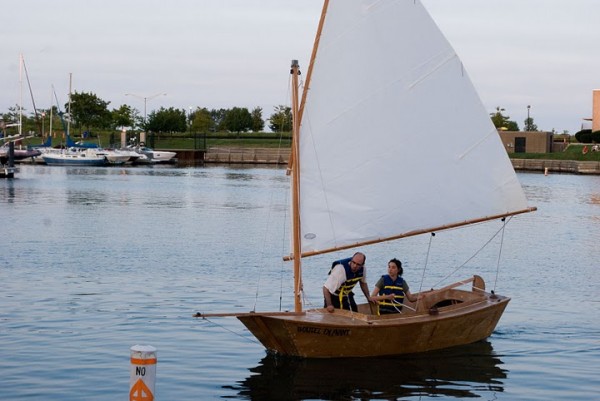
Jim Barry’s last Facebook post was on July 10. The part in English simply said “Tonight I’m missing cowboys and SAIC… (the good parts).”
Jim suffered a heart attack while waiting for a bus to work on July 27 in Taiwan, where he’d lived for four years with his wife Zen “Mimi” Lulu; they’d been married just under a year.
Jim completed a BA in English in Seattle University in 1995 He then relocated to Chicago to pursue a BFA and then an MFA from School of the Art Institute Chicago. While in graduate school he was so broke that, against policy, he secretly lived in his SAIC-provided studio. He befriended the security staff, learning their routines so he could hide his sleeping mat and hot plate in the storage cabinet when they came through for inspection.
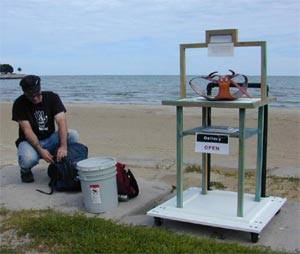
As an artist, Jim was interested in wonder and discovery and in demystifying art itself. He may best be known for his Two Foot Square art gallery, which he set up in parks and other public spaces to engage the casual passersby in a discussion about art. He was also known for his long-running project with Hui-min Tsen, The Mount Baldy Expedition. Inspired by historic voyages during the Age of Discovery, they built a boat to sail from Chicago to the Mt. Baldy sand dune in Indiana.
To make a living, Jim did what many young artists do: he was a preparator and mount builder. He worked at the Smart Museum of Art and in other exhibition spaces before site-managing SAIC’s G2 (later Sullivan Galleries). He later became the galleries’ Exhibition Manger. It may be in this work that Jim’s greatest legacy lies, for somewhere in his job description was the one word that kept him coming back, despite the stressful work, low pay and occasional verbal abuse by a sleep-deprived students with no concept of how to install a video projector; and that word was mentor.
Jim was a recognizable figure on State Street, where he took his breaks in his Sox cap, horn rimmed safety glasses, Carhartt shorts, tucked-in, oversized t-shirt and work boots, chain-smoking Reds and elegantly balancing his cup of coffee on top of his thermos.
He loved baseball, Iggy Pop, the Cramps, cooking and the work of Tehching Hsieh. He often tried to get me to accompany him to tango lessons: the man loved to tango. He also loved to regale anyone who would listen with tales of the chaos caused by the Monkey King from the classic Chinese novel The Journey to the West. To the chagrin of the administration, Jim made the Monkey King the unofficial mascot of Sullivan Gallery.
Most nights after work Jim would say, “Let’s get a quick one,” which we both know would be neither quick nor just one. Over whiskey at the Exchequer, George’s, or the L&L, where Jim had been a regular for years, talk would inevitably turn to our student workers: “the crew,” then “the kids” and by the end of the night, “my kids.”
He loved his “kids” and taught them all he could—not just about hanging art, but also about being an artist and a stand-up person in the world. Jim assembled not a team of student workers, but a family. Through his work he impacted the lives of countless SAIC students, the crew and every student who exhibited in the gallery, which means pretty much every graduating student. Jim missed the good parts of SAIC, and for many of us, he was certainly one of them.
Jim is survived by his wife Ye Mimi, his mother, the cowboys, SAIC, countless friends around the globe, and of course by his “kids.”
Philip von Zweck
What You Should Have Noticed in July
July 25, 2014 · Print This Article

Good god damn, summer in Chicago! The storms, the ‘fests, the beautiful bodies, the fruit flies, and most of all the regular monthly blog posts. This year’s most tolerable season in Chicago has brought with it plenty of new beginnings and other moves: artists, having used up their two year grace period after grad school, are making their destined migrations to one coast or another; galleries are closing, opening, and relocating; and rents are increasing everywhere. Together, you and I will track these changes, along with all what other what there is in What You Should Have Noticed in July.
At Julius Caesar, Torches Pass to New Management
Shakeup at the independent gallery Julius Caesar as local artist and professor Dana DeGiulio has officially left her position as the gallery’s co-operator. I suppose she’s still co-founder, along with the other originals: Diego Leclery, Colby Shaft, Hans Peter Sundquist, and Molly Zuckerman-Hartung. Chris Naka is also leaving the gallery’s directorial board. According to the exit letter posted by DeGiulio on July 20th, management of Julius Caesar will pass to Maddie Reyna and Levi Budd, both recent MFA graduates from the School of the Art Institute of Chicago. May the new blood take.
Other shuffles were written up by Jason Foumberg for an article at NewCity: Jessica Cochran is leaving the Center for Book & Paper Arts for the private sector, Jamilee Polson Lacy is saying goodbye for a sweet gig at the Providence College Galleries in Rhode Island, Joel Keunnen is leaving ArtSlant Chicago for ArtSlant New York City, and Cortney Lederer is leaving Chicago Artist Coalition for her own venture, CNL Art Consulting; you can check the article for the rest and more. More bad news too – Edie Fake is leaving for Los Angeles! And Sofia Leiby for somewhere else! And Kate Ruggeri for Yale! Madeleine Bailey is out too! Julia Hendrickson is already in Austin! This happens every year!
Blackest Black
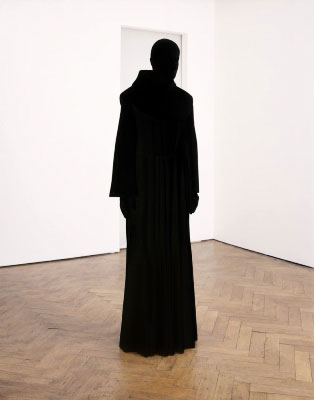
In darker news, scientists at Surrey Nanosystems made headlines this month by revealing their latest product: Vantablack, or nanotube black, a coating of vertically aligned carbon nanotubes capable of absorbing more than 99.85% of light, thereby creating the blacking black to ever black. While artistic applications are still forthcoming, you might imagine a cross between a Katharina Fritsch and those monsters from Attack the Block: a sculpture as shifting silhouette, flattened into two dimensions by the absence of interior lights and shadows, like a black hole in illuminated space.
Genesis Art Supply Moving
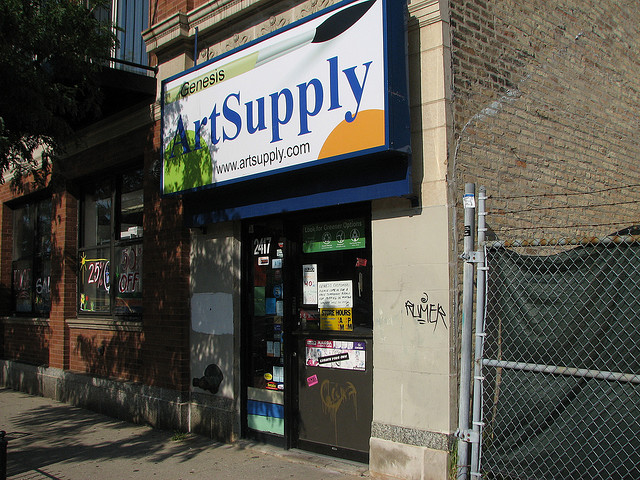
In lighter news, the family owned retailer Genesis Art Supply, beloved to Logan Square and the blue line neighborhoods, will be moving from its endearingly crowded space at Western and Fullerton to new and bigger digs on Elston, near the Riverfront Plaza – you know, by the big Target! Set for an October ribbon cutting, the new space will provide later hours, more parking, and a brand switch to ArtSupply.com, owner Rich Goldman’s longtime online storefront (and where I purchased the very same desk where I am currently typing this article). The current location at 2517 N. Western Avenue is having deep cut sales, so be sure to go notice the hell out of it before the good stuff is gone.
Peanut Gallery Moving
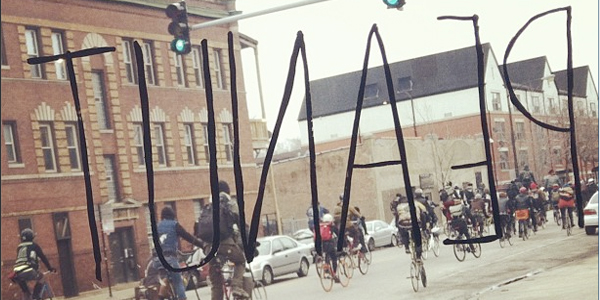
In darker news again, Peanut Gallery is leaving its convenient home beside the California Clipper in Humboldt Park, after being forced out by new development in the area. The funky studio collective / exhibition space, led by Charlie Megna and Kelly Reaves, will be replaced by a cozy pie and ice cream space, a generous move by landlord Gio Battaglia to satisfy the city’s need for more independently run, alternative venues for emerging dessert culture. While the gallery is seeking to relocate (perhaps to Logan Square? But that’s some T for some other article), the other victim of the same neighborhood vitality it basically created out of blight or at least obscurity, Knockbox Cafe, will be shuttered this fall forever.
Obituaries: On Kawara
This month we learned that Japanese artist and quiet pillar of Conceptual art, On Kawara, passed away in late June in New York City. Most famous for his meditative date paintings, produced in a maximum of one day on various days in the artist’s life, as well as for his earlier and perpetually haunting “I am still alive” telegrams, Kawara’s passing marks both the end of a life and the end of an art more intimately tied to life than most.

Chicago Cultural Center Unveils DCASE Residency
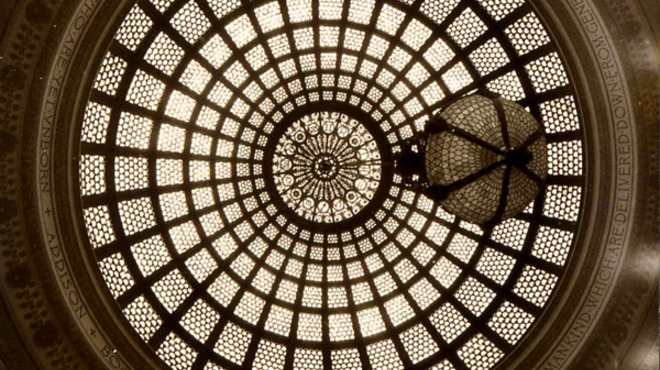
You know, because I publish this article on the last Friday of every month, I court the possibility of months like this one, where the article falls on the earliest possible Friday of the month, the 25th, meaning I’m really only sharing what you should have noticed in three and a half weeks. I worry that Saturday morning will have some big news – like maybe the opening of another Ed Paschke Art Center – and history will wonder why I’d left it out. Other times, like right now for example, I’m glad that I can reward the present and direct your noticing eyes to a subject before it is too late: the DCASE (Department of Cultural Affairs and Special Events) residency at the Chicago Cultural Center, also known as the Studio Artist and Curatorial Residency Program. The program looks fantastic, offering six residencies (either public or private) along with two curatorial fellowships to artists at all levels of their career. Both residencies come with the support of the Cultural Center (technical, promotional, and PR), a $2,000 / month stipend for three months, and more. While big news for the present – you still have six days left! – the residency is also perhaps the first really major investment in the city’s visual arts from DCASE, which formed in 2012 from the slaughtered slurry of the Chicago Office of Tourism and Culture. Cheers for the new program, and good luck to the applicants.
Theaster Gates’ Dorchester Artist Housing Open for Applications
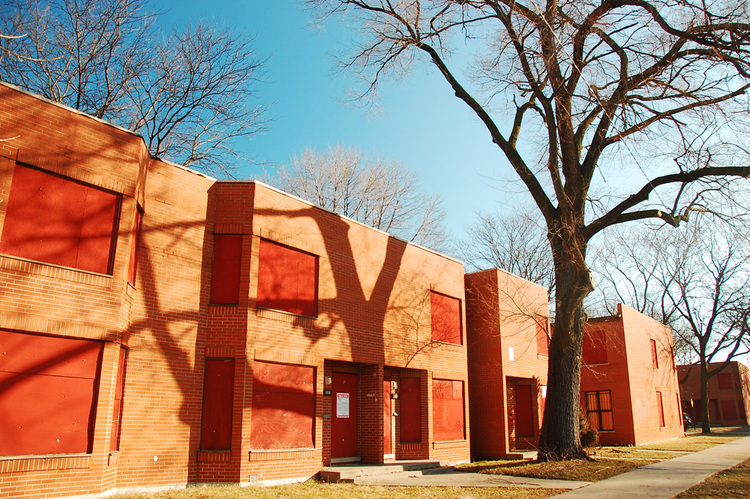
Are you an artist of some kind? Theaster Gates is looking for thirty two tenants at the Dorchester Art+Housing Collaborative, his new Grand Crossing artist’s housing and studio compound on Chicago’s south side. Check out details at Rebuild Foundation, or call (773) 324-2270.
 And that’s it! Other notable mentions include those weak ass white flags in Brooklyn (project whatever meaning you wish upon them), Jaume Plensa‘s new and pretty impressive addition to Chicago’s Millenium Park (which already features giant heads by Plensa in his Crowd Fountain sculpture), wars, and Rokudenashiko’s 3D-printed vagina scandal in Japan. Until next month, keep watching the skies!
Top 5 Weekend Picks! (7/25-7/27)
July 24, 2014 · Print This Article

1. Addendum at Chicago Artists Coalition

Curated by John Marks and David Petersen, with work by Luke Aleckson, Allen Brewer, Casey Deming, Kristina Estell, Katelyn Farstad, Isa Gagarin, Peter Happel Christian, Jess Hirsch, Jonathan Kaiser, Tynan Kerr, Andie Mazorol, Ben Moren, Michael Mott, Stefanie Motta, Scott Nedrelow, Natasha Pestich, Andy Sturdevant, and Pamela Valfer.
Chicago Artists Coalition is located at 217 N Carpenter St. Reception Friday, 6-9pm.
2. Bookish at Corbett vs. Dempsey

Work by Richard Artschwager, Sarah Canright, and Arturo Herrera.
Corbett vs. Dempsey is located at 1120 N. Ashland Ave. 3rd Fl. Reception Saturday, 3-6pm.
3. City Symphony in 16mm: A New Work for Expanded Cinema at Roman Susan

Work by Sam Hoolihan and John Marks.
Roman Susan is located at 1224 W. Loyola Ave. Screening Saturday, 10pm-12am.

Performance by Jessica Blinkhorn and Joseph Ravens.
DfbrL8r is located at 1136 N. Milwaukee Ave. Performance Friday, 8-10pm.

Curated by MK Meador, with work by Stacia Yeapanis and Jason Uriah White.
Design Cloud is locate at 118 N Peoria, Suite #2N. Reception Friday, 6-9pm.