Ogham (᚛ᚑᚌᚐᚋ᚜)
Ogham is an alphabet that appears on monumental inscriptions
dating from the 4th to the 6th century AD, and in manuscripts dating from the
6th to the 9th century. It was used mainly to write Primitive and Old
Irish, and also to write Old Welsh, Pictish and Latin.
It was inscribed on stone monuments throughout Ireland,
particuarly Kerry, Cork and Waterford, and in England,
Scotland, the Isle of Man and Wales, particularly in
Pembrokeshire in south Wales.
The name Ogham is pronounced [ˈoːm] or [ˈoːəm]
in Modern Irish, and it was spelt ogam and pronounced
[ˈɔɣam] in Old Irish. Its origins are
uncertain: it might be named after the Irish god Ogma, or
after the Irish phrase og-úaim (point-seam), which
refers to the seam made by the point of a sharp weapon.
Ogham is also known as or ogham craobh (tree ogham)
beth luis fearn or beth luis nion, after
the first few letters.
Ogham probably pre-dates the earliest inscriptions -
some scholars believe it dates back to the 1st century AD - as the
language used shows pre-4th century elements. It is thought to
have been modelled on or inspired by the Roman, Greek or Runic
scripts. It was designed to write Primitive Irish and was possibly
intended as a secret form of communication.
While all surviving Ogham inscriptions are on stone, it was
probably more commonly inscribed on sticks, stakes and trees.
Inscriptions are mostly people's names and were probably used
to mark ownership, territories and graves. Some inscriptions in primitive
Irish and Pictish have not been deciphered, there are also a number
of bilingual inscriptions in Ogham and Latin, and Ogham and Old Norse
written with the Runic alphabet.
Notable features
- Type of writing system: alphabet
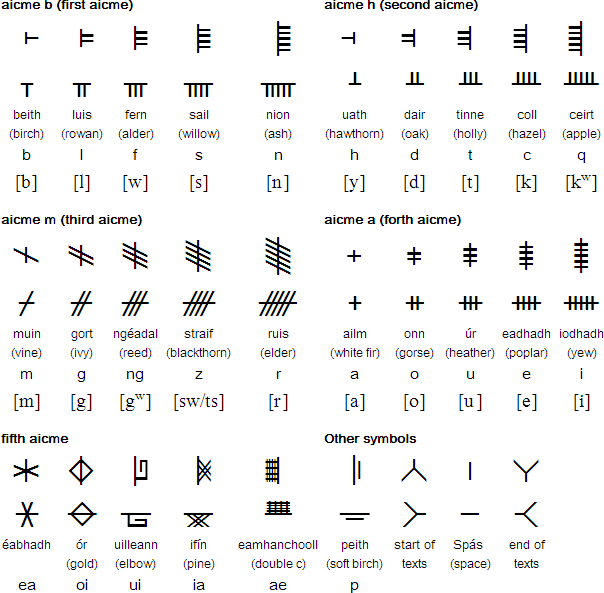
- Number of letters: 25, which are grouped into five aicmí
(sing. aicme = group, class). Each aicme is named after its
first letter. Originally Ogham consisted of 20 letters or four aicmí;
the fifth acime, or Forfeda, was added for use in manuscripts.
- Writing surfaces: rocks, wood, manuscripts
- Direction of writing: inscribed around the edges of rocks running from
bottom to top and left to right, or left to right and horizontally in manuscripts.
- Letters are linked together by a solid line.
- Used to write: Primitive and Old Irish, Pictish, Old Welsh and Latin
The Ogham alphabet
The letters are shown in their vertical and horizontal variants.
The pronunciation is for Primitive Irish, the language used in the
majority of Ogham inscriptions. The names and sounds represented by
the letters uath and straif are uncertain.
There are many different version of the letter names - the standard ones
are used here [with the Primitive Irish ones, where known, in bracketts]
- others can be found at: evertype.com.
Downloads
Download the Ogham alphabet chart (Excel)
Sample texts in Ogham
Texts in Primitive Irish

Transliteration
LIE LUGNAEDON MACCI MENUEH
Translation
The stone of Lugnaedon son of Limenueh
From: Inchagoill Island, County Galway, Ireland
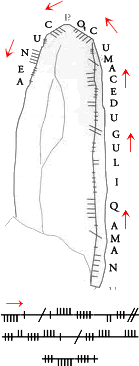
Ogham stone form Mount Melleray in County Waterford in Ireland.
Transliteration
Na Maqi Lugudeca Muc Cunea
Translation
The Sons of Lugudeca, Son of Cunea
Source: http://www.prehistoricwaterford.com/news/the-stones/
An Old Irish Joke in Primtive Irish (translation by David Stifter)
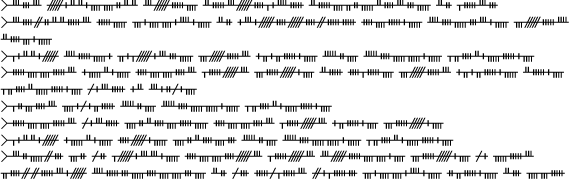
Transliteration
Tengwās īwerijonākā
Tut raddassodd trīs dītrebākī dīslondetun do bitū.
Tēgoddit in wāssākan do atareregiyī esyan kenutan writ dēwan.
Bāddar kina labarātun writ alaliyan qos qennan blēdaniyās.
Issit andan esset bīrt wiras dī ēbis writ alaliyan diyas blēdniyas: “mati ad tāyomas.”
Bowet samali qos qennan blēdaniyās.
“Issit mati sodesin,” esset bīrt aliyas uiras.
Bāddar andan ēran sodesū qos qennan blēdaniyās.
“Tongū wo mō brattan,” esset bīrt trissas uiras, “ma nīt lēggītar kiyunessus do mū, imbit gabiyū wāssākan oliyan dū swi.”
Old Irish (Sengoídelc) version
Tríar manach do·rat díultad dont ṡaegul.
Tíagait i fásach do aithrigi a peccad fri día.
Bátar cen labrad fri araile co cenn blíadnae.
Is and as·bert fer diib fri araile dia blíadnae, “Maith at·taam,” olse.
Amein co cenn blíadnae.
“Is maith ón,” ol in indara fer.
Bátar and íar suidiu co cenn blíadnae.
“Toingim fom aibit,” ol in tres fer, “mani·léicthe ciúnas dom co n-imgéb in fásach uile dúib.”
Modern Irish (Gaeilge) version (by Dennis King)
Triúr manach a thug diúltú don saol.
Téann siad ins an fhásach chun aithrí a dhéanamh ina gcuid peacaí roimh Dhia.
Bhí siad gan labhairt lena chéile go ceann bliana.
Ansin dúirt fear díobh le fear eile bliain amháin ina dhiaidh sin, “Táimid go maith,” ar seisean.
Mar sin go ceann bliana.
“Is maith go deimhin,” arsa an dara fear.
Bhí siad ann ina dhiaidh sin go ceann bliana.
“Dar m’aibíd,” arsa an treas fear, “mura ligeann sibh ciúnas dom fágfaidh mé an fásach uile daoibh!”
English version (by Dennis King)
Three holy men turned their back on the world.
They went into the wilderness to atone for their sins before God.
They did not speak to one another for a year.
At the end of the year, one of them spoke up and said, "We’re doing well."
Another year went by the same way.
"Yes we are," said the next man.
And so another year went by.
"I swear by my smock," said the third man, "if you two won’t be still I’m going to leave you here in the wilderness!
Source: http://www.smo.uhi.ac.uk/sengoidelc/donncha/tm/ilteangach/
Texts in Latin

Transliteration
Numus honoratur sine. Numo nullus amatur.
Translation
Money is honoured, without money nobody is loved
From: The Annals of Inisfallen of 1193
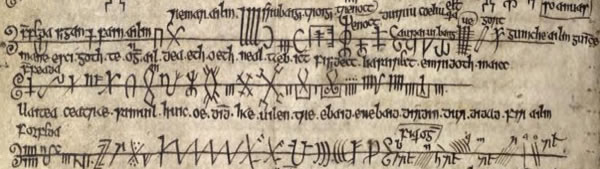
From: The Book of Ballymote (Leabhar Bhaile an Mhóta), written in 1390 or 1391.
Irish language |
Gaelic script |
Ogham alphabet |
Phrases |
Numbers |
Colours |
Family words |
Terms of endearment |
Time |
Weather |
Proverbs |
Comparison of Celtic languages |
Celtic cognates |
Tower of Babel |
Tongue twisters |
Songs |
Learning materials |
Books about Ogham |
Links
Links
Information about Ogham
http://en.wikipedia.org/wiki/Ogham
http://en.wikipedia.org/wiki/Ogham_inscriptions
http://en.wikipedia.org/wiki/Scholastic_ogham
http://www.evertype.com/standards/og/ogmharc.html
Ogham transliterator
http://nuacht1.com/ogham/
Free Ogham fonts
http://www.evertype.com/celtscript/ogfont.html
http://www.csupomona.edu/~jcclark/ogham
Photos of Ogham stones with transliterations of the inscriptions
http://titus.uni-frankfurt.de/ogam/ogsing.htm
Examples of Ogham inscriptions
http://en.wikipedia.org/wiki/Ogham_inscription
Details of the Book of Ballymote
http://en.wikipedia.org/wiki/Book_of_Ballymote
http://www.ria.ie/library/special-collections/manuscripts/book-of-ballymote.aspx
http://www.maryjones.us/ctexts/bb.html
http://staffweb.itsligo.ie/staff/jforan/Irish_project/Alt14/alt14a.htm
Translating Ancient Ogham - an introduction to linguistic archaeology in Ireland
http://www.celticgrounds.com/chapters/ogham_translat.htm
ALPHABETUM - a Unicode font
specifically designed for ancient scripts, including classical
& medieval Latin, ancient Greek, Etruscan, Oscan, Umbrian,
Faliscan, Messapic, Picene, Iberian, Celtiberian, Gothic, Runic,
Old & Middle English, Hebrew, Sanskrit, Old Nordic, Ogham,
Kharosthi, Glagolitic, Old Cyrillic, Phoenician, Avestan, Ugaritic,
Linear B, Anatolian scripts, Coptic, Cypriot, Brahmi, Old Persian cuneiform:
http://guindo.pntic.mec.es/~jmag0042/alphabet.html
Celtic languages
Breton,
Cornish,
Irish,
Manx,
Scottish Gaelic,
Welsh
- Adlam,
- Armenian,
- Avestan,
- Avoiuli,
- Bassa (Vah),
- Beitha Kukju,
- Borama / Gadabuursi,
- Carian,
- Carpathian Basin Rovas,
- Chinuk pipa,
- Coorgi-Cox,
- Coptic,
- Cyrillic,
- Dalecarlian runes,
- Deseret,
- Elbasan,
- Etruscan,
- Faliscan,
- Galik,
- Georgian (Asomtavruli),
- Georgian (Nuskhuri),
- Georgian (Mkhedruli),
- Glagolitic,
- Gothic,
- Greek,
- Irish (Uncial),
- Kaddare,
- Khatt-i-Badí’,
- Khazarian Rovas,
- Korean,
- Latin,
- Lepontic,
- Luo Lakeside Script,
- Lycian,
- Lydian,
- Manchu,
- Mandaic,
- Mandombe,
- Marsiliana,
- Messapic,
- Mongolian,
- Mro,
- Naguaké Taíno Pictographic Alphabet,
- N'Ko,
- North Picene,
- Ogham,
- Old Church Slavonic,
- Oirat Clear Script,
- Old Italic,
- Old Nubian,
- Old Permic,
- Orkhon,
- Oscan,
- Phrygian,
- Pollard script,
- Runic,
- Santali,
- Székely-Hungarian Rovás (Hungarian Runes),
- Somali (Osmanya),
- South Picene,
- Sutton SignWriting,
- Tai Lue,
- Thaana,
- Todhri,
- Umbrian,
- Uyghur,
- Zaghawa
Other writing systems
If you like this site and find it useful, you can support it by making a donation, or by contributing in other ways. Omniglot is how I make my living.


