Gothic is an extinct East Germanic language that was spoken in parts
of the Crimea until the 17th century. It was originally written with a
runic alphabet about which little is known.
One theory of the origins of Runes is that they were invented by the Goths,
but this is impossible to prove as very few inscriptions of writing in
Gothic runes survive.
The Gothic alphabet was invented around middle the 4th century AD by
Bishop Wulfila (311-383 AD), the religious leader of the Visigoths,
to provide his people with a written language and a means of reading
his translation of the Bible. It is based on the Greek
alphabet, with some extra letters from the Latin
and Runic alphabets.
The Goths were divided into two main tribes: the Ostrogothi
or Greutungi (dune-dwellers) and the Visigothi or
Tervingi (steppe-dwellers). Related tribes included the
Burgundians and the Vandals.
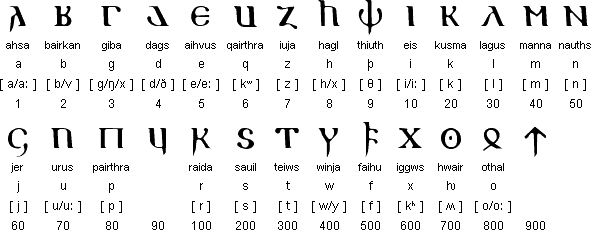
Gothic alphabet
There are no separate numerals, but each letter has a numeric value.
Downloads
Download a Gothic alphabet chart in Excel,
Word
or PDF format
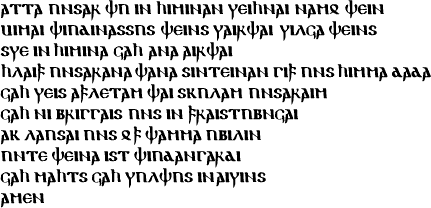
Sample text in Gothic (The Lord's Prayer)
Transliteration
Atta unsar þu in himinam
weihnai namo þein
qimai þiudinassus þeins
wairþai wilja þeins
swe in himina jah ana airþai.
hlaif unsarana þana sinteinan gif uns himma daga
jah aflet uns þatei skulans sijaima
swaswe jah weis afletam þaim skulam unsaraim
jah ni briggais uns in fraistubnjai
ak lausei uns af þamma ubilin
unte þeina ist þiudangardi jah mahts
jah wulþus in aiwins.
Translation
Father our, thou in heaven
be holy name thy.
Come kingdom thy,
happen will thy,
as in heaven also on earth.
Bread (loaf) our, the everyday, give us this day,
and forgive us, who debtors be,
just as also we forgive those debtors our.
And [do] not bring us in[to] temptation,
but free (loose) us from the evil [one].
For thine is [the] kingdom and [the] might
and glory in eternity.
IPA transcription
ˈatːa ˈunsar θuː in ˈhiminam
ˈwiːhnɛː ˈnamoː θiːn
ˈkʷimɛː ˈθiu̯ðinasːus θiːns
ˈwɛrθɛː ˈwilja θiːns
sweː in ˈhimina jah ana ˈɛrθɛː
hlɛːɸ ˈunsarana ˈθana ˈsinˌtiːnan ɡiɸ uns ˈhimːa ˈdaɣa
Note: the pronunciation of Gothic has been reconstructed but there is
some debate about how certain sounds are pronounced.
Translation
All human beings are born free and equal in dignity and rights. They
are endowed with reason and conscience and should act towards one another
in a spirit of brotherhood. (Article 1 of the Universal Declaration of Human Rights)
ALPHABETUM - a Unicode font
specifically designed for ancient scripts, including classical
& medieval Latin, ancient Greek, Etruscan, Oscan, Umbrian,
Faliscan, Messapic, Picene, Iberian, Celtiberian, Gothic, Runic,
Old & Middle English, Hebrew, Sanskrit, Old Nordic, Ogham,
Kharosthi, Glagolitic, Old Cyrillic, Phoenician, Avestan, Ugaritic,
Linear B, Anatolian scripts, Coptic, Cypriot, Brahmi, Old Persian cuneiform:
http://guindo.pntic.mec.es/~jmag0042/alphabet.html
If you need to type in many different languages, the Q International Keyboard can help. It enables you to type almost any language that uses the Latin, Cyrillic or Greek alphabets, and is free.