


On December 6th, 2012, Israeli program Kolbotek aired one of the most comprehensive investigative reports to have ever been conducted on the subject of animal products in Israel. The report uncovered the abuse inflicted upon animals at the largest slaughterhouse in the country, the Adom Adom (Red Red) slaughterhouse in Beit-Shean.
Through a co-operation between the Kolbotek crew and an Anonymous activist, the exposé depicted calves and lambs being led to slaughter by using extensive violence through beating, use of electric shockers and dragging by the animals' hind legs and other body parts, at times with a forklift.
The exposé led to an unprecedented amount of reactions from the media, the authorities and the consumers. A week after the broadcast, we present some of the most noticeable reactions to the exposé.
In an interview conducted by the host of the program, Raffi Ginat, claimed Tnuva CEO, Erez Wolf, that the incident was an irregular, one-time occurrence. Wolf claimed that the issue would be resolved with firing of the employees involved and tightening the slaughterhouse's regulations. In addition, Wolf uploaded a video on Tnuva's YouTube channel, in which he makes similar claims. However, these claims raised much criticism. The critics insisted that blaming junior slaughterhouse employees for the incident was a rejection of responsibility on the part of the company's management.
Numerous articles mentioned that this had not been the first time for Tnuva to be caught red-handed. Only a year ago, Anonymous activists documented the unloading of calves brought by shipments from Australia to the Adom-Adom slaughterhouse. In this case, too, similar use of violence was exposed, including beatings and use of electric shockers for the purpose of hasting the descent of the calves from the transportation trucks. In that case as well, the Tnuva management claimed that it had been a one-time occurrence, firing junior employees and refusing to acknowledge that the issue stems from company policy.
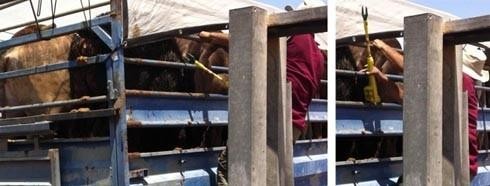
From our previous investigation August 2011, which focused on the calves being shipped from Australia by sea. In that case too we documented cases where calves were hit by rods and electric shockers, and then too Tnuva claimed it was a one-off occasion.
 Ronen Bar, the Anonymous activist who conducted the investigation, said in an interview for the Malaria daily newspaper that most animal abuse at the slaughterhouse is not the result of abnormal employee behavior, but an integral part of the slaughterhouse activities (12.12.2012). "Once you're there, you realize it's all part of the system. No sheep goes happily to slaughter, and where there's wholesale killing of animals, there will be violence. Furthermore, the place's infrastructure is entirely faulty. Instead of a walkway to the actual slaughter, there is simply a large enclosure, and that's why the animals must be dragged inside." (Ronen Bar)
Likewise, Itzik Bader, Chairman of Granot Corporation, co-owners of Tnuva, admitted in an interview for Yediot Ahronot that a certain amount of violence is inevitable (10.12.2012). "One should remember that it's not a stork that puts the steak on your plate. All the meat we consume comes from slaughter. It's never pleasant, and at the slaughterhouse there is a fine line between reasonable and unreasonable conduct. However, the fact that the animal is meant for slaughter does not justify any abuse."
In an op-ed published in a local portal, Anonymous activist Deddy Shy emphasized that animal abuse is first and foremost a result of economic considerations: "All the industries based on animal products entail abuse. Does a chicken cooped up all its life in a cage so small it can hardly move or stretch its wings suffer less than a calf electrocuted by its testicles? I imagine that's even worse abuse. The reason that animal abuse can be uncovered in any animal-based product industry is simple: Making sure every animal is treated with consideration and respect requires an investment of time, attention and resources. When the cost of food and medicine fed to the animal surpassed the value of the animal itself, not bothering with proper treatment became a cheap solution – and the animal product industry is a commercial enterprise. As such, it operates accordingly with what is cheap and profitable, and not with what is moral." ("Tnuva is not alone", 10.12.2012)
Following the airing of the investigation, the Minister of Environmental Protection Gilad Erdan called for a criminal investigation against the Tnuva slaughterhouse. On 12.12.2012 police officers and inspectors of both the Environmental Protection Ministry and the Ministry of Agriculture raided the premises and confiscated instruments used for animal abuse, including ropes, electrical shockers and sticks.
A simultaneous investigation was initiated by the Australian authorities. This was due to a recently approved Australian law, following campaigns by animal rights organizations, which allows legal prosecution against animal exporters on counts of animal abuse, even if it was conducted outside of Australia. The law passed after the uncovering of a series of abuse incidents of animals exported from Australia, including one depicted in last year's Anonymous investigation. The law has already led to a temporary suspension of livestock exports from Australia to Indonesia, and as a result of the Tnuva exposé, might have consequences on exports to Israel as well.
The investigation in Israel rapidly gained exposure in Australia, through a report on ABC News on 11.12.2012. The report presented images from the Kolbotek program as well as an interview with Ronen Bar. Following the exposure in the Australian press, Australian animal rights organizations demanded an investigation in accordance with the new legislation.
Following the exposé, Anonymous and Let the Animals Live filed a plea to the High Court of Justice to order the closing of the Tnuva slaughterhouse. In addition, resident of Petach-Tikva Ruth Kollian has filed a representative action against Tnuva, accusing the company of consumer deception on account of concealing animal abuse from the public. In an interview for daily newspaper Ma'ariv, Kollian explained: "I have been purchasing meat from this company for three years, and feel like everything I've eaten so far was not kosher. The deception was manifested in Tnuva's hiding animal abuse from its consumers, and acting in opposition to the Animal Protection Act and to Animal Disease regulations. This puts a big question mark over the kashrut certification I have so far counted on." (Ari Gelber and Adi Khashmonai, 10.12.2012)

Apart from Tnuva's wrongdoing, the exposé has also shed light on the oversight by the Ministry of Agriculture, which is supposedly responsible for the implementation of the Animal Protection Act. In an article in web portal TheMarker, a senior member of the Ministry of Agriculture admitted to the inherent conflict of interest engrained in the Ministry's control of the Act: "The Ministry of Agriculture supports farmers, and thus does not impose on Tnuva a high cost on the subject of animal welfare. Adom Adom is the largest meat factory in the country, and thus has an effect on meat prices. It doesn't make that much revenue as it is, so we don't want to burden it with higher costs by looking into the issue of animal welfare." (Adi Dovrat-Mazritz and Hila Raz, 10.12.2012)
On his Facebook page, Minister of Environmental Protection Gilad Erdan has criticized the Ministry of Agriculture's conduct and expressed his support of the recently-proposed law which requires the transfer of the enforcement authorities of the Animal Protection Act from the Ministry of Agriculture to the Environmental Protection Ministry.
An article in daily newspaper Yediot Ahronot reported that the veterinarians from the Ministry of Agriculture in charge of supervising the slaughterhouse will face disciplinary charges and have their future employment at the company reassessed.
A report by Avi Amit aired on TV Channel 10 on 12.12.2012, reminded that in the animal product industry, animal abuse occurs not only during slaughter but in all stages of production and of the animals' lives. The report referred to common abuse tactics in the industry, such as removing of tails and teeth without anesthetics in the pork industry, or death by electrocution of chickens whose egg laying rates have declined. The report presents criticism of the Ministry of Agriculture's inadequate conduct, and Amit interviews the person in charge of the Animal Protection Act, Dganit Ben-Dov, who claims: "the interest of the Ministry of Agriculture is to balance between issues of animal welfare, issues of the state of agriculture in Israel and issues of consumers' satisfaction." In response as to why, 18 years since the passing of the law, no regulations have been established for minimizing animal suffering in various domains, as was required, she replies: "I think there are many issues that are no less important. We take care of each issue at a time and there is a certain pace in which we can progress."
The media attention directed at the issue of animal abuse also started a discussion about the consumers' responsibility in the matter. For instance, Aviv Lavi, Mako's Environment correspondent, wrote the following in his column: "You wouldn't want to be the junior employee or manager whose livelihood depends on this wretched job and who has to explain the slaughter goals have not been reached because of a cheeky calf that refused to flow in the death river. Given his options, it is possible that both you and I would've used the electric shocker. But that employee wouldn't have to do that, and the dilemma wouldn't even exist if there weren't such vigorous demand for that calf's juicy meat as it left the factory."
Lavi himself has turned vegetarian in recent years after repeatedly being exposed to animal abuse in the food industry. In addition to his column, Lavi expressed his stance in an interview for television program "Creating Order" ("Osim Seder", 09.12.2012). Though not a vegetarian, host Caspit agreed that reducing meat consumption is an advisable move.
Orna Banai, who has recently become a vegetarian, wrote about her experience in an op-ed for Ynet ("We pay for animal abuse", 09.12.2012): "As long as we keep paying for the meat of animals that have been slaughtered behind faraway closed doors – as I myself have done for (too many) years – we can't shift the blame onto anyone else."
A discussion about vegetarianism has also developed on the radio program "The Last Word" ("Hamila Ha'ahrona", 09.12.2012). Gilad stated the irony in the fact that many viewers were taken aback by the images in the Kolbotek exposé (though the program's editors have chosen to not use the worst footage from the investigation!), but would do nothing the avoid consumption of products derived from that abuse: "Kolbotek's ratings for that episode with "Adom Adom" were dramatically lower than other episodes. And the reason for that is – you can see it in the graphs – people started watching the program and then ran away. Just ran away. Changed the channel. Couldn't watch it. And I say, and this is my line for today, everything else I will say after this is just filling time: if you can't watch a stage in the production of your food, you shouldn't eat it. If there is a food whose production at any point makes you cover your eyes, or run away, or repress, you can't eat that food. […] If you can't watch an animal being slaughtered, if you can't watch a fish being clubbed – you can't eat it. If, by any chance, you can in fact watch it and stay indifferent to it, then I've got completely other things to say about you. But we shall leave that to another time."
In a survey conducted by TheMarker (Adi Dovrat-Mezritz, 12.12.2012), only 8.6% of participants replied that they will continue to purchase "Adom Adom" products at the same rate as before. Although answering the survey does not necessarily indicate serious moral commitment, it does suggest that the public understands the connection between our consumption habits and animal abuse.
Meanwhile, the nutritional consulting service provided by Anonymous, which offers professional support to those making their first steps as vegans and vegetarians, has enjoyed unprecedented demand after the Kolbotek exposé – which, perhaps above all, indicates the vast effect of that exposé.
For more information, visit the investigation website at tnuvacruelty.co.il.
Through a co-operation between the Kolbotek crew and an Anonymous activist, the exposé depicted calves and lambs being led to slaughter by using extensive violence through beating, use of electric shockers and dragging by the animals' hind legs and other body parts, at times with a forklift.
The exposé led to an unprecedented amount of reactions from the media, the authorities and the consumers. A week after the broadcast, we present some of the most noticeable reactions to the exposé.
Irregular abuse or a structural issue?
In an interview conducted by the host of the program, Raffi Ginat, claimed Tnuva CEO, Erez Wolf, that the incident was an irregular, one-time occurrence. Wolf claimed that the issue would be resolved with firing of the employees involved and tightening the slaughterhouse's regulations. In addition, Wolf uploaded a video on Tnuva's YouTube channel, in which he makes similar claims. However, these claims raised much criticism. The critics insisted that blaming junior slaughterhouse employees for the incident was a rejection of responsibility on the part of the company's management.
Numerous articles mentioned that this had not been the first time for Tnuva to be caught red-handed. Only a year ago, Anonymous activists documented the unloading of calves brought by shipments from Australia to the Adom-Adom slaughterhouse. In this case, too, similar use of violence was exposed, including beatings and use of electric shockers for the purpose of hasting the descent of the calves from the transportation trucks. In that case as well, the Tnuva management claimed that it had been a one-time occurrence, firing junior employees and refusing to acknowledge that the issue stems from company policy.
From our previous investigation August 2011, which focused on the calves being shipped from Australia by sea. In that case too we documented cases where calves were hit by rods and electric shockers, and then too Tnuva claimed it was a one-off occasion.
Ronen Bar, the Anonymous activist who conducted the investigation, said in an interview for the Malaria daily newspaper that most animal abuse at the slaughterhouse is not the result of abnormal employee behavior, but an integral part of the slaughterhouse activities (12.12.2012). "Once you're there, you realize it's all part of the system. No sheep goes happily to slaughter, and where there's wholesale killing of animals, there will be violence. Furthermore, the place's infrastructure is entirely faulty. Instead of a walkway to the actual slaughter, there is simply a large enclosure, and that's why the animals must be dragged inside." (Ronen Bar)Likewise, Itzik Bader, Chairman of Granot Corporation, co-owners of Tnuva, admitted in an interview for Yediot Ahronot that a certain amount of violence is inevitable (10.12.2012). "One should remember that it's not a stork that puts the steak on your plate. All the meat we consume comes from slaughter. It's never pleasant, and at the slaughterhouse there is a fine line between reasonable and unreasonable conduct. However, the fact that the animal is meant for slaughter does not justify any abuse."
In an op-ed published in a local portal, Anonymous activist Deddy Shy emphasized that animal abuse is first and foremost a result of economic considerations: "All the industries based on animal products entail abuse. Does a chicken cooped up all its life in a cage so small it can hardly move or stretch its wings suffer less than a calf electrocuted by its testicles? I imagine that's even worse abuse. The reason that animal abuse can be uncovered in any animal-based product industry is simple: Making sure every animal is treated with consideration and respect requires an investment of time, attention and resources. When the cost of food and medicine fed to the animal surpassed the value of the animal itself, not bothering with proper treatment became a cheap solution – and the animal product industry is a commercial enterprise. As such, it operates accordingly with what is cheap and profitable, and not with what is moral." ("Tnuva is not alone", 10.12.2012)
The Authorities respond: Investigations in Israel and Australia
Following the airing of the investigation, the Minister of Environmental Protection Gilad Erdan called for a criminal investigation against the Tnuva slaughterhouse. On 12.12.2012 police officers and inspectors of both the Environmental Protection Ministry and the Ministry of Agriculture raided the premises and confiscated instruments used for animal abuse, including ropes, electrical shockers and sticks.
A simultaneous investigation was initiated by the Australian authorities. This was due to a recently approved Australian law, following campaigns by animal rights organizations, which allows legal prosecution against animal exporters on counts of animal abuse, even if it was conducted outside of Australia. The law passed after the uncovering of a series of abuse incidents of animals exported from Australia, including one depicted in last year's Anonymous investigation. The law has already led to a temporary suspension of livestock exports from Australia to Indonesia, and as a result of the Tnuva exposé, might have consequences on exports to Israel as well.
The investigation in Israel rapidly gained exposure in Australia, through a report on ABC News on 11.12.2012. The report presented images from the Kolbotek program as well as an interview with Ronen Bar. Following the exposure in the Australian press, Australian animal rights organizations demanded an investigation in accordance with the new legislation.
Following the exposé, Anonymous and Let the Animals Live filed a plea to the High Court of Justice to order the closing of the Tnuva slaughterhouse. In addition, resident of Petach-Tikva Ruth Kollian has filed a representative action against Tnuva, accusing the company of consumer deception on account of concealing animal abuse from the public. In an interview for daily newspaper Ma'ariv, Kollian explained: "I have been purchasing meat from this company for three years, and feel like everything I've eaten so far was not kosher. The deception was manifested in Tnuva's hiding animal abuse from its consumers, and acting in opposition to the Animal Protection Act and to Animal Disease regulations. This puts a big question mark over the kashrut certification I have so far counted on." (Ari Gelber and Adi Khashmonai, 10.12.2012)
A calf urged to slaughter by means of electrocution. From the exposé.
Where is the Animal Protection Act?
Apart from Tnuva's wrongdoing, the exposé has also shed light on the oversight by the Ministry of Agriculture, which is supposedly responsible for the implementation of the Animal Protection Act. In an article in web portal TheMarker, a senior member of the Ministry of Agriculture admitted to the inherent conflict of interest engrained in the Ministry's control of the Act: "The Ministry of Agriculture supports farmers, and thus does not impose on Tnuva a high cost on the subject of animal welfare. Adom Adom is the largest meat factory in the country, and thus has an effect on meat prices. It doesn't make that much revenue as it is, so we don't want to burden it with higher costs by looking into the issue of animal welfare." (Adi Dovrat-Mazritz and Hila Raz, 10.12.2012)
On his Facebook page, Minister of Environmental Protection Gilad Erdan has criticized the Ministry of Agriculture's conduct and expressed his support of the recently-proposed law which requires the transfer of the enforcement authorities of the Animal Protection Act from the Ministry of Agriculture to the Environmental Protection Ministry.
An article in daily newspaper Yediot Ahronot reported that the veterinarians from the Ministry of Agriculture in charge of supervising the slaughterhouse will face disciplinary charges and have their future employment at the company reassessed.
A report by Avi Amit aired on TV Channel 10 on 12.12.2012, reminded that in the animal product industry, animal abuse occurs not only during slaughter but in all stages of production and of the animals' lives. The report referred to common abuse tactics in the industry, such as removing of tails and teeth without anesthetics in the pork industry, or death by electrocution of chickens whose egg laying rates have declined. The report presents criticism of the Ministry of Agriculture's inadequate conduct, and Amit interviews the person in charge of the Animal Protection Act, Dganit Ben-Dov, who claims: "the interest of the Ministry of Agriculture is to balance between issues of animal welfare, issues of the state of agriculture in Israel and issues of consumers' satisfaction." In response as to why, 18 years since the passing of the law, no regulations have been established for minimizing animal suffering in various domains, as was required, she replies: "I think there are many issues that are no less important. We take care of each issue at a time and there is a certain pace in which we can progress."
Consumer responsibility: Talk of Vegetarianism and Veganism
The media attention directed at the issue of animal abuse also started a discussion about the consumers' responsibility in the matter. For instance, Aviv Lavi, Mako's Environment correspondent, wrote the following in his column: "You wouldn't want to be the junior employee or manager whose livelihood depends on this wretched job and who has to explain the slaughter goals have not been reached because of a cheeky calf that refused to flow in the death river. Given his options, it is possible that both you and I would've used the electric shocker. But that employee wouldn't have to do that, and the dilemma wouldn't even exist if there weren't such vigorous demand for that calf's juicy meat as it left the factory."
Lavi himself has turned vegetarian in recent years after repeatedly being exposed to animal abuse in the food industry. In addition to his column, Lavi expressed his stance in an interview for television program "Creating Order" ("Osim Seder", 09.12.2012). Though not a vegetarian, host Caspit agreed that reducing meat consumption is an advisable move.
Orna Banai, who has recently become a vegetarian, wrote about her experience in an op-ed for Ynet ("We pay for animal abuse", 09.12.2012): "As long as we keep paying for the meat of animals that have been slaughtered behind faraway closed doors – as I myself have done for (too many) years – we can't shift the blame onto anyone else."
A discussion about vegetarianism has also developed on the radio program "The Last Word" ("Hamila Ha'ahrona", 09.12.2012). Gilad stated the irony in the fact that many viewers were taken aback by the images in the Kolbotek exposé (though the program's editors have chosen to not use the worst footage from the investigation!), but would do nothing the avoid consumption of products derived from that abuse: "Kolbotek's ratings for that episode with "Adom Adom" were dramatically lower than other episodes. And the reason for that is – you can see it in the graphs – people started watching the program and then ran away. Just ran away. Changed the channel. Couldn't watch it. And I say, and this is my line for today, everything else I will say after this is just filling time: if you can't watch a stage in the production of your food, you shouldn't eat it. If there is a food whose production at any point makes you cover your eyes, or run away, or repress, you can't eat that food. […] If you can't watch an animal being slaughtered, if you can't watch a fish being clubbed – you can't eat it. If, by any chance, you can in fact watch it and stay indifferent to it, then I've got completely other things to say about you. But we shall leave that to another time."
In a survey conducted by TheMarker (Adi Dovrat-Mezritz, 12.12.2012), only 8.6% of participants replied that they will continue to purchase "Adom Adom" products at the same rate as before. Although answering the survey does not necessarily indicate serious moral commitment, it does suggest that the public understands the connection between our consumption habits and animal abuse.
Meanwhile, the nutritional consulting service provided by Anonymous, which offers professional support to those making their first steps as vegans and vegetarians, has enjoyed unprecedented demand after the Kolbotek exposé – which, perhaps above all, indicates the vast effect of that exposé.
For more information, visit the investigation website at tnuvacruelty.co.il.
http://anonymous.org.il/tnuvacruelty


