


The Image
As winter approaches, the clothing stores start offering many leather products, made from the hides of cattle and other animals. Beyond the common use of leather in shoe manufacturing (about 70% of the skin flayed from cattle is sold to the shoe industry), vendors and distributors try to increase the popularity of leather jackets, various accessories like leather bags, and even leather pants. The amount of leather required to produce jackets and pants is much larger compared to that required for other products, hence the great effort the industry invests in marketing these products. Unlike fur, which has gradually been going out of style in the last few decades as the public's recognition of the cruelty in the fur industry spread, very few consumers give any thought to the life and suffering of the leather's original owners. This lack of consideration is because, in our minds, leather products sold in stores have no connection with any production process that we know. These products are even more Anonymous than meat, eggs and dairy: we typically don't know from which country the hides come from, or even from which animals they were flayed. This is how the leather industry keeps a morally "neutral" image - an image far removed from the harsh reality of the animals that it exploits.Byproducts?
Most of the hides used in the leather industry come from animals already exploited by other industries, especially the beef industry. Most of us assume that leather is a byproduct of the main industry, with no influence on it. But the opposite is true: since the beginning of the industrialization of animal-product manufacture in the nineteenth century, and to this day, these "byproducts" have been essential for turning a profit; the hides, blood, hair, hooves, body parts not consumed by people - everything is processed and sold as food for different animals, chemicals, and various accessories. Leather is the most expensive of these "byproducts". Breeding the animals, their transport, killing and processing - all these use up a lot of resources, and the income from the "byproducts" determines whether the industry can be profitable. The importance of the extent of sales of leather products, which comprise about 10% of the beef industry's income, has been increasing steadily, alongside the decrease in the consumption of beef, which began in the 1970's and is escalated by the outbreaks of the big cattle epidemics in recent years. The leather industry sales are increasingly dictating the future of the cattle industry as a whole. To quote the American Cattle Breeders Association: "The use of byproducts enables us to keep the prices of the beef sold to consumers lower than it might have been. Leather is the only byproduct that really matters".Life before leather
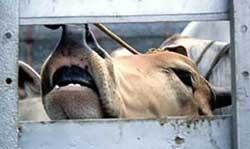
Every animal whose hide is sold in the clothing and shoe industry has suffered at some stage of its life. The "lucky" ones only suffered neglect during their upbringing, an overcrowded and long transport to the slaughterhouse, and violent handling there. To this group belongs the cattle industry in India, which exports mostly to the West: the ranchers get around the prohibition to slaughter cows, extant in large parts of India, by first transporting them to places where slaughtering is allowed. The cattle are crammed onto trucks until there is no more room, body against body, tied together by a rope, and transported hundreds of kilometers on bumpy roads. Fractures and death are a regular consequence of these horrific journeys (the GAP company, which used to be a major importer of leather from India, surrendered in the spring of 2000 after a short campaign by PETA, and announced that they will no longer import leather from India). But the fate of animals raised in the West is no better. Here, the animals endure much more intensive treatment during their raising, and are subjected to a series of violent acts, mostly without the use of anesthetics or pain killers: castration, dehorning, branding, ear puncturing, tail amputating, teeth cutting, artificial insemination and more. On top of all that, the most wretched victims of the leather industry are locked away their entire lives in industrial farms (not only for the beef industry, but also for the dairy industry), deprived of all opportunity to fulfill their natural needs including the bond between mother and young, social bonding, and even basic physical needs like eating food essential to their health or seeing the light of day. As a result of the close confinement in which they are kept, many of the animals can't even move their bodies freely.Killing for leather
Some of the leather products that we are asked to buy, come from animals that had been hunted or slaughtered especially for their hides. A large variety of wild animals, including some endangered species, are hunted specifically for this purpose, among them zebras, antelopes, kangaroos and crocodiles. Leather manufacture is an economic incentive for capturing and breeding wild animals and establishing new industries, such as the ostrich industry, which exploits ostriches for their meat and feathers as well as their skins. The ostrich industry in Israel is the second largest in the world, and in this industry ostriches, who are naturally adapted to a life of fast movement in large open spaces, are crammed in their thousands in overcrowded enclosures. The crocodile leather industry, which is also very prosperous in Israel, specializes even more in leather production. The crocodiles are locked for all of their (very short) lives, jam-packed, literally, one on top of the other. In order not to damage the skin, they are not slaughtered, and in order to save on expenses, they are not killed by gassing or electrocution. The accepted killing methods include bashing their heads in, severing their spinal cords, or inflicting small cuts all over their bodies, leading to a slow death by blood loss. Testimony from the United States tells of the flaying of crocodiles while they are still alive. In most of these methods the crocodiles linger for hours before dying.How the product influences production
Even in industries where leather is considered a "byproduct", it has a direct influence on the animals' fate. The younger an animal is, the finer its skin - a fact that is an incentive to slaughter animals while they are still young: calves, kids and others. Flaying is a complicated process, taking up precious working time in the slaughterhouse, which tries to work as efficiently as possible. That is why flaying might begin when the animal is still fully conscious. Dina Sadeh, who witnessed a cow being flayed in a slaughterhouse during a chef-training course by the Israeli Ministry of Labor, recounts:"The cow was tied by only one leg. All her tremendous weight was only on one leg, and she was kicking around in the air... They slit her throat and immediately pounced on her and started removing her skin. It happened right after the slaughter, a few seconds later. They didn't even wait for her to lose consciousness... While they were flaying her, she was still convulsing, with her tongue sticking out, trying to breathe, to fight, banging her head on the metal..."
What can be done?
The conclusion is simple: don't buy leather products! Like in any other livestock industry, the harm to the animals is completely dependent on consumer funding. In addition, consuming meat and dairy products contributes to the existence of the leather industry - yet another reason not to buy these products. It is easy to avoid not only leather jackets, pants, and handbags, but also leather shoes. Even the in Israeli Defense Forces it is no longer mandatory to wear leather shoes: due to the efforts of Anonymous for Animal Rights, with the help of the Association for Civil Rights in Israel, it has become possible in recent years to obtain a release from wearing leather shoes. Many shoe models made from cloth and synthetic materials are available in the market, and it is worthwhile to check other models of "veggie shoes", some of which are extremely durable (and accepted as a substitute by the IDF) at http://www.vegetarian-shoes.co.uk as well as other on-line stores.Substitutes
For every leather product there exists a similar product, whose manufacture did not involve harm to animals. We witness the replacement of traditional leather products by synthetic products: sandals are, perhaps, the best example, but also leather cases for photography equipment have become rare, and shoe stores offer a variety of leather-like synthetic shoes, in addition to cloth shoes. Some people are deterred from buying synthetic products, and prefer leather because it is "natural". But leather, in its natural condition, rots quickly and is damaged by insects, in addition to losing its flexible texture. The leather industries process the living tissue to create a resilient product by intensive chemical treatment, which includes a long list of toxic materials, among them diverse acids, lead, zinc, sulfur and cyanide. The leather processing plants severely pollute the environment, in addition to the pollution caused during the intensive breeding of the animals. Buying cloth or synthetic products instead of leather is not only the right choice ecologically, but above all it is the least any human being can do to prevent the suffering of the animals exploited to produce leather products. The existence of the leather industry and its collapse are down to us, the consumers.לחצו כאן כדי להרשם לשבועוןOriginally published in "Animal Rights this Week",
Anonymous for Animal Rights' Weekly Online Magazine for Animal Rightsלחצו כאן כדי להרשם לשבועון
http://anonymous.org.il/art495.html


