Fonye khazer (Fonye Pig) sung by Nachman Libeskind Lyrics by Moyshe Broderzon (1890 – 1956), music by Henech Kon. From the repertoire of the “Ararat” variety theater (1927-1938) in Lodz, Poland
This blog post begins with the recording of the song Fonye khazer, followed by its transcription, translation and in Yiddish. This is followed by a commentary on the singer Nachman Libeskind by the singer’s daughter Annette Libeskind Berkovits.
Photo: Moyshe Broderzon
We’ll provide more on Ararat and on the great Yiddish writer Moyshe Broderzon in the coming weeks. Special thanks to Jake Schneider, Eliezer Niborski and especially Annette Libeskind Berkovits.
Spoken by Nachman Libeskind
“A lid geshribn fin Moyshe Broderzon un geshpilt gevorn in yidishn klaynkunst-teater Ararat in Lodz, in di yurn 1928 [actually 1927 – Ed.] biz 1938– ‘Fonye khazer’“
A song written by Moyshe Broderzon and performed in the Yiddish variety theater “Ararat” in Lodz, from 1928 to 1938– ‘Fonye hazer‘”
Transcription
Fonye, fonye shpilt harmonye, fonye, khazer, kvas. Furt in punim mit a dlonye, Gur nisht oyf kayn shpas.
Hay, ray, ray, ray, Shpiln mir mit koyekh. Fin fornt gayt der kapelmayster, Fin intn [hintn] geyt a royekh
In orkester oyf trumpaytn shpilt men vos men kon. Oyf klarnetn, oyf kornetn oyf piston-trombon.
Hey! ray, ray, ray shpiln mir mit koyekh. Fin fornt geyt der kapelmayster fin intn zetst a royekh.
Translation
Fonye, fonye plays the accordion, Russian, pig, cider. Hits your face with his palm, Not at all as a joke.
Hey, ray, ray, ray We play powerfully. In front goes the bandleader. In the back there is smoke.
In the orchestra, on trumpets we play what we can. On clarinets, on cornets, on valve-trombones.
Hay, ray, ray, ray We play with force. In front goes the bandleader In the back we’re hit with smoke (a stink).
COMMENTARY on the singer by Annette Libeskind Berkovits:
Photo: Dora, Daniel, Annette and Nachman Libeskind
My father, Nachman Libeskind, was a man whose love of music was nurtured when he attended his primary school in Łódź, Poland from approximately 1916 until 1924. The Vladimir Medem school, founded by the Jewish Labor Bund, taught all classes in Yiddish.
My father was in the very first student cohort, sent there by his observant family because the school was free. My father adored the school and particularly its music and dance teachers. They fostered in him a life long love of music and Yiddish. In his twenties, Nachman performed in the Ararat Theatre (an acronym for Artistic Revolutionary Revue-Theater) an avant-garde cabaret. The songs he performed there kept up his spirit during successive incarcerations in pre-WWII Polish prison and in Soviet gulags.
I’m most grateful to my husband David Berkovits who bought my father the tape recorder and persuaded him to tell his life story during his Florida winters. I am equally thankful that my daughter Jessica Ursell and her husband Steve Ursell who have worked tirelessly to preserve and maintain the CDs of Nachman’s narration and songs. I know he’d be delighted to know that his songs are finding a new audience.
More of Nachman’s incredible life story based on his recordings can be found in the book Unlikeliest of Places: How Nachman Libeskind Survived the Nazis, Gulags and Soviet Communism.” The book is available on Amazon and from Wilfrid Laurier University Press.
Az in drousn geyt a reygn (another version of Az in droysn geyt a regn) / When It Rains Outside A love song sung by Lifshe Schaechter-Widman (LSW), recorded by Leybl Kahn in NYC 1954.
COMMENTARY BY ITZIK GOTTESMAN
This week’s post on Yiddish Song of the Week marks fifteen years of the blog which began March 2010 and is a part of the An-sky Institute for Yiddish Culture, a project of the Sholem Aleichem Cultural Center and the Center for Traditional Music and Dance (CTMD).
We are approaching 300 posts of rarely heard Yiddish songs and the influence of the blog can be heard on numerous recordings all over the world.
Not every singer can be a Tsunye Rymer, Jacob Gorelik, Lifshe Schaechter-Widman,Beyle Schaecther-Gottesman or Harry Ary, but one can learn something about traditional Yiddish singing with every post. Alevay vayter! !הלוואַי ווײַטער Let’s hope it continues. A shout out to Pete Rushefsky, Executive Directive of CTMD, for the actual posting on the web of the blog posts from the very beginning.
Finally, a plea to the followers of the blog to please comment under the “Comments” space, whether it be a correction in the translation or a misspelling, or another version of the song or just a reaction to the song and singer.
Arun Viswanath has found another version of Az in droysn geyt a regnsung by LSW and recorded by Barbara Kirshenblatt-Gimblett in 1970. That recording would become part of the YIVO Folksong Project: East European Jewish Folksong in its Social Context. To hear the song, click the below link (it will open in a new tab). The song begins at 15:00 (15 minutes into the interview).
Az in drousen geyt a reygn, vern di shteyndelekh nas. Di host dokh mir tsigezugt di vest mit mir khasene hubn az ekh vel mekh (nor) upshtelm di ershte klas.
Az di kenst af keyn broyt nit fardinen, vos toyg dir dayn khasene hubn? Az mir veln nisht hobn vus tsu esn Vus far a velt vel ikh bay dir hobn?
Az mir veln nisht hobn vus tsu esn. Derfar darfsti dikh nit zorgn. Fin danet veyg [for your sake], mayn tayer zis leybn, layen vel ikh un borgn.
Af stu layen, un of tsu borgn. Vey iz tsin aza velt opleybn. Az me vet indz kimen di khoyvelekh munen, Ver vet zey far indz opgeybn.
Di khoyvelekh uptsumunen, Dus darf dir nit lign deran. [you needn’t think about it] Ikh volt (or “vet’) mikh internmen in di hayzer tsi geyn. abi ekh zol zan dan man.
YIDDISH
,אַז אין דרויסן גייט אַ רעגן .ווערן די שטיינדעלעך נאַo ,דו האָסט דאָך מיר צוגעזאָגט דו וועסט מיט מיר חתונה האָן .אַז איך וועל מיך אָפּשטעלן די ערשטע קלאַס
Posted in Main Collection on February 18, 2025 by yiddishsong
“Haveyn Yakir Li Efrayim” Sung by Cantor Sam Weiss on November 30, 2003 at the annual cantorial concert at JCC on the Palisades in Tenafly, NJ, where it was recorded by an audience member.
Guest post by Arun Schaechter Viswanath. Special thanks to Dr. Michael Lukin for sharing numerous findings cited here, directing me to relevant source material, providing helpful feedback, and offering indirect methodological inspiration for analyzing this song.
Background
Cantor Sam Weiss
Sam (Shmuel) Weiss, Cantor Emeritus at Congregation Beth Tikvah in Paramus, submitted this song. He learned it from the book Folks-gezangen as Interpreted by Chaim Kotylansky (Los Angeles, 1944). “Haveyn Yakir Li Efrayim,” also referred to as “Dem Barditshevers Mayse,” “In di Moyredike Teg,” or “Nign Vos-zhe Veynstu,” is traditionally attributed to Reb Leyvi-Yitskhok Barditshever (1740-1809; RLY hereafter). RLY is credited with composing several Yiddish folksongs, including at least one version of “Got fun Avrom,” which has been featured on this blog here and here. Ethnographer Shmuel Hurvits (1862-1943) visited Barditshev on the eve of World War I and writes in his travelogue Yudishe neshomes (New York, 1916; pp. 24-30) under his pseudonym A. Litvin that the Barditshever used to sing this song on Rosh Hashanah night. An alternate tradition is presented in Sefer Devarim Arevim, a hagiographic compilation of stories about Hasidic masters (Dov Ber Ehrmann, Munkacs 1903; folio 25 [p. 69]), according to which he would sing it during Rosh Hashanah davenen at the point in the repetition of the Mussaf Amidah when the verse haveyn yakir li efrayim from the prophet Jeremiah was mentioned.
A version of the song in Sefer Devarim Arevim (1903)
The Text
On one level, the song seems straightforward, presenting a dialogue between two characters. One is a weeping woman with a headache, stemming from her distress that her children may not be zoykhe badin (found worthy of positive judgment) during the High Holidays. The other is the narrator’s father,who reassures her that God will have mercy on her children as well, citing the verse haveyn yakir li efrayim from Jeremiah. In this verse, God speaks of Ephraim as his beloved son, whom he will remember and have mercy on – an allegory for the redemption from exile of the Ten Tribes of Israel, whose leader was from the tribe of Ephraim.
However, the song features a number of narrative and structural elements that warrant a closer look. The opening line introduces three characters whose identities are not immediately clear: der tate zikhroyne livrokhe hot mir dertseylt / az s’iz gekimen tsin im a mul a yidene (“my father, may he rest in peace, told me how a [Jewish] woman once came to him”). Who is the father, who is the narrator, and who is the weeping woman with the headache?
The father seems to be a Hasidic rebbe. Hasidim commonly visited the rebbe (also known as a tsadek or guter-yid) for various purposes, including joyful lifecycle events like a bar-mitzvah boy donning tefillin for the first time, or in the case of illness, dilemmas, or a troublesome dream (as in Mame A Kholem). A woman going to the rebbe over a simple headache would not have been out of the ordinary; calling the doctor was reserved (if at all) for life-threatening illnesses, only after rabbinic intercession and home remedies had failed.
As noted, this song is among several attributed to the Barditshever. Lukin & Wygoda’s analysis (“The Songs of Rabbi Levi Yitzchak of Barditchev from a Historical Perspective,” in Rabbi Levi Yitzchak of Berdichev: History, Thought, and Music, ed. Zvi Mark & Roee Horen, 2017, p. 426) supports this attribution, identifying a constellation of textual and musical features linking the songs to each other as well as to RLY’s religious writings in his Hasidic tract, Kedushas Levi. If our song was indeed written by RLY, then it would seemingly follow that his father is the rebbe; however, this is implausible for two reasons. Firstly, although RLY was indeed born into a rabbinic family, it was not Hasidic; he was only won over to Hasidism as a teenager, after becoming acquainted with two Hasidic leaders, Shmelke of Nikolsburg and the Maggid of Mezritsh. Second, the aforementioned Sefer Devarim Arevim, the earliest published version of the song text, is missing any mention of the father, instead recounting the incident itself in first person: a yidene is far mir gekimen in hot zeyer geveynt. This suggests that the father is RLY himself, and the narrator is one of RLY’s sons. Indeed, there are traditions that attribute the song, or at least its popularization, to one of his sons: either Rabbi Israel of Pikev, or Rabbi Meir of Barditshev. (On a related note, Lukin & Wygoda demonstrate convincingly that the song “Meyerke, Mayn Zun” is actually a conversation between RLY and his deceased son Meir, consisting of veiled references to funeral rites and the world to come.)
The crying yidene with the headache could be understood literally. Although such a level of agitation over the potential fate of her children on the Day of Judgment might seem excessive, Litvin describes the song as being RLY’s intentional response to the magidim (itinerant preachers) who would scare people at that time of the year with stories of punishment and the angel of death. However, the figure of the woman can be read allegorically as well. Earlier in the same chapter of Jeremiah that contains the verse haveyn yakir li, we read: “A cry is heard […] wailing, bitter weeping – Rachel weeping for her children (rokhl mevako al boneho). […] Thus said the Lord: “Restrain your voice from weeping […] there is hope for your future, declares the Lord: Your children shall return to their country.” This passage, referring to Rachel the Matriarch – the wife of Jacob and the grandmother of Ephraim – is understood midrashically to be a manifestation of the shkhine (feminine divine energy in Kabbalistic thought) approaching God to plead on behalf of the exiled Ten Tribes, and God reassuring her of their future redemption. Indeed, the broader passage from Jeremiah 31 encompassing both haveyn yakir li and rokhl mevako is read as the haftoyre on the second day of Rosh Hashanah. The role of Rachel as intercessor would likely have carried special meaning for RLY, who was known for interceding and pleading with God on behalf of the Jewish people. This reputation of his is reflected in his popular epithet “Sanegoyron shel yisroel” (“the Jews’ defense attorney” in the Divine courtroom) and is reflected in two others songs attributed to him: “Ikh vel mit dir makhn a bayt” and “A din-toyre mit got.”
To tie this back to the question of the identity of the father, it is interesting that there are versions of the song sung today with no mention of the phrase “zikhroyne livrokhe,” which then allows for an allegorical interpretation of the father as God himself. As R’ Elimelech Biderman says at the farbrengen linked below: “der tate – dos iz der riboyn kol oylomim, un di idene – dos iz di shkhine hakdoyshe […] vos veynt zikh oys ibern matsev fun kneses yisroel.” But as far as our and other versions are concerned, the inclusion of “zikhroyne livrokhe” precludes any identification with God.
A final note on the text: The Hebrew text citing the verse haveyn yakir li is split into eight phrases, each of which is followed by a loose paraphase in Yiddish. Paraphrase of Hebrew text was frequently employed in Eastern European Jewish life, both in the khumesh-taysh of the kheyder as well as in Yiddish folksong, including several others attributed to RLY.
The Melody
I have been able to locate at least 3 different melodies for this song. The earliest documented melody was published by A. Litvin in the newspaper Di Tsayt (1921). This simple, recitative melody uses the natural minor and resembles parts of the prayer chant (nusekh) heard in the repetition of the Rosh Hashanah Amidah – which is consistent with the tradition in Sefer Devarim Arevim that RLY would sing the song at that very point. The version as sung here by Slonimer Hasidim seems closely related to Litvin’s. Another melody popular among Hasidim today also employs the natural minor and has some melodic contours in common with Litvin’s, suggesting a common provenance. You can hear it sung at this farbrengen with R’ Elimelech Biderman (starting at 54:42), or in this commercial recording by the Hasidic pop star Lipa Schmeltzer.
In contrast, Chaim Kotylansky’s version that Cantor Weiss sings is of a very different, cantorial character, featuring modal variety, elaborate intervals, and melismas typical of khazones. At the same time, it distinctly incorporates certain melodic phrases found in Litvin (for example, the minor triad in the opening cadence, as well as the phrase in the image below). Noting this similarity, Lukin & Wygoda suggest that Kotylansky composed this piece himself, drawing melodic inspiration from the melody seen in Litvin. Cantor Weiss, in turn, deviates substantially from Kotylansky’s melody, especially during the later Hebrew-Yiddish paraphrase section, and he is not the first to do so (compare this rendition, track 14, possibly sung by Chaskele Ritter). Given the improvisation typical in khazones, it’s quite possible that Kotylansky would not have considered the latter half of the printed melody to be canonical, perhaps himself improvising at each performance.
Part of the melody published by A. Litvin in Di Tsayt, which is echoed in Kotylansky’s version sung by Cantor Weiss. Transcription courtesy of Michael Lukin.
From a musical perspective, Kotylansky’s piece is brilliantly constructed. While the bulk of the song is in the Freygish mode*, the opening words of the Hebrew verse haveyn yakir li are accompanied by a musical quotation heard in Yossele Rozenblatt’s Haveyn Yakir Li (starting at 1:50) in Ukrainian-Dorian**. It is not immediately clear whether the relevant section was composed by Rozenblatt, or whether this is itself also a quotation. Perhaps as a preemptive nod to this quotation, the opening lines of the song are also in Ukrainian-Dorian, while the brief “Rozenblatt quotation” is followed by a reversion back to the Freygish mode, which (mostly) holds through the end of the piece. What we have then, modally speaking, there is an ABAB structure. Furthermore, the entire dialog features a prominent alternation between the subdominant and the tonic of the Freygish mode: the former is the tonal center of gravity where the majority of the speaking occurs, while the appearance of the tonic tends to signal a shift in speaker. In other words: another ABAB structure, nested within the broader one. The result is a complex musical structure which is in dialogue with Litvin’s published melody, with previous compositions of khazones, and indeed with itself. The multiple layers of alternations effectively mirror the dialog in the text, and the linguistic oscillation inherent in the Hebrew-Yiddish paraphrase.
*Natural minor scale with lowered 2nd and raised 3rd, also known as Ahavah Rabbah. **Natural minor with raised 4th and 6th, also known as the Mishebeirach mode.
Transcription of the text
Kotylansky’s printed text is in the cross-dialectal standard, derived from Northeastern Yiddish. While Weiss does sing the Hebrew verse with this pronunciation, he sings the Yiddish text almost exclusively in Ukrainian dialect, which is fitting given the location of Barditshev (today Berdychiv in Northwestern Ukraine). This fact, combined with numerous minor textual variations, indicates his likely native proficiency. The following transcription reflects Weiss’s rendition, rather than Kotylansky’s printed text.
der tate zikhroyne livrokhe hot mir dertseylt az s’iz gekimen tsin im a mul a yidene in hot biterlekh geveynt
hot der tate tsu der yidene gezugt sertse***, sertse, vuzhe veynste?
hot di yidene tsim tatn gezugt ikh veyn val der kop tit mir vey
hot der tate tsi der yidene gezugt sertse, sertse, nite zhe veyn vurem az di vest veynen, in az di vest klugn vet der kop dir nokh erger vey tun
hot di yidene tsim tatn gezugt vi azoy zol ikh nit veynen, in vi azoy zol ikh nit klugn az se geyen azelekhe forkhtike teyg hob ikh moyre tomer veln mayne kinder nisht zoykhe zayn badin
hot der tate tsin ir gezugt sertse, sertse, nite zhe veyn vorem der eybershter iz a rakhim vekhanin der eybershter iz a rakhim vekhanin vet er mistume rakhmunes hubn of zane kinder bifrat nokh of azelekhe tayere kinder
kakusiv — azoy vi in pusik shteyt haveyn yakir li efrayim — oy, efrayim iz dokh aza tayerer zin im yeled, im yeled shaashuim — oy, er iz dokh aza libhartsik kind ki midey dabri voy — ti ikh nor fin im reydn zokhoyr ezkerenu oyd — vel ikh zikh in im nokh mer dermanen al keyn homu meyay loy — derfar tit man harts nukh im benken vos mer rakheym arakhmenu — vel ikh zikh derbaremen of im neum adoyshem — azoy zugt got, got aleyn
***The term sertse “dearest,” literally “[my] heart,” evokes familiarity and love, and is typically used between family members or romantic partners. Although it seems out of place in this context, Sefer Devarim Arevim notes that RLY would frequently address people with this term, perhaps parallel to his familiar, no-nonsense approach to speaking with God himself.
In a Litvish derfl vayt / In a Lithuanian village today. A Holocaust song also known as “Dos Farvoglte kind” and “A yidish kind”. Written and composed in the Shavli ghetto by Khane Kheytin-Weinstein. Recorded and sung by Zev Engel, Brooklyn, 2023.
photo: children in Shavli ghetto
Commentary by Itzik Gottesman
Khane Kheytin (1925 – 2004) was born in Shavel (Siaulia, Lithuania). During the war she was at first in the Shavli ghetto and then sent to the Stutthof concentration camp. The song was composed after the massacre of children in the Shavel ghetto. As a child, Zev Engel learned the song from his mother.
This is just one of a number of songs and poems by Khaytin composed. In 2003 a collection of her ghetto poetry was published in Hebrew with the title שירים מגטו שבלי / Shirim me-geto Shavli. More on the song can be found on the Yad-Vashem website.
The song can be found in a number of Holocaust Yiddish song collections where it is also called “Dos farvoglte kind” or “A yidish kind”. The music, according to Bret Werb, staff musicologist at the US Holocaust Memorial Museum in Washington DC is by composer Henoch Kohn from the 1935 play “Misisipi”. The song was also featured in the Folksbiene National Yiddish Theater production “Tsvishn falndike vent/Amid Falling Walls” in 2023
At the Yiddish New York festival in 2023, Yiddish scholar Anna Rozenfeld spoke about the song. She mentioned that during the three weeks before Tisha b’av, a mourning period, when no singing is generally permitted in the Hasidic girl schools the children do sing “In a litvish derfl” because of its sad theme.
Thanks to Zev Engel, Anna Rozenfeld and Bret Werb for this week’s post.
In a litvish shtetl vayt, in a shtibl in a zayt, durkh a fentster nisht tsu groys kukn kinderlekh aroys. Yinglekh mit blonde kep, meydelekh mit lange tsep. un tsuzamen dort mit zey kukn shvartse oygn tsvey.
Shvartse oygn fil mit kheyn un a nezele a kleyn. Lipelekh tsum kushn nor sheyne, shvartse, gelokte hor. Di mame hot em [im] do gebrakht ayngevinklt [ayngeviklt] shpet bay nakht gekusht, geveynt un geklogt shtilerheyt tsu em [im] gezogt:
Fun haynt mayn kind iz do dayn ort. Gedenk dayn mames letste vort. Ikh bahalt dikh do derfar Vayl dayn lebn iz in gefar. Mit di kinderlekh shpil zikh sheyn, Shtil geherkhzam [gehorkhzam] ruik zayn. Kayn yidish vort kayn yidish lid, Gedenk in harts du bist a yid.
Zi hot im tsugezogt a sakh. Es hot geholfn keyn shum zakh. Er hot geshrien “neyn, neyn, neyn!” Ikh vil nisht blaybn do aleyn. Loz mikh nisht iber do mit zey. Ikh vel nisht blaybn do say-vi-say. Loz mikh geyn mit dir. Ikh hob dikh lib azoy fil.
Oyf di hent genumen em [im] mit a tsiderdike shtim, ayngeshlifn dos kind oyf zikh un geklibn tsu geyn gikh. Royte oygn fun geveyn, gekusht dos kepele dos kleyn. Gekusht mit fil harts un shrek, aleyn gelozt un iz avek
אין אַ ליטוויש דערפֿל רעקאָרדירט און געזונגען פֿון זאבֿ ענגעל, ברוקלין אין אַ ליטוויש דערפֿל ווײַט
In a Lithuanian village far away, In a home to the side, from a window not very big, children are looking out. Boys with blond hair, Girls with long braids and together with them, looks out a boy with two black eyes.
Black eyes with charm, and a small nose, lips only good for kissing, pretty black curly hair. His mother brought him here, wrapped him late at night. Kissed, cried and lamented quietly she spoke to him:
From today, my child, your place is here. Remember your mother’s last words. I am hiding you here because your life is in danger. Play nicely with the children. Be quiet, obedient, and still. Not a Yiddish word, no Yiddish song. Remember in your heart that you’re a Jew.
She promised him a lot, but nothing helped. He yelled “no, no, no” I don’t want to remain here alone. Don’t leave me here with them. I won’t stay in any case, Let me go with you. I love you so much.
She took him in her arms. With a tender voice she put the child to sleep. unprepared to leave quickly. Red eyes from weeping, she kissed his little head Kissed with a full heart and fear she left him and went away.
Vi nemt men di amulike yurn? / Where Can One Get the Years Past? Sung by Lifshe Schaechter-Widman [LSW], recorded by Leybk Kahn, NYC 1954
Commentary by Itzik Gottesman
Why are they staring at her in the river? What is her shame? That her lover left her? Is the unmarried singer pregnant? Though rare, there are Yiddish songs about mothers abandoning their newborn children (see the very first Yiddish Song of the Week post “Fintster, glitshik’) or drowning them (see “Tsvishn di berg, di grine” sung by Mariam Nirenberg). I could find no variants of the song but there is a completely different Yiddish vaudeville song with a similar title “Vu nemt men amolike yor” by David Meyerowitz. Jane Peppler includes it in her collection Yiddish Penny Songs.
What follows are the transliteration in LSW’s dialect, a translation and the lyrics in Yiddish.
Transliteration
Vi nemt men di amulike yurn? Oy, ver iz geveyn tsi mir glaykh? Ven mir hot geshant mayn glik, mit a yeydn mentshn tsi glaykh.
Ikh hob gemeygt denstmul zugn, az di bist maner geveyn. Oy, haynt ti ikh veynen in klugn, far vus iz mir aza brokh gesheyn?
Ekh bud ‘ekh mikh in a takhl. Oy, mentshn tien kikn mit di oygn. Vi iz mayn gelibte atsind? Oy vayt fin mir avekgefloygn.
Avek iz er fin mir in a fremd land. Dertseyln, dertseyl ikh nit far keynem, vayl ikh vil nit me zol visn mayn shand.
TRANSLATION
How does one get back the past years? O, who was equal to me? When my good fortune was shining equal to everyone’s.
I could have said then that you were mine. O, today I only cry and lament. Why did such a tragedy happen to me?
I bathe in the river O, people stare at me. Where is my love now? O, far from me he has flown.
He has left me to a foreign land. I’m not telling anyone, because I doמ’t want them to know my shame.
Mir zenen zikh klezmorimlekh / We are little musicans Sung by Zvika Blusztejn, submitted by Eddy Portnoy
Zvika Blusztejn
Mir zenen zikh klezmoremlekh mit hertselekh vos filn. Khotsh navenad un oremlekh Nor halt men in eyn shpiln
We are little klezmorim with hearts that feel. Though homeless and poor we keep on playing
Un ven der soyne, akh un akh Tif in hartsn tut a shtokh A zemerl vos darf men nokh der veytok undz tsu shtiln?
And when the enemy, woe and woe, stabs us in our hearts what more do you need than a tune to quiet the pain?
Ven arum undz brent a fayer un di faynt undz tuen vey, ersht dos lebn, s’iz un tayer shpilt men oyf tsu lokhes zey.
When around us a fire burns and the enemy hurts us, Then our life which we hold dear. we play to spite them.
A zemerl, a lidele, Fun trern un fun freyd. Oyf tats un bas un fidele Oyf paykele, oyf fleyt.
A tune, a melody of tears and of joy. On cymbal, on bass and fiddle. Oy, tshiribiri, tshiribiri bim bom….
Ay, ay, ay, ay
Commentary by Eddy Portnoy, Academic advisor and director of exhibitions at the YIVO Institute
The singer of this song, Zvika Blusztejn, was born in Brussels in the early 1930s to migrants from Poland. During World War II, he was given a false identity and hidden in a school in the Belgian countryside, where he survived the war. His parents, however, were both sent to Auschwitz in 1942, where they were murdered. He returned to Brussels after the war and discovered he had an uncle who survived. His uncle wanted him to be able to read and write Yiddish, so he sent him to a secular “Sunday School” and also arranged for private Yiddish lessons at home given by a teacher from the Sunday School. He learned this song as part of his lessons. Because Belgium did not have citizenship by birth, Zvika was not permitted to remain there. He became involved with the Borokhov section of the Left Labor Zionists in Brussels and left for Israel in 1950 where he lives today.
Special thanks for this post to Zvika Blusztstejn, Eddy Portnoy and Eliezer Niborski
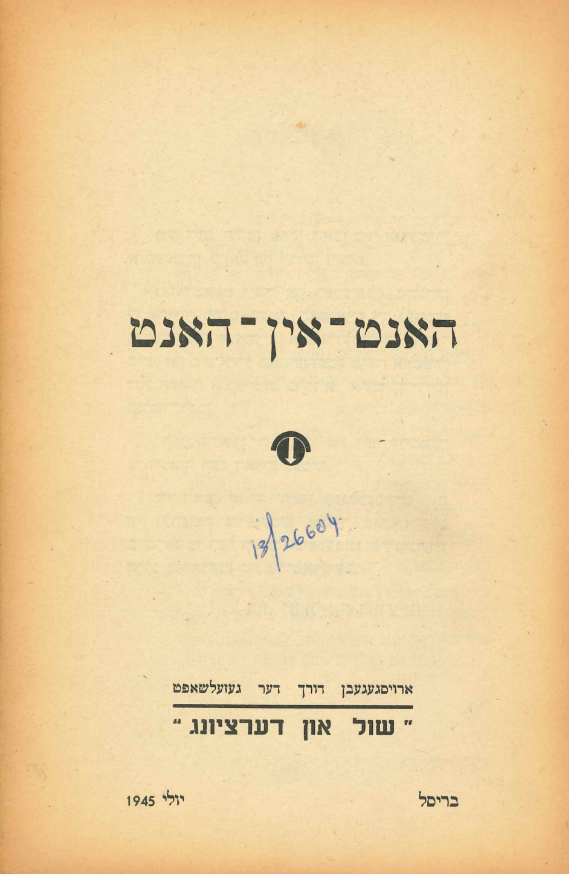
PS – AUTHOR AND ORIGINAL TEXT FOUND! In the poetry book for children put together by Yeshaye Zandberg titled “Hant-in-hant”, Brussels, 1945, we have found the author of the song – “P. Blank” and the complete text. Attached are the pages from the book that contain the original text and the pages just of the song. Thanks to Zvika Blusztejn we now have the melody.
Yosef, Yosef iz a voyler ying / Joseph, Joseph is a Swell Guy A fragment of a Purim play sung by Lifshe Schaechter-Widman, recorded by Leybl Kahn, NY 1954
Purim shpil, United Orthodox Synagogues, Houston, TX
Yosef, Yosef iz a voyler ying. Er meyg dokh trugn dem keysers ring. Yosef, Yosef iz voyler parshoyn. Se kimt im untsitin di kroyn.
Joseph, Joseph is a swell guy He should wear the emperor’s ring. Joseph, Joseph is a swell fellow. He deserves to wear the crown.
.יוסף, יוסף איז אַ וווילער יונג .ער מעג דאָך טראָגן דעם קייסערס רינג ,יוסף, יוסף איז אַ וווילער פּאַרשוין .קומט אים אָנצוטון די קרוין
Commentary by Itzik Gottesman
In her small town of Zvinyetshke in the Bukovina region, Purim “shpiler” would go from house to house performing a short skit – either about the story of Purim, or about David and Goliath among others. But the most popular theme of the Purim play was the Biblical story of the selling of Joseph known as “Mekhires yoysef” מכירת יוסף In this blog we have earlier printed a longer song from the same play, sung by Lifshe at this link:
Purim plays were full of anachronisms, often to comic effect. Itzik Manger’s “Purim shpil” would be a more recent well-known example. In “Yosef, Yosef” calling the Pharaoh an “emperor”, a “keyser”, might have been a touch of humor.
איך וואָלט מיך גערן ערקונדיקט / Ekh volt mekh gern erkindikt / I would like to find out A lament of a childless woman sung by Lifshe Schaechter-Widman [LSW]
photo: LSW with her son Mordkhe Schaechter, Chernovitz, 1930s.
To be a childless Jewish woman – an עקרה (akore) – in the shtetl was a tragedy. In this moving song we hear her lament, comparing herself to a tree that cannot bear fruit and therefore withers away. Very few Yiddish akore songs have been collected. LSW was recorded by Leybl Kahn in 1954, NY. This recording first appeared on the cassette “Az di furst avek: A Yiddish Folksinger from the Bukovina”, Global Village Music, 1986.
Ekh volt mekh gern erkindikt Vus ikh ho azoyne groyse zind. Vus ikh hob mekh azoy farzindikt. Ekh bin farsholtn fin a kind.
I would like to know what great sins have I? How have I so sinned, to be cursed with no children?
Der numen “mame” iz a groys vinder, Voyl iz der mame ven zi azoyns hert. Ekh bin farsholtn fin kinder. “Mame” tsi hern bin ikh gur nisht vert.
The name “mother” is a great wonder. Blessed is the other who hears this word, I am cursed with no children. I am not worthy to hear “mother”.
Vus far a vert hot der boym un peyres in un tsvagn. Er ligt ba dr’erd d in vert getsert Im iz nebekh tsi baklugn.
What good is a tree with no fruit and with no branches? It lays on the ground and withers away. It is only to be pitied.
איך וואָלט מיך גערן ערקינדיקט איך וואָלט מיך גערן ערקינדיקט .וואָס איך האָב אַזוינע גרויסע זינד .וואָס איך האָב מיך אַזוי פֿאַרזינדיקט .איך בין פֿאַרשאָלטן פֿון אַ קינד
.דער נאָמען „מאַמע” איז אַ גרויס וווּנדער .ווויל איז דער מאַמע, וואָס זי אַזוינס הערט .איך בין פֿאַרשאָלטן פֿון קינדער .מאַמע” צו הערן בין איך גאָר נישט ווערט¨
אַז דו פֿאָרסט אַוועק / Az di furst avek / When You Leave Sung by Lifshe Schaechter-Widman, recorded by Leybl Kahn, NYC 1954.
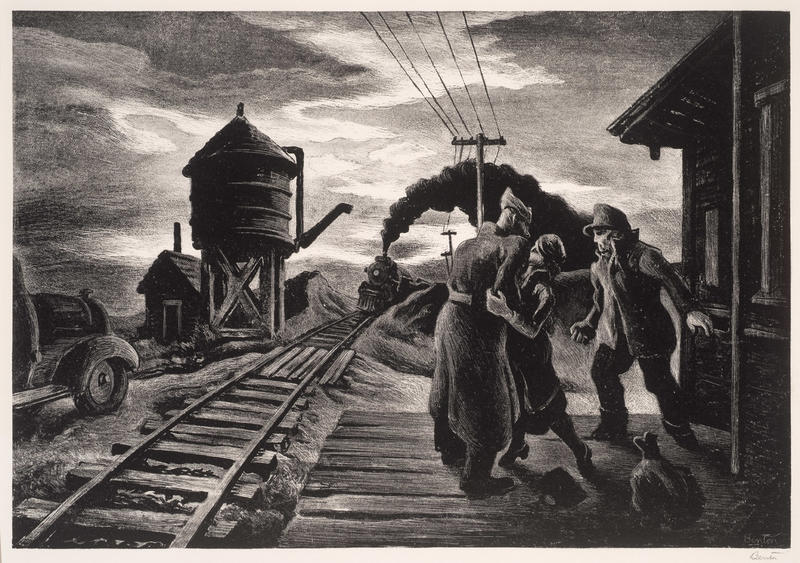
photo: “Morning Train (Soldier’s Farewell) by Thomas Hart Benson, 1943
Az di furst avek, oy, az di furst avek. Af veymen zhe lozti meykh iber. Az di furst avek. Az di furst avek Ven zhe mir zikh nokh a mol zeyn vider.
Loz mir dayn bild, oy, loz mir dayn bild. Efsher vel ikh mekh kenen treystn. Az ekh vel es unkikn, vel ikh meynen az di shteyst far mir. Efsher vel ekh on dir kenen fargesn.
Oy, veyn nisht lyubitshku. Oy, veyn nisht dushenyu. Mit keyn geveyn, zolsti tse mir nit reydn. Vayl s’iz dokh shoyn gekimen, di imgliklekhe shtunde, Az mir beyde miz me zikh tsesheydn.
Oy, az di ban, oy, hot gegibn deym ershtn faf Mit trern zenen farlofn mayne oygn. Ersht bisti geveyn. Ersht hob ikh dekh gezeyn. In eyne, tsvey minitn bisti farfloygn. Ersht bisti geveyn. Ersht hob ikh dekh gezeyn. In eyne, tsvey minitn bisti farfloygn.
In az di ban, oy, iz avekgegan, geblibn bin ikh aleyn shteyn. Oy gevald, ikh khalesh. Oy gevald, ikh shtarb. Oy gevald, ekh bin elnt vi a shteyn.
ENGLISH TRANSLATION
When you leave, oh, when you leave with whom are you leaving me? When you leave, oh, when you leave, When will we see each other again?
Leave me your picture, oh, leave me your picture. Maybe it will comfort me. When I will look at it, I’ll think you’re standing before me. Maybe I will be able to forget you.
Oh, don’t cry my love, oh don’t cry my sweetheart. You should not speak to me with tears. For the unhappy hour has arrived, when we must depart.
Oh, when the train blew the first whistle, my eyes filled up with tears. You were just here, I just saw you. And in one, two minutes, you flew away.
An when the train departed, I was left standing alone. Woe is me, I’m fainting. Woe is me, I’m dying. Woe is me – I’m as lonely as a stone.
אַז דו פֿאָרסט אַוועק געזונגען פֿון ליפֿשע שעכטער־ווידמאַן
אַז די פֿאָרסט אַוועק, אוי, אַז דו פֿאָרסט אַוועק ?אויף וועמען לאָזסטו מיך איבער .אַז דו פֿאָרסט אַוועק. אַז דו פֿאָרסט אַוועק ?ווען וועלן מיר זיך נאָך אַ מאָל זען ווידער
.לאָז מיר דײַן בילד, אוי, לאָז מיר דײַן בילד .אפֿשר וועל איך מיך קענען טרייסטן .אַז איך וועל עס אָנקוקן, וועל איך מיינען, אַז דו שטייסט פֿאַר מיר .אפֿשר וועל איך אָן דיר קענען פֿאַרגעסן
.געבליבן בין איך אַליין שטיין .אוי גוואַלד! איך חלש.אוי גוואַלֹד איך ! איך שטאַרב .אוי גוואַלֹד איך בין עלנט ווי אַ שטיין
COMMENTARY BY ITZIK GOTTESMAN
As before, I have transliterated Lifshe Schaechter-Widman’s (LSW’s) Yiddish into English letters adhering as best as I could to her Bukovina dialect. To see the song written in standard Yiddish, please look at the Yiddish text in Yiddish letters, below.
This song by LSW was included in the casette “Az di furst avek” (Global Village,1986). A similar melody and motif to “Az di furst avek” cassette can be heard in the song “Oy, forn forstu fun mir avek”. Though in that version the lover is leaving for Tsarist conscription. Dora Wasserman’s performance of the song can be heard at this link in the Ruth Rubin Archive at the YIVO Institute for Jewish Research’s website:
LSW’s powerful and emotional rendering of the song is heartbreaking. The lyrical folk poetry paints the tragic farewell scene dramatically, culminating in the killer last line, “Oy gevald ikh bin elnt vi a shteyn” – “Woe is me, I am left as lonely as a stone”.
When LSW’s daughter Beyle Gottesman sang the song, she sang שעה “sho” instead of the German, “shtunde” meaning “hour”.
Simkhe mit zayn yidene (Simkhe and His Wife), words by Yosel Cutler, music by M.M. Warshawsky. Sung by Tillie Fishman, recorded by Gertrude Nitzberg 1979, Baltimore. This recording is found in the Gertrude Nitzberg Collection at the Jewish Museum of Maryland.
“Self-portrait” Yosl Cutler.
Commentary by Itzik Gottesman
Artist and Yiddish writer Yosl Cutler (1896 – 1930) included this poem in his book Muntergang (1934). The text is sung to the melody of M.M. Warshavsky’s Passover song Tayere Malke (Dear Malke), which is well-known due to its inclusion in the annual Worker’s Circle Third Seder. Fishman sings a 7-verse version. In Cutler’s original text (attached) there are 10 verses. Though the song was very popular among the Yiddish left, the only recordings I could find are in a 1930s short film of the NY-based Yiddish puppet theater Modicut, created by Zuni Maud and Yosl Cutler, and in a more recent production by Jenny Romaine and the Great Small Works theater, Muntergang and Other Cheerful Downfalls (2016) – you can see Great Small Works performance of the song in the below excerpt starting at 9:23:
Tillie Fishman says that she changed some words which she found inappropriate. This includes a line about the strikers beating up the landlord. The charm and humor of the song is the repetition of the rhyme “farshidene” (various) and “yidene” (old fashioned woman, wife). The text’s tragic tale is given an ironic twist by Warshawsky’s sing-song melody.
Thanks this week to Lorin Sklamberg and the YIVO sound archive, Eddy Portnoy and Jenny Romaine.
Oy, Simkhe hot gearbet bay shleser farshidene. hot er hot gehat a sakh arbet hot im geholfn zayn yidene.
Oy, Simkhe labored on various locks. When he had a lot of work, he was helped by his wife. Bim-bom…
Oysgelozt di shleser. Nishtu mer keyn shleser hot er gekrogn a plats un iz gevorn a preser.
The work on locks ended; no more locks. So he got a place and became a presser.
Hot er geprest un gebiglt af kleyder farshidene. Az er hot gehat a sakh presn hot geprest di yidene. Bim-bam…
So he ironed and pressed various clothes. When he had much to iron his wife ironed too.
Oysgelozt dus presn nishtu mer keyn presn iz er gezesn leydik un hot nisht gehat vus tsu esn.
The ironing came to an end. No more ironing. So he sat empty and had nothing to eat.
Hot er gekrekhst un gezifst mit krektsn farshidene. Hot gehat a sakh krekhtsn, hot gekrekhtset di yidene.
So he moaned and groaned various moans. When he had many moans, his wife also groaned.
Iz ungekimen shlekhte tsaytn mit frest farshidene Hot der “landlord” aroysgevorfn Simkhe mit der yidene.
Bad times arrived with various freezes. So the landlord threw out Simkhe and his wife.
Iz ongekimen skheynim mit ‘straykers’ farshidene un hot tsurik arayngeshtelt Simkhe mit zayn yidene Bim-bam…
So neighbors arrived with various strikers and put back in his place Simkhe and his wife.
Song as printed in Yosl Cutler’s book Muntergang (1934), p. 19:






 Yiddish Song of the Week