

|
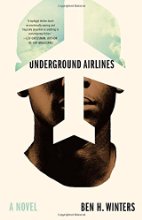
Loading... Underground Airlinesby Ben Winters
   None. No current Talk conversations about this book.  Olivermagnus | Dec 14, 2016 | Olivermagnus | Dec 14, 2016 |  What if Abraham Lincoln was assassinated before he had a chance to serve as president? What if the Civil War never happened? What would the present day United States be like? In Underground Airlines, the author has created an alternate history detective story told through the eyes of a former slave, Victor. In Victor’s world, four states still allow slavery, and according to the constitution it can never be abolished. To keep his freedom, Victor had to agree to work as bounty hunter for the US Marshalls and track down runaways. We see that he is good at his job as he almost effortlessly picks up the trail of a runaway slave hiding in the Midwest. But Victor is a conflicted character — he knows what he is doing is wrong, and this case is particularly troubling: Something is not right, documents are missing from the file, and things are not what they appear to be. I enjoyed this fast-paced thriller set in a believable world with a thought-provoking ending. Will there be a sequel? I hope so; there is plenty of material for another story in this well-developed alternate world. Audio production: I listened to part of this novel which was expertly narrated by William DeMeritt. Through his voice we can feel the conflict, and often despair, that Victor feels. Both audio and print versions were equally compelling. (  ) UnderMyAppleTree | Nov 29, 2016 | ) UnderMyAppleTree | Nov 29, 2016 | Jim, a 40 year old black man who has escaped from slavery, is tearfully trying to convince a priest, Father Barton, to help him free his wife. But his name isn't Jim (he goes by Victor, but that isn't his name either), he doesn't have a wife and its the present day, not the 1800s. In this terrific alternative history thriller there was no Civil War and Lincoln did not free the slaves. Slavery is still legal in four southern states. Victor works in the north as an agent of the U.S. Marshals Service tracking down escaped slaves, and he is now in Indianapolis hunting for the slave Jackdaw. Victor knows that the priest is part of a network of abolitionists known as the Underground Airline and he suspects that they are hiding Jackdaw. This was a very imaginative and surprising plot. Motives are never straight forward. The Marshals become increasingly desperate to recover Jackdaw, and Barton is just as desperate to keep him away from them. Victor is caught in the middle between these two sides and each is willing to both bribe and threaten Victor to get his help. The book was particularly exciting when Victor had to head to one of the slave states to recover some information. He is required to have a white escort. Victor is a very complicated character, filled with anger and with an interesting backstory that is revealed gradually over the course of the book. He is a good person but very skilled at deception. He managed to free himself from slavery but not from racism and his work for the Marshals is not entirely voluntary. The pace of this book was very fast. I had not intended to finish it in a day but I didn't want to stop listening to it. The ending was not all together satisfying, but I liked it. The audiobook was read by William DeMeritt, who has a voice that is extremely pleasant to listen to. I received a free copy of this book from the publisher but I wound up listening to the audiobook borrowed from the library. (  ) fhudnell | Nov 26, 2016 | ) fhudnell | Nov 26, 2016 | A timely and unsettling book, with lots to say about race, slavery, and history. And at the same time, entertaining as hell. Part spy story, mystery, part deliciously told alternate history-- this is the real deal. I enjoyed Winters' "Last Policeman" books, and didn't realize he was the same author til well into this novel. He has a sure way of writing rather matter-of-factly about things that would freak us the fuck out. ( ) jjaylynny | Nov 12, 2016 | What if the American Civil War had never occurred? What if one early assassination united a nation before it had a chance to be torn apart? What if slavery was still practiced in Louisiana, Mississippi, Alabama, and Carolina? This is the premise of Underground Airlines. It's a great premise that elicits plenty of thought, but the execution leaves something to be desired. Underground Airlines is a thriller: politics, cops, chase scenes, double crosses—tension in general. I'm not a big fan of this style, but I was certainly willing to give it a go because I thought the plot was intriguing. Ben H. Winters nails the mood: late night meetings in the city, the sound of cars swooshing through rainwater in the distance, faces covered in shadow—it was impossible not to see much of the novel as scenes from a movie. Underground Airlines is a thriller with a great concept, but in the end it's still a thriller; a book for fans of Grisham, Coben, Baldacci, or—hell, I don't know what I'm talking about, I've never read any of those authors. As far as I know, they write nothing like this. My main complaint about Underground Airlines comes in the way of alternate history. In this novel, historical and political events have changed. Because the Civil War was not fought, laws were put in effect to appease Southern interests. Texas claims sovereignty and tensions between it and the States are high. Much of the world, especially Europe, has placed sanctions on the United States for its continued acceptance of people as property. Only in the last four years has Japan lifted its embargo. And yet, aside from these political differences, one would not notice a difference between the alternate history of Underground Airlines and our own: towering metropolises, luxury cars, smartphones with all the best apps. Michael Jackson was still the king of pop. Rockwell still painted a picture of little black girl in Arkansas. To Kill a Mockingbird was a sensation, with a slightly altered plot. Rap music, Ralph Ellison, James Brown, baggy pants, Martin Luther King, Jr., Zora Neale Hurston, the list goes on. I am willing to accept that some of these things might have come about in one way or another despite the existence of slavery; I cannot fathom how so little has changed, particularly given how much slavery must have had an effect on these people and American culture. And that's where the story, despite its imaginative plot, shows it lacks much imagination at all. This is an opportunity to paint the world drastically different, to show how the United States could have been a backwards nation with little culture, secluded from the outside world that moves with swiftness into the future. Instead we have our same world, with that trivial issue of slavery nagging us. It's much like our own world, I guess. Slavery does still exist in some forms, even in the US. Yet, for many, its either unknown or a nuisance. It's something that might appear on the news, or might show up in a documentary as we flip through the television channels, stopping only for the briefest moment before we realize this isn't an adaptation of a Grisham novel. And maybe that's part of what's going on in Underground Airlines. Maybe life does go on while slavery rages. But really? “Northerners” playing Michael Jackson on their Samsung phone while driving around Indianapolis in their Nissan? That's just unimaginative. (  ) chrisblocker | Oct 27, 2016 | ) chrisblocker | Oct 27, 2016 | no reviews | add a review
References to this work on external resources.
|
 Google Books — Loading... Google Books — Loading...RatingAverage: (4.08) (4.08)
Is this you?Become a LibraryThing Author. |
||||||||||||||||||||||||||||||||||||||||||||||||||||||||||||||||||||||||||||||||||||||||||||||||||||||||||



 Wikipedia in English


 1
1
Victor works for the U.S. Marshals, specifically for Mr. Bridge, a man he has never met but only communicates with on the phone. He tracks down runaway slaves and has already found and returned 209 escapees. He can easily go into areas where escapees might be hiding because he is black himself, and an escaped slave. Currently he's in pursuit of an escapee named Jackdaw, who was enslaved in a textile plantation in Alabama owned by a vast corporation called Garments of the Greater South, Inc.
This book is essentially a thriller, and Victor is a detective in a classic noir approach. He's damaged, extremely good at his job, and torn between following orders and doing the right thing. The story often strains credibility, but it is always fascinating. I would recommend it to anyone interested in alternative history/dystopian fiction or to anyone interested in a good thriller. I listened to the audio version, narrated by William DeMeritt, who did a fantastic job. (