September 4, 2026
 AI and the New Frontier of Torah Study
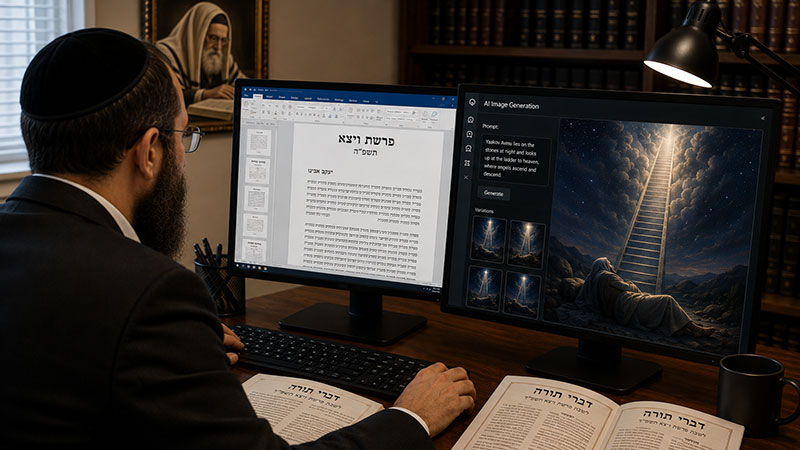


For centuries, every major technological innovation has eventually found its way into the beis midrash. For example, the invention of the codex meant that we stopped using scrolls for actual study. The printing press transformed the dissemination of Torah which until then was largely through manuscripts. Cheap offset printing democratized the publication of sefarim. The personal computer revolutionized typesetting and indexing. The internet made vast libraries of Torah literature available to anyone with a connection. Today, we are experiencing the beginning of another technological revolution: artificial intelligence.
Like any powerful tool, AI can be used wisely or unwisely. It has already begun changing the way Torah scholars research, organize, translate, publish, and teach Torah. Yet even its most enthusiastic proponents recognize a crucial distinction: AI can assist Torah learning, but it can never replace it. The responsibility to understand a sugya, evaluate evidence, weigh conflicting sevaros, and ultimately engage in the mitzvah of talmud Torah remains uniquely human.
What Exactly Is AI?
Artificial intelligence is an umbrella term for computer systems designed to perform tasks that traditionally required human intelligence. Modern AI encompasses several related technologies.
Large language models (LLMs), such as ChatGPT, Gemini, and Grok, can generate human-like text, summarize documents, answer questions, translate languages, and draft written material. Machine learning systems recognize patterns in enormous datasets and improve through experience. Computer vision allows computers to "see" and interpret images, making possible technologies such as Optical Character Recognition (OCR), which converts photographs of printed pages into searchable digital text. Speech recognition converts spoken language into written text, while image and video generation creates entirely new visual content from textual descriptions.
These technologies are increasingly finding applications in Torah scholarship.
Turning Shiurim into Searchable Text
One of the most immediately useful applications is automatic transcription. Many people have long relied on general transcription services to convert lectures into text. Years ago, I frequently used services such as Temi for this purpose. But Torah shiurim present unique challenges. A typical shiur effortlessly jumps between English, Hebrew, Aramaic, and Yiddish – sometimes within a single sentence. Conventional transcription software often becomes hopelessly confused by this constant code-switching. And this is without even getting into accents and different forms of pronunciation (Ashkenazi vs. Sefardi).
That is where Sofer.AI enters the picture. Designed specifically for Torah content, that platform allows users to upload an MP3 or WAV recording of a shiur. Within minutes, it returns a remarkably accurate transcript that correctly handles the multiple languages commonly heard in Torah lectures. Recent updates have added editing tools, outlines, summaries, and improved Hebrew handling, making the platform increasingly useful for serious learners.
A searchable transcript makes it possible to locate a particular insight from a two-hour shiur in seconds rather than listening through the entire recording again.
Giving Old Seforim New Life
Another area where AI is making rapid progress is OCR – Optical Character Recognition. A scanned page is essentially just a picture. While a human can read it effortlessly, a computer sees nothing more than colored pixels. OCR attempts to identify each printed character and reconstruct the underlying text.
The difference is significant. Once a page has been converted into actual text, every word becomes searchable. Quotations can be copied and pasted. Digital editions can be indexed and cross-referenced.
Hebrew OCR has historically been much more difficult than English because of old fonts, obscure abbreviations, and the absence of vowels. Plus, the constant offset reprinting has resulted in many seforim being copies of copies of copies, and we know that each time you photocopy a photocopy, the quality diminishes, resulting in broken letters and other random blotches on the page.
But OCR technology continues improving rapidly. Perhaps no institution illustrates this better than Otzar HaChochmah (founded by Rabbi Erez Sela, author of Arzei HaLevanon on Maseches Nazir), whose enormous digital library contains hundreds of thousands of Torah works. Its search capabilities use OCR, but that technology is pretty iffy for Hebrew (even though it's constantly getting better). The company behind Otzar HaChochmah has recently begun exploring incorporating AI into its OCR workflow. One particularly creative initiative of theirs invites users to manually correct OCR mistakes. Those human corrections were used to train improved AI models, creating a virtuous cycle in which human expertise teaches the machine to perform better. Just recently they released a beta version of their new powerful OCR engine that you can access at https://ocr.otzar.org/
AI as a Research Assistant
Generative AI receives the most public attention, but it also requires the greatest caution. General-purpose chatbots – including ChatGPT, Gemini, and Grok – have improved dramatically over the past year. Nevertheless, they still occasionally "hallucinate" (sometimes called "confabulate") by confidently inventing quotations, citations, or sources that do not actually exist.
For that reason, they are often most effective when assigned focused tasks such as summarizing, translating, reorganizing notes, or brainstorming avenues of inquiry, rather than serving as authoritative Torah reference works.
Dedicated Torah-oriented AI systems seek to reduce this problem by grounding their responses in classical Jewish sources. Examples include Binata, Rav Dicta, Torah AI, RabbiGPT, and similar projects. Even these specialized systems generally emphasize that users must verify all citations and consult qualified rabbinic authorities regarding practical halacha. In other words, responsibility for checking sources always remains with the user, not the software.
I have found that one particularly productive approach is creating custom AI notebooks using Google's Gemini Notebook (which just changed its name recently from NotebookLM). Instead of relying on the model's general knowledge, users upload their own PDFs or – better yet – machine-readable text files. The resulting AI limits itself to the supplied sources. Meaning, you can then ask it questions that it will answer solely based on the information you have provided it. This transforms the software into something akin to a digital chavrusa. It can summarize chapters, outline complicated arguments, locate a forgotten passage, compare parallel discussions, or answer questions based solely on the uploaded seforim.
Breaking Language Barriers
Translation represents another area where AI has become remarkably capable. Many online Torah resources now employ AI-assisted translations to make Hebrew and Aramaic sources more accessible to broader audiences. Websites such as Sefaria increasingly incorporate machine-assisted translations alongside human editing.
In my own experience, modern AI language models generally produce more natural and context-sensitive translations than traditional machine-translation programs like Google Translate. Nevertheless, no translation – human or artificial – should be accepted uncritically. A translator who truly understands both the source language and the target language, plus the underlying Torah concepts, must always review the final product.
Dicta: Building AI for Hebrew
Among the organizations at the forefront of this revolution is Dicta, the Israeli nonprofit founded by Prof. Moshe Koppel together with an interdisciplinary team of computer scientists and Torah scholars.
Rather than building a single chatbot, Dicta has developed an extensive suite of AI-powered tools for Hebrew texts. These include Nakdan Live, which automatically inserts vowels (nikud) into Hebrew text; abbreviation expansion for the countless acronyms (roshei teivos) found throughout rabbinic literature; sophisticated Bible and Talmud search engines; automatic translation; parallel-source detection; OCR enhancement; and the above-mentioned "Rav Dicta," an AI system that answers questions based on classical rabbinic literature while presenting supporting sources. Dicta's mission is not to replace Torah scholarship, but to remove the tedious technical barriers that often stand in its way.
AI in the Classroom
AI is influencing not only research but also Torah education. I have already been seeing written Torah works that obviously use AI-generated images, like a certain commentary on the Mishna and various weekly alonim (short printed pamphlets) that make their way to my shul each Erev Shabbos.
But there's even been an unexpected use of AI-generated videos in Torah study. Anyone who has watched Reb Eli Stefansky's enormously popular Mercaz Daf Yomi (MDY) shiurim has seen this firsthand. Available in both English and Hebrew (and translated into additional languages), his daily shiurim regularly incorporate AI-generated video clips that vividly illustrate Gemara scenarios, reimagine historical settings, and help learners visualize complex halachic concepts. My teenage sons are enthusiastic fans of MDY, and it's easy to see why his brand of Gemara edutainment is so popular. Used thoughtfully, these visual aids make difficult material more memorable without replacing the actual learning.
Other initiatives seek to help educators harness AI responsibly. Shpait.AI, founded by Rabbi Shlomo Einhorn (a former client of mine), combines AI consulting with Jewish educational programming, in order to help schools, businesses, and Torah learners integrate AI tools while remaining grounded in Torah values. Similar initiatives, including Lerns.Ai, JEDAI, and JewPT, are exploring how artificial intelligence can strengthen Jewish education rather than undermine it.
A Powerful Assistant – Not a Substitute
Every technological revolution brings understandable anxiety. Some fear that AI will make human scholarship obsolete. Others dismiss it as a passing fad. History suggests a more balanced conclusion. The printing press did not replace Torah scholars. Radio never became the main platform for delivering shiurim. Digital databases did not eliminate the need for lamdanus. And search engines never rendered chazarah unnecessary.
Artificial intelligence belongs in the same category. It can locate sources more quickly, transcribe shiurim more accurately, translate texts more naturally, organize research more efficiently, and help students navigate the vast oceans of Torah literature. But it cannot determine which interpretation is correct, filter out irrelevant or rejected views, resolve a dispute between the Rambam and the Raavad, appreciate the elegance of a chakirah, or otherwise fulfill the cherished mitzvah of Torah study on our behalf.
Those responsibilities remain exactly where they have always belonged – with flesh-and-blood talmidei chachamim.
The wisest way to approach AI is neither with fear nor with blind enthusiasm, but with discernment. Used responsibly, artificial intelligence may become one of the most valuable additions to the Torah scholar's toolbox since the invention of the printing press.
Rabbi Reuven Chaim Klein is a freelance researcher and scholar living in Beitar Illit. He has authored multiple books and essays, including “Lashon HaKodesh: History, Holiness, & Hebrew” and “God versus Gods: Judaism in the Age of Idolatry.” He studied for over a decade at the Mir Yeshiva in Jerusalem and BMG in Lakewood before he earned his MA in Jewish Education from Middlesex University/London School of Jewish Studies. To contact the author, email [email protected].