
News
CODATA International Training Workshop on Scientific Big Data and Machine Learning
Date: May 10, 2019 WDS Data Stewardship Award 2019: Call for Nominations Open!
Date: May 10, 2019 The Call for Nominations for the 2019 WDS Data Stewardship Award is now open until 29 July 2019. This annual prize celebrates the exceptional contributions of early career researchers to the improvement of scientific data stewardship through their (1) engagement with the community, (2) academic achievements, and (3) innovations. We are also pleased to announce that the process has been opened up from this year, and nominations may now be made any scientific organization, group, body, union, or otherwise. The winner for the 2019 Data Stewardship Award will be presented with their Award and a prize in plenary at the next SciDataCon (dates and venue to be confirmed)—alongside the 2020 Award winner—with their attendance covered by the World Data System. If you know of an early career researcher who deserves to have their accomplishments recognized and highlighted to the international community then please be sure to complete the below form (see notes) and send it to the WDS International Programme Office by 29 July 2019. We also encourage you to disseminate this information far-and-wide. Second White Paper on Next Generation Disaster Data Infrastructure
Date: May 9, 2019 The draft white paper 2 is released for comments to coincide with the upcoming Global Platform in Geneva, 13-17 May 2019. The draft white paper can be accessed here <https://doi.org/10.5281/zenodo.2682654> as Word or PDF or from Google Drive https://docs.google.com/document/d/1qG4EyjuA6i2rEIjnVX2f7b33YJ5x3FYrdZJtG_pK2cI/edit?usp=sharing. We invite comments, constructive criticism and suggestions for improvement by 30 June 2019. Please add comments and suggestions to the Google doc or send them to Edward Chu <[email protected]> and Bapon Fakhruddin <[email protected]>. The report will be refine and improved thanks to your inputs and suggestions. CODATA and IIASA Collaboration Facilitated by TG on Data-Driven Applied Systems Analysis
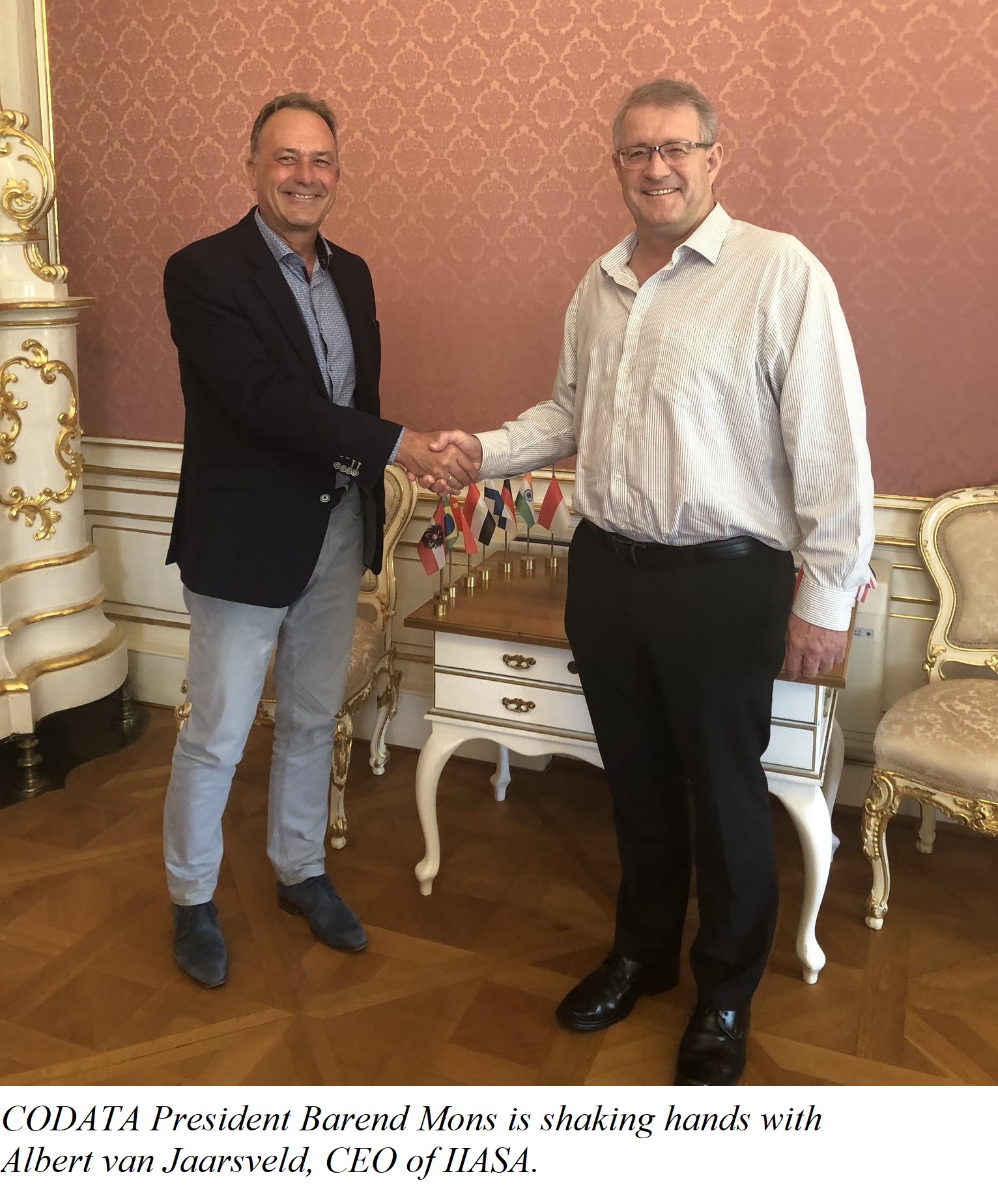
Date: May 9, 2019 On Friday 26 April, a CODATA delegation met with colleagues from IIASA (International Institute for Applied Systems Analysis). The purpose of the meeting was to establish a dialog between IIASA and CODATA and discuss possible joint collaboration. Among principal results was an agreement to held a workshop at the end of 2019 in IIASA with active participation of IIASA programm directors and leaders of a newly elected CODATA Task Group Advanced mathematical tools for data-driven applied systems analysis. The objective of the Task Group is development of an advanced mathematical toolkit for the wide spectrum of applied systems analysis problems, that we can be expected to face in the near future while building a global digital economy. Disaster Risk Reduction and Open Data Newsletter: May 2019 Edition
Date: May 1, 2019 United Nations Office for Disaster Risk Reduction - 2018 Annual Report Date: Apr 30, 2019 The goal of this school is to train researchers in Research Data Science (RDS). RDS refers to the principles and practice of Open Science and research data management and curation, the use of a range of data platforms and infrastructures, large scale analysis, statistics, visualization and modelling techniques, software development and data annotation. These are important tools for extracting useful information from data and these tools are useful in every research area. A 10-day school, organized by the African Open Science Platform (AOSP), the Ethiopian Academy of Sciences (EAS), CODATA: the Committee on Data of the International Science Council, the Research Data Alliance (RDA), the International Centre of Theoretical Physics (ICTP) and East African Institute for Fundamental Research (EAIFR), will be conducted at Addis Ababa University to introduce participants to the skills of RDS. Robert Quick Louise Bezuidenhout Solomon Gizaw This school is open to researchers in every field. Science graduates (masters and doctoral levels) working in data intensive fields will find it particularly useful. Female candidates are strongly encouraged to apply. Selection of participants will be based on their technical background and also the urgency of their needs to apply the tools of RDS. Applications for participation for the workshop must be made at: https://e-applications.ictp.it/applicant/login/9010 Deadline for applications: May 10, 2019 For further information contact: [email protected] There is no registration fee for this event. Some support for travel and accommodation is available and its allocation will be determined during the selection process. Much of this funding is intended for participants from lower and middle income countries. Potential participants have the opportunity to indicate they need support in the application. Self-funded participants are welcome. All applicants are strongly encouraged to look for alternative ‘third-party’ sources of funding to support their participation. Applicants are expected to be based in Ethiopia or certain countries in the surrounding region (Eritrea, South Sudan, Somalia and Central African Republic). The AOSP School of Research Data Science, in collaboration with CODATA-RDA, is open to researchers in any discipline. The data skills taught are also useful for (data) librarians and other research support staff, such as those who envisage a career as data steward or data analysts. Furthermore, people who are more advanced in their careers who would like to improve their data skills as a form of continuing professional development are also eligible. Participants will be selected on merit from a very competitive field. Applicants are urged therefore to ensure they pay careful and full attention to the requirements of the application process. Selected participants for this School will have a baseline of data skills and these will have been tested by an online form. Applicants should pay particular attention to their personal statement and communicate persuasively their reasons for wishing to attend the School: how do they intend to use these skills and experiences, how will participation in the Summer School and/or Advanced Workshops benefit their research or the institution in which they work? Finally, candidates should take pains to ensure that their application is well supported by references from their past or present tutors or line managers. This is particularly important so that the directors and organisers of these events have confidence in the candidate and that the skills learnt will have the maximum benefit and impact. Growing the Conversation on the Science of Data
Date: Apr 29, 2019 One week to go: CALL FOR SESSIONS FOR CODATA 2019 BEIJING: DEADLINE 29 April 2019
Date: Apr 22, 2019 CALL FOR SESSIONS – DEADLINE 29 April 2019 https://conference.codata.org/CODATA_2019/ The CODATA 2019 Conference will be held on 19-20 September 2019 in Beijing, China. This year’s conference theme is: Towards next-generation data-driven science: policies, practices and platforms. The conference will follow a high-level workshop, 17-18 September 2019, on ‘Implementing Open Research Data Policy and Practice’ that will examine such challenges in China and elsewhere in the light of the emergence of data policies and in particular the China State Council’s Notice on ‘Measures for Managing Scientific Data’. Science globally is being transformed by new digital technologies. At the same time addressing the major global challenges of the age requires the analysis of vast quantities of heterogeneous data from multiple sources. In response, many countries, regions and scientific domains have developed Research Infrastructures to assist with the management, stewardship and analysis. These developments have been stimulated by Open Science policies and practices, both those developed by funders and those that have emerged from communities. The FAIR principles and supporting practices seek to accelerate this process and unlock the potential of analysis at scale with machines. This conference provides a significant opportunity to survey and examine these developments from a global perspective. The convening organisations are pleased to invite you to contribute to the program by proposing sessions. The deadline for session proposals is 29 April 2019: https://conference.codata.org/CODATA_2019/submit/ All proposals related to open science and open data, FAIR data, research data management and stewardship, research infrastructures and platforms are welcomed. The following themes are of particular interest: 1 February: Call for Session Proposals Released 22 April: Registration Open 29 April: Deadline for session proposals 13 May: Accepted session proposals notified; call for presentations and posters released 17 June: Deadline for presentation submissions and first round of poster submissions 8 July: Submitters notified of acceptances of full presentations and posters 1 August: Close of second round of poster submissions 18 August: Close of early bird registration 17-18 September: High Level Workshop on 'Implementing Open Research Data Policy and Practice’ 19-20 September: CODATA 2019 Conference ‘Towards next-generation data-driven science: policies, practices and platforms’ The Friendship Hotel of Beijing is one of the largest garden-style hotels in Asia. Located in the heart of ZhongGuanCun Hi-Tech Zone, the Friendship Hotel neighbours many world famous tourist sites and universities such as Tsinghua and Peking University, the Summer Palace. Address: Zhongguancun South St. Beijing 100873, P.R. China Website: http://www.friendshipshotel.com/en/ Dialogue on Open Science and FAIR Data - Kenya
Date: Apr 18, 2019 Public Lecture: Openness in Data, Science and Governance
Date: Apr 15, 2019 CODATA's Executive Committee member, Professor Muliaro Wafula will be giving a public lecture on 'Openness in Data, Science and Governance' at the Jomo Kenyatta University of Agriculture and Technology. CODATA's President, Barend Mons and CODATA's Executive Director, Simon Hodson will attend this event. Location: Jomo Kenyatta University of Agriculture and Technology, ICT Centre of Excellence and Open Data-iCEOD. Venue: Assembly Hall, JKUAT Main Campus Time: 1.50 pm – 4.00 pm Date: Monday, April 15th, 2019 Registration: Entry is free

9-20 September 2019, Beijing, China
Participants in the Training Workshop will also attend the CODATA 2019 Beijing Conference: Towards next-generation data-driven science: policies, practices and platforms. Applicants are encouraged also to submit a paper or poster for the conference.
The deadline for applications is 11:59 pm CST (UTC+8) on 30 May.
Due to advances in information technology, we are witnessing an explosion in digital data through all forms of human activity: much of this data can also contribute to the production of knowledge for all domains of enquiry and across domains, as well as providing essential information for decision-making in response to global challenges such as sustainable development, disaster risk reduction, climate change, the growth of cities, the maintenance of biodiversity etc., etc. In order to meet the many global challenges and to take advantage of the opportunities of the data revolution, it is imperative to develop global skills and capacity in the science of data.
The mission of CODATA, the Committee on Data of the International Science Council, is to support the advancement of science as a global public good by promoting improved research data management and use, and by advancing data science and the enhanced exploitation of data in all areas of scientific research. Building data science capacity in countries with developing and emerging economies (in part through promoting technical training in data science, in data management and in the implications of the data revolution for science) is an important part of CODATA’s strategy.
The training program offered aims to engage participants with a number of facets of data science and data management in the age of the data revolution and Big Data. Topics include, but are not limited to:
You will be asked to complete an application form with personal information and to submit supporting document. Once you have created an account and entered the personal information you will need to click on [Submission] to access the page to upload your supporting document.
The personal statement should describe your interests and why you want to do the Training Workshop. You should answer these questions:
 The work of Linked Open Data for Global Disaster Risk Research (LODGD) task group of CODATA is an increasingly important activity linking four global milestones – the Sendai Framework for Disaster Risk Reduction (SFDRR), Sustainable Development Goal (SDG), Paris Agreement for Climate Change and the New Urban Agenda (NUA)-Habitat III. The Sendai Framework recognises this need in its guiding principles: ‘Disaster risk reduction requires a multi-hazard approach and inclusive risk-informed decision-making based on the open exchange and dissemination of disaggregated data, including by sex, age and disability, as well as on easily accessible, up-to-date, comprehensible, science-based, non-sensitive risk information….’ (Sendai Framework 2015 paragraph 19g). However, assessment processes are challenging, as they require collaboration and participation across multiple sectors, data integration, interpretation as well as the establishment of a mechanism to share data within and across UN member states, the UN system and other stakeholders. The LODGD produced series of white papers to provide policy guidance, technical understanding on data and disaster science to informs readers concisely about a complex issues, gap analysis on data interconnectivity, data infrastructure and data driven policies on disaster risk reduction.


What frameworks can be used to localise global and national indicators for sustainable development? These reports from the Sustainable Development Solutions Network document the efforts to bring Sustainable Development goals to the sub-national level.
What frameworks can be used to localise global and national indicators for sustainable development? These reports from the Sustainable Development Solutions Network document the efforts to bring Sustainable Development goals to the sub-national level.
 The African Open Science Platform School of Research Data Science, in collaboration with the CODATA-RDA Data Schools Initiative will take place on 17-28 June 2019 at Addis Ababa University, Ethiopia. The deadline for applications is 10 May: https://e-applications.ictp.it/applicant/login/9010
Topics covered
Directors
UITS Research Technologies, Indiana University
rquick (at) iu.edu
Institute for Science, Innovation and Society, University of Oxford
louise.bezuidenhout [at] insis.ox.ac.uk
Department of Computer Science, Addis Ababa University
solomong [at] aau.edu.etParticipation Information
Information for Applicants

'Thanks to Sarah’s great work, DSJ has a bright future as submissions continue to increase in number and quality. DSJ was ahead of its time when it was founded in the 1990s. I am eager to explore how it can continue to push important conversations forward. I welcome all your ideas. Please tell me what you think. Better yet, tell the community through a submission to DSJ https://datascience.codata.org/submit/start/ !
'It is time for me to hand over the role of EiC to another, and it is with no small amount of sadness that I do so. Being EiC has been incredibly rewarding (and occasionally infuriating) and I have learned a great deal from it. I am very pleased to know that Mark Parsons is taking over the role, and know that the journal will be in safe, knowledgeable hands.
'It only remains for me to say my farewells and thank yous. Thank you to the authors, without whom there would be no articles to publish. A thousand thank yous to all my editors, reviewers, colleagues and friends – your efforts on behalf of the journal are deeply, deeply appreciated, as is your wisdom and expertise. I wish you all the very best for the future, and look forward to reading more excellent papers published in the DSJ!’

CODATA 2019: Towards next-generation data-driven science: policies, practices and platforms
1. FAIR and Open data policies
2. Advanced research infrastructures for Open Science and FAIR data
3. Data driven scientific discovery and decision-making.
4. Data intensive research for international scientific and global challenges
Programme
Important dates:
Organization
Possible venue (TBC): the Friendship Hotel of Beijing.

Read Prof. Muliaro: The advent of big data heralds huge opportunities
