I was talking to Chetan Puttagunta yesterday, and we both agreed that 2018 has been an incredible year for Open Source businesses so far. (Chetan helped lead NEA's investment in Acquia, but is also an investor in Mulesoft, MongoDB and Elastic.)
Between a series of acquisitions and IPOs, Open Source companies have shown incredible financial returns this year. Just look at this year-to-date list:
Company
Acquirer
Date
Value
WP Engine
Silverlake (P/E)
January 2018
$250 million
CoreOS
RedHat
January 2018
$250 million
Mulesoft
Saleforce
May 2018
$6,5 billion
Magento
Adobe
June 2018
$1,7 billion
GitHub
Microsoft
June 2018
$7,5 billion
Suse
EQT partners
July 2018
$2,5 billion
Elastic
IPO
September 2018
$4,9 billion
For me, the success of Open Source companies is not a surprise. In 2016, I explained how open source crossed the chasm in 2016, and predicted that proprietary software giants would soon need to incorporate Open Source into their own offerings to remain competitive:
The FUD-era where proprietary software giants campaigned aggressively against open source and cloud computing by sowing fear, uncertainty and doubt is over. Ironically, those same critics are now scrambling to paint themselves as committed to open source and cloud architectures.
Last week, I had a chance to meet with Inrupt, a startup founded by Sir Tim Berners-Lee, who is best known as the inventor of the World Wide Web. Inrupt is based in Boston, so their team stopped by the Acquia office to talk about the new company.
Inrupt's mission is to give individuals control over their own data. Today, a handful of large platform companies (such as Facebook) control the media and flow of information for a majority of internet users. These companies have profited from centralizing the Open Web and lack transparent data privacy policies on top of that. Inrupt's goal is not only to improve privacy and data ownership, but to take back power from these large platform companies.
Inrupt will leverage Solid, an open source, decentralized web platform that Tim and others have been developing at MIT. Solid gives users a choice of where their personal data is stored, how specific people and groups can access select elements, and which applications can use it. Inrupt is building a commercial ecosystem around Solid to fuel its success. If Solid and/or Inrupt are widely adopted, it could radically change the way web sites and web applications work today.
As an advocate for the Open Web, I'm excited to see how Inrupt's mission continues to evolve. I've been writing about the importance of the Open Web for many years and even proposed a solution that mirrors Solid, which I called a Personal Information Broker. For me, this is an especially exciting and important mission, and I'll be rooting for Inrupt's success.
My unsolicited advice: disrupt the digital marketing world
It was really interesting to have the Inrupt team visit the Acquia office, because we had the opportunity to discuss how their technology could be applied. I shared a suggestion to develop a killer application that surround "user-controlled personalization".
Understanding visitors' interests and preferences to deliver personalized experiences is a big business. Companies spend a lot of time and effort trying to scrape together information about its website's visitors. However, behavior-based personalization can be slow and inaccurate. Marketers have to guess a visitor's intentions by observing their behavior; it can take a long time to build an accurate profile.
By integrating with a "Personal Information Broker" (PIB), marketers could get instant user profiles that would be accurate. When a user visits a site, they could chose to programmatically share some personal information (using a standard protocol and standard data schema). After a simple confirmation screen, the PIB could programmatically share that information and the site would instantly be optimized for the user. Instead of getting "cold leads" and trying to learn what each visitor is after, marketers could effectively get more "qualified leads".
It's a win not only for marketers, but a win for the site visitor too. To understand how this could benefit site visitors, let's explore an example. I'm 6'5" tall, and using a commerce site to find a pair of pants that fit can be a cumbersome process. I wouldn't mind sharing some of my personal data (e.g. inseam, waist size, etc) with a commerce site if that meant I would instantly be recommended pants that fit based on my preferences. Or if the store has no pants that would fit, it could just tell me; Sorry, we currently have no pants long enough for you!. It would provide me a much better shopping experience, making it much more likely for me to come back and become a long-time customer.
It's a simple idea that provides a compelling win-win for both the consumer and retailer, and has the opportunity to disrupt the digital sales and marketing world. I've been thinking a lot about user-controlled personalization over the past few years. It's where I'd like to take Acquia Lift, Acquia's own personalization product.
Inrupt's success will depend on good execution
I love what Solid and Inrupt are building because I see a lot of potential in it. Disrupting the digital marketing world is just one way the technology could be applied. Whatever they decide to focus on, I believe they are onto something important that could be a foundational component of the future web.
However, it takes a lot more than a good idea to build a successful company. For startups, it's all about good execution, and Inrupt has a lot of work to do. Right now, Inrupt has prototype technology that needs to be turned into real solutions. The main challenge is not building the technology, but to have it widely adopted.
For an idea this big, Inrupt will have to develop a protocol (something Tim Berners-Lee obviously has a lot of experience with), build out a leading Open Source reference implementation, and foster a thriving community of developers that can help build integrations with Drupal, WordPress and hundreds of other web applications. Last but not least, Inrupt needs to look for a sustainable business model by means of value-added services.
The good news is that by launching their company now, Inrupt has put themselves on the map. With Tim Berners-Lee's involvement, Inrupt should be able to attract top talent and funding for years to come.
Long story short, I like what Inrupt is doing and believe it has a lot of potential. I'm not sure what specific problem and market they'll go after, but I think they should consider going after "user-controlled personalization" and disrupt the digital marketing world. Regardless, I'll be paying close attention, will be cheering for their success and hopefully find a way to integrate it in Acquia Lift!
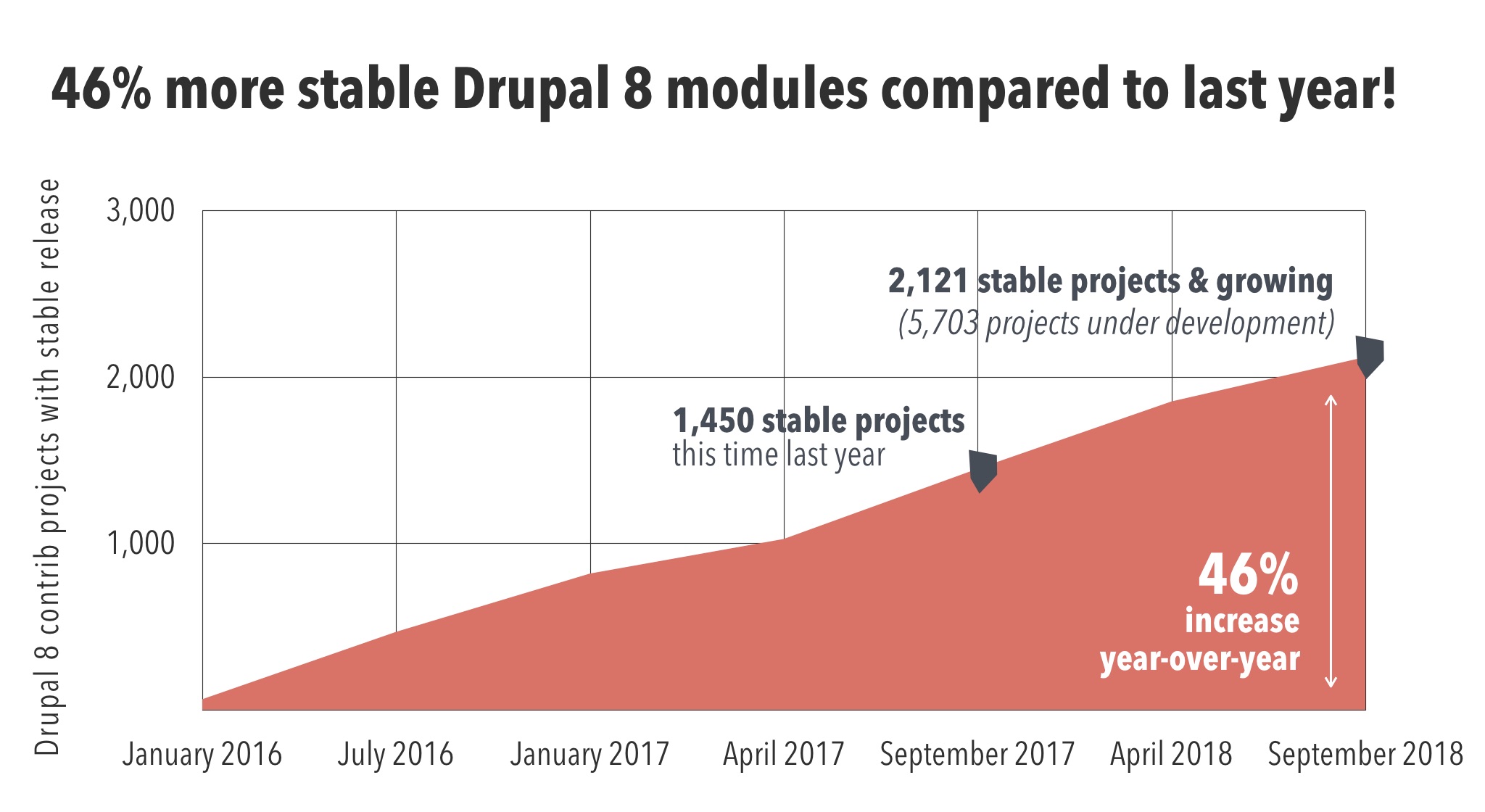
I started my keynote by highlighting this month's Drupal 8.6.0 release. Drupal 8.6 marks the sixth consecutive Drupal 8 release that has been delivered on time. Compared to one year ago, we have 46 percent more stable Drupal 8 modules. We also have 10 percent more contributors are working on Drupal 8 Core in comparison to last year. All of these milestones indicate that the Drupal 8 is healthy and growing.
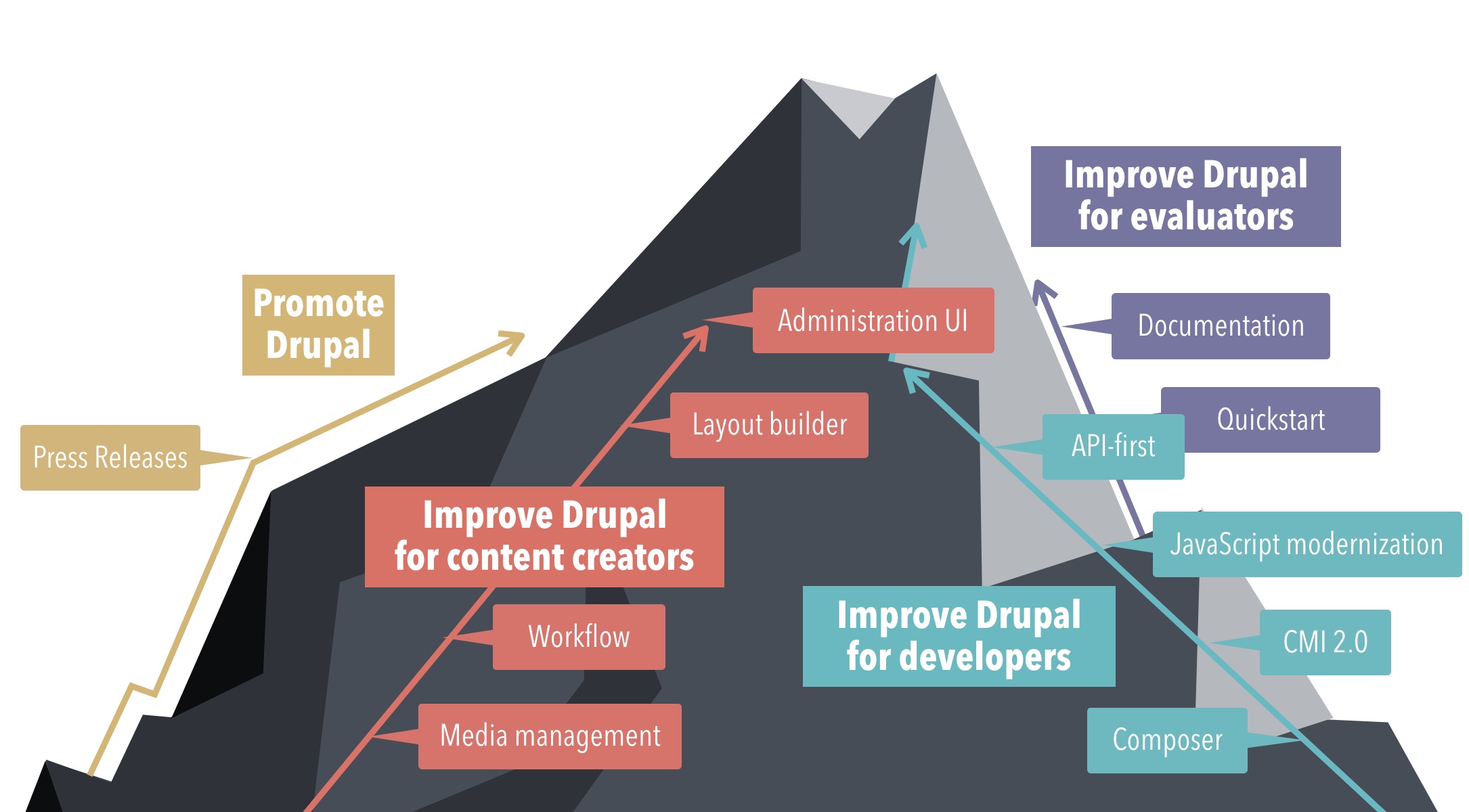
Next, I gave an update on our strategic initiatives:
The expectations of content creators are changing. For Drupal to be successful, we have to continue to deliver on their needs by providing more powerful content management tools, in addition to delivering simplicity though drag-and-drop functionality, WYSIWYG, and more.
With the release of Drupal 8.6, we have added new functionality for content creators by making improvements to the Media, Workflow, Layout and Out-of-the-Box initiatives. I showed a demo video to demonstrate how all of these new features not only make content authoring easier, but more powerful:
We also need to improve the content authoring experience through a modern administration user interface. We have been working on a new administration UI using React. I showed a video of our latest prototype:
Extended security coverage for Drupal 8 minor releases
I announced an update to Drupal 8's security policy. To date, site owners had one month after a new minor Drupal 8 release to upgrade their sites before losing their security updates. Going forward, Drupal 8 site owners have 6 months to upgrade between minor releases. This extra time should give site owners flexibility to plan, prepare and test minor security updates. For more information, check out my recent blog post.
Make Drupal better for evaluators
One of the most significant updates since DrupalCon Nashville is Drupal's improved evaluator experience. The time required to get a Drupal site up and running has decreased from more than 15 minutes to less than two minutes and from 20 clicks to 3. This is a big accomplishment. You can read more about it in my recent blog post.
Promote Drupal
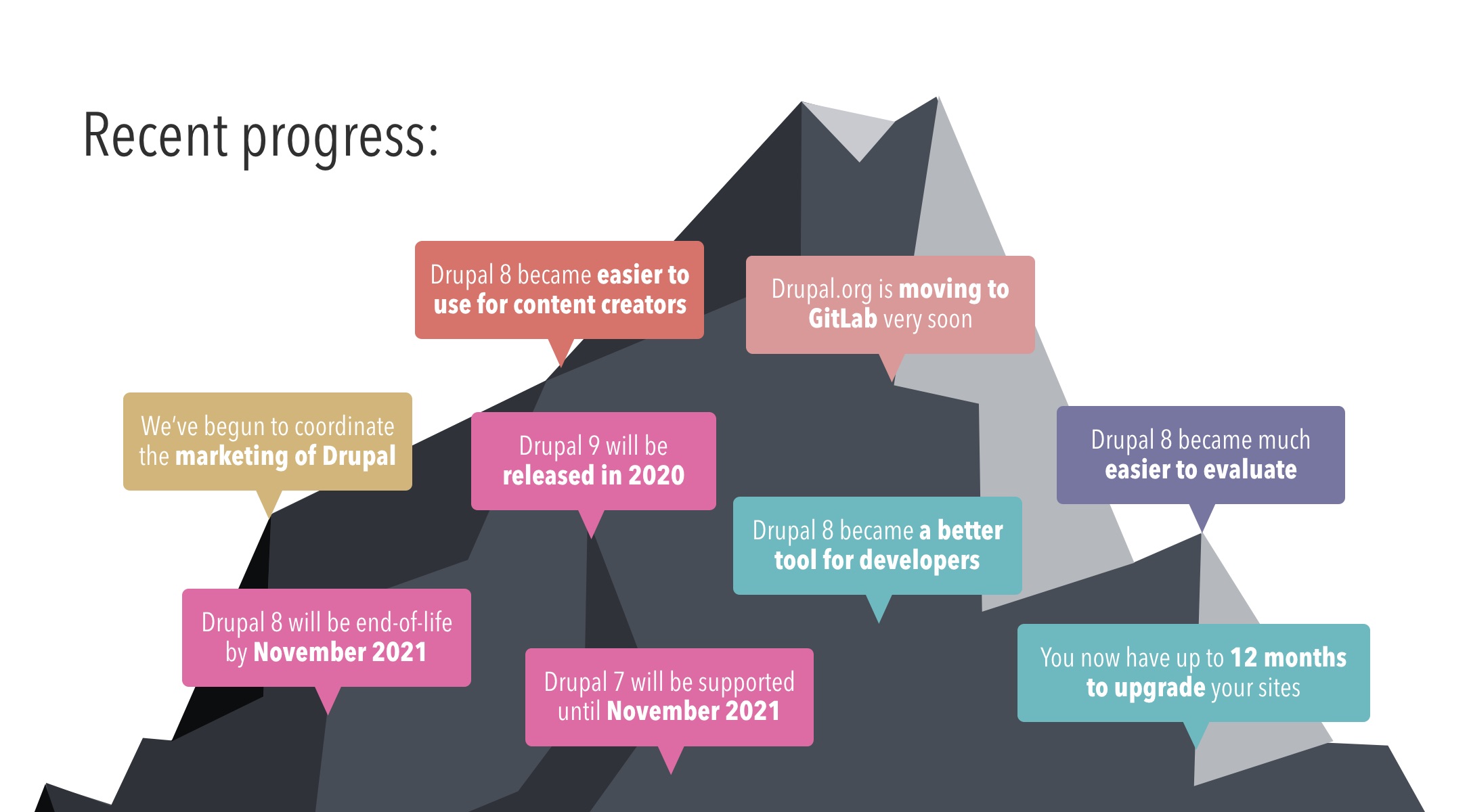
After launching Promote Drupal at DrupalCon Nashville, we hit the ground running with this initiative and successfully published a community press release for the release of Drupal 8.6, which was also translated into multiple languages. Much more is underway, including building a brand book, marketing collaboration space on Drupal.org, and a Drupal pitch deck.
The Drupal 9 roadmap and a plan to end-of-life Drupal 7 and Drupal 8
To keep Drupal modern, maintainable, and performant, we need to stay on secure, supported versions of Drupal 8's third-party dependencies. This means we need to end-of-life Drupal 8 with Symfony 3's end-of-life. As a result, I announced that:
Historically, our policy has been to only support two major versions of Drupal; Drupal 7 would ordinarily reach end of life when Drupal 9 is released. Because a large number of sites might still be using Drupal 7 by 2020, we have decided to extend support of Drupal 7 until November 2021.
Finally, the Drupal Association is working to integrate GitLab with Drupal.org. GitLab will provide support for "merge requests", which means contributing to Drupal will feel more familiar to the broader audience of open source contributors who learned their skills in the post-patch era. Some of GitLab's tools, such as inline editing and web-based code review, will also lower the barrier to contribution, and should help us grow both the number of contributions and contributors on Drupal.org.
To see an exciting preview of Drupal.org's gitlab integration, watch the video below:
Thank you
Our community has a lot to be proud of, and this progress is the result of thousands of people collaborating and working together. It's pretty amazing! The power of our community isn't just visible in minor releases or a number of stable modules. It was also felt at this very conference, as many volunteers gave their weekends and evenings to help organize Drupal Europe in the absence of a DrupalCon Europe organized by the Drupal Association. From code to community, the Drupal project is making an incredible impact. I look forward to celebrating our community's work and friendships at future Drupal conferences.
Seven months ago, Matthew Grasmick published an article describing how hard it is to install Drupal. His article included the following measurements for creating a new application on his local machine, across four different PHP frameworks:
Platform
Clicks
Time
Drupal
20+
15:00+
Symfony
3
1:55
WordPress
7
7:51
Laravel
3
17:28
The results from Matthew's blog were clear: Drupal is too hard to install. It required more than 15 minutes and 20 clicks to create a simple site.
Seeing these results prompted me to launch a number of initiatives to improve the evaluator experience at DrupalCon Nashville. Here is the slide from my DrupalCon Nashville presentation:
A lot has happened between then and now:
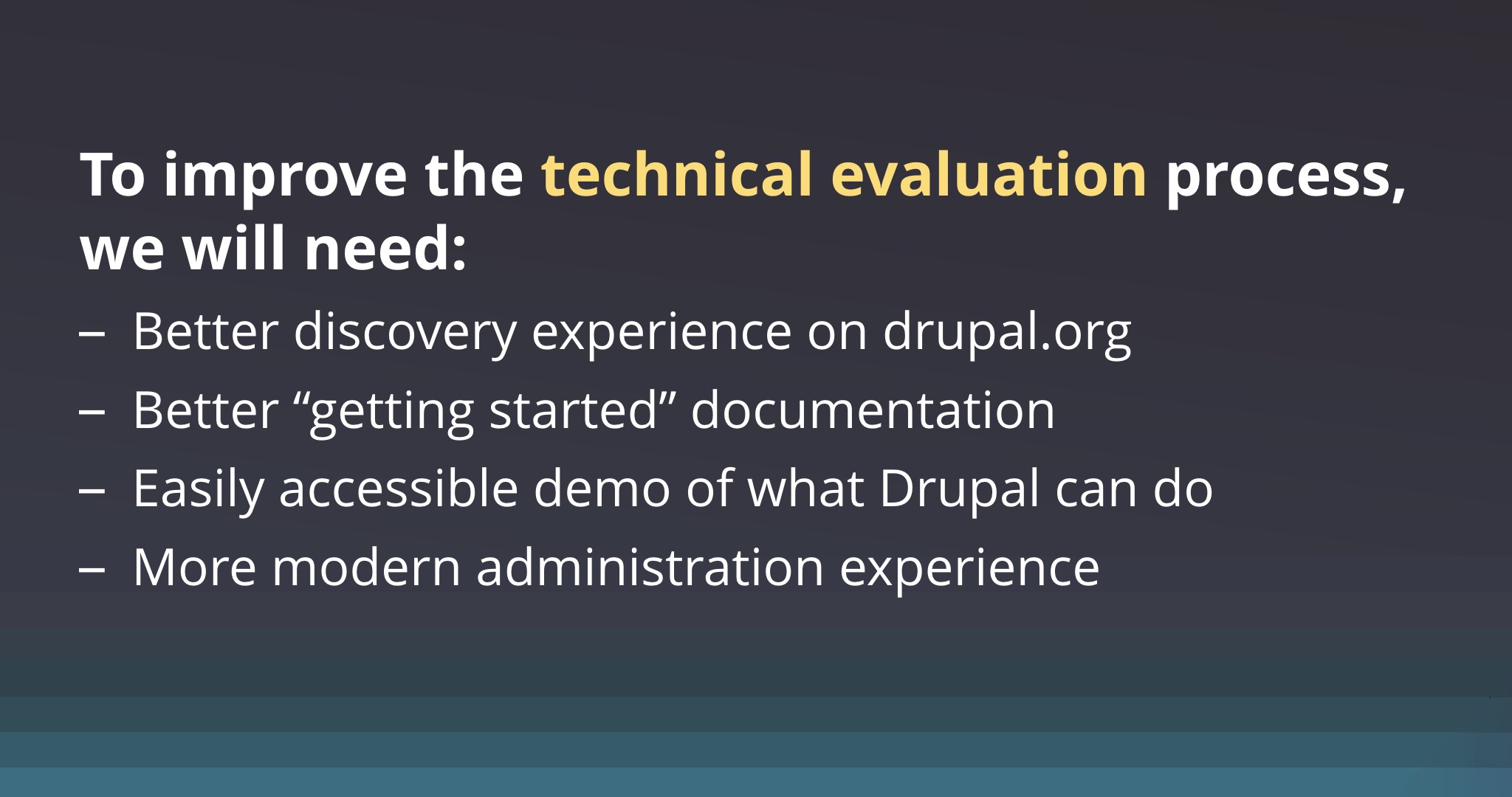
We improved the download page to improve the discovery experience on drupal.org
We started working on a more modern administration experience (in progress)
You can see the result of that work in this video:
Thanks to this progress, here is the updated table:
Platform
Clicks
Time
Drupal
3
1:27
Symfony
3
1:55
WordPress
7
7:51
Laravel
3
17:28
Drupal now requires the least time and is tied for least clicks! You can now install Drupal in less than two minutes. Moreover, the Drupal site that gets created isn't an "empty canvas" anymore; it's a beautifully designed and fully functional application with demo content.
Copy-paste the following commands in a terminal window if you want to try it yourself:
mkdir drupal && cd drupal && curl -sSL https://www.drupal.org/download-latest/tar.gz | tar -xz --strip-components=1
php core/scripts/drupal quick-start demo_umami