
Heading home with a new companion in tow.
cc. @brownorama

Journal 2408 Links 6794 Articles 66 Notes 3321
Heading home with a new companion in tow.
cc. @brownorama
Checked in at Marymoor Amphitheatre. Beck — with Jessica, Jeb

Mercer Street Books haul. 📚
If Safari is updating its “share” functionality to look for canonical URLs, then that should work not just for AMP pages, but also Medium posts that include a canonical URL (like the ones created by posting to the Medium API, which is what I’m doing).
Jason lists the stages of gradually turning the Cloud Four site into a progressive web app:
- Jul 13: Our redesign launches
- Oct 3: Service worker added
- Oct 18: More offline functionality and faster performance
- Nov 22: Web notifications
- Dec 7: Small tweaks and “launch”
And you can just keep incrementally adding and tweaking:
You don’t have to wait to bundle up a binary, submit it to an app store, and wait for approval before your customers benefit.
Checked in at La Marzocco Cafe. with Jessica
I quite like this proposal for geo element in HTML, especially that it has a fallback built in (like video). I’m guessing the next step is to file an issue and create a web component to demonstrate how this could work.
That brings up another question: what do you name a custom element that you’d like to eventually become part of the spec? You can’t simply name it geo because you have to include a hyphen. geo-polyfill? geo-proposal? or polyfill-geo? proposal-geo?

When @wordridden met @IsabellaABT.
Alla looks at ways of documenting animations into a pattern library. I tell ya, her book is going to be unmissable!
Paul Ford jots down his thoughts on that report on Ev’s blog:
The web is inherently decentralized, which has made it much easier for large companies to create large, centralized platforms. It’s a paradox and very thorny. I’m writing this on a centralized platform called Medium. Clap!
I like his geeky idea for mini self-contained social networks:
What I want is like, 5 of these little computers and whenever I see a truly trusted friend, I just give them one. And they take it home, and plug it in somewhere, and now we’re on the same, secure network together. Sharing files and with a little messageboard. Maybe after 5 computers the network can’t get any bigger. And if you unplug one your whole archive goes down. I don’t know. I’m riffing here.
A report by the Digital Currency Initiative and the Center for Civic Media. Download the PDF or read the executive summary.
In this report, we explore two important ways structurally decentralized systems could help address the risks of mega-platform consolidation: First, these systems can help users directly publish and discover content directly, without intermediaries, and thus without censorship. All of the systems we evaluate advertise censorship-resistance as a major benefit. Second, these systems could indirectly enable greater competition and user choice, by lowering the barrier to entry for new platforms. As it stands, it is difficult for users to switch between platforms (they must recreate all their data when moving to a new service) and most mega-platforms do not interoperate, so switching means leaving behind your social network.
After the eclipse I climbed down from the hilltop and reconnected with the world. That’s when I heard the news. Brian Aldiss had passed away.
He had a good innings. A very good innings. He lived to 92 and was writing right up to the end.
I’m trying to remember the first thing I read by Brian Aldiss. I think it might have been The Billion Year Spree, his encyclopaedia of science fiction. The library in my hometown had a copy when I was growing up, and I was devouring everything SF-related.
Decades later I had the great pleasure of meeting the man. It was 2012 and I was in charge of putting together the line-up for that year’s dConstruct. I had the brilliant Lauren Beukes on the line-up all the way from South Africa and I thought it would be fun to organise some kind of sci-fi author event the evening before. Well, one thing led to another: Rifa introduced me to Tim Aldiss, who passed along a request to his father, who kindly agreed to come to Brighton for the event. Then Brighton-based Jeff Noon came on board. The end result was an hour and a half in the company of three fantastic—and fantastically different—authors.
I had the huge honour of moderating the event. Here’s the transcript of that evening and here’s the audio.
That evening and the subsequent dConstruct talks—including the mighty James Burke—combined to create one of the greatest weekends of my life. Seriously. I thought it was just me, but Chris has also written about how special that author event was.
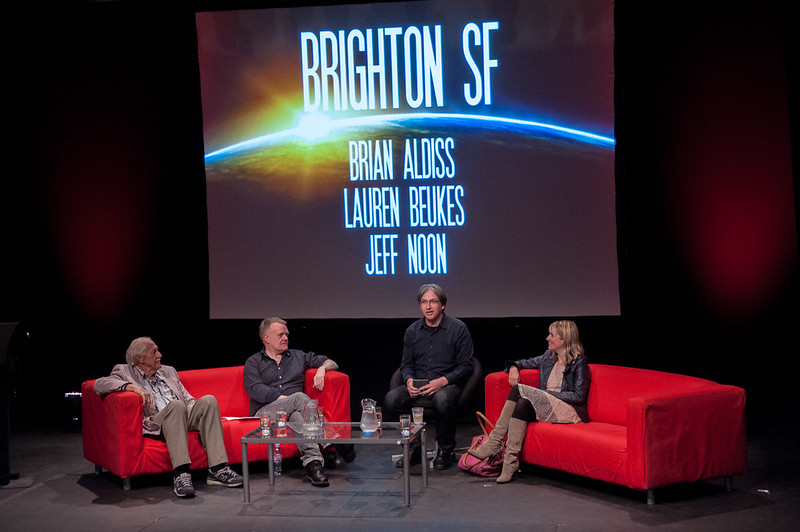
Brian Aldiss was simply wonderful that evening. He regaled us with the most marvellous stories, at times hilarious, at other times incredibly touching. He was a true gentleman.
I’m so grateful that I’ll always have the memory of that evening. I’m also very grateful that I have so many Brian Aldiss books still to read.
I’ve barely made a dent into the ludicrously prolific output of the man. I’ve read just some of his books:
Then there are the short stories. Hundreds of ‘em! Most famously Super-Toys Last All Summer Long—inspiration for the Kubrick/Spielberg A.I. film. It’s one of the most incredibly sad stories I’ve ever read. I find it hard to read it without weeping.

Whenever a great artist dies, it has become a cliché to say that they will live on through their work. In the case of Brian Aldiss and his astounding output, it’s quite literally true. I’m looking forward to many, many years of reading his words.
My sincerest condolences to his son Tim, his partner Alison, and everyone who knew and loved Brian Aldiss.
Interface is a font for highly legible text on computer screens.
And it’s free!
This looks like an interesting network-level approach to routing around the censorship of internet-hostile governments like China, Turkey, Australia, and the UK.
Rather than trying to hide individual proxies from censors, refraction brings proxy functionality to the core of the network, through partnership with ISPs and other network operators. This makes censorship much more costly, because it prevents censors from selectively blocking only those servers used to provide Internet freedom. Instead, whole networks outside the censored country provide Internet freedom to users—and any encrypted data exchange between a censored nation’s Internet and a participating friendly network can become a conduit for the free flow of information.
Lin gives a deep dive into Firefox’s new CSS engine specifically, but this is also an excellent primer on how browsers handle CSS in general: parsing, styling, layout, painting, compositing, and rendering.
I lived in Germany for the latter half of the nineties. On August 11th, 1999, parts of Germany were in the path of a total eclipse of the sun. Freiburg—the town where I was living—wasn’t in the path, so Jessica and I travelled north with some friends to Karlsruhe.
The weather wasn’t great. There was quite a bit of cloud coverage, but at the moment of totality, the clouds had thinned out enough for us to experience the incredible sight of a black sun.
(The experience was only slightly marred by the nearby idiot who took a picture with the flash on right before totality. Had my eyesight not adjusted in time, he would still be carrying that camera around with him in an anatomically uncomfortable place.)
Eighteen years and eleven days later, Jessica and I climbed up a hill to see our second total eclipse of the sun. The hill is in Sun Valley, Idaho.

Travelling thousands of miles just to witness something that lasts for a minute might seem disproportionate, but if you’ve ever been in the path of totality, you’ll know what an awe-inspiring sight it is (if you’ve only seen a partial eclipse, trust me—there’s no comparison). There’s a primitive part of your brain screaming at you that something is horribly, horribly wrong with the world, while another part of your brain is simply stunned and amazed. Then there’s the logical part of your brain which is trying to grasp the incredible good fortune of this cosmic coincidence—that the sun is 400 times bigger than the moon and also happens to be 400 times the distance away.
This time viewing conditions were ideal. Not a cloud in the sky. It was beautiful. We even got a diamond ring.
I like to think I can be fairly articulate, but at the moment of totality all I could say was “Oh! Wow! Oh! Holy shit! Woah!”

Our two eclipses were separated by eighteen years, but they’re connected. The Saros 145 cycle has been repeating since 1639 and will continue until 3009, although the number of total eclipses only runs from 1927 to 2648.
Eighteen years and twelve days ago, we saw the eclipse in Germany. Yesterday we saw the eclipse in Idaho. In eighteen years and ten days time, we plan to be in Japan or China.
Luke has been asking people to imagine ways of augmenting the world. Spimes are back, baby!
Deb Chachra:
If research on biases has told us anything, it is that humans make better decisions when we learn to recognize and correct for bias.
Matt writes about the pleasure of independent publishing on the web today:
It feels transgressive to have a website in 2017. Something about having a domain name and about coding HTML which is against the grain now. It’s something big companies do, not small groups. We’re supposed to put our content on Facebook or Medium, or keep our publishing to an email newsletter. But a website?
But he points out a tension between the longevity that you get from hosting the canonical content yourself, and the lack of unified analytics when you syndicate that content elsewhere.
There’s no simple online tool that lets me add up how many people have read a particular story on Upsideclown via the website, the RSS feed, and the email newsletter. Why not? If I add syndication to Facebook, Google, and Apple, I’m even more at sea.
Checked in at Hot Water Inn. with Jessica