

The first thing every business owner needs is a professional email address. After you setup your website, the next most important to do is create a professional branded email address. In this article, we will show you how to setup professional email address with Google Apps and Gmail.

What is a Professional Email Address?
A professional email is the one that has your business name in it. For example, [email protected] is a professional email address.
Email accounts on free email services like [email protected] are not good because they do not look professional.
For a professional email address, you will need a domain name and a website. We have step by step guide on how to choose a domain name and how to install WordPress to quickly setup a website.
If you already have a domain name and a website, then you are all set to have your own professional email address.
Why Use Google Apps for Professional Branded Email Address?
You might be thinking why use Google Apps when most WordPress hosting companies offer unlimited email accounts with your own domain name?
Email is one of the most crucial communication tool for any individual or business. With an unreliable email service, you can miss important emails, and this can hurt your business.
Most hosting email servers are unreliable, restrictive, isolated, and less secure. You wouldn’t even know if the email you sent was delivered.
This is where Google Apps for Work and Gmail comes in.
Gmail is already the industry leader in email and with Google Apps for Work, you can use your professional branded email address with Gmail.
Here are some of the benefits of using Google Apps and Gmail for a professional email address.
- Professional business email address on your own domain.
- Gmail’s rock solid security and spam filters
- 30 GB – Double the storage of a free Gmail Account.
- Manage email even when offline using Gmail app on mobile devices
- Works anywhere web, mobile, tablet, you name it.
- Works great with Outlook and can even sync old Outlook accounts.
- Each user can have up to 30 email aliases.
- Use Google Calendar, Google Hangouts for chat, video, and voice calls on your own business email address.
- No advertisements and 24/7 professional support whenever you need help
- Works seamlessly with your WordPress site.
- Most important of all, high deliverability, no delays, no ending up in spam folder.
Now that you know why using Google Apps for professional is important, let’s take a look at how to set up a branded professional email address with Google Apps.
Editor’s Note: We use Google Apps for all of our professional email addresses, and can honestly say it’s the best.
Setting up a Professional Email Address with Google Apps and Gmail
First you will need to signup for a Google Apps for Work account.
It costs around $5/month for each user. If you pay annually, then you get 2 months free ($50/year per user).
Google Apps for Work also offer a free 30 day trial, which allows you to test drive everything before you make up your mind. Basically its all the powerful features you’re used to if Gmail, Drive, Calendar, etc (but now it’s for your business).
Simply visit the Google Apps for Work website and click on the Get Started button.

Fill out a form with your first and last name, an existing email address, and your phone number.
Click on the next button to continue.

On the next screen, you will be asked if you would like to signup for a new domain name, or use a domain name that you already own.
If you don’t have your own WordPress site or a domain name, then you can buy a new domain here. It will cost you $8 per year, and your email will be automatically setup by Google. You will not need to follow rest of the tutorial.
However, if you are an owner of a self-hosted WordPress site, then you already own a domain name. Simply enter your WordPress site’s domain name and click on the next button.
Google will now ask you to create your Google Apps account. This is where you will pick your business email address like [email protected].
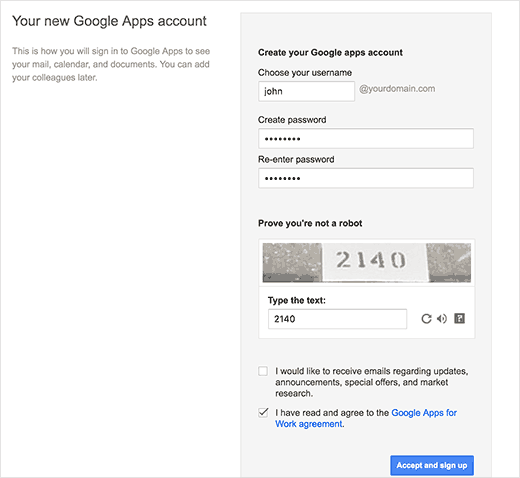
This will become your first email address and will also become your Google Apps admin account. You can always add more email addresses and email aliases later on.
Fill in the username and password and then click on accept and sign up button.
Google will now create a Google Apps business account for you. Upon completion, it will show you the progress dashboard.
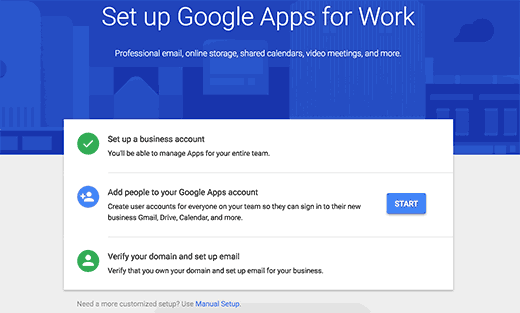
As you can see in the screenshot, that you have completed the first step of the setup.
Now you need to add users to your Google Apps account. Simply click on the start button next to ‘Add people to your Google Apps account’.
This will bring up a popup where you can add more users if you need to.
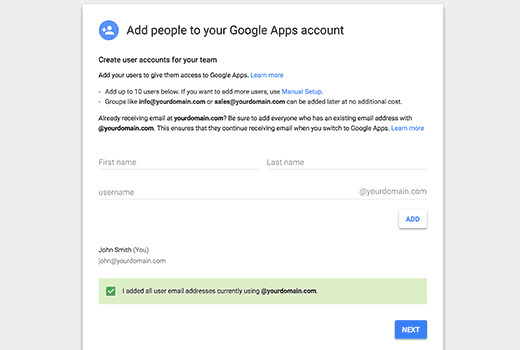
If you just want to keep that single user, then you need to scroll down and just check the box next to ‘I added all user email addresses currently using @yourdomain.com.’
Click on the next button to continue.
The last step in the Google Apps for Work setup wizard is to verify the ownership of your domain name.
Google offers multiple ways to do that. You can add a meta tag to your website’s header, upload a file to your webserver, or add a TXT/CNAME record. You can choose any one of these methods.
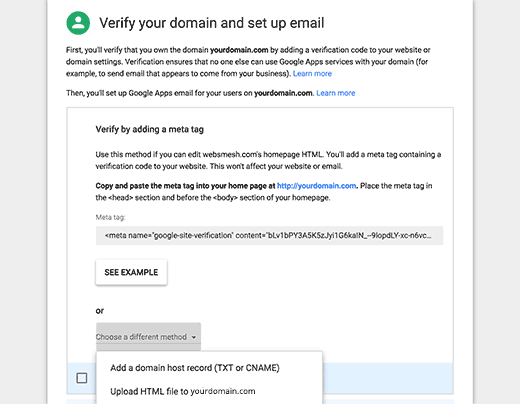
The easiest one is to add a meta tag to your website’s header. Copy the meta tag code shown on Google Apps setup screen.
You will need to login to admin area of your WordPress site.
After that install and activate the Insert Headers and Footers plugin. For more details, see our step by step guide on how to install a WordPress plugin.
Upon activation, you need to visit Settings » Insert Headers and Footers page.
Paste the meta tag line you copied from Google Apps setup screen into the headers section.
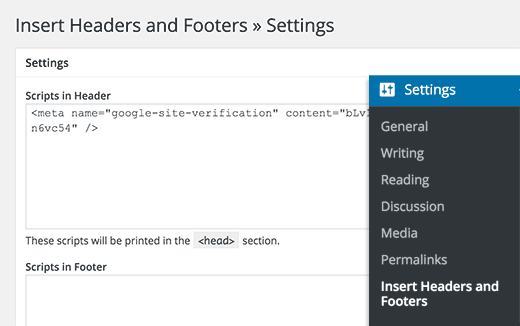
Don’t forget to click on the Save button to store your changes.
Return back to Google Apps setup screen and check the box next to ‘I added the meta tag to my homepage.’ option.

The setup wizard will now ask you to visit your domain’s account management section.
Login to your web hosting account (cpanel dashboard). Under the mail section, click on MX Entry icon.
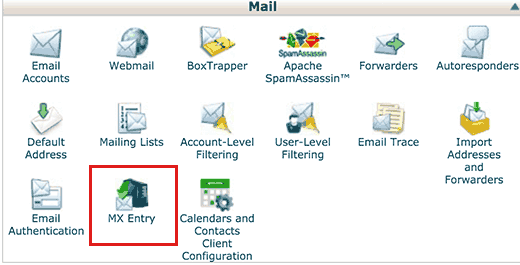
On the next screen, you will be asked to select your domain name. After which you will see a list of options.
Scroll down and you will find MX Records. There would be one or more entries there. You need to delete all of them.
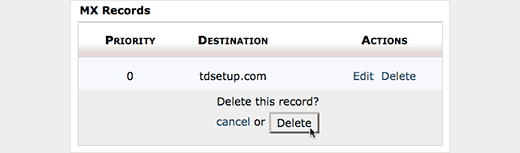
Return back to Google Apps setup screen and check the box next to ‘I have opened the control panel for my domain’ option.
Google will now show you a list of entries. These entries are called MX records and you need to add them to your domain.
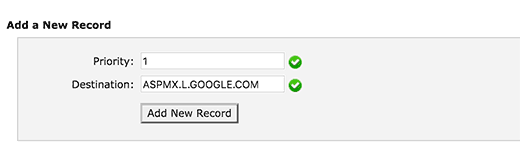
Return back to MX Entry page in cPanel to add priority and then the matching MX value. Click on Add record button to save an entry, and then repeat till you have added all MX record entries shown in the Google Apps setup page.
After entering MX record entries, return back to Google Apps setup screen and check the box next to ‘I created new MX records’ option.
Google will now ask you to delete old MX Records. We have already deleted old MX records, so you can mark that as checked.

Click on verify domain and setup button to finish the setup wizard.
DNS settings like MX Records can take some time to update. In that case, you will see an estimated time notice.
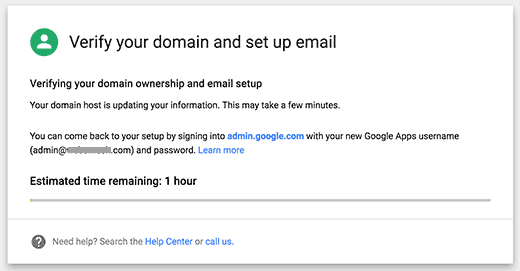
You can stay on this page for a few minutes, and then it would automatically show you a success message that your domain is now verified.
Click on the next button to continue.
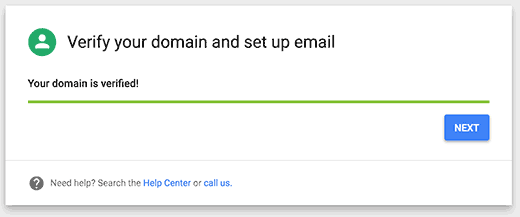
That’s all you have successfully setup Google Apps and Gmail.
Using Your Professional Email with Google Apps and Gmail
Your email account works as any other Gmail account. You can access it by visiting Gmail Website and sign in with your email address, e.g. [email protected].
You can also manage your Google Apps account by visiting the admin console.

This is where you can add/remove new users to your domain name. Each of your users will have 30 GB storage and all the same features, but they will not have access to the admin console. You can remove those users at any time you want.
Troubleshooting Google Apps Domain Setup
It is likely that your web host may not be using a dashboard like we have shown in the screenshots above.
Google Apps for Work has detailed documentation for many of the popular web hosting and domain registration service providers. Visit, set up MX records (Hosts specific steps) page and then locate your domain registrar or web host from the list.
If you do not find your service provider in the list, then you can ask them directly to help you setup Google Apps for Work for your domain name.
We hope this article helped you setup a professional email address with Google Apps for Work and Gmail. You may also want to see our list of 19+ free Google tools every WordPress blogger should use.
If you liked this article, then please subscribe to our YouTube Channel for WordPress video tutorials. You can also find us on Twitter and Facebook.


How can i maintain my email address
Why on earth do you hide yourself? Why make it so difficult to get in touch with you?
And, why do I not get my e-mails? And why do I get så many “failures” (mislykket)?
Why do you send me failure messages when I send to correct e-mail addresses?
I am fed up with you.
Perhaps time to find myself some other e-mail company?
Best regards
Ragnhild Margreth Nordlund
Hi Ragnhild,
If you are talking about Google Apps for work (also known as Guite), then they do have 24/7 dedicated email and phone support.
Would Google Apps for Work provide the same services as described in your “7 Best Email Marketing Services for Small Business (2016)” blog post using Constant Contact, AWeber, or MailChimp, etc.?
No google apps for work does not offer email newsletter service. It does give you a professional email address that you can use in combination with an email marketing service, so your emails look more professional
Hi, thank for your this detailed walk-through; only thing, (maybe I’m just slow/dunce; I did read through the entire article btw), but I’m unsure about this: if I sign up for business email with GSuite/Google apps and I respond to an email sent to the business email, the client will see the business email, right?
You see, I’m new to this owning your website business. I have a subdomain.wordpress.com website (I plan on upgrading to my own domain soon) and I know the upgraded WP offers business emails, but when I read the info. on the WP site, no where does it say that when I respond to a client’s message, that the client will see the business email; it looks like the client will see my own/non-business email.
Eg. Let’s say my business is wpbeginner and I upgraded to WP’s business plan and I selected the email: hello (at) wpbeginner to forward emails to my actual/non-business email: justanexample (a) gmail.
If a client hits the ‘contact’ button on my site and/or sends an email to hello (at) wpbeginner, when I reply, will the client see hello (at) wpbeginner or will the client see prettylady (a) gmail? That’s what I don’t understand.
I have this same question for Google apps.
I want to make sure I do the correct thing; if it is that the client will see my non-business email when I respond, then getting a WP business email doesn’t make sense.
But on Google apps, the client *will* see my *business* email when I respond, correct?
Thank you for clarifying.
Clients will see your business address when you reply to them.
There is nothing mentioned about WhoIs privacy. Is this option automatic or an extra cost?
You can purchase Domain Whois Privacy from your registrar.
When I get to the page “Open Google Cloud Account” I am taken to my main Google sign-in page. I put in passwords for account, it goes back to “Open GC Account”. I put in password that I just created for the account, still doesn’t work.
Pulling my hair out in Texas.
Can you advise?
Debbe
I have purchased an 30 days trial.
Now when I am trying for billing, it is automatically showing me this on
(HOW YOU PAY:
Automatic payments: Pay after your ads run. Your ads typically start running almost right after you submit billing details. You pay only after you accrue costs, via an automatic charge when you reach your billing threshold or 30 days after your last automatic payment, whichever comes first. Learn more
Manual payments: Pay before your ads run. Your ads typically start running after we process your first payment. We deduct charges from your prepaid balance each time your account accrues a cost. If your account runs out of funds, your ads stop running until you make another payment. Learn more)
Now, I just wanna purchase an Professional email not this Ad service account what should I do
Contact Google customer support from your account dashboard.
I believe you were routed to the AdWords page. As for the Apps payment, or Email payment, basic is like $3/user and also the payment can be automatic if you put a card. You can also deposit an amount minimum of $10.
I creat email account
What about adding addresses in a group in outlook?
How can it be achieved under this setup ?
Hi thanks for the tutorial! I ran into 1 hiccup though at the “verify your domain” step. Once I click the button to do so, I get a small gray popup that says “Server error”. What does that mean?
No explanation. I can’t click on it to get more details. when I click on the listed “help center” link under the google setup steps, I got a 403 error.
Is it because bluehost only lets us set min. TTL at 14400 and google asks for it to be 3600?
Can you please help…
Your domain may not be properly setup. Please contact BlueHost support, they will be able to help you troubleshoot,
Yet 6 days I’d tried to do it, but still unsuccessful. My new account not excist((
Nice article, Have one question , Some where I read that google will provide free user accounts like
, etc with main account, is it correct ? and what generic accounts it will provide as free user accounts?
Hi. I want to use a free custom email address for my website. How should I go about doing that? I am using Bluehost.
if i use 5 emails on my domain, which is used by 5 other people, then is it necessary that i have to take all the emails to google work email.
if yes, do i have to pay for all accounts seperately.
can i only take one email and rest will be used normally on outlook or integrated with free google account.
I didn’t know about the google app .I guess Good things do not come with free option. I am happy to use my professional email provided by my hosting. Maybe in future Will go for google app .
Hi – I appreciate the article and decided to give Google Apps for Work a try because I’ve had many issues with the current email service I currently use for my business mail and also for my clients business mail as well as their website service provider.
FYI: The only issue I have at this point is that the coupon code provided in this article was only valid for a single user (which I guess was first come firs served). I contacted Google who would not honor the 20% off offer.
Excellent step by step… I’m going to definitely save this…
So, to confirm… if I am the only one accessing the email… then other alias’ I set up, e.g. info@, sales@, etc., do not incur a charge as another user… correct?
How difficult to sync with Outlook… especially if you want updates to be global… and and Outlook uses folders and Google apps/gmail does not… any issues?
Finally… I’m building out my next site on a subdomain.domain.com right now… would I be able to go ahead and set up the email or should I wait until I migrate the site and turn on the search engine, etc.?
Christine
Christine, yes that is correct aliases do not incur charges as separate user. For Outlook you can use Google Apps Sync tool for Microsoft Outlook. You can also add your Google Apps account as an IMAP or POP account to your Outlook mail. If you have access to domain’s DNS records, then you can set it up.
Great tutorial as usual! You guys truly do the heavy lifting and it’s all very helpful. Thanks!
As always, thanks for the awesome tutorial. Always wanted to do this to use our own domain for emails, but never had the time to research. Now i don’t have to research, you already have the info i need here for new email addresses, thanks!
I just have one question, what happens to my old/existing email addresses using my domain? How do i migrate them?
If you are the only person using those email addresses then you can add them as email aliases. If other users use those email addresses, then you will need to add them as users in Google Apps Admin Console.
Got it, thanks!
Thank you for this tutorial. When I add aliases, do they have to be al @yourdomain.com or can they be totally different? I have a few different websites and would rather not have a separate Google Apps for Work account (& fee) for each. Thanks again!
They have added multiple domain support to Google Apps, but there are A LOT of restrictions and issues associated with it.
And what really sucks is those of us with legacy accounts can’t add multiple domains. So much for the early adoption bonus.
I have created a Google Apps Work account (example.com) and have 5 users … one is my son [email protected] … he has a youtube business and has used a free gmail account for this business for a few years [email protected] … I thought that I could simply add [email protected] as a send from and send to account so that Shane can stay logged into his [email protected] email and view ALL emails coming in from [email protected] and [email protected] …. this seems like it would be a VERY common requirement but I cannot get it to work!! Ironically, I have no problem adding a NON gmail account as a send from and send to account. Does ANYONE know how to set this up using a Google Apps Work account and adding a free gmail account?
Instead of change Send From and Reply to fields, you can also setup forwarding. Open the Google Apps email account and go to Settings -> Forwarding and add the gmail address. Similarly you can setup forwarding on free gmail account to forward all mail to the Google Apps account.
amazing Guide and rich info, just wondering if you can suggest a free one until i can afford to buy from google thanks said
I agree
Yes, thank you for the article… However a very important aspect has been left out I think.
Setting up the MX record in the actual domain handler.. This is a crucial piece of the puzzle, this way you can have complete control over the email and there is no connection to the webhost.
They way to do it is to temporarily park the domain so you can access the DNS manager inside:
1. Park domain – i.e. with godaddy just put the default NS records or “set to default”
2. Go to the DNS file zone editor and post the host to your webhost IP
3. And now add the mail exchanger info
So this way I think your email address with google aps is 100% independent.
Or this is not the way to do this? Please confirm.
Yes, this is correct and we have mentioned it in the article above. You need to delete existing MX entries from your domain and add Google MX records.
I use Google apps for my business email and it works flawlessly.