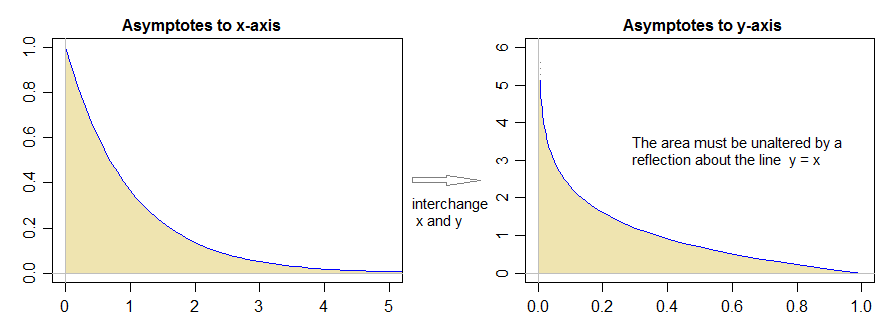
The Dirac delta is really not overly helpful here (although it is interesting), because the Gamma distribution has a continuous density, whereas the Dirac is about as non-continuous as you can get.
You are right that the integral of a probability density must be one (I'll stick to densities defined on the positive axis only),
$$ \int_0^\infty f(x)\,dx =1.$$
In the Gamma case, the density $f(x)$ diverges as $x\to 0$, so we have what is called an improper integral. In such a case, the integral is defined as the limit as the integration boundaries approach the point where the integrand is not defined,
$$ \int_0^\infty f(x)\,dx := \lim_{a\to 0}\int_a^\infty f(x)\,dx,$$
as long as this limit exists.
(Incidentally, we use the same abuse of notation to give a meaning to the symbol "$\int^\infty$", which is defined as the limit of the integral $\int^b$ as $b\to\infty$, again as long as this limit exists. So in this particular case, we have two problematic points - $0$, where the integrand is not defined, and $\infty$, where we can't evaluate the integral directly. We need to work with limits in both cases.)
For the Gamma distribution specifically, we kind of side-step the problem. We first define the Gamma function as follows:
$$\Gamma(k) := \int_0^\infty y^{k-1}e^{-y}\,dy.$$
We next prove that this definition actually makes sense, in the sense of the different limits outlined above. For simplicity, we can here stick to $k>0$, although the definition can be extended to (many) complex values $k$ as well. This check is a standard application of calculus and a nice exercise.
Next, we substitute $x:=\theta y$ for $\theta>0$ and by the change of variables formula obtain
$$\Gamma(k) = \int_0^\infty \frac{x^{k-1}e^{-\frac{x}{\theta}}}{\theta^k}\,dx,$$
from which we get that
$$1 = \int_0^\infty \frac{x^{k-1}e^{-\frac{x}{\theta}}}{\Gamma(k)\theta^k}\,dx.$$
That is, the integrand integrates to one and is therefore a probability density. We call it the Gamma distribution with shape $k$ and scale $\theta$.
Now, I realize that I really passed the buck here. The meat of the argument lies in the fact that the Gamma function definition above does make sense. However, this is straightforward calculus, not statistics, so I only feel very slightly guilty in referring you to your favorite calculus textbook and the gamma-function tag at Math.SO, especially this question and this question.