Hello! For today’s installment of I Totally Didn’t Know This, we’re going to talk about voice doubles. When you’re making a movie or a TV show and you’re in the editing phase, cutting a trailer, or doing promotional videos, sometimes you need some extra dialogue that you didn’t get during the main filming. So you get the actor to come in to do the new dialogue. But sometimes, if the actor is famous and super busy, they might not be available. So there are voice actors whose job it is to impersonate the real actor’s voice. Saaaaay whaaaaat?
It’s called ADR, Automated Dialogue Replacement. Amy Landecker, who plays Sarah Pfefferman on Transparent, has done this job for movies starring Julia Roberts. She sounds amazingly like Julia:
She even did most of Julia’s dialogue in this Duplicity trailer:
Jim Hanks has done voiceover work for his brother Tom in the past:
He does the voice for Woody in all the Toy Story video games…it’s not an exact match, but it’s pretty good. (via vulture)
More about...
In The Oxford History of Board Games published in 1999, scholar David Parlett wrote that there are four types of classical board game: race, chase, space, and displace. The book is out of print (but is available direct from the author as a PDF), so I found this description of Parlett’s categorization in a book by Stewart Woods called Eurogames.
In categorizing these public domain or “folk” games, Parlett (1999) draws on the work of H.J.R. Murray (1952) and R.C. Bell (1979) in describing four types of game, as identified by the game goals: race games, in which players traverse a track in an attempt to be the first to finish (e.g. Nyout, Pachisi); space games, in which players manipulate the position of pieces to achieve prescribed alignments, make connections, or traverse the board (e.g. Noughts and Crosses, Twixt, and Halma, respectively); chase games, in which asymmetrical starting positions and goals cast players in the role of pursuer and pursued (e.g. Hnefatafl, Fox & Geese); and games of displacement, where symmetrically equipped players attempt to capture and eliminate each other’s pieces (e.g. Chess, Draughts).
You’re probably unfamiliar with some of these games (as I was). For race games, Parcheesi is a modern version of pachisi…other examples would be Sorry, Candyland, or Snakes and Ladders. Noughts and crosses is tic-tac-toe; other space games include Go and Connect 4. A modern example of a chase game might be Clue. And as written above, chess and draughts (checkers) are classic displace games. (via @genmon)
More about...
In 1959, physicist Richard Feynman, who had already done work that would win him the Nobel Prize a few years later, gave a talk at Caltech that didn’t have much to do with his main areas of study. The talk was called There’s Plenty of Room at the Bottom and it was a scientist at the peak of his formidable powers asking a question of the scientific community: What about nanotechnology?
I would like to describe a field, in which little has been done, but in which an enormous amount can be done in principle. This field is not quite the same as the others in that it will not tell us much of fundamental physics (in the sense of, “What are the strange particles?”) but it is more like solid-state physics in the sense that it might tell us much of great interest about the strange phenomena that occur in complex situations. Furthermore, a point that is most important is that it would have an enormous number of technical applications.
Even though he made no formal contribution to the field, Feynman’s talk has been credited with jumpstarting interest in the study of nanotechnology. No recording exists of the original talk, but in 1984, Feynman gave a talk he called Tiny Machines, in which he recalled his original talk and spoke of the progress that had been made over the past 25 years. (via @ptak)
More about...
During the German occupation of France, teenager Adolfo Kaminsky forged thousands of documents for Jews about to be deported to concentration camps. He worked at a shop that dyed clothes and a Jewish resistance cell recruited him because he knew how to remove ink stains, a skill that served him well in altering documents.
If you’re doubting whether you’ve done enough with your life, don’t compare yourself to Mr. Kaminsky. By his 19th birthday, he had helped save the lives of thousands of people by making false documents to get them into hiding or out of the country. He went on to forge papers for people in practically every major conflict of the mid-20th century.
Now 91, Mr. Kaminsky is a small man with a long white beard and tweed jacket, who shuffles around his neighborhood with a cane. He lives in a modest apartment for people with low incomes, not far from his former laboratory.
When I followed him around with a film crew one day, neighbors kept asking me who he was. I told them he was a hero of World War II, though his story goes on long after that.
A remarkable story and a remarkable gentleman. The video above is based on a book Kaminsky’s daughter wrote about him.
More about...
From Candice Drouet, a quick supercut of some of notable athletic shoes in movies, including Marty’s self-lacing Nikes from Back to the Future II (which you can win in a raffle). Michael Keaton’s Batman wore Nikes?
More about...

The Information is Beautiful Awards have announced the shortlist of nominees for the best infographics, data visualizations, and data journalism for 2016. Literally hours of exploration here. Some well-deserved shouts out to Polygraph (multiple projects, including their breakdown of film dialogue by gender and age), Nicholas Felton’s Photoviz, climate spirals, FiveThirtyEight’s 2016 election forecast map, and many other projects you might have seen here or elsewhere.
The images above are from Adventures in Mapping, Polygraph, and Shipmap.
More about...
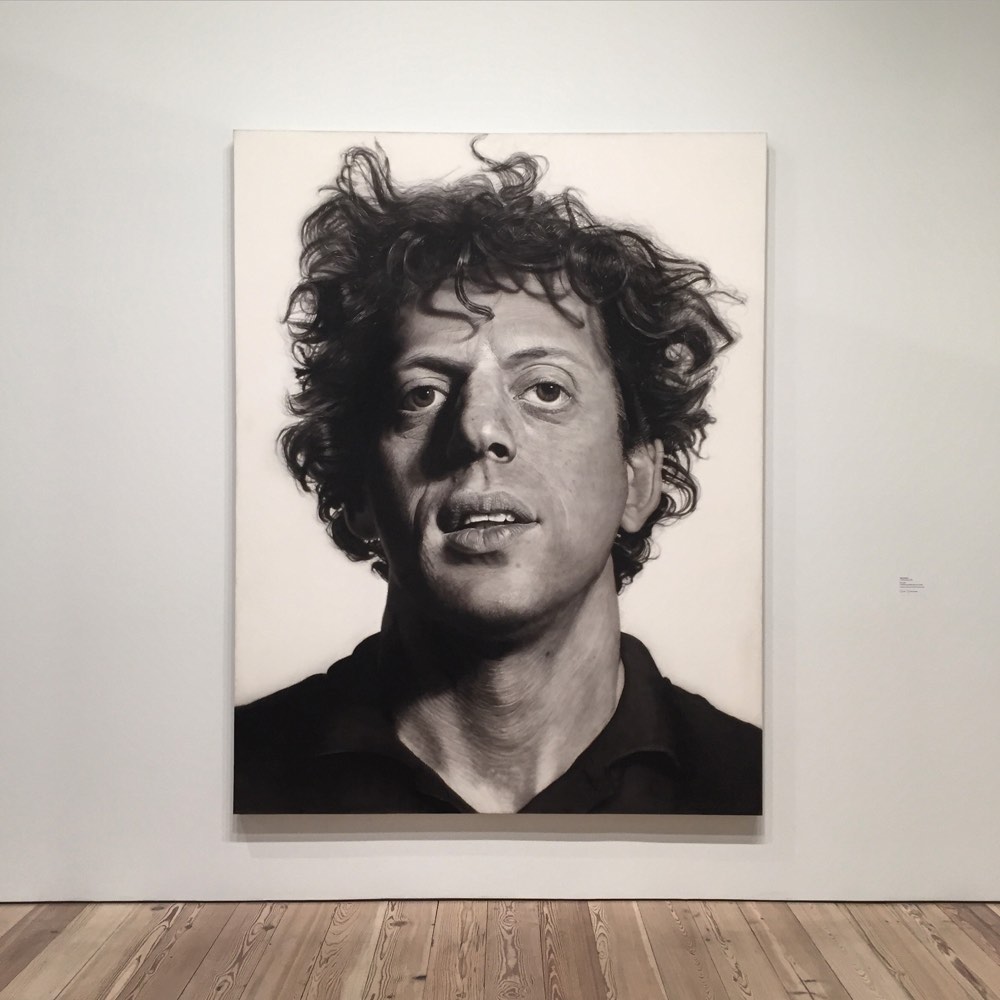
From a new Kickstarter publication called The Creative Independent, Philip Glass was interviewed about the importance of artists owning their work and getting paid for it.
My personal position was that I had wonderful parents. Really wonderful people. But my mother was a school teacher. My father had a small record shop in Baltimore. They had no money to support my career. I began working early. You’re too young to know this, but when you get your first Social Security check, you get a list of every place you’ve worked since you began working. It’s fantastic! I discovered that I was working from the time I was 15 and putting money into the Social Security system from that age onward. I thought it was much later. No, I was actually paying money that early.
The point is that I spent most of my life supporting myself. And I own the music. I never gave it away. I am the publisher of everything I’ve written except for a handful of film scores that the big studios paid. I said, “Yeah, you can own it. You can have it, but you have to pay for it.” They did pay for it. They were not gifts.
A lot in this interview resonates, including this:
It’s never been easy for painters, or writers, or poets to make a living. One of the reasons is that we, I mean a big “We,” deny them an income for their work. As a society we do. Yet, these are the same people who supposedly we can’t live without. It’s curious, isn’t it?
And this bit about making work vs performing (italics mine):
What happens, is that the artists are in a position where they can no longer live on their work. They have to worry about that. They need to become performers. That’s another kind of work we do. I go out and play music. The big boom in performances is partly because of streaming, isn’t it? We know, for example, that there are big rock and roll bands that will give their records away free. You just have to buy the ticket to the concert. The cost of the record is rather small compared to the price of the ticket. It’s shifted around a little bit; they’re still paying, but they’re paying at the box office rather than at the record store. The money still will find its way.
Then you have to be the kind of person who goes out and plays, and some people don’t.
I’ve been thinking a lot about the economics of writing online. Making a comfortable living only by writing is tough and very few independents are able to do it. More successful are those who are able to get away from writing online by speaking at conferences, writing books, starting podcasts, selling merchandise,1 post sponsored tweets and Instagram photos, building apps, consulting for big companies, etc. This stuff is the equivalent of the band that tours, sells merch, composes music for TV commercials, etc. But as Glass said, what about those who just want to write? (And I count myself among that number.) How can we support those people? Anyway, more on this very soon (I hope).
Photo is of a Chuck Close painting of Philip Glass taken by me at The Whitney.
More about...
From a New Zealand sketch comedy show called Funny Girls, a send-up of a typical manly man “built tough” truck commercial. I barely watch any actual TV anymore, but those truck commercials have always been the worst. (thx, sarah)
More about...
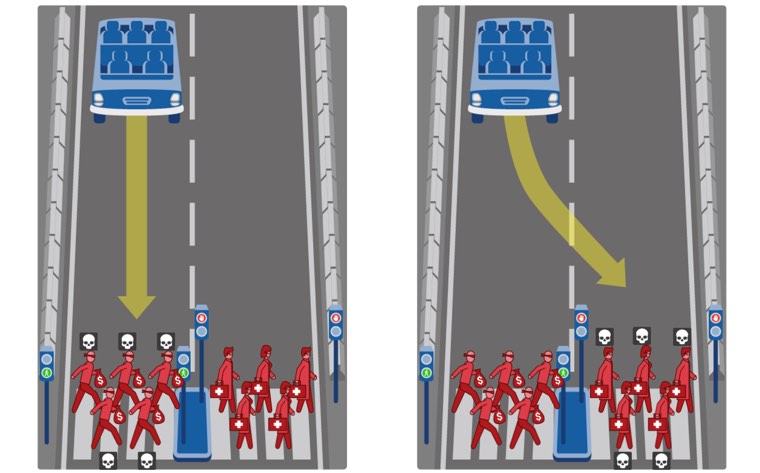
A group at MIT built an app called the Moral Machine, “a platform for gathering a human perspective on moral decisions made by machine intelligence, such as self-driving cars”. They want to see how humans solve trolley problem scenarios.
We show you moral dilemmas, where a driverless car must choose the lesser of two evils, such as killing two passengers or five pedestrians. As an outside observer, you judge which outcome you think is more acceptable. You can then see how your responses compare with those of other people.
That was a really uncomfortable exercise…at the end, you’re given a “Most Killed Character” result. Pretty early on, my strategy became mostly to kill the people in the car because they should absorb the risk of the situation. The trolley problem may end up not being such a big deal, but I hope that the makers of these machines take care1 in building them with thoughtfulness.
More about...
Isabelle Mège does not call herself an artist, but she has nonetheless been working on an interesting project for the last 30 years. Mège contacts photographers she likes and asks them to incorporate her into their work, keeping a copy of each photograph afterwards. She has over 300 photographs and has curated 135 of them into what she calls “the collection”.
After each shoot, Mège would follow up and ask the artist for a print, signed and sometimes numbered by its edition. The print would go into her archive, along with any artifacts related to its making; Elkoury’s letter, for instance, is accompanied in the archive by Mège’s notes about their encounter (he was late to their first meeting, and arrived with his shoelaces untied). Also in her archive are the heels that Witkin attached to her feet during the 1990 shoot, and a news item about Japanese customs having seized incoming copies of the magazine ARTnews to prohibit their circulation; the photograph, in which Mège’s pubic hair is visible, was considered obscene. Her diarizing and collection of correspondence, clippings, image reproductions, and relevant items reveal that the planning around certain images often lasted years. Several times, having worked with an artist to make an image, she was unhappy with the results and excluded it from her collection. When approached by artists who wanted to work with her but for whose work she had no feeling, she refused.
Mège felt strongly that no money should be exchanged in these interactions. (“As soon as there’s a question of payment, it’s dead, you fall asleep,” she told me.) She also asked each artist to sign a contract printed on a three-inch slip of paper, stating that she would have the right to exhibit or publish the image for noncommercial reasons only.
Mège’s project fits neatly into contemporary selfie culture. Her collection reminds me of other creative people who have incorporated themselves into their media of behalf of someone or something else. Call them “selfie auteurs”. Adam Lisagor has starred in many of the videos his company makes for tech clients. Casey Neistat films himself going on adventures for clients like J. Crew and Nike. Noah Kalina was commissioned by VH1 to take photos of himself posing with celebrities in his Everyday stance. I’m sure there are many more examples1 but few have done it as cleanly and purely as Mège.
More about...
OneZoom is an interactive zoomable map of “the evolutionary relationships between the species on our planet”, aka tree of life. Browsing around is fun, but you’ll want to use the search function to find specific groups and animals, like mammals, humans, and mushrooms. The scale of this is amazing…there are dozens of levels of zoom. (via @pomeranian99)
More about...
Designing Your Life is one of the most popular courses at Stanford. Taught by Bill Burnett and Dave Evans, the class teaches how you can use design thinking and techniques to shape your life and career. Burnett and Evans just came out with a book based on the class, Designing Your Life: How to Build a Well-Lived, Joyful Life.
In this book, Bill Burnett and Dave Evans show us how design thinking can help us create a life that is both meaningful and fulfilling, regardless of who or where we are, what we do or have done for a living, or how young or old we are. The same design thinking responsible for amazing technology, products, and spaces can be used to design and build your career and your life, a life of fulfillment and joy, constantly creative and productive, one that always holds the possibility of surprise.
The course itself isn’t available online, but there are a couple of lectures from the class available on YouTube: Reframe Your Passion and Prototypes for Personal Success.
More about...
This is entertaining: Megan McArdle considers four possible economic approaches to how couples should order food in restaurants.
3. Individual property rights, with option trading. Now we’re moving toward a more centrally planned economy. The menu is individually consulted, and then the two parties state their preferences. If these preferences are strong, then matters proceed much as in the above strategy. However, if indecision is expressed, the trading is opened: “If you get the clam chowder, I’ll get the mushroom crostini, and we can split.” Option trading is usually, but not always, confined to the appetizer course. Any offer can be refused, and a substitute offered — “What if I got the clam chowder, and you got the ham timbales?” — or both parties may reluctantly conclude that no trade is possible, and revert to their original choices.
Well done, Team Restaurant! You are now beginning to realize the magnificent benefits of trade. Coordination and cooperation have permitted you to agree on choices that jointly improve utility.
However, I must tell you that you are still probably not at the highest valued use of your food dollar. You are almost certainly investing most of your effort in appetizers or shared desserts, which are the minority of your spending, time and consumption. If you want not merely to improve your utility, but to maximize it, then you are going to have to invest more effort in coordination.
Her conclusion is spot on; it’s the best way to dine out.
More about...
Episcopal Community Services runs a program called CHEFS that provides food industry training for homeless and low-income people in San Francisco. Photographer Wesley Verhoeve visited the program to take portraits of the students and staff. The photos accompany a San Francisco Magazine article that has more information on the program.
The seven-month program culminates in a 240-hour internship at participating eateries like Nopa and Kokkari; Hanks completed her internship at Lotta’s Bakery in Nob Hill, where she was struck by the universal power of food. “We cook when somebody dies, we cook when a child is born,” she says. “I’ve realized cooking is related to everything: to family, to religion, to happiness, to sadness.”
More about...
Older posts
And much more in the archives...