<?xml version="1.0" encoding="utf-8" ?>
<rdf:RDF xmlns:rdf="http://www.w3.org/1999/02/22-rdf-syntax-ns#" xmlns:dc="http://purl.org/dc/elements/1.1/" xmlns:syn="http://purl.org/rss/1.0/modules/syndication/" xmlns="http://purl.org/rss/1.0/">


<channel rdf:about="http://www.fsf.org/news/aggregator/RSS">
  <title>FSF News</title>
  <link>http://www.fsf.org/news/aggregator</link>
  <description></description>
  <image rdf:resource="http://www.fsf.org/logo.png"/>

  <items>
    <rdf:Seq>
      
        <rdf:li rdf:resource="http://www.fsf.org/news/free-software-foundation-stresses-necessity-of-full-user-control-over-internet-connected-devices"/>
      
      
        <rdf:li rdf:resource="http://www.fsf.org/news/fsf-job-opportunity-copyright-and-licensing-associate"/>
      
      
        <rdf:li rdf:resource="http://www.fsf.org/news/fsf-job-opportunity-web-developer"/>
      
      
        <rdf:li rdf:resource="http://www.fsf.org/news/free-software-foundation-releases-fy2015-annual-report"/>
      
      
        <rdf:li rdf:resource="http://www.fsf.org/news/web-drm-standard-moves-to-next-phase-of-development-fsfs-defective-by-design-campaign-to-continue-opposition"/>
      
      
        <rdf:li rdf:resource="http://www.fsf.org/news/lulzbot-taz-6-3d-printer-now-fsf-certified-to-respect-your-freedom"/>
      
      
        <rdf:li rdf:resource="http://www.fsf.org/news/libreplanet-conference-videos-and-slides-online-edward-snowden-richard-stallman-karen-sandler-and-more"/>
      
      
        <rdf:li rdf:resource="http://www.fsf.org/news/allies-join-defective-by-design-for-the-tenth-anniversary-international-day-against-drm"/>
      
      
        <rdf:li rdf:resource="http://www.fsf.org/news/hundreds-explore-ways-to-fork-the-system-with-free-software-at-libreplanet-2016"/>
      
      
        <rdf:li rdf:resource="http://www.fsf.org/news/gnu-releases-ethical-evaluations-of-code-hosting-services"/>
      
      
        <rdf:li rdf:resource="http://www.fsf.org/news/fsf-job-opportunity-operations-assistant-2016"/>
      
      
        <rdf:li rdf:resource="http://www.fsf.org/news/interpreting-enforcing-and-changing-the-gnu-gpl-as-applied-to-combining-linux-and-zfs"/>
      
      
        <rdf:li rdf:resource="http://www.fsf.org/news/anti-drm-activists-go-to-w3c-meeting-to-protest-digital-restrictions-management-in-web-standards"/>
      
      
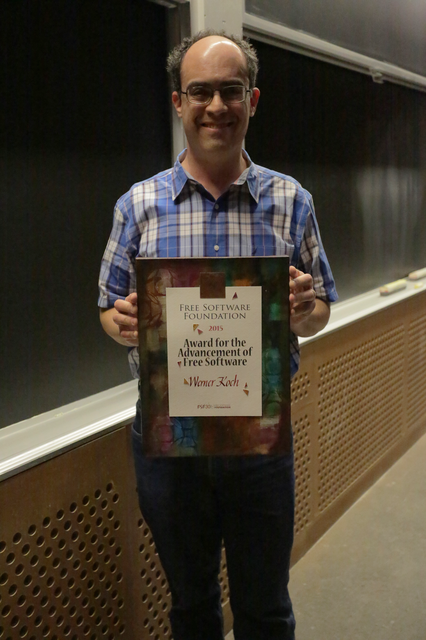
        <rdf:li rdf:resource="http://www.fsf.org/news/library-freedom-project-and-werner-koch-are-2015-free-software-awards-winners"/>
      
      
        <rdf:li rdf:resource="http://www.fsf.org/news/libreplanet-free-software-conference-coming-to-mit-in-one-week-march-19-20"/>
      
    </rdf:Seq>
  </items>

</channel>


  <item rdf:about="http://www.fsf.org/news/free-software-foundation-stresses-necessity-of-full-user-control-over-internet-connected-devices">
    <title>Free Software Foundation stresses necessity of full user control over Internet-connected devices</title>
    <link>http://www.fsf.org/news/free-software-foundation-stresses-necessity-of-full-user-control-over-internet-connected-devices</link>
    <description>The Internet of Things (IoT) refers to the integration of Internet
technology into a wider range of home devices than previously envisaged
by most users. Early adopters of IoT may now have homes with
Internet-connected lightbulbs, alarm systems, baby monitors and even
coffee machines. Internet integration allows owners to have greater
flexibility over their devices, making it possible to turn on their air
conditioning as they leave work to cool the house before they return, to
have curtains that automatically close based on sunset time, or lights
that automatically turn off after the owner has left the house. Each
individual benefit may seem marginal, but overall they add significant
benefit to the owners.</description>
    <content:encoded xmlns:content="http://purl.org/rss/1.0/modules/content/"><![CDATA[<p>Most IoT systems consist of three components:</p>
<p>1) The "smart" device itself, capable of communicating via a protocol
such as Z-Wave, Zigbee, Bluetooth or IEEE 802.11, running either a
full operating system (commonly based on the kernel Linux) or an
embedded OS designed for this purpose.</p>
<p>2) A remote service provided by the device manufacturer. The smart device
communicates with this service in order to provide information about its
current state and in order to provide an interface for users to control
the device.</p>
<p>3) An application designed for mobile platforms which interacts with the
remote service and allows control of the smart device regardless of
whether the user is currently located near the device or not.</p>
<p>Devices that use the Zigbee or Z-Wave protocols also typically require a
local "hub," a device running interface software that bridges the
devices to the remote service.</p>
<p>There are multiple significant security concerns around this design
pattern. The first is that either the smart devices themselves or the
hub that they communicate with require Internet access. Depending on
local network configuration, this may result in the devices being
visible to the public Internet. These devices inherently provide a
service of some description in order to permit their integration with
the remote services, but frequently also provide additional services
for directly local communication and often include further unnecessary
services used for diagnostics during the design and production stage
(such as <a href="https://fail0verflow.com/blog/2012/microcell-fail.html">MicroCell</a> -- the same backdoor was present on a series of
baby monitors shipped by a major manufacturer).</p>
<p>These devices are often locked down in such a way that it is impossible
for the user to replace the software that they run. These devices are
also often abandoned by their manufacturers after a short space of time
due to them being either discontinued or replaced by newer devices.
Users who continue using these devices are thus at significant risk,
without any real chance of security updates being made available and
frequently without any notification that any security issues have been
identified. If any issues are identified, then without the permission of
the manufacturer it is impossible for any third party to provide aid to
said users.</p>
<p>This concern is frequently mitigated by typical home network setups that
restrict external access to internal devices. But smart devices
inherently require external access to be possible, and this
functionality is provided by the remote service. The smart device
connects to the remote service and awaits commands -- users in turn
connect to the remote service and send commands.</p>
<p>These remote services are themselves frequently insecure. Authentication
details are often sent in plaintext, allowing anyone who can observe
network traffic to obtain credentials. Some systems involve no
authentication at all (<a href="https://www.amazon.com/gp/review/R2JVRCO8T1ON0R">for instance</a>). This makes it possible for a
malicious individual to gain control over home devices, in some cases
potentially even being able to execute arbitrary code on said devices
and gain access to the internal network.</p>
<p>If vendors are unwilling or unable to fix these security issues, users
are left in an unfortunate position. They can either retain the
convenience provided by the smart devices they paid for, or they can
remove them and attempt to obtain a refund. The worst case scenario is
perhaps when the vendor unilaterally decides to shut down the remote
service, rendering the devices useless.</p>
<p>Another consideration is the behavior of the manufacturer itself.
Manufacturers may not always act in the interests of their customers,
doing things ranging from invasive collection of personal data to
intrusive advertising or even disabling device functionality remotely.
Even if ostensibly permitted by terms of service, users should be able
to protect themselves against such scenarios.</p>
<p>There is an alternative. Third-party free software alternatives to the
pre-installed software are common in certain market segments, such as
home routers (<a href="https://librecmc.org">libreCMC</a>, <a href="http://www.openwrt.org">OpenWrt</a> and <a href="http://www.dd-wrt.com">DD-WRT</a>, for instance).
Security vulnerabilities can be mitigated by replacing the original
software with a functional equivalent provided by a third party.
Unfortunately, many IoT devices are designed such that the software can
only be replaced by the manufacturer. The software will only communicate
with the manufacturer's remote service -- no third party can provide a
functional equivalent.</p>
<p>To ensure that users do not end up in a situation where they are left
choosing between security and convenience, or left with no ability
whatsoever to use the devices they bought, it is vital that these
devices be ultimately under the control of the user. The user should be
able to replace the software on the device in order to fix security
vulnerabilities. The user should be able to modify the software on the
device such that it communicates with a different remote service that
provides strong security guarantees. The user should not be left with no
option other than to discard the device and replace it with a new
version.</p>
<p>In order for this to be possible, it is necessary to know how the
devices communicate with the remote server. Unfortunately this is
frequently in the form of a proprietary protocol that lacks any public
documentation, and as such it is a significant engineering effort for
anyone to implement a replacement service. Several well-known protocols
exist for controlling remote devices (such as <a href="http://www.mqtt.org">MQTT</a>) and re-using
these rather than proprietary protocols makes it easier to both
identify whether any security issues exist (being forced to reverse
engineer a protocol may result in missing subtle aspects that cause
security issues) and provide alternative implementations in the event of
significant security flaws being discovered or the vendor choosing to
cease support of the remote services.</p>
<p>To that end, we encourage the adoption of practices that:</p>
<p>a) Ensure that documented and freely-implementable (rather than
patent-encumbered) protocols be used for communication between smart
devices and remote services, and</p>
<p>b) Ensure that owners of smart devices are able to replace their
software with implementations provided by either themselves or third
parties in order to prevent the vendor being a single point of failure
in either service</p>
<p>c) Strongly encourage the use of free "as in freedom" software
throughout the entire stack, making it easier for security researchers
to identify issues, third parties to provide alternative
implementations and users to retain as much control as possible over
devices that will become increasingly integrated into their homes and
lives.</p>
<p><em>Matthew Garret is a member of the FSF's board of directors.</em></p>
<p><em>This was submitted in response to the <a href="https://www.federalregister.gov/articles/2016/08/10/2016-18948/information-on-current-and-future-states-of-cybersecurity-in-the-digital-economy#h-8">Commission on Enhancing National Cybersecurity request for information about current and future states of cybersecurity in the digital economy</a>.</em></p>]]></content:encoded>
    <dc:publisher>No publisher</dc:publisher>
    <dc:creator></dc:creator>
    <dc:rights></dc:rights>
    <dc:date>2016-09-09T19:09:35Z</dc:date>
    <dc:type>News Item</dc:type>
  </item>


  <item rdf:about="http://www.fsf.org/news/fsf-job-opportunity-copyright-and-licensing-associate">
    <title>FSF Job Opportunity: Copyright and Licensing Associate</title>
    <link>http://www.fsf.org/news/fsf-job-opportunity-copyright-and-licensing-associate</link>
    <description>The Free Software Foundation (FSF), a Massachusetts 501(c)(3) charity
with a worldwide mission to protect computer user freedom, seeks a
motivated and talented Boston-based individual to be our full-time
Copyright and Licensing Associate.</description>
    <content:encoded xmlns:content="http://purl.org/rss/1.0/modules/content/"><![CDATA[<p>This position, reporting to the executive director, works as part of
our licensing and compliance team to protect and promote the use of
freely licensed works of software and documentation. For over twenty
years, the <a href="https://fsf.org/licensing">FSF's Licensing and Compliance Lab</a> has been the
preeminent community resource for information about free licensing.
From enforcement of the GNU General Public License, to certifying
software and devices as fully free, to the writing and distribution of
licensing-related educational materials, the team does work vital for
the free software movement.</p>
<p>For this position, we are looking for a strong writer who is familiar
with free software copyright licenses, and understands the basics of
how software is written, compiled, and distributed. Neither a legal
nor computer science education is required, but both would be a plus.
Ideal candidates will also have experience with administrative tasks
and record keeping.</p>
<p>Examples of job responsibilities include, but are not limited to:</p>
<ul>
<li>
<p>diligent and careful filing, archiving, and recording of all the
    FSF's copyright assignment data (both electronic and paper),</p>
</li>
<li>
<p>daily correspondence with GNU and other free software developers
    from around the world,</p>
</li>
<li>
<p>reviewing hardware devices for our <a href="https://www.fsf.org/ryf">Respects Your Freedom</a>
    certification program,</p>
</li>
<li>
<p>investigating violations of free licenses on FSF-copyrighted
    works,</p>
</li>
<li>
<p>public speaking as an FSF representative,</p>
</li>
<li>
<p>writing articles and materials on licensing-related issues and
    news,</p>
</li>
<li>
<p>helping to organize and facilitate educational licensing events
    both online and in-person,</p>
</li>
<li>
<p>working with volunteers and mentoring interns, and</p>
</li>
<li>
<p>pitching in to help with organization-wide projects like our major
    fundraising activities and the annual LibrePlanet conference.</p>
</li>
</ul>
<p>Because the FSF works globally and seeks to have our materials
distributed in as many languages as possible, multilingual candidates
will have an advantage. With our small staff of thirteen, each person
makes a clear contribution. We work hard, but offer a humane and fun
work environment at an office located in the heart of downtown Boston.
The FSF is a mature but growing organization that provides great
potential for advancement; existing staff get the first chance at any
new job openings.</p>
<h2>Benefits and Salary</h2>
<p>This job is a union position that must be worked on-site at the FSF's
downtown Boston office. The salary is fixed at $51,646/year and is
non-negotiable. Other benefits include:</p>
<ul>
<li>full family health coverage through Blue Cross/Blue Shield's HMO Blue program,</li>
<li>subsidized dental plan,</li>
<li>four weeks of paid vacation annually,</li>
<li>seventeen paid holidays annually,</li>
<li>public transit commuting cost reimbursement,</li>
<li>403(b) program through TIAA-CREF,</li>
<li>yearly cost-of-living pay increases (based on government guidelines), and</li>
<li>conference travel opportunities.</li>
</ul>
<h2>Application Instructions</h2>
<p>Applications must be submitted via email to <a href="mailto:hiring@fsf.org">&#104;&#105;&#114;&#105;&#110;&#103;&#64;&#102;&#115;&#102;&#46;&#111;&#114;&#103;</a>. The
email must contain the subject line "Copyright and Licensing
Associate". A complete application should include:</p>
<ul>
<li>resume,</li>
<li>cover letter, and</li>
<li>a published writing sample.</li>
</ul>
<p>All materials must be in a free format. Email submissions that do not
follow these instructions will probably be overlooked. No phone calls,
please.</p>
<p><strong>Applications must be received by Sunday, September 18, 2016 at 17:00
  EDT.</strong></p>
<p>The FSF is an equal opportunity employer and will not discriminate
against any employee or application for employment on the basis of
race, color, marital status, religion, age, sex, sexual orientation,
national origin, handicap, or any other legally protected status
recognized by federal, state or local law. We value diversity in our
workplace.</p>
<h3>About the Free Software Foundation</h3>
<p>The Free Software Foundation, founded in 1985, is dedicated to
promoting computer users' right to use, study, copy, modify, and
redistribute computer programs. The FSF promotes the development and
use of free (as in freedom) software -- particularly the GNU operating
system and its GNU/Linux variants -- and free documentation for free
software. The FSF also helps to spread awareness of the ethical and
political issues of freedom in the use of software, and its Web sites,
located at fsf.org and gnu.org, are an important source of information
about GNU/Linux. Donations to support the FSF's work can be made at
<a href="https://donate.fsf.org">https://donate.fsf.org</a>. We are based in Boston, MA, USA.</p>
<p>More information about the FSF, as well as important information for
journalists and publishers, is at <a href="https://www.fsf.org/press">https://www.fsf.org/press</a>.</p>]]></content:encoded>
    <dc:publisher>No publisher</dc:publisher>
    <dc:creator></dc:creator>
    <dc:rights></dc:rights>
    <dc:date>2016-08-30T18:02:04Z</dc:date>
    <dc:type>News Item</dc:type>
  </item>


  <item rdf:about="http://www.fsf.org/news/fsf-job-opportunity-web-developer">
    <title>FSF Job Opportunity: Web Developer</title>
    <link>http://www.fsf.org/news/fsf-job-opportunity-web-developer</link>
    <description>Free Software Foundation is hiring a Web Developer</description>
    <content:encoded xmlns:content="http://purl.org/rss/1.0/modules/content/"><![CDATA[<p>The Free Software Foundation (FSF), a Massachusetts 501(c)(3) charity
with a worldwide mission to protect computer user freedom, seeks a
motivated and talented Boston-based individual to be our full-time Web
Developer.</p>
<p>This position, reporting to the executive director, works closely with
our sysadmin team to maintain and improve the FSF's Web presence. The
FSF uses several different free software Web platforms in the course
of its work, both internally and externally. These platforms are
critical to work supporting the GNU Project, free software adoption,
free media formats, and freedom on the Internet; and to opposing bulk
surveillance, Digital Restrictions Management, software patents, and
proprietary software.</p>
<p>We are looking for someone who is comfortable with keeping these
systems up-to-date and working, as well as customizing them when
necessary. While the main duties will relate to the backend systems,
frontend experience with templates, HTML, CSS, JavaScript, and design
tools will be a big plus. The Web Developer will help lead major
projects, such as the relaunch of <a href="https://www.fsf.org">https://www.fsf.org</a> and migration
of <a href="https://audio-video.gnu.org">https://audio-video.gnu.org</a> to GNU MediaGoblin.  S/he will also
be part of the team running the annual LibrePlanet conference as well
as contribute to decisions about which new platforms to use or which
existing ones to retire.</p>
<p>Examples of platforms maintained by the Web Developer include, but are
not limited to:</p>
<ul>
<li>CiviCRM</li>
<li>Drupal</li>
<li>MediaWiki</li>
<li>Plone / Zope</li>
<li>Ikiwiki</li>
<li>Request Tracker</li>
<li>Etherpad</li>
<li>CAS</li>
<li>GNU social</li>
<li>GNU MediaGoblin</li>
<li>Icecast</li>
</ul>
<p>Because the FSF works globally and seeks to have our materials
distributed in as many languages as possible, multilingual candidates
will have an advantage. With our small staff of thirteen, each person
makes a clear contribution. We work hard, but offer a humane and fun
work environment at an office located in the heart of downtown Boston.</p>
<p>The FSF is a mature but growing organization that provides great
potential for advancement; existing staff get the first chance at any
new job openings. This position is also a good starting point for
anyone who might be interested in other roles on our technical team in
the future.</p>
<h2>Benefits and Salary</h2>
<p>This job is a union position that must be worked on-site at the FSF's
downtown Boston office. An on-site interview will be required with the
executive director and other team members. The salary is fixed at
$51,646/year and is non-negotiable. Other benefits include:</p>
<ul>
<li>conference travel opportunities,</li>
<li>full family health coverage through Blue Cross/Blue Shield's HMO
Blue program,</li>
<li>subsidized dental plan,</li>
<li>four weeks of paid vacation annually,</li>
<li>seventeen paid holidays annually,</li>
<li>public transit commuting cost reimbursement,</li>
<li>403(b) program through TIAA-CREF,</li>
<li>yearly cost-of-living pay increases (based on government
    guidelines).</li>
</ul>
<h2>Application Instructions</h2>
<p>Applications must be submitted via email to <a href="mailto:hiring@fsf.org">&#104;&#105;&#114;&#105;&#110;&#103;&#64;&#102;&#115;&#102;&#46;&#111;&#114;&#103;</a>. The
email must contain the subject line "Web Developer". A complete
application should include:</p>
<ul>
<li>resume,</li>
<li>cover letter, and</li>
<li>links to any previous work online.</li>
</ul>
<p>All materials must be in a free format. Email submissions that do not
follow these instructions will probably be overlooked. No phone calls,
please.</p>
<p><strong>Applications will be reviewed on a rolling basis
until the position is filled. To guarantee consideration, submit your
application by Friday, September 9, 2016 at 17:00 EDT.</strong></p>
<p>The FSF is an equal opportunity employer and will not discriminate
against any employee or application for employment on the basis of
race, color, marital status, religion, age, sex, sexual orientation,
national origin, handicap, or any other legally protected status
recognized by federal, state or local law. We value diversity in our
workplace. Women, people of color and LGBTQ individuals are strongly
encouraged to apply.</p>
<h3>About the Free Software Foundation</h3>
<p>The Free Software Foundation, founded in 1985, is dedicated to
promoting computer users' right to use, study, copy, modify, and
redistribute computer programs. The FSF promotes the development and
use of free (as in freedom) software -- particularly the GNU operating
system and its GNU/Linux variants -- and free documentation for free
software. The FSF also helps to spread awareness of the ethical and
political issues of freedom in the use of software, and its Web sites,
located at fsf.org and gnu.org, are an important source of information
about GNU/Linux. Donations to support the FSF's work can be made at
<a href="https://donate.fsf.org">https://donate.fsf.org</a>. We are based in Boston, MA, USA.</p>
<p>More information about the FSF, as well as important information for
journalists and publishers, is at <a href="https://www.fsf.org/press">https://www.fsf.org/press</a>.</p>]]></content:encoded>
    <dc:publisher>No publisher</dc:publisher>
    <dc:creator></dc:creator>
    <dc:rights></dc:rights>
    <dc:date>2016-08-22T17:45:00Z</dc:date>
    <dc:type>News Item</dc:type>
  </item>


  <item rdf:about="http://www.fsf.org/news/free-software-foundation-releases-fy2015-annual-report">
    <title>Free Software Foundation releases FY2015 Annual Report</title>
    <link>http://www.fsf.org/news/free-software-foundation-releases-fy2015-annual-report</link>
    <description>BOSTON, Massachusetts, USA -- Thursday, August 11th, 2016 -- The Free Software Foundation (FSF) today published its FY2015 Annual Report.</description>
    <content:encoded xmlns:content="http://purl.org/rss/1.0/modules/content/"><![CDATA[<p>The report is available in <a href="http://static.fsf.org/nosvn/annual-reports/FY2015_annual_report_LR.pdf">low-resolution (2.4 MB PDF)</a> and
<a href="http://static.fsf.org/nosvn/annual-reports/FY2015_annual_report_HR.pdf">high-resolution (30.7 MB PDF)</a>.</p>
<p>The Annual Report reviews the Foundation's activities,
accomplishments, and financial picture. The report examines the impact
of the FSF's programs, and FY2015's major events, including
LibrePlanet and our thirtieth anniversary.</p>
<p>As with all of the Foundation's activities, the Annual Report was made
exclusively using free software, including <a href="https://www.scribus.net/">Scribus</a>, <a href="https://www.gimp.org/">GIMP</a>,
<a href="https://inkscape.org/en/">Inkscape</a>, and <a href="https://www.libreoffice.org/">LibreOffice</a>, along with freely licensed fonts
and images. The report is released under a <a href="https://creativecommons.org/licenses/by-sa/4.0/">CC BY SA 4.0</a> license.</p>
<h3>About the Free Software Foundation</h3>
<p>The Free Software Foundation, founded in 1985, is dedicated to
promoting computer users' right to use, study, copy, modify, and
redistribute computer programs. The FSF promotes the development and
use of free (as in freedom) software -- particularly the GNU operating
system and its GNU/Linux variants -- and free documentation for free
software. The FSF also helps to spread awareness of the ethical and
political issues of freedom in the use of software, and its Web sites,
located at fsf.org and gnu.org, are an important source of information
about GNU/Linux. Donations to support the FSF's work can be made at
<a href="https://my.fsf.org/donate">https://my.fsf.org/donate</a>. Its headquarters are in Boston, MA, USA.</p>
<p>More information about the FSF, as well as important information for
journalists and publishers, is at <a href="https://www.fsf.org/press">https://www.fsf.org/press</a>.</p>
<h2>Media Contacts</h2>
<p>Georgia Young<br />
Program Manager<br />
Free Software Foundation<br />
+1 (617) 542 5942 x 17<br />
<a href="mailto:campaigns@fsf.org">&#99;&#97;&#109;&#112;&#97;&#105;&#103;&#110;&#115;&#64;&#102;&#115;&#102;&#46;&#111;&#114;&#103;</a></p>]]></content:encoded>
    <dc:publisher>No publisher</dc:publisher>
    <dc:creator></dc:creator>
    <dc:rights></dc:rights>
    <dc:date>2016-08-11T22:28:48Z</dc:date>
    <dc:type>News Item</dc:type>
  </item>


  <item rdf:about="http://www.fsf.org/news/web-drm-standard-moves-to-next-phase-of-development-fsfs-defective-by-design-campaign-to-continue-opposition">
    <title>Web DRM standard moves to next phase of development, FSF's Defective by Design campaign to continue opposition</title>
    <link>http://www.fsf.org/news/web-drm-standard-moves-to-next-phase-of-development-fsfs-defective-by-design-campaign-to-continue-opposition</link>
    <description>BOSTON, Massachusetts, USA — Wednesday, July 6, 2016 — Despite
dedicated resistance by tens of thousands of Web users and civil
society groups, Web inventor Tim Berners-Lee allowed Encrypted Media
Extensions (EME) to move to the next phase of development within the
World Wide Web Consortium (W3C) yesterday.
</description>
    <content:encoded xmlns:content="http://purl.org/rss/1.0/modules/content/"><![CDATA[<p>EME (<a href="https://www.w3.org/TR/encrypted-media">full text</a>) is a proposed technological standard for
Web-based <strong><a href="https://www.defectivebydesign.org/what_is_drm_digital_restrictions_management">Digital Restrictions Management (DRM)</a></strong>, digital
handcuffs that video-streaming services use to micromanage users'
access to legitimately obtained media. As Web users asserted while
<a href="https://www.defectivebydesign.org/from-the-web-to-the-streets-protesting-drm">protesting the W3C's meeting this March</a>, DRM is coercive,
disempowering and insulting to users. It also causes broad collateral
damage to the health of our digital society. DRM's dark history —
from the <a href="https://www.defectivebydesign.org/ten-years-after-sony-rootkit">Sony rootkit malware</a> to
<a href="https://www.defectivebydesign.org/end-DMCA-anti-circumvention-provisions">draconian anti-circumvention laws</a> — demonstrates that
integrating it into Web standards would be nothing but bad for the
Web's users. It is predicted to stymie security research, curtail
privacy, freedom, and accessibility, and set back the interoperability
that is necessary for innovation on the Web. There is considerable
dissent about EME within the W3C — staff member Harry Halpin has
<a href="https://www.defectivebydesign.org/blog/w3c_staff_member_pledges_resignation_if_drm_added_web_standards">pledged to resign</a> if it becomes an official standard.</p>
<p><a href="https://www.defectivebydesign.org">Defective by Design</a> is the FSF's campaign against DRM in all its
forms and the aegis for its work against EME. Campaigns manager Zak
Rogoff made this statement:</p>
<blockquote>
<p>"The W3C and its director, Tim Berners-Lee, are abdicating their
responsibility — as stated in their <a href="https://www.w3.org/TR/html-design-principles/">official design principles</a>
— to put users first in the design of the Web. We had hoped that
Berners-Lee would uphold the vision of inclusion and empowerment
that he articulated in his famous Tweet about the Web: 'This is for
everyone.'  But by allowing EME to continue, he has given license to
Netflix, Google and media owners to warp the Web so that it works
firstly for them.</p>
<p>We are inspired by the worldwide network of activists who have
joined us in our struggle for the freedom-respecting Web we
deserve. Defective by Design will continue to escalate our campaign,
deploying new and creative forms of resistance until EME is
stopped."</p>
</blockquote>
<p>The EME standardization effort, sponsored by streaming giants like
Google and Netflix, aims to take advantage of the W3C's influence over
Web technology to make it cheaper and more efficient to impose DRM
systems. As of yesterday, the EME proposal is now upgraded from
Working Draft to Candidate Recommendation within the W3C's
process. Under the W3C's rules there are at least three more chances
to pull the plug on EME before it becomes a ratified standard, also
known as a W3C Recommendation.</p>
<p><strong>W3C member organizations wishing to join the campaign against EME
  are invited to contact Defective by Design at
  <a href="mailto:info@defectivebydesign.org">&#105;&#110;&#102;&#111;&#64;&#100;&#101;&#102;&#101;&#99;&#116;&#105;&#118;&#101;&#98;&#121;&#100;&#101;&#115;&#105;&#103;&#110;&#46;&#111;&#114;&#103;</a>. Concerned individuals can start by
  <a href="https://my.fsf.org/civicrm/profile/create%3Fgid%3D183%26reset%3D1">signing Defective by Design's petition</a> or
  <a href="https://www.defectivebydesign.org/selfie-against-drm-in-web-standards">adding a protest selfie to the growing gallery</a>.</strong></p>
<h3>About Defective By Design</h3>
<p>Defective by Design is the Free Software Foundation's campaign against
Digital Restrictions Management (DRM). DRM is the practice of imposing
technological restrictions that control what users can do with digital
media, creating a good that is defective by design. DRM requires the
use of proprietary software and is a major threat to computer user
freedom. It often spies on users as well. The campaign, based at
defectivebydesign.org, organizes anti-DRM activists for in-person and
online actions, and challenges powerful media and technology interests
promoting DRM. Supporters can donate to the campaign at
<a href="https://www.defectivebydesign.org/donate">https://www.defectivebydesign.org/donate</a>.</p>
<h3>About the Free Software Foundation</h3>
<p>The Free Software Foundation, founded in 1985, is dedicated to
promoting computer users' right to use, study, copy, modify, and
redistribute computer programs. The FSF promotes the development and
use of free (as in freedom) software — particularly the GNU operating
system and its GNU/Linux variants — and free documentation for free
software. The FSF also helps to spread awareness of the ethical and
political issues of freedom in the use of software, and its Web sites,
located at fsf.org and gnu.org, are an important source of information
about GNU/Linux. Donations to support the FSF's work can be made at
<a href="https://donate.fsf.org">https://donate.fsf.org</a>. Its headquarters are in Boston, MA, USA.</p>
<p>More information about the FSF, as well as important information for
journalists and publishers, is at <a href="https://www.fsf.org/press">https://www.fsf.org/press</a>.</p>
<h1></h1>
<h1></h1>
<h1></h1>
<h3>Media Contact</h3>
<p>Zak Rogoff<br />
Campaigns Manager <br />
Free Software Foundation<br />
+1 (617) 542 5942 x31<br />
<a href="mailto:info@defectivebydesign.org">&#105;&#110;&#102;&#111;&#64;&#100;&#101;&#102;&#101;&#99;&#116;&#105;&#118;&#101;&#98;&#121;&#100;&#101;&#115;&#105;&#103;&#110;&#46;&#111;&#114;&#103;</a></p>]]></content:encoded>
    <dc:publisher>No publisher</dc:publisher>
    <dc:creator></dc:creator>
    <dc:rights></dc:rights>
    <dc:date>2016-07-06T20:38:04Z</dc:date>
    <dc:type>News Item</dc:type>
  </item>


  <item rdf:about="http://www.fsf.org/news/lulzbot-taz-6-3d-printer-now-fsf-certified-to-respect-your-freedom">
    <title>LulzBot TAZ 6 3D printer now FSF-certified to respect your freedom</title>
    <link>http://www.fsf.org/news/lulzbot-taz-6-3d-printer-now-fsf-certified-to-respect-your-freedom</link>
    <description>BOSTON, Massachusetts, USA -- Friday, June 10, 2016 -- The Free
Software Foundation (FSF) today awarded Respects Your Freedom (RYF)
certification to the TAZ 6, the sixth model in the LulzBot TAZ line of
3D printers by Aleph Objects, Inc., and their 10th product to be
awarded RYF certification. The RYF certification mark means that the
product meets the FSF's standards in regard to users' freedom, control
over the product, and privacy.</description>
    <content:encoded xmlns:content="http://purl.org/rss/1.0/modules/content/"><![CDATA[<p>In October 2012, the LulzBot AO-100 3D printer became the first
hardware product to be awarded use of the FSF's <a href="https://www.fsf.org/ryf">RYF</a> certification
mark. Since that time, Aleph Objects, Inc. has continued to release
new and improved successors to the AO-100 model, including the AO-101,
the Mini, and five successor TAZ models. The latest model, which can
be purchased from <a href="https://www.lulzbot.com/store/printers/lulzbot-taz-6">LulzBot.com</a>, has numerous hardware
improvements, including a self-leveling printing bed made of
borosilicate glass with a PEI surface, a self-cleaning nozzle system,
and an integrated power supply. It uses 100% free software: from the
low-level firmware that controls the motors and heats the printing
bed, to end-user software, including <a href="https://www.lulzbot.com/cura">Cura LulzBot Edition</a>, which
allows users to both prepare 3D digital objects for printing as well
as control the operation of the 3D printer itself.</p>
<p>"Aleph Objects, Inc. continues to be one of the most innovative and
impressive makers of desktop 3D printers in the world, and they have
done it without compromising their core values and commitment to
computer user freedom," said Joshua Gay, FSF licensing &amp; compliance
manager.</p>
<p>"The Free Software Foundation is the preeminent voice advancing
technology that respects user freedom. It is a privilege to receive
their seal of approval on the new LulzBot TAZ 6 desktop 3D printer,"
said Jeff Moe, president of Aleph Objects, Inc.</p>
<p>To learn more about the Respects Your Freedom hardware certification
program visit <a href="https://fsf.org/ryf">https://fsf.org/ryf</a>.</p>
<p>Hardware sellers interested in applying for certification can consult
<a href="https://www.fsf.org/resources/hw/endorsement/criteria">https://www.fsf.org/resources/hw/endorsement/criteria</a>.</p>
<h3>About the Free Software Foundation</h3>
<p>The Free Software Foundation, founded in 1985, is dedicated to
promoting computer users' right to use, study, copy, modify, and
redistribute computer programs. The FSF promotes the development and
use of free (as in freedom) software -- particularly the GNU operating
system and its GNU/Linux variants -- and free documentation for free
software. The FSF also helps to spread awareness of the ethical and
political issues of freedom in the use of software, and its Web sites,
located at fsf.org and gnu.org, are an important source of information
about GNU/Linux. Donations to support the FSF's work can be made at
<a href="https://donate.fsf.org">https://donate.fsf.org</a>. Its headquarters are in Boston, MA, USA.</p>
<p>More information about the FSF, as well as important information for
journalists and publishers, is at <a href="https://www.fsf.org/press">https://www.fsf.org/press</a>.</p>
<h3>Media Contacts</h3>
<p>Joshua Gay<br />
Licensing &amp; Compliance Manager<br />
Free Software Foundation<br />
+1 (617) 542 5942<br />
<a href="mailto:licensing@fsf.org">&#108;&#105;&#99;&#101;&#110;&#115;&#105;&#110;&#103;&#64;&#102;&#115;&#102;&#46;&#111;&#114;&#103;</a><br />
</p>
<p>Kara Sawinska<br />
Media Contact<br />
Aleph Objects, Inc.<br />
+1 (970) 377 1111<br />
<a href="mailto:press@lulzbot.com">&#112;&#114;&#101;&#115;&#115;&#64;&#108;&#117;&#108;&#122;&#98;&#111;&#116;&#46;&#99;&#111;&#109;</a><br />
</p>]]></content:encoded>
    <dc:publisher>No publisher</dc:publisher>
    <dc:creator></dc:creator>
    <dc:rights></dc:rights>
    <dc:date>2016-06-13T14:55:00Z</dc:date>
    <dc:type>News Item</dc:type>
  </item>


  <item rdf:about="http://www.fsf.org/news/libreplanet-conference-videos-and-slides-online-edward-snowden-richard-stallman-karen-sandler-and-more">
    <title>LibrePlanet conference videos and slides online: Edward Snowden, Richard Stallman, Karen Sandler, and more</title>
    <link>http://www.fsf.org/news/libreplanet-conference-videos-and-slides-online-edward-snowden-richard-stallman-karen-sandler-and-more</link>
    <description>Boston, Massachusetts, USA – Tuesday, May 31, 2016 – The Free Software Foundation (FSF) today announces that recordings and slides from its LibrePlanet 2016 free software conference are now available online.</description>
    <content:encoded xmlns:content="http://purl.org/rss/1.0/modules/content/"><![CDATA[<p>All recordings from LibrePlanet 2016 can be found <a href="https://media.libreplanet.org/u/libreplanet/tag/libreplanet-2016-video/">here</a>.</p>
<p>LibrePlanet 2016: Fork the System was held in the Massachusetts
Institute of Technology's Stata Center on March 19 and 20,
2016. Video for the opening <a href="https://media.libreplanet.org/u/libreplanet/m/libreplanet-2016-the-last-lighthouse-3d51/">keynote with NSA whistleblower
Edward Snowden</a> and dozens more sessions from the conference
– over 25 hours of free software ideas – are available on the
FSF's instance of <a href="http://www.mediagoblin.org">GNU MediaGoblin</a>, a free software media
publishing platform that is a decentralized replacement to sites
like YouTube and Flickr.</p>
<p>Recorded talks include <strong><em><a href="https://media.libreplanet.org/u/libreplanet/collection/free-software-free-society/">Free software, free society</a></em></strong> by
<a href="https://libreplanet.org/2016/program/speakers.html#randal">Allison Randal</a>, current and past director of multiple
foundations in the world of free software; <strong><em><a href="https://media.libreplanet.org/u/libreplanet/collection/companies-free-software-and-you/">Companies, free
software, and you</a></em></strong> by <a href="https://libreplanet.org/2016/program/speakers.html#sandler">Karen Sandler</a>, executive
director of the Software Freedom Conservancy; <strong><em><a href="https://media.libreplanet.org/u/libreplanet/m/free-software-awards/">The Free
Software Awards</a></em></strong> with a talk by <a href="https://libreplanet.org/2016/program/speakers.html#stallman">Richard Stallman</a>,
founder of the Free Software Foundation; <strong><em><a href="https://media.libreplanet.org/u/libreplanet/collection/restore-online-freedom/">Restore
online freedom!</a></em></strong> by <a href="https://libreplanet.org/2016/program/speakers.html#gerwitz">Mike Gerwitz</a>, GNU Project
volunteer; and <strong><em><a href="https://media.libreplanet.org/u/libreplanet/m/inessential-weirdnesses-in-free-software/">Inessential weirdnesses in free
software</a></em></strong> by <a href="https://libreplanet.org/2016/program/speakers.html#harihareswara">Sumana Harihareswara</a>, founder of
Changeset Consulting.</p>
<p>The <a href="https://libreplanet.org/2016/program/">LibrePlanet 2016 program</a> has links to all recorded
talks and their accompanying slides. All sessions recorded for
LibrePlanet 2016 are now available – 33 talks in all. For more
information about how the sessions were recorded with free
software, see intern David Testé's <a href="https://www.fsf.org/blogs/sysadmin/abyss-the-genesis-of-a-fully-free-streaming-software-package-used-at-libreplanet">post</a> about his
experience creating the fully free streaming software package,
ABYSS.</p>
<p>LibrePlanet 2016 was produced in partnership by the Free Software
Foundation and the Student Information Processing Board (SIPB) at
MIT.</p>
<h3>About the Free Software Foundation</h3>
<p>The Free Software Foundation, founded in 1985, is dedicated to
promoting computer users' right to use, study, copy, modify, and
redistribute computer programs. The FSF promotes the development
and use of free (as in freedom) software – particularly the GNU
operating system and its GNU/Linux variants – and free
documentation for free software. The FSF also helps to spread
awareness of the ethical and political issues of freedom in the
use of software, and its Web sites, located at fsf.org and
gnu.org, are an important source of information about
GNU/Linux. Donations to support the FSF's work can be made at
<a href="https://my.fsf.org/donate">https://my.fsf.org/donate</a>. Its headquarters are in Boston, MA,
USA.</p>
<p>More information about the FSF, as well as important information
for journalists and publishers, is at
<a href="https://www.fsf.org/press">https://www.fsf.org/press</a>.</p>
<h2>Media Contacts</h2>
<p>Georgia Young<br />
Program Manager<br />
Free Software Foundation<br />
+1 (617) 542 5942<br />
<a href="mailto:campaigns@fsf.org">&#99;&#97;&#109;&#112;&#97;&#105;&#103;&#110;&#115;&#64;&#102;&#115;&#102;&#46;&#111;&#114;&#103;</a><br />
</p>]]></content:encoded>
    <dc:publisher>No publisher</dc:publisher>
    <dc:creator></dc:creator>
    <dc:rights></dc:rights>
    <dc:date>2016-05-31T15:45:00Z</dc:date>
    <dc:type>News Item</dc:type>
  </item>


  <item rdf:about="http://www.fsf.org/news/allies-join-defective-by-design-for-the-tenth-anniversary-international-day-against-drm">
    <title>Allies join Defective by Design for the tenth anniversary of the International Day Against DRM</title>
    <link>http://www.fsf.org/news/allies-join-defective-by-design-for-the-tenth-anniversary-international-day-against-drm</link>
    <description></description>
    <content:encoded xmlns:content="http://purl.org/rss/1.0/modules/content/"><![CDATA[<p>BOSTON, Massachusetts, USA -- Tuesday, May 3rd, 2016 -- Today
community groups, activist organizations, and businesses are taking
part in the <a href="https://www.dayagainstdrm.org">International Day Against DRM</a>, celebrating ten years
since the first global day of action in 2006. The groups are united in
envisioning a world without <a href="https://www.defectivebydesign.org/what_is_drm_digital_restrictions_management">Digital Restrictions Management
(DRM)</a>, technology that polices what people can do with digital
media by spying on them and compromising their computer security. As
the largest anti-DRM event in the world, the International Day Against
DRM is intended as a counterpoint to the pro-DRM message broadcast by
powerful media and software companies. The Day is coordinated by
<a href="https://www.defectivebydesign.org">Defective by Design</a>, a campaign of the <a href="https://fsf.org">Free Software
Foundation</a>.</p>
<p>At the time of publication, community members and activists have
organized <a href="https://libreplanet.org/wiki/Group:Defective_by_Design/Day_Against_DRM_2016">eleven events</a> in Mexico, Bangladesh, Spain, Belgium,
the Netherlands, Italy, and the US. Fifteen organizations are
participating, including the Electronic Frontier Foundation, Creative
Commons, the Document Foundation (home of LibreOffice), and the Free
Software Foundation sister organizations in India and
Europe. <a href="https://www.defectivebydesign.org/dayagainstdrm/2016#stores">Bookstores and publishers</a>, including O'Reilly Media, are
offering sales on DRM-free media</p>
<p>Today Defective by Design released a <a href="https://www.defectivebydesign.org/dayagainstdrm/2016/timeline">timeline recounting the first
ten years of the International Day Against DRM</a>. Community members
are encouraged to continue the timeline by envisioning future victories
against DRM on social media.</p>
<p>Zak Rogoff, campaigns manager for the Free Software Foundation said,
"Giving its owners power over our cars, medical devices, phones,
computers, and more, DRM opens a deep crack in our digital rights and
freedoms. That crack will only get wider and more dangerous as our
societies continue to interweave with technology. Governments and
corporations steer the massive technosocial system that perpetuates
DRM and makes it profitable, often steering it away from the best
interests of the technology's actual users. Committed to a more
ethical technological future, our movement pushes back. Today, looking
back on ten years since the first International Day Against DRM, we
have a lot of progress to celebrate, and we still have a lot of work
to do."</p>
<p>Individuals can participate with a variety of online and in-person
actions on <a href="https://www.dayagainstdrm.org">dayagainstdrm.org</a>, from DRM-free media purchases to
gatherings. To be part of Defective by Design's year-round anti-DRM
campaigns, supporters can <a href="http://www.defectivebydesign.org/join">join the low-volume action alerts email
list</a>, the <a href="https://lists.defectivebydesign.org/mailman/listinfo/drm-elimination-crew">DRM Elimination Crew discussion list</a> and the <a href="irc://irc.gnu.org/dbd">#dbd
IRC channel on Freenode</a>. Media stores, activist organizations
and other groups interested in participating in the International Day
Against DRM in 2017 should join the <a href="https://lists.defectivebydesign.org/mailman/listinfo/drm-elimination-crew">email discussion list</a> to get
reminders and support when the event is near.</p>
<h3>About Defective By Design</h3>
<p>Defective by Design is the Free Software Foundation's campaign against
Digital Restrictions Management (DRM). DRM is the practice of imposing
technological restrictions that control what users can do with digital
media, creating a good that is defective by design. DRM requires the
use of proprietary software and is a major threat to computer user
freedom. It often spies on users as well. The campaign, based at
defectivebydesign.org, organizes anti-DRM activists for in-person and
online actions, and challenges powerful media and technology interests
promoting DRM. Supporters can donate to the campaign at
<a href="https://www.defectivebydesign.org/donate">https://www.defectivebydesign.org/donate</a>.</p>
<h3>About the Free Software Foundation</h3>
<p>The Free Software Foundation, founded in 1985, is dedicated to
promoting computer users' right to use, study, copy, modify, and
redistribute computer programs. The FSF promotes the development and
use of free (as in freedom) software -- particularly the GNU operating
system and its GNU/Linux variants -- and free documentation for free
software. The FSF also helps to spread awareness of the ethical and
political issues of freedom in the use of software, and its Web sites,
located at fsf.org and gnu.org, are an important source of information
about GNU/Linux. Donations to support the FSF's work can be made at
<a href="https://donate.fsf.org">https://donate.fsf.org</a>. Its headquarters are in Boston, MA, USA.</p>
<h3>Media Contact</h3>
<p>Zak Rogoff<br />
Campaigns Manager<br />
Free Software Foundation<br />
+1-617-542-5942 x31<br />
<a href="mailto:campaigns@fsf.org">&#99;&#97;&#109;&#112;&#97;&#105;&#103;&#110;&#115;&#64;&#102;&#115;&#102;&#46;&#111;&#114;&#103;</a><br />
</p>]]></content:encoded>
    <dc:publisher>No publisher</dc:publisher>
    <dc:creator></dc:creator>
    <dc:rights></dc:rights>
    <dc:date>2016-05-03T02:29:25Z</dc:date>
    <dc:type>News Item</dc:type>
  </item>


  <item rdf:about="http://www.fsf.org/news/hundreds-explore-ways-to-fork-the-system-with-free-software-at-libreplanet-2016">
    <title>Hundreds explore ways to Fork the System with free software at LibrePlanet 2016</title>
    <link>http://www.fsf.org/news/hundreds-explore-ways-to-fork-the-system-with-free-software-at-libreplanet-2016</link>
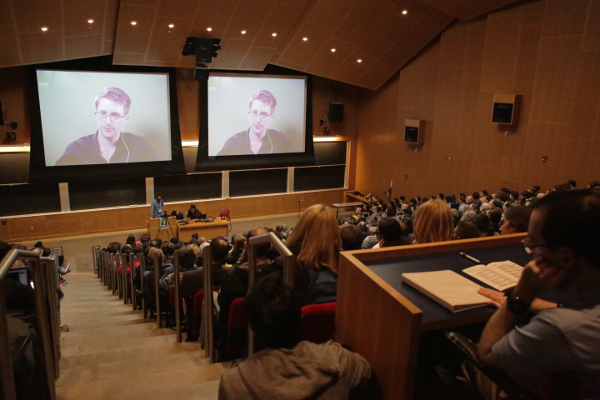
    <description>CAMBRIDGE, Massachusetts, USA -- Wednesday, March 23, 2016 -- The 2016 LibrePlanet free software conference drew nearly 350 activists from around the world to discuss issues of freedom, privacy, and security in computing. NSA whistleblower Edward Snowden and ACLU technologist Daniel Kahn Gillmor discussed "The last lighthouse: free software in dark times" in an opening keynote before a brimming audience at MIT's Stata Center, with hundreds of remote participants tuning in online.</description>
    <content:encoded xmlns:content="http://purl.org/rss/1.0/modules/content/"><![CDATA[<div style="float: right; width: 250px; margin: 10px 0px 10px 10px; padding: 4px; background-color: #EEEEEE; text-align: center;">
<img alt="Edward Snowden on the screen talking with Daniel Kahn Gillmore at LibrePlanet 2016" src="//media.libreplanet.org/mgoblin_media/media_entries/376/snowden-video.png" width="250" />
<p style="margin: 10px 0px;">Edward Snowden talks with Daniel Kahn Gillmor at LibrePlanet 2016.</p>
</div>

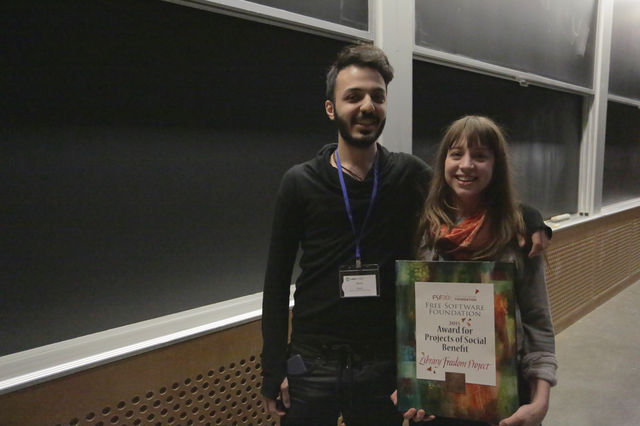
<p>At a ceremony on Saturday, March 21st, Free Software Foundation
President Richard M. Stallman announced the winners of the
FSF's annual Free Software Awards. Two awards were given: the
Award for the Advancement of Free Software was presented to
Werner Koch for his work on GNU Privacy Guard, the defacto tool
for encrypted communication, and the Award for Projects of Social
Benefit was presented to the Library Freedom Project, a
partnership among librarians, technologists, attorneys, and
privacy advocates which aims to make real the promise of
intellectual freedom in libraries.</p>
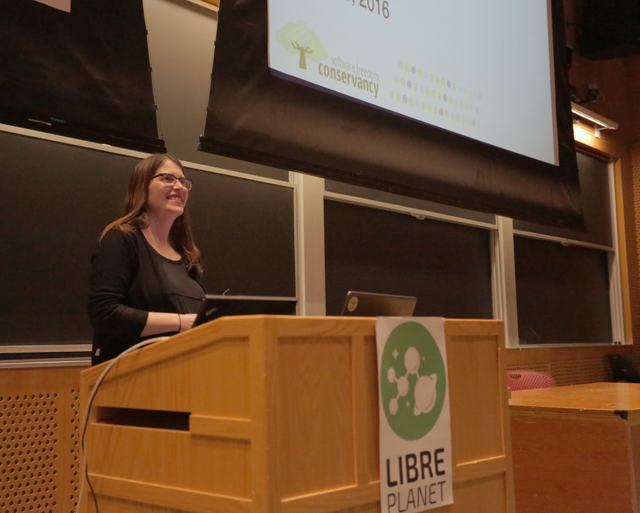
<p>Software Freedom Conservancy executive director Karen Sandler
closed out the conference with "Companies, free software, and
you," in which she urged free software developers to push their
employers to allow them to retain copyleft on their code.</p>
<div style="float: left; width: 250px; margin: 10px 10px 10px 0px; padding: 4px; background-color: #EEEEEE; text-align: center;">
<img alt="Karen Sandler speaking at LibrePlanet 2016" src="//media.libreplanet.org/mgoblin_media/media_entries/404/Sandler_01.medium.png" width="250" />
<p style="margin: 10px 0px;">Software Freedom Conservancy Executive Director Karen Sandler closed out LibrePlanet 2016.</p>
</div>

<p>A video of the opening keynote conversation between Edward
Snowden and Daniel Kahn Gillmor is available now at
<a href="http://media.libreplanet.org/u/libreplanet/m/libreplanet-2016-the-last-lighthouse/">http://media.libreplanet.org/u/libreplanet/m/libreplanet-2016-the-last-lighthouse/</a>. Videos
of all the conference sessions, along with photographs from the
conference, will soon be available on
<a href="https://media.libreplanet.org">https://media.libreplanet.org</a>, the conference's instance of
<a href="http://www.mediagoblin.org/">GNU MediaGoblin</a>, a free software
media publishing platform that anyone can run.</p>
<p>LibrePlanet 2016 was produced in partnership by the Free Software
Foundation and the Student Information Processing Board (SIPB) at
MIT.</p>
<h3>About the Free Software Foundation</h3>
<p>The Free Software Foundation, founded in 1985, is dedicated to
promoting computer users' right to use, study, copy, modify, and
redistribute computer programs. The FSF promotes the development
and use of free (as in freedom) software -- particularly the GNU
operating system and its GNU/Linux variants -- and free
documentation for free software. The FSF also helps to spread
awareness of the ethical and political issues of freedom in the
use of software, and its Web sites, located at fsf.org and
gnu.org, are an important source of information about
GNU/Linux. Donations to support the FSF's work can be made at
<a href="https://my.fsf.org/donate">https://my.fsf.org/donate</a>. Its headquarters are in Boston, MA,
USA.</p>
<p>More information about the FSF, as well as important information
for journalists and publishers, is at
<a href="https://www.fsf.org/press">https://www.fsf.org/press</a>.</p>
<h2>Media Contacts</h2>
<p>Georgia Young<br />
Program Manager<br />
Free Software Foundation<br />
+1 (617) 542 5942<br />
<a href="mailto:campaigns@fsf.org">&#99;&#97;&#109;&#112;&#97;&#105;&#103;&#110;&#115;&#64;&#102;&#115;&#102;&#46;&#111;&#114;&#103;</a></p>]]></content:encoded>
    <dc:publisher>No publisher</dc:publisher>
    <dc:creator></dc:creator>
    <dc:rights></dc:rights>
    <dc:date>2016-04-29T15:20:11Z</dc:date>
    <dc:type>News Item</dc:type>
  </item>


  <item rdf:about="http://www.fsf.org/news/gnu-releases-ethical-evaluations-of-code-hosting-services">
    <title>GNU releases ethical evaluations of code-hosting services</title>
    <link>http://www.fsf.org/news/gnu-releases-ethical-evaluations-of-code-hosting-services</link>
    <description>BOSTON, Massachusetts, USA -- Monday, April 25th, 2016 -- Today the
Free Software Foundation (FSF) and the GNU Project announced
evaluations of several major repository-hosting services according to
the standards of the GNU Ethical Criteria for Code Repositories.
Released in 2015, these criteria grade code-hosting services for their
commitment to user privacy and freedom. At the time of publication,
Savannah and GitLab have met or surpassed the baseline standards of
the criteria.
</description>
    <content:encoded xmlns:content="http://purl.org/rss/1.0/modules/content/"><![CDATA[<p>The completed evaluations can be viewed on the <a href="https://www.gnu.org/software/repo-criteria-evaluation.html">evaluation page</a>,
while the <a href="https://www.gnu.org/software/repo-criteria.en.html">criteria page</a> offers more information on the evaluation
process, as well as the criteria themselves.</p>
<p>Repositories are used not only by software developers but also by
software users, and they have a large impact on the free software
community. The evaluations promote and honor good ethical practices on
the part of repositories, and make it easy for users to find services
that respect them.</p>
<p>Version 1.0 of the criteria ranks sites on a score from F
(unacceptable) to A+ (extra credit). No site has yet received extra
credit, but Savannah achieved an A grade. An F grade shows the service
has not met even the minimum ethical standards expected for the
hosting of a GNU package. <a href="https://lists.gnu.org/mailman/listinfo/repo-criteria-discuss">GNU's Repo Criteria Discussion list</a> is
happy to offer assistance to repository-hosting organizations seeking
to improve their service's score.</p>
<p>One service which has passed the criteria is GitLab. "We want to allow
everyone to contribute to software. We recognize that many people have
a need for free software to do this," said GitLab's CEO Sytse
Sijbrandij, adding that "as a former developer myself, I think it is
natural that you can contribute to the software you use to
collaborate." Many repository sites require the user to run
proprietary JavaScript to access their full functionality, but GitLab
has addressed this by <a href="https://about.gitlab.com/2015/05/20/gitlab-gitorious-free-software/">relicensing its JavaScript as free
software</a>.</p>
<p>Savannah, which has also passed these criteria, "host[s] projects for
the sake of the ideals of freedom and community that the free software
movement stands for," according to its Web site, which also makes
clear that "[t]he space given to you on this server is given for the
expressed purpose of advancing free software." Savannah is hosted by
the FSF but run almost entirely by a dedicated team of volunteers.</p>
<p>Andrew Ferguson, a community member who played a leadership role in
the evaluation project, said "More volunteers with coding ability are
needed to aid the development of existing repository services to help
them meet these criteria. All community members are encouraged to
write the administrators of code-hosting services, to build awareness
and a motivation to improve their ethical evaluations. GitHub has
responded to some requests from the free software community and has
recently updated its <a href="http://choosealicense.com/">license chooser</a> to include the GPLv3
license. However more community advocacy is required, as GitHub still
fails to meet the criteria."</p>
<p>General discussion regarding the criteria or evaluations can be
directed to the <a href="https://lists.gnu.org/mailman/listinfo/libreplanet-discuss">libreplanet-discuss</a> mailing list. If you'd like
to lend your help evaluating repositories, please join the
<a href="https://lists.gnu.org/mailman/listinfo/repo-criteria-discuss">repo-criteria-discuss</a> list.</p>
<h3>About the Free Software Foundation</h3>
<p>The Free Software Foundation, founded in 1985, is dedicated to
promoting computer users' right to use, study, copy, modify, and
redistribute computer programs. The FSF promotes the development and
use of free (as in freedom) software -- particularly the GNU operating
system and its GNU/Linux variants -- and free documentation for free
software. The FSF also helps to spread awareness of the ethical and
political issues of freedom in the use of software, and its Web sites,
located at fsf.org and gnu.org, are an important source of information
about GNU/Linux. Donations to support the FSF's work can be made at
<a href="https://donate.fsf.org">https://donate.fsf.org</a>. Its headquarters are in Boston, MA, USA.</p>
<p>More information about the FSF, as well as important information for
journalists and publishers, is at <a href="https://www.fsf.org/press">https://www.fsf.org/press</a>.</p>
<h3>Media Contacts</h3>
<p>Zak Rogoff <br />
Campaigns Manager <br />
Free Software Foundation  <br />
+1 (617) 542 5942 x31 <br />
<a href="mailto:campaigns@fsf.org">&#99;&#97;&#109;&#112;&#97;&#105;&#103;&#110;&#115;&#64;&#102;&#115;&#102;&#46;&#111;&#114;&#103;</a></p>]]></content:encoded>
    <dc:publisher>No publisher</dc:publisher>
    <dc:creator></dc:creator>
    <dc:rights></dc:rights>
    <dc:date>2016-04-25T19:55:09Z</dc:date>
    <dc:type>News Item</dc:type>
  </item>


  <item rdf:about="http://www.fsf.org/news/fsf-job-opportunity-operations-assistant-2016">
    <title>FSF Job Opportunity: Operations Assistant</title>
    <link>http://www.fsf.org/news/fsf-job-opportunity-operations-assistant-2016</link>
    <description>DEADLINE PASSED. No longer accepting applications.

The Free Software Foundation (FSF), a Massachusetts 501(c)(3) charity
with a worldwide mission to protect freedoms critical to the
computer-using public, seeks a motivated and organized Boston-based
individual to be its full-time Operations Assistant.
</description>
    <content:encoded xmlns:content="http://purl.org/rss/1.0/modules/content/"><![CDATA[<p>This position works closely with FSF staff and management to ensure
all administrative functions of the FSF run smoothly and efficiently,
preserving our 4-star Charity Navigator rating and boosting all areas
of our work.</p>
<p>The Operations Assistant is responsible for handling phone calls,
managing office operations, and being a friendly face for visitors to
our office at the center of Boston's Downtown Crossing. Examples of
job responsibilities include, but are not limited to:</p>
<ul>
<li>fulfilling orders for FSF merchandise and related bookkeeping,</li>
<li>blogging about merchandise-related news,</li>
<li>processing incoming donations,</li>
<li>coordinating volunteers,</li>
<li>updating our contact database,</li>
<li>organizing fundraising mailings, membership mailings, and similar
    communications,</li>
<li>assisting with local and special events, including our annual
    LibrePlanet conference,</li>
<li>assisting with website maintenance, and</li>
<li>looking after the office space.</li>
</ul>
<p>This is a great opportunity for a team-oriented self-starter who
thrives on multitasking, is calm under pressure, has an eye for
detail, and wants to make a difference. The position must be worked
from the Boston office, and the position must be able to lift small to
medium-size packages (up to 50 pounds) on a regular basis. With our
small staff of thirteen, each person makes a clear contribution. We
work hard, but offer a humane and fun work environment.</p>
<p>Because our mission is worldwide, language skills and a demonstrated
ability to interact with people across cultures and age groups will be
highly valued. While the position does not require advanced computer
skills, a willingness to learn and work with new software is a must.
We use free software like CiviCRM, Plone, Emacs, and LibreOffice, all
running on GNU/Linux.</p>
<p>The FSF is a growing organization and provides great potential for
advancement; existing staff get the first chance at any new job
openings. Previous Operations Assistants have often gone on to hold
other positions within the organization.</p>
<h2>Benefits and salary</h2>
<p>This job is a union position. The salary is fixed at $51,646/year and
is non-negotiable. Other benefits include the following:</p>
<ul>
<li>full family health coverage through Blue Cross/Blue Shield's HMO
    Blue program,</li>
<li>subsidized dental plan,</li>
<li>four weeks of paid vacation annually,</li>
<li>seventeen paid holidays annually,</li>
<li>public transit commuting cost reimbursement,</li>
<li>403(b) program through TIAA-CREF, and</li>
<li>yearly cost-of-living pay increases (based on government
    guidelines).</li>
</ul>
<p>Resumes and cover letters must be submitted via email to
<a href="mailto:hiring@fsf.org">&#104;&#105;&#114;&#105;&#110;&#103;&#64;&#102;&#115;&#102;&#46;&#111;&#114;&#103;</a>. The email must contain the subject line, "Operations
Assistant". Resumes should be attached in text, PDF, or OpenDocument.
No Word documents, please. Email submissions that do not follow these
instructions will be ignored.</p>
<p><strong>Applications must be received by Friday, May 20, 2016.</strong></p>
<p>The FSF is an equal opportunity employer and will not discriminate
against any employee or application for employment on the basis of
race, color, marital status, religion, age, sex, sexual orientation,
national origin, handicap, or any other legally protected status
recognized by federal, state or local law.</p>
<h2>About the Free Software Foundation</h2>
<p>The Free Software Foundation, founded in 1985, is dedicated to
promoting computer users' right to use, study, copy, modify, and
redistribute computer programs. The FSF promotes the development and
use of free (as in freedom) software -- particularly the GNU operating
system and its GNU/Linux variants -- and free documentation for free
software. The FSF also helps to spread awareness of the ethical and
political issues of freedom in the use of software, and its Web sites,
located at fsf.org and gnu.org, are an important source of information
about GNU/Linux. Donations to support the FSF's work can be made at
<a href="https://donate.fsf.org">https://donate.fsf.org</a>. Its headquarters are in Boston, MA, USA.</p>]]></content:encoded>
    <dc:publisher>No publisher</dc:publisher>
    <dc:creator></dc:creator>
    <dc:rights></dc:rights>
    <dc:date>2016-04-21T15:25:00Z</dc:date>
    <dc:type>News Item</dc:type>
  </item>


  <item rdf:about="http://www.fsf.org/news/interpreting-enforcing-and-changing-the-gnu-gpl-as-applied-to-combining-linux-and-zfs">
    <title>Interpreting, enforcing and changing the GNU GPL, as applied to combining Linux and ZFS</title>
    <link>http://www.fsf.org/news/interpreting-enforcing-and-changing-the-gnu-gpl-as-applied-to-combining-linux-and-zfs</link>
    <description>BOSTON, Massachusetts, USA -- Monday, April 11, 2016 -- The Free
Software Foundation (FSF) today announced the publication of
"Interpreting, enforcing and changing the GNU GPL, as applied to
combining Linux and ZFS," by its founder and president, Richard M.
Stallman.</description>
    <content:encoded xmlns:content="http://purl.org/rss/1.0/modules/content/"><![CDATA[<p>The <a href="https://www.fsf.org/licensing/zfs-and-linux">FSF's statement</a> explains why the current license of ZFS
prevents it from being combined with Linux. To reach that conclusion,
the statement covers all the necessary background for understanding
license incompatibilities and violations in general.</p>
<p>In January of 2005, the FSF added to its <a href="https://www.gnu.org/licenses/license-list.html#CDDL">license list</a> an
explanation that the Common Development and Distribution License,
version 1.0 (CDDL), though a free license, is incompatible with all
versions of the GNU General Public License (GNU GPL). While the CDDL
is not commonly used, it is the license that Sun Microsystems (and now
Oracle) chose for distributing the file system ZFS. ZFS was originally
written for Solaris, but recent projects aim to make it work as a
module with other operating system kernels, including Linux, which is
licensed under the terms of the GNU GPL version 2.</p>
<p>"Normally, incompatibility questions like this are raised by people
trying to write proprietary modules for copyleft free programs. They
want to benefit from the work done by free software developers without
providing others the same freedom, and they treat users unethically.
That is not the case here, because ZFS is free software. The ideal
solution would be for Oracle, who has become a large and tremendously
influential distributor of GPL-covered code, to show their leadership
by giving explicit permission allowing their ZFS work to be used under
the GPL," said FSF's licensing and compliance manager, Joshua Gay.</p>
<p>FSF's executive director John Sullivan added, "The FSF does not
develop Linux and does not presume to tell the developers of Linux
when to do GPL enforcement. What we do is provide general materials
that make clear the intent behind the GNU family of licenses, and the
legal basis for that intent, to create shared and reliable best
practices surrounding their use. As this statement makes clear, we
support and encourage GPL enforcement work in this area and others
when it is done in agreement with these best practices, and in accord
with the <a href="https://www.fsf.org/licensing/enforcement-principles">Principles of Community-Oriented GPL Enforcement</a>."</p>
<h3>About the Free Software Foundation</h3>
<p>The Free Software Foundation, founded in 1985, is dedicated to
promoting computer users' right to use, study, copy, modify, and
redistribute computer programs. The FSF promotes the development and
use of free (as in freedom) software -- particularly the GNU operating
system and its GNU/Linux variants -- and free documentation for free
software. The FSF also helps to spread awareness of the ethical and
political issues of freedom in the use of software, and its Web sites,
located at fsf.org and gnu.org, are an important source of information
about GNU/Linux. Donations to support the FSF's work can be made at
<a href="https://donate.fsf.org">https://donate.fsf.org</a>. Its headquarters are in Boston, MA, USA.</p>
<p>More information about the FSF, as well as important information for
journalists and publishers, is at <a href="https://www.fsf.org/press">https://www.fsf.org/press</a>.</p>
<h3>About the GNU Operating System and Linux</h3>
<p>Richard Stallman announced in September 1983 the plan to develop a
free software Unix-like operating system called GNU. GNU is the only
operating system developed specifically for the sake of users'
freedom. See <a href="https://www.gnu.org/gnu/the-gnu-project.html">https://www.gnu.org/gnu/the-gnu-project.html</a>.</p>
<p>In 1992, the essential components of GNU were complete, except for
one, the kernel. When in 1992 the kernel Linux was re-released under
the GNU GPL, making it free software, the combination of GNU and Linux
formed a complete free operating system, which made it possible for
the first time to run a PC without non-free software. This combination
is the GNU/Linux system. For more explanation, see
<a href="https://www.gnu.org/gnu/gnu-linux-faq.html">https://www.gnu.org/gnu/gnu-linux-faq.html</a>.</p>
<h3>Media Contacts</h3>
<p>Joshua Gay<br />
Licensing &amp; Compliance Manager<br />
Free Software Foundation<br />
+1 (617) 542 5942  <br />
<a href="mailto:licensing@fsf.org">&#108;&#105;&#99;&#101;&#110;&#115;&#105;&#110;&#103;&#64;&#102;&#115;&#102;&#46;&#111;&#114;&#103;</a><br />
</p>]]></content:encoded>
    <dc:publisher>No publisher</dc:publisher>
    <dc:creator></dc:creator>
    <dc:rights></dc:rights>
    <dc:date>2016-04-11T19:03:32Z</dc:date>
    <dc:type>News Item</dc:type>
  </item>


  <item rdf:about="http://www.fsf.org/news/anti-drm-activists-go-to-w3c-meeting-to-protest-digital-restrictions-management-in-web-standards">
    <title>Anti-DRM activists go to W3C meeting to protest Digital Restrictions Management in Web standards</title>
    <link>http://www.fsf.org/news/anti-drm-activists-go-to-w3c-meeting-to-protest-digital-restrictions-management-in-web-standards</link>
    <description>Cambridge, Massachusetts, USA -- Tuesday, March 22, 2016 -- On Sunday
the Free Software Foundation (FSF) led a protest at the World Wide Web
Consortium (W3C) against an attempt by Netflix, Hollywood and other
technology and media companies to weave Digital Restrictions
Management (DRM) into the HTML standard that undergirds the Web. With
about 75 protesting outside an ongoing W3C event, it was the largest
protest ever at the standards body.</description>
    <content:encoded xmlns:content="http://purl.org/rss/1.0/modules/content/"><![CDATA[<img alt="Protesters marching outside the W3C office." src="//static.fsf.org/nosvn/dbd/no-drm-in-html/eme-protest-small.png" style="float: right; width: 250px; margin: 10px 0px 10px 10px;" />

<p>The protest began outside the W3C office and continued with a march
past Google's Cambridge office, to Microsoft's office nearby. The
companies are both supporters of <a href="https://www.defectivebydesign.org/dbd-condemns-drm-in-html">Encrypted Media Extensions
(EME)</a>, the proposal to enshrine <a href="https://www.defectivebydesign.org/what_is_drm_digital_restrictions_management">DRM</a> in Web standards. The
protest included free software users and developers, including
Richard Stallman and Chris Webber, the maintainer of the GNU
MediaGoblin decentralized publishing platform. A small number of
protesters split from the group, their actions were <em>not</em> condoned
by the FSF, to enter the W3C meeting but they were ejected by
police.</p>
<p>DRM in Web standards would make it cheaper and more politically
acceptable to impose restrictions on users, opening the floodgates to
a new wave of DRM throughout the Web, with all the vulnerabilities,
surveillance and curtailed freedom that DRM entails.</p>
<p>In the week before the protest, Dutch activists held their own
demonstration at the Amsterdam W3C office, and a Brazilian Web expert
met with staff at the W3C office in São Paulo. Concerned people from
around the world posted <a href="https://media.libreplanet.org/u/zakkai/collection/no-drm-in-web-standards/">selfie photos with protest signs against
DRM</a>, many in front of other W3C offices. For every person at the
protest, there were about five hundred who spoke up online against
Encrypted Media Extensions.</p>
<p>"The fight against digital restrictions in Web standards is a new
front in the struggle for liberty and expression on the global
network. It matters for many of the same reasons as protecting strong
encryption and net neutrality, or reigning in online surveillance:
increasingly, the Web mediates our politics and our society. We cannot
be free without a free Web" said by Zak Rogoff, FSF campaigns manager.</p>
<p>The W3C responded to the pressure with multiple posts on the topic in
recent weeks, and participated in a public dialogue about the issue
following the protest. The dialogue was hosted by the MIT Media Lab
and included Richard Stallman of the Free Software Foundation, Joi Ito
of the Media Lab and Danny O'Brien of the Electronic Frontier
Foundation (EFF). At the public dialogue, W3C staff member Harry
Halpin pledged to resign in protest if the standards body recommend
Encrypted Media Extensions.</p>
<p>The FSF, EFF and others concerned with Internet and software freedom
have been protesting Encrypted Media Extensions since 2013. The Free
Software Foundation's opposition to Encrypted Media Extensions has
included a <a href="https://my.fsf.org/civicrm/profile/create?gid=183&amp;reset=1">petition</a> to Stop the Hollyweb, signed by more than
33,000 people and <a href="https://www.defectivebydesign.org/oscar-awarded-w3c-in-the-hollyweb">delivered to the W3C with fanfare</a>, a <a href="https://www.defectivebydesign.org/dbd-condemns-drm-in-html">joint
letter</a> signed by 27 organizations, and a <a href="https://www.defectivebydesign.org/cancelnetflix">boycott against
Netflix</a> for its role in developing Encrypted Media
Extensions. This work is coordinated through the Foundation's anti-DRM
campaign, <a href="https://www.defectivebydesign.org/">Defective by Design</a>.</p>
<h3>About the Free Software Foundation</h3>
<p>The Free Software Foundation, founded in 1985, is dedicated to
promoting computer users' right to use, study, copy, modify, and
redistribute computer programs. The FSF promotes the development and
use of free (as in freedom) software -- particularly the GNU operating
system and its GNU/Linux variants -- and free documentation for free
software. The FSF also helps to spread awareness of the ethical and
political issues of freedom in the use of software, and its Web sites,
located at fsf.org and gnu.org, are an important source of information
about GNU/Linux. Donations to support the FSF's work can be made at
<a href="https://donate.fsf.org">https://donate.fsf.org</a>. Its headquarters are in Boston, MA, USA.</p>
<p>More information about the FSF, as well as important information for
journalists and publishers, is at <a href="https://www.fsf.org/press">https://www.fsf.org/press</a>.</p>
<h3>About Defective By Design</h3>
<p>Defective by Design is the Free Software Foundation's campaign against
Digital Restrictions Management (DRM). DRM is the practice of imposing
technological restrictions that control what users can do with digital
media, creating a good that is defective by design. DRM requires the
use of proprietary software and is a major threat to computer user
freedom. It often spies on users as well. The campaign, based at
defectivebydesign.org, organizes anti-DRM activists for in-person and
online actions, and challenges powerful media and technology interests
promoting DRM. Supporters can donate to the campaign at
<a href="https://www.defectivebydesign.org/donate">https://www.defectivebydesign.org/donate</a>.</p>
<h3>Media Contacts</h3>
<p>Zak Rogoff <br />
Campaigns Manager <br />
Free Software Foundation <br />
+1 (617) 542 5942 <br />
campaigns@fsf.org <br />
</p>]]></content:encoded>
    <dc:publisher>No publisher</dc:publisher>
    <dc:creator></dc:creator>
    <dc:rights></dc:rights>
    <dc:date>2016-03-22T15:55:00Z</dc:date>
    <dc:type>News Item</dc:type>
  </item>


  <item rdf:about="http://www.fsf.org/news/library-freedom-project-and-werner-koch-are-2015-free-software-awards-winners">
    <title>Library Freedom Project and Werner Koch are 2015 Free Software Awards winners</title>
    <link>http://www.fsf.org/news/library-freedom-project-and-werner-koch-are-2015-free-software-awards-winners</link>
    <description>BOSTON, Massachusetts, USA -- Saturday, March 19, 2016 -- The Free
Software Foundation (FSF) today announced the winners of the 2015 Free
Software Awards at a ceremony held during the LibrePlanet 2016
conference at the Massachusetts Institute of Technology (MIT). FSF
president Richard M. Stallman presented the two awards: the Award for
the Advancement of Free Software and the Award for Projects of Social
Benefit.</description>
    <content:encoded xmlns:content="http://purl.org/rss/1.0/modules/content/"><![CDATA[<p>
<img alt="Award being accepted by Alison Macrina and Nima Fatemi" src="https://media.libreplanet.org/mgoblin_media/media_entries/358/library-freedom.medium.png" style="float: left; width:50%; padding:0.5em;" />
</p>

<p>The <a href="https://www.fsf.org/awards/sb-award">Award for Projects of Social Benefit</a> is presented to a
project or team responsible for applying free software, or the ideas
of the free software movement, in a project that intentionally and
significantly benefits society in other aspects of life. This award
stresses the use of free software in the service of humanity.</p>
<p>This year, it was given to the <a href="https://libraryfreedomproject.org/">Library Freedom Project</a>, a
partnership among librarians, technologists, attorneys, and privacy
advocates which aims to make real the promise of intellectual freedom
in libraries. By teaching librarians about surveillance threats,
privacy rights and responsibilities, and digital tools to stop
surveillance, the project hopes to create a privacy-centric paradigm
shift in libraries and the local communities they serve. Notably, the
project helps libraries launch Tor exit nodes. Project founders Alison
Macrina and chief technology wizard Nima Fatemi accepted the award.</p>
<p>
<img alt="Werner Koch" src="https://media.libreplanet.org/mgoblin_media/media_entries/356/Werner_Koch_Portrait_01.2015-2.medium.jpg" style="float: right; width:30%; padding:0.5em;" />
</p>

<p>
<img alt="Award being accepted by David Shaw" src="https://media.libreplanet.org/mgoblin_media/media_entries/359/david-shaw.medium.png" style="float: left; width: 25%; padding:0.5em;" />
</p>

<p>The <a href="https://www.fsf.org/awards/fs-award">Award for the Advancement of Free Software</a> is given annually
to an individual who has made a great contribution to the progress and
development of free software, through activities that accord with the
spirit of free software.</p>
<p>This year, it was presented to Werner Koch, the founder and driving
force behind GnuPG. GnuPG is the defacto tool for encrypted
communication. Society needs more than ever to advance free encryption
technology. Werner Koch
was unable to attend, so the award was accepted on his behalf by David
Shaw, a GnuPG contributor since 2002.</p>
<br />

<h3>About the Free Software Foundation</h3>
<p>The Free Software Foundation, founded in 1985, is dedicated to
promoting computer users' right to use, study, copy, modify, and
redistribute computer programs. The FSF promotes the development and
use of free (as in freedom) software -- particularly the GNU operating
system and its GNU/Linux variants -- and free documentation for free
software. The FSF also helps to spread awareness of the ethical and
political issues of freedom in the use of software, and its Web sites,
located at fsf.org and gnu.org, are an important source of information
about GNU/Linux. Donations to support the FSF's work can be made at
<a href="https://donate.fsf.org">https://donate.fsf.org</a>. Its headquarters are in Boston, MA, USA.</p>
<p>More information about the FSF, as well as important information for
journalists and publishers, is at <a href="https://www.fsf.org/press">https://www.fsf.org/press</a>.</p>
<h3>Media Contacts</h3>
<p>John Sullivan<br />
Executive Director<br />
Free Software Foundation<br />
+1 (617) 542 5942<br />
<a href="mailto:campaigns@fsf.org">&#99;&#97;&#109;&#112;&#97;&#105;&#103;&#110;&#115;&#64;&#102;&#115;&#102;&#46;&#111;&#114;&#103;</a> </p>
<p>
<a rel="license" href="http://creativecommons.org/licenses/by/4.0/"><img alt="Creative Commons License" style="border-width:0" src="https://i.creativecommons.org/l/by/4.0/88x31.png" /></a><br /><span xmlns:dct="http://purl.org/dc/terms/" href="http://purl.org/dc/dcmitype/StillImage" rel="dct:type">Photo of Werner Koch</span> by <span xmlns:cc="http://creativecommons.org/ns#" property="cc:attributionName">Willi Nothers </span>, licensed under a <a rel="license" href="http://creativecommons.org/licenses/by/4.0/">Creative Commons Attribution 4.0 International License</a>
</p>

<p>
<a rel="license" href="http://creativecommons.org/licenses/by/4.0/"><img alt="Creative Commons License" style="border-width:0" src="https://i.creativecommons.org/l/by/4.0/88x31.png" /></a><br /><span xmlns:dct="http://purl.org/dc/terms/" href="http://purl.org/dc/dcmitype/StillImage" rel="dct:type">Other photos</span> by <span xmlns:cc="http://creativecommons.org/ns#" property="cc:attributionName">Kori Feener</span>, licensed under a <a rel="license" href="http://creativecommons.org/licenses/by/4.0/">Creative Commons Attribution 4.0 International License</a>
</p>]]></content:encoded>
    <dc:publisher>No publisher</dc:publisher>
    <dc:creator></dc:creator>
    <dc:rights></dc:rights>
    
      <dc:subject>award</dc:subject>
    
    
      <dc:subject>Advancement of Free Software</dc:subject>
    
    
      <dc:subject>Project of Social Benefit</dc:subject>
    
    <dc:date>2016-03-19T23:55:00Z</dc:date>
    <dc:type>News Item</dc:type>
  </item>


  <item rdf:about="http://www.fsf.org/news/libreplanet-free-software-conference-coming-to-mit-in-one-week-march-19-20">
    <title>LibrePlanet free software conference coming to MIT in one week, March 19-20</title>
    <link>http://www.fsf.org/news/libreplanet-free-software-conference-coming-to-mit-in-one-week-march-19-20</link>
    <description>CAMBRIDGE, Massachusetts, USA -- Friday, March 11th, 2016 -- In just
one week, the Free Software Foundation (FSF) and MIT's Student
Information Processing Board (SIPB) are once again teaming up to bring
the LibrePlanet free software conference to Cambridge, March
19-20, 2016, at the Stata Center at MIT. LibrePlanet is an annual
conference for people who care about their digital freedoms, bringing
together software developers, policy experts, activists, and computer
users to learn skills, share accomplishments, and tackle challenges
facing the free software movement.</description>
    <content:encoded xmlns:content="http://purl.org/rss/1.0/modules/content/"><![CDATA[<p><a href="http://libreplanet.org/2016/">LibrePlanet 2016</a> will feature sessions for all ages and experience levels, and <a href="https://media.libreplanet.org/u/libreplanet/m/libreplanet-2016-fork-the-system/">a promotional video for the event has just been released.</a></p>
<p>Organized around the theme "Fork the System", the conference's
sessions will examine how free software creates the opportunity of a
new path for its users, allows developers to fight the restrictions of
a system dominated by proprietary software by creating free
replacements, and is the foundation of a philosophy of freedom,
sharing, and change. Keynote speakers include NSA whistleblower Edward
Snowden in conversation with the ACLU's Daniel Kahn Gillmor; Open
Source Initiative board president Allison Randal; Free Software
Foundation founder Richard Stallman; and Software Freedom Conservancy
executive director Karen Sandler.</p>
<p>This year's LibrePlanet conference will feature over <a href="http://libreplanet.org/2016/program/">40 sessions</a>,
such as <em>Yes, the FCC might ban your operating system</em>, <em>Trans Code:
Free software as model &amp; critique of diversity by transgender
hackers</em>, and <em>Ending Online Tracking! Privacy Badger and Beyond!</em>, as
well as a hands-on workshop showing participants how to use the free
software 3-D animation program Blender and a Libreboot install workshop.</p>
<p>"This year's LibrePlanet conference will be our biggest ever, and it's
not hard to see why," said Georgia Young, program manager at the Free
Software Foundation. "From the conversation with Edward Snowden, to
strategy sessions aimed at helping activists use free software in
their social change work, to talks encouraging free software advocacy
in school and your workplace, the conference offers intriguing ways
for anybody to Fork the System."</p>
<p>Due to high demand, advance registration is closed. Attendees may
register in person at the event.</p>
<h3>About LibrePlanet</h3>
<p>LibrePlanet is the annual conference of the Free Software Foundation,
and is co-produced by the Student Information Processing Board. What
was once a small gathering of FSF members has grown into a larger
event for anyone with an interest in the values of software
freedom. LibrePlanet is always gratis for <a href="https://my.fsf.org/join">associate members</a> of
the FSF. To sign up for announcements about LibrePlanet 2016, visit
<a href="https://www.libreplanet.org/2016">https://www.libreplanet.org/2016</a>.</p>
<p><a href="http://libreplanet.org/2015/">LibrePlanet 2015</a> was held at MIT from March 21-22, 2015. Over 350
attendees from all over the world came together for conversations,
demonstrations, and keynotes centered around the theme of "Free
Software Everywhere." You can watch videos from past conferences at
<a href="http://media.libreplanet.org">http://media.libreplanet.org</a>.</p>
<h3>About the Free Software Foundation</h3>
<p>The Free Software Foundation, founded in 1985, is dedicated to
promoting computer users' right to use, study, copy, modify, and
redistribute computer programs. The FSF promotes the development and
use of free (as in freedom) software -- particularly the GNU operating
system and its GNU/Linux variants -- and free documentation for free
software. The FSF also helps to spread awareness of the ethical and
political issues of freedom in the use of software, and its Web sites,
located at fsf.org and gnu.org, are an important source of information
about GNU/Linux. Donations to support the FSF's work can be made at
<a href="https://donate.fsf.org">https://donate.fsf.org</a>. Its headquarters are in Boston, MA, USA.</p>
<p>More information about the FSF, as well as important information for
journalists and publishers, is at <a href="https://www.fsf.org/press">https://www.fsf.org/press</a>.</p>
<h3>Media Contact</h3>
<p>Georgia Young 
Program Manager<br />
Free Software Foundation<br />
+1 (617) 542 5942<br />
<a href="mailto:campaigns@fsf.org">&#99;&#97;&#109;&#112;&#97;&#105;&#103;&#110;&#115;&#64;&#102;&#115;&#102;&#46;&#111;&#114;&#103;</a> </p>]]></content:encoded>
    <dc:publisher>No publisher</dc:publisher>
    <dc:creator></dc:creator>
    <dc:rights></dc:rights>
    <dc:date>2016-03-11T21:35:00Z</dc:date>
    <dc:type>News Item</dc:type>
  </item>


</rdf:RDF>