We live in an expanding universe - so I'm told. But how can that be possible? Everything imaginable is attracted by a bigger thing. So, why can't gravitation stop the expansion of the universe? I know the "Big Bang" theory, but is it possible that the expansion of the universe is caused by the attraction of a bigger object?
|
|
|||||||||
|


|
Suppose you throw a ball up into the air. You could ask how the ball manages to move upwards when gravity is pulling it down, and the answer is that it started with an upwards velocity. Gravity pulls on the ball and slows it down so it will eventually reach a maximum height and fall back, but the ball manages to move upwards against gravity because of its initial velocity. Basically the same is true of the expansion of the universe. A moment after the Big Bang everything in the universe was expanding away from everything else with an extremely high velocity. In fact if we extrapolate back to time zero those velocities become infinite. In the several billion years following the Big Bang gravity was slowing the expansion, in basically the same way gravity slows the ball you threw upwards, but the gravity didn't stop the expansion - it only slowed it. The obvious next question is how did the universe get to start off expanding with such high velocities, and the answer is that we don't know because we have no theory telling us what happened at the Big Bang. There is a slight complication that I'll mention in case anyone is interested: dark energy acts as a sort of anti-gravity and makes the expansion faster not slower. This has only become an important effect in the last few billion years, but as a result of dark energy right now gravity isn't slowing the expansion at all - in fact it's making the expansion faster. |
|||||||||||||||||||||
|

|
Something the other answers don't really delve into is this: Space itself is what's expanding Let's think about a regular Newtonian Spacetime with zero expansion, borrowing Jims example of a car on the road. You're sitting completely still, as is a friend you're following on a roadtrip, with about a hundred feet of distance between you. If I move towards them at a few feet per second, then my distance is going to decrease at the same rate. I'll also be approaching another car a few hundred feet ahead of them at the same speed, because again none of us are moving. Now, if we were in a classical, flat, non-expanding spacetime that's more or less what we'd see. Galaxies would gravitationally attract, and eventually (Meaning over a literally infinite timeframe) everything would re-merge. This is where things get bizzare, and well outside the scope of our daily experience. We're not on a road as we know it, The road itself is growing. Space itself is expanding. Imagine that, somehow, every 10 feet of road is growing an extra foot every second. If I were standing still, I'd see my friend move away from me at about 10 ft/s for the first second. A car 500 feet away would move away at 50 ft/s, and a car a mile away would rocket off at over 500 ft/s If I started moving towards my friend at 20 ft/s, I'd only see him getting closer at a rate of 10 ft/s, and the car a mile away would still be speeding into the distance faster than I could catch up to it. This is where the idea of the Observable Universe comes from. There are points in space that we can never see, because they're "expanding" away from us faster than the speed of light. |
|||||||||||||||||||||
|

|
After the Big Bang, the universe was left already expanding. Imagine sitting in a car. You step on the gas and get it to top speed. Then you put it in neutral and turn off the engine. What happens? You keep moving forward. But why? The car can't take off by itself. Friction should prevent it from moving. This answer is obvious, the car keeps moving because it has inertia; momentum. Similarly, the universe kept expanding initially; back when radiation and matter dominated the universe. In those eras, gravity, as you'd expect, caused expansion to slow. Much like friction and air resistance slows your car. Then, when dark energy became dominant in the universe, its negative pressure caused the universe to begin accelerated expansion. Dark energy is like negative friction. I know that doesn't make sense, but you have to expect that not every crazy and wonderful thing in the universe has a simple analogy to things in everyday life. I see in John Rennie's answer, he described dark energy as a sort of anti-gravity. Here, I describe it as a form of energy itself that counteracts the gravitational influence of normal matter and radiation. You might think those are two different things and that only one of us can be right, but no! Dark energy can easily be described as either a part of gravity or as a form of energy. It's completely up to you. Both are valid and each just represents where you want to include dark energy in the gravity vs. matter-energy equation. But Jim, you absent-minded artichoke, you forgot to mention why the universe had such a large initial expansion in the first place. Oops, you're right. We can't give you a single good, accepted reason for the initial expansion of the Big Bang. But we can tell you that very soon after the initial curvature singularity (that's the Big Bang), if it existed, inflation drove expansion. This was the part where you stepped on the gas. Inflatons, which are quasi-particle things present during inflation, caused the universe to expand almost exponentially. If you don't like comparing it to stepping on the gas, then it's like if the car started on a large hill. In park, nothing happens. But put the car in neutral and it'll just start rolling down the hill and then continue once it hits the level area at the bottom. Clear? Hope that helps! |
|||||||||
|
|
we totally don't know. we don't know why the universe started expanding at the beginning of time. we basically just shrug and say "it seems like there was this big bang". your question seems to imply that gravity should have stopped the expansion by now, which makes sense. originally, we thought that the universe was still expanding simply because it hasn't been long enough since the big bang for gravity to stop the expansion. but now we know, the universe appears to be expanding faster over time, rather than more slowly. we don't know why that is happening either. ask a physicist why the universe is expanding and he will say "dark energy". then ask him what dark energy is, and he'll say "the thing that makes the universe expand". this circular definition reflects the fact that we dont' really know why, but we expect to find an explanation that fits our mathematical models. in the mean time, we call that something "dark energy". i don't feel qualified to address the math or physics of your question about a "bigger object" pulling the universe apart. but from a philosophical perspective, it seems to be an unproductive homunculus argument. although, i admit i like the parallels it draws between vacuum polorization and the big bang. side note: John Rennie's answer is also excellent (as usual). but i felt he kind of dodged the question by illustrating what we do know (or theorize). |
||||
|
|

Because gravity alters the motion of light and matter through space. But it doesn't make space fall down.
Because the expanding universe is something like a stress ball. Squeeze it down in your fist, then let go. It expands.
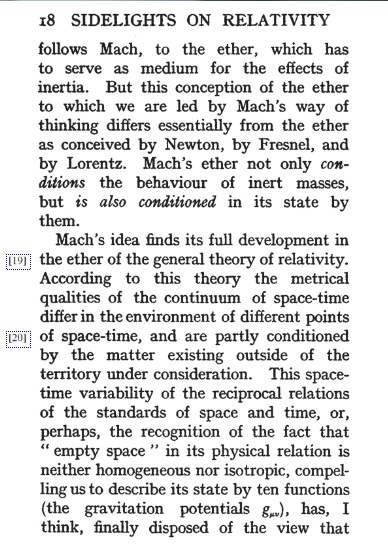
Because a gravitational field is a place where space is "neither homogeneous nor isotropic", this being modelled as curved spacetime. See the Einstein digital papers:
And on the very largest scale space is homogeneous and isotropic, see the FLRW metric. There is no overall gravitational field in the universe. And even if there was, it wouldn't stop space expanding.
No. A massive body such as a star "conditions" the surrounding space. It alters it, and this effect diminishes with distance. As a result there's a gravitational field. But the space doesn't fall down towards the star. The waterfall analogy is badly misleading in this respect. In similar vein expanding space is not falling up towards some other object. NB: dark energy is not gravity: gravity is not making the universe expand faster. |
|||||
|

|
One simple explanation is that the universe is not (going to be permanently) expanding (or contracting) at all. In the absence of external force, the center of mass of all the physical bodies in universe will stay stationary. So, essentially bodies are moving in such a way that center of mass is stationary while in our limited vision we see it expanding. Consequently, one day we will see it contracting too when this limited expansion will cease and motion will start in reverse direction. It is same as a body moving in elliptical motion around another body is sometimes going far and other times moving in close. More important than my answer above is a point I can add regarding the sentence in your question:
Big Bang is a hypothesis, not a proven event. Big Bang explanation is a result of people trying to bring universe under their limited thinking that everything has a start and an end. When you open yourself to the idea that things can be permanent too, you can see universe in a different light. For example: Look at any matter. It cannot be created or destroyed but only converted to another form. It's true for every material. Henceforth, consider the universe. It has come to its current form from a previous form at an earlier moment in time and that has come from a previous form at an even earlier point in time. This way you can continue to go backwards in time non-stop (popularly known as the induction method in mathematics). Hence, universe is eternal. It hasn't grown out of some Big Bang and it will continue to exist always with its forms changing. |
|||||
|

|
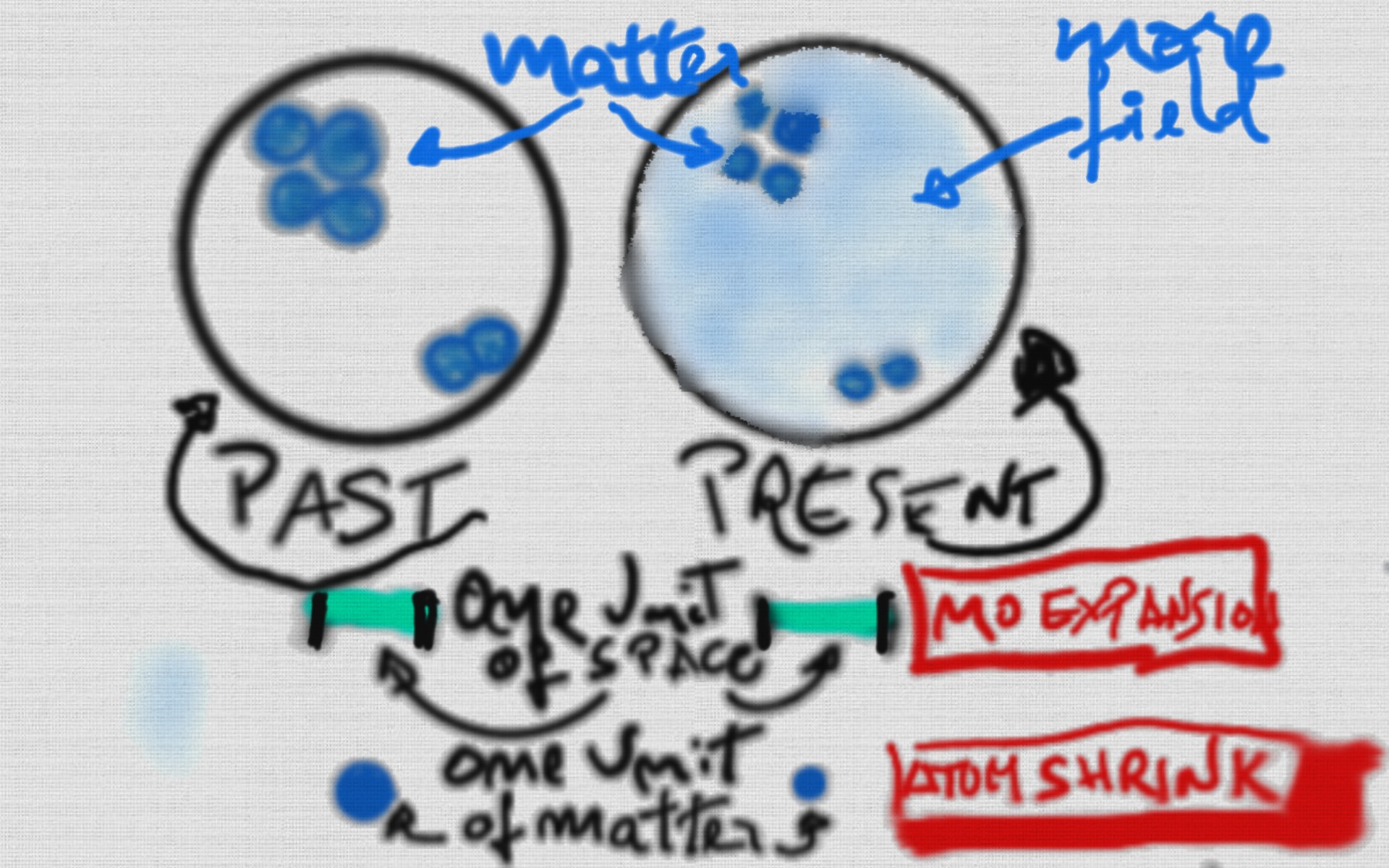
Everything is measured with atoms (upon atomic properties) oooooo < these are atoms in the lab now OOOOOO < the very same atoms in the past
radiated at longer wavelengths (redshifted). Is it clear that any space expansion is an artifact of the measuring process ? If you do not beleive in your eyes and intuition please present one fundamental equation (from all physics) able to discriminante between the atoms version 1 and version 2 (besides the radiated light wavelengths as said above). For those that want to check the validity of, or deny, my viewpoint please comment the proof in this document "A self-similar model of the Universe unveils the nature of dark energy". In physics there is no mention to any absolute or invariant size of the particles. This absolute notion was never questioned before and is an hidden postulate of the standard Model. Because the "oos/OOs" is not clear enough here is the balloon analogy:
Explaining "more field" in ligth blue in the 'present' balloon: |
|||||||||
|