

Brain Pickings Icon
Brain Pickings

Elizabeth Alexander on Writing, the Ethic of Love, Language as a Vehicle for the Self, and the Inherent Poetry of Personhood

“You have to tell your own story simultaneously as you hear and respond to the stories of others.”

Elizabeth Alexander on Writing, the Ethic of Love, Language as a Vehicle for the Self, and the Inherent Poetry of Personhood

“You’ve got to tell the world how to treat you,” James Baldwin observed in his terrific forgotten conversation with Margaret Mead. “If the world tells you how you are going to be treated, you are in trouble.” A generation later, the great poet (both in the literal and in the Baldwian sense), essayist, playwright, memoirist, and beloved professor Elizabeth Alexander explores the trying, triumphant art of that telling in Power and Possibility: Essays, Reviews, and Interviews (public library) — a slim, towering treasure of a book.

Weaving together history, literature, politics, and personal experience, Alexander — who became the fourth poet in history to read at a U.S. presidential inauguration when she welcomed Barack Obama to the presidency with her poem “Praise Song for the Day” — examines the rewards and challenges of being a black woman, a poet, an academic figure of authority and, above all, of inhabiting a culture in which the Venn diagram of these psychographic particulars is still lamentably improbable.

Radiating from these essays and interviews is incisive and generous insight into writing, the creative process, and the complexity of the self.

Elizabeth Alexander
Elizabeth Alexander

Echoing Audre Lorde’s abiding wisdom on the responsibility, to ourselves and others, of breaking our silences and Adrienne Rich’s insistence that an education is something you claim rather than something you get, Alexander considers the reactions and resistances she frequently encounters in those “feeling displaced in a room where the first-person voices of black women are primary”:

I want to inject them with a serum that makes them believe what I now: that speaking is crucial, that you have to tell your own story simultaneously as you hear and respond to the stories of others, that education is not something you passively consume.

And yet the necessity of speaking and the authority of visibility come with a personal cost, which Alexander articulates with a vulnerable self-awareness tremendously inspiring amid our culture of invulnerable facades:

I have been in public discussions where my own paralysis had made me quiet or less articulate than I can be and kept me, perhaps, from being the role model a young woman needed at that moment. I now choose my battles and deal with the same beleagueredness that perhaps my teachers those years ago felt. I have learned that you can’t always be who others need you to be at any moment.

Alexander revisits this question in another interview:

I try to remember that you can get really distracted by the demands people make on you. Demands that are real are one thing, demands that come from a real community in need, or a real person in need. We’re asked all the time to be of service. But demands that are about posturing — you may have to deal with them, but I’m trying to figure out a way not to let them worm their way in too much.

Asserting that this obligation to the truth of one’s story must be “lived in our day-to-day lives, in the way we conduct the business of our lives, in the way we spend our money and raise our children and make a multitude of decisions every day,” Alexander considers the role of writing in inhabiting one’s visibility:

Great writing can make you face the truth around you and within yourself.

In another interview from the collection, Alexander turns to the transmutation of personal truth into writing:

A lot of my poetry comes from “personal” or autobiographical material. What is the transformation that has to happen in order for those details and that realm of personal to work within a poem? I can’t really say that I could anatomize it, but I know that there’s a transformation that has to take place.

Citing Sterling Brown’s pronouncement that “every I is a dramatic I” — a quote she wove into her beautiful poem “Ars Poetica #100: I Believe” — Alexander adds:

Regardless of whether or not you’re working in an autobiographical or personal mode, if there is a persona in the poem, you have certain charges to make it work dramatically in the poem itself. So, fulfilling those demands in the poem as such puts a nice set of parameters around the question of working within the infinite personal, because it’s quite infinite… The day-to-day me “I” [is] one level removed, or alchemized.

Echoing Kierkegaard’s assertion that “the more a person limits himself, the more resourceful he becomes,” Alexander cautions:

For any poem to succeed, whatever its rules, there are strict rules, or else the whole thing falls apart.

She recounts what the inimitable Derek Walcott, her only poetry teacher, taught her about writing and about the loaded interplay between personal identity and creative integrity:

He would always say never try to charm in your poems, never try to charm with your identity, it’s not enough that you’re a cute, black girl.

That was very useful advice, though I was already averse to exploiting “identity.” I think the point is, he’s saying, none of us as persona is ever enough. Whatever your identity, your set of particulars, there is going to be someone out there who thinks it’s fascinating unto itself. But that unto itself doesn’t make for a fine poem you could stand with. So he was also saying, don’t be swayed and don’t let praise go to your head. And don’t let it get into your writing, and don’t let it get into your quest.

But Alexander notes that there is a universe of difference between not being swayed by praise and being wholly impermeable, severing one’s connection to the world — a connection carried out through the authenticity of the word:

We live in the word. And the word is precious, and the word must be precise, and the word is one of the ways we have to reach across to each other, and … it has to be tended with that degree of respect… I believe that life itself is profoundly poetic, in all sorts of … guises and unexpected places.

Being open to those poetic surprises, Alexander argues, also requires a certain openness to the audience and to the range of possible receptions:

To be presumptuous about any kind of audience is not a good thing. I’ve had too many wonderful surprises… I’ve had many surprises with people who read poetry who I wouldn’t have imagined read poetry, that it has a place in their lives. You just really never know. You just can’t let that imagining get into the creative process because it would twist it and distort it and shut it down… Some people talk about the ideal reader, and I don’t really have an ideal reader… I just trust that when it goes out there, it will be found by whoever can make use of it… The beautiful thing about poetry is that you never now who will find it, and you never know what will be found in it.

In another interview from the same volume, she considers the origin of the creative impulse. In a sentiment that calls to mind Hannah Arendt’s notion that unanswerable questions are the wellspring of our spiritual and intellectual vitality, Alexander offers:

Spiritual and ethical situations and conundrums are occasions for poems — though I am rarely aware of the conundrum as such when I embark upon the poem — and the writing of the poem is a way of working through those conundrums and accepting their frequent open-endedness. Besides making and raising children, the mystery of making art is the most spiritual zone of my life.

Among those conundrums is the way we relate to one another, or what Adrienne Rich called the alchemy of possibility between us. Alexander observes:

No matter how devoted we are to the culture and to each other, we have a lot to overcome, imagining ourselves, or imagining each other. And in receiving each other.

Language, Alexander argues, is the locus of reception — the medium in which we imagine ourselves and each other — something she captures beautifully in the piercing final line of a poem: “…and are we not of interest to each other?” She revisits the complexity of personal identity and considers how the self lives in language:

It’s all well and good to have an idea, to say, I want to write about such-and-such and such-and-such. But I think the idea has to be rooted in language. It has to live in language.

[…]

That’s what catches the imagination of somebody else, a listener or a reader. Even the way that we express ourselves as non-poet “civilians,” if you will, is what makes us interesting to other people… Who is the self in language? And what is the revelatory and unguarded and surprising self in language? That’s what makes somebody else pay attention. When you start turning that into art, that’s what making poems is about.

But this unguarded self in language, she argues, isn’t about “superseding the social identity, but it is about protecting the full dimension of the self.” And yet social identity and the poetics of personhood can never be fully disentwined from one another, nor unmoored from the wider cultural context. Alexander writes:

Being an empowered and intelligent black person and even more so being an empowered and intelligent and self-respecting black woman is profoundly destabilizing to most status quo. You’ve got to remember that in a way that’s not disabling.

Turning to some of her creative and cultural heroes — Audre Lorde, Lucille Clifton, Melvin Dixon — she echoes Bertrand Russell’s assertion that construction is both more difficult and more satisfying than destruction, and adds:

Those [are] examples of brilliant, courageous, beautiful, engaged lives full of rampant loving, loving of the world. Loving of the work. Loving of each other. Moving toward what we love and not just toward the destruction of enemies… And that’s what I feel like it’s important to do upon rising each day.

Half a century after Dr. King’s beautiful case for an ethic of love inspired by the Greek notion of agape, Alexander reflects:

When I was younger I used to think that love as an ethic was … obviously a good thing, but a little corny. I am certainly an optimist but not a fool. In academic environments, we are taught a skepticism that can lead us to discount the power and force of love. But the older I get, the more I think of all the possible permutations and possibilities of a love ethic. To love someone or something is not just to agree with them or affirm them. To bother to engage with problematic culture, and problematic people within that culture, is an act of love. So what does it mean in a complex and dead-serious way to come from that place of love?

When asked about the mental habits and practicalities of her creative process in writing poetry, Alexander offers:

I try to grab things when I can, to keep notes of things as I internally hear them so that when I do have writing time I have something to begin with.

[…]

Paper first, then the screen, for I feel bollixed up if I don’t attend to my internal soundtrack, so there is a personal satisfaction that comes from attending to it in writing. Also, at this point, twenty years into my life as a poet, I feel clearer about having something to say and people who benefit from hearing it.

A generation after Susan Sontag urged aspiring writers to “love words, agonize over sentences, and pay attention to the world,” Alexander offers her advice to the young:

I always tell student poets to read and listen as much and as variously as they can to build up a rolodex of possibilities in their minds when they sit down to write a poem. You always need to have many more possibilities of approaching a poem than you end up using… It’s about tuning your internal ear and listening to what the poem at hand is trying to do and be.

This internal process, Alexander enjoins, should be the primary focus of creative work:

Submit to it, tend it, nurture it, honor it. Too many young writers get distracted by thinking about career before process; without process, there is no real work and thus, no career. Every day is another blank page to be filled from your own particular landscape. Process it all.

Power and Possibility is an illuminating read in its totality and a fine addition to this evolving collection of writers’ advice on the craft. Complement it with Alexander’s stirring memoir of love and loss, one of the best books of 2015, then revisit her wonderful On Being conversation with Krista Tippett:

BP

Stunning Early-Twentieth-Century Illsutrations for Scheherazade’s Stories and Scandinavian Fairy Tales by Swedish Modernist Art Pioneer GAN

A visionary reimagining of beloved storytelling by the Oscar Wilde of the Scandinavian art world.

Around the time Kay Nielsen was producing his extraordinary early-twentieth-century illustrations for Scandinavian fairy tales and Arthur Rackham was revolutionizing the Brothers Grimm, an artist far less remembered but no less gifted and visionary was reimagining some of humanity’s most beloved storytelling. In the late 1910s, the painter Gösta Adrian-Nilsson, better known as GAN (April 2, 1884–March 29, 1965) — a pioneer of Swedish modernist art — turned his imaginative eye to the stories of Scheherazade and a selection of Swedish folk tales.

GAN1

GAN10

GAN45

GAN11

A dandy, artist, and radical writer in his youth, GAN was the Scandinavian Oscar Wilde — a comparison that would have gladdened him, for he admired Wilde greatly. But GAN was arguably even more culturally defiant than his British counterpart: Wilde, after all, was married to a woman despite his greatest love being a man; GAN, on the other hand, was an openly gay man in the early twentieth century, which lent him the kind of outsiderdom that a great deal of groundbreaking creative work has in common as its wellspring.

GAN12

GAN7

Tinged with futurism and cubism, GAN’s modernist art emanates an air of protest against outmoded norms, both aesthetic and cultural. And yet it is also laced with a certain irreverent respect for tradition — nowhere more so than in his paintings for fairy tales and folkloric storytelling, which depict violent, subversive, and sexually charged scenes in the aesthetic of religious illuminated manuscripts.

GAN9

GAN8

GAN6

GAN4

GAN3

GAN2

Like Maurice Sendak, GAN bequeathed his estate to his housekeeper, Lilly Johansson. After his death, she transferred his personal papers to the University Library at his hometown of Lund, where they are currently housed and available to scholars.

Complement with Aubrey Beardsley’s stunning 1893 illustrations for Oscar Wilde’s Salome and the most beautiful illustrations from 200 years of Brothers Grimm fairy tales.

Images via Katia Lexx

BP

Against Self-Criticism: Adam Phillips on How Our Internal Critics Enslave Us, the Stockholm Syndrome of the Superego, and the Power of Multiple Interpretations

“In broaching the possibility of being, in some way, against self-criticism, we have to imagine a world in which celebration is less suspect than criticism.”

Against Self-Criticism: Adam Phillips on How Our Internal Critics Enslave Us, the Stockholm Syndrome of the Superego, and the Power of Multiple Interpretations

I have thought and continued to think a great deal about the relationship between critical thinking and cynicism — what is the tipping point past which critical thinking, that centerpiece of reason so vital to human progress and intellectual life, stops mobilizing our constructive impulses and topples over into the destructiveness of impotent complaint and embittered resignation, begetting cynicism? In giving a commencement address on the subject, I found myself contemplating anew this fine but firm line between critical thinking and cynical complaint. To cross it is to exile ourselves from the land of active reason and enter a limbo of resigned inaction.

But cross it we do, perhaps nowhere more readily than in our capacity for merciless self-criticism. We tend to go far beyond the self-corrective lucidity necessary for improving our shortcomings, instead berating and belittling ourselves for our foibles with a special kind of masochism.

The undergirding psychology of that impulse is what the English psychoanalytical writer Adam Phillips explores in his magnificent essay “Against Self-Criticism”, found in his altogether terrific collection Unforbidden Pleasures (public library).

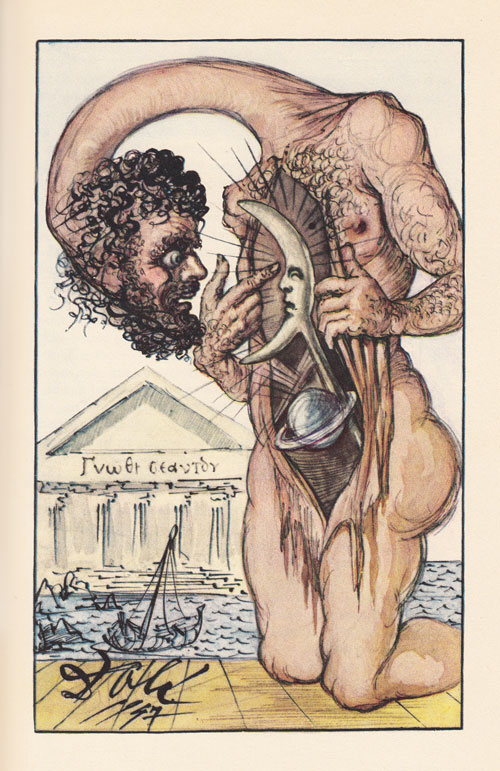
One of Salvador Dalí’s illustrations for the essays of Montaigne

Phillips — who has written with beguiling nuance about such variousness of our psychic experience as the importance of “fertile solitude,” the value of missing out, and the rewards of being out of balance — examines how “our virulent, predatory self-criticism [has] become one of our greatest pleasures,” reaching across the space-time of culture to both revolt against and pay homage to Susan Sontag’s masterwork Against Interpretation. He writes:

In broaching the possibility of being, in some way, against self-criticism, we have to imagine a world in which celebration is less suspect than criticism; in which the alternatives of celebration and criticism are seen as a determined narrowing of the repertoire; and in which we praise whatever we can.

Our masochistic impulse for self-criticism, he argues, arises from the fact that ambivalence is the basic condition of our lives. In a passage that builds on his memorable prior reflections on the paradox of why frustration is necessary for satisfaction in romance, Phillips considers Freud’s ideological legacy:

In Freud’s vision of things we are, above all, ambivalent animals: wherever we hate, we love; wherever we love, we hate. If someone can satisfy us, they can also frustrate us; and if someone can frustrate us, we always believe that they can satisfy us. We criticize when we are frustrated — or when we are trying to describe our frustration, however obliquely — and praise when we are more satisfied, and vice versa. Ambivalence does not, in the Freudian story, mean mixed feelings, it means opposing feelings.

[…]

Love and hate — a too simple, or too familiar, vocabulary, and so never quite the right names for what we might want to say — are the common source, the elemental feelings with which we apprehend the world; and they are interdependent in the sense that you can’t have one without the other, and that they mutually inform each other. The way we hate people depends on the way we love them, and vice versa. And given that these contradictory feelings are our ‘common source’ they enter into everything we do. They are the medium in which we do everything. We are ambivalent, in Freud’s view, about anything and everything that matters to us; indeed, ambivalence is the way we recognize that someone or something has become significant to us… Where there is devotion there is always protest… where there is trust there is suspicion.

[…]

We may not be able to imagine a life in which we don’t spend a large amount of our time criticizing ourselves and others; but we should keep in mind the self-love that is always in play.

But we have become so indoctrinated in this conscience of self-criticism, both collectively and individually, that we’ve grown reflexively suspicious of that alternative possibility. (Kafka, the great patron-martyr of self-criticism, captured this pathology perfectly: “There’s only one thing certain. That is one’s own inadequacy.”) Phillips writes:

Self-criticism, and the self as critical, are essential to our sense, our picture, of our so-called selves.

[…]

Nothing makes us more critical, more confounded — more suspicious, or appalled, or even mildly amused — than the suggestion that we should drop all this relentless criticism; that we should be less impressed by it. Or at least that self-criticism should cease to have the hold over us that it does.

But this self-critical part of ourselves, Phillips points out, is “strikingly unimaginative” — a relentless complainer whose repertoire of tirades is so redundant as to become, to any objective observer, risible and tragic at the same time:

Were we to meet this figure socially, as it were, this accusatory character, this internal critic, we would think there was something wrong with him. He would just be boring and cruel. We might think that something terrible had happened to him. That he was living in the aftermath, in the fallout of some catastrophe. And we would be right.

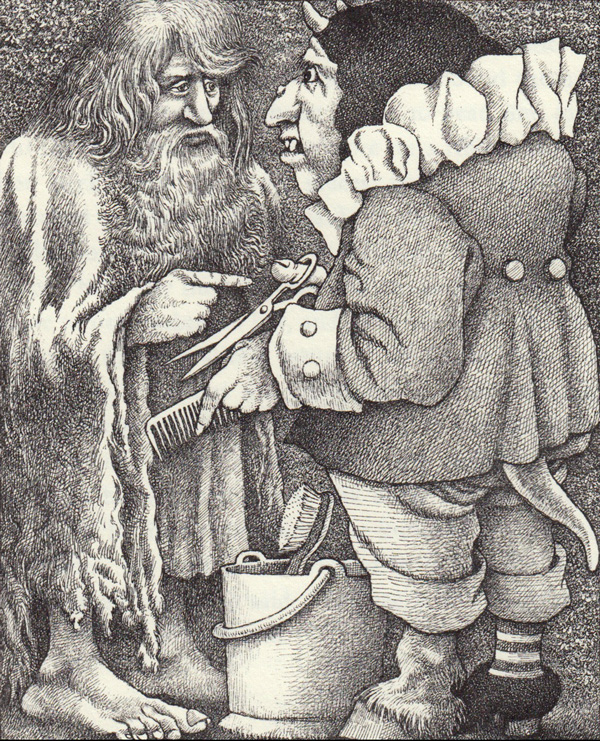
One of Maurice Sendak’s illustrations for the Brothers Grimm fairy tales

Freud termed this droll internal critic superego, and Phillips suggests that we suffer from a kind of Stockholm syndrome of the superego:

We are continually, if unconsciously, mutilating and deforming our own character. Indeed, so unrelenting is this internal violence that we have no idea what we are like without it. We know virtually nothing about ourselves because we judge ourselves before we have a chance to see ourselves (as though in panic). Or, to put it differently, we can judge only what we recognize ourselves as able to judge. What can’t be judged can’t be seen. What happens to everything that is not subject to approval or disapproval, to everything that we have not been taught how to judge? … The judged self can only be judged but not known. [We] think that it is complicitous not to stand up to, not to contest, this internal tyranny by what is only one part — a small but loud part — of the self.

The tyranny of the superego, Phillips argues, lies in its tendency to reduce the complexity of our conscience to a single, limiting interpretation, and to convincingly sell us on that interpretation as an accurate and complete representation of reality:

Self-criticism is nothing if it is not the defining, and usually the overdefining, of the limits of being. But, ironically, if that’s the right word, the limits of being are announced and enforced before so-called being has had much of a chance to speak for itself.

[…]

We consent to the superego’s interpretation; we believe our self-reproaches are true; we are overimpressed without noticing that that is what we are being.

With an eye to Freud’s legacy and the familiar texture of the human experience, Phillips makes his central point:

You can only understand anything that matters — dreams, neurotic symptoms, literature — by overinterpreting it; by seeing it from different aspects as the product of multiple impulses. Overinterpretation here means not settling for one interpretation, however apparently compelling it is. Indeed, the implication is — and here is Freud’s ongoing suspicion, or ambivalence, about psychoanalysis — that the more persuasive, the more compelling, the more authoritative, the interpretation is, the less credible it is, or should be. The interpretation might be the violent attempt to presume to set a limit where no limit can be set.

Here, the ideological wink at Sontag becomes apparent. Indeed, the Sontag classic would’ve been better titled “Against an Interpretation,” for the essence of her argument is precisely that a single interpretation invariably warps and flattens any text, any experience, any cultural artifact. (How tragicomical to see, then, that a reviewer who complains that Phillips’s writing is too open to interpretation both misses his point and, in doing so, makes it.)

What Phillips is advocating isn’t the wholesale relinquishing of interpretation but the psychological hygiene of inviting multiple interpretations as a way of countering the artificial authority of the superego and loosening its tyrannical grip on our experience of ourselves:

Authority wants to replace the world with itself. Overinterpretation means not being stopped in your tracks by what you are most persuaded by; it means assuming that to believe one interpretation is to radically misunderstand the object one is interpreting, and indeed interpretation itself.

Illustration by Kate Beaton from To Be or Not To Be, a choose-your-own-adventure reimagining of Hamlet

Cuing in Shakespeare’s Hamlet, that “genius of self-reproach,” Phillips considers the cowardice of self-criticism:

Tragic heroes always underinterpret, are always emperors of one idea.

[…]

The first quarto of Hamlet has, “Thus conscience does make cowards of us all,” while the second quarto has, “Thus conscience does make cowards.” If conscience makes cowards of us all, then we are all in the same boat; this is just the way it is. If conscience simply makes cowards we can more easily wonder what else it might be able to make. Either way, and they are clearly different, conscience makes something of us; it is a maker, if not of selves, then of something about selves. It is an internal artist, of a kind… The superego … casts us as certain kinds of character: it, as it were, tells us who we really are. It is an essentialist: it claims to know us in a way that no one else, including ourselves, can ever do. And, like a mad god, it is omniscient: it behaves as if it can predict the future by claiming to know the consequences of our actions (when we know, in a more imaginative part of ourselves, that most actions are morally equivocal, and change over time in our estimation; no apparently self-destructive act is ever only self-destructive; no good is purely and simply that).

Half a century after Eleanor Roosevelt’s memorable admonition that “when you adopt the standards and the values of someone else … you surrender your own integrity [and] become, to the extent of your surrender, less of a human being,” Phillips urges us to question the superego’s despotic standards:

The superego is the sovereign interpreter… [It] tells us what we take to be the truth about ourselves. Self-criticism, that is to say, is an unforbidden pleasure. We seem to relish the way it makes us suffer [and] take it for granted that each day will bring its necessary quotient of self-disappointment. That every day we will fail to be as good as we should be; but without our being given the resources, the language, to wonder who or what is setting the pace; or where these rather punishing standards come from.

Under this docile surrender to self-criticism, Phillips cautions, our conscience slips into cowardice:

Conscience … it is the part of our mind that makes us lose our minds; the moralist that prevents us from evolving a personal, more complex and subtle morality; that prevents us from finding, by experiment, what may be the limits of our being. So when Richard III says, in the final act of his own play, “O coward conscience, how dost thou afflict me!”, a radical alternative is being proposed. That conscience makes cowards of us all because it is itself cowardly. We believe in, we identify with, this starkly condemnatory and punitively forbidding part of ourselves; and yet this supposedly authoritative part of ourselves is itself a coward.

The most virulent and culturally contagious form of this cowardice, I would argue, is the resignation of cynicism — a resignation Phillips traces to the punitive system at the root of our culture’s moral framework, in which good behavior is incentivized largely through fear of punishment for bad behavior. This effort to foster the constructive by the destructive, he suggests, ends up turning us on ourselves as our fear of punishment metastasizes into self-criticism. (The cynic bypasses the constructiveness — that is, refuses to do anything about changing a situation for the better — and rushes straight to inflicting punishment, be it by insult or condemnation or that most cowardly and passive-aggressive fusion of the two, the eyeroll.)

Phillips returns to the central paradox, arguing for the importance of overinerpreting our self-critical conscience:

How has it come about that we are so bewitched by our self-hatred, so impressed and credulous in the face of our self-criticism, as unimaginative as it usually is? And why is it akin to a judgement without a jury? A jury, after all, represents some kind of consensus as an alternative to autocracy… We need to be able to tell the difference between useful forms of responsibility taken for acts committed, and the evasions of self-contempt… This doesn’t mean that no one is ever culpable; it means that culpability will always be more complicated than it looks; guilt is always underinterpreted… Self-criticism, when it isn’t useful in the way any self-correcting approach can be, is self-hypnosis. It is judgement as spell, or curse, not as conversation; it is an order, not a negotiation; it is dogma, not overinterpretation.

Our self-criticism, to be sure, couldn’t be entirely eradicated — nor should it, for it is our most essential route-recalculating tool for navigating life. But by nurturing our capacity for multiple interpretations, Phillips suggests, self-criticism can become “less jaded and jading, more imaginative and less spiteful.”

Unforbidden Pleasures is a magnificent read in its entirety, exploring such strands of our psychic complexity as desire, disappointment, indifference, and idealism. Complement this particular portion with Albert Camus on happiness, unhappiness, and our self-imposed prisons, then revisit Phillips on why our capacity for boredom is essential for a full life.

BP

View Full Site

Brain Pickings participates in the Amazon Services LLC Associates Program, an affiliate advertising program designed to provide a means for sites to earn commissions by linking to Amazon. In more human terms, this means that whenever you buy a book on Amazon from a link on here, I get a small percentage of its price. That helps support Brain Pickings by offsetting a fraction of what it takes to maintain the site, and is very much appreciated